2020 Honda CR-V Reviews, Pricing & Specs


Pros & cons
What we like
Great handling
Fuel-efficient
What to consider
Outdated technology
Interior materials feel cheap
Expert review
With more than 5 million CR-V sales under its belt, Honda didn't need to take any risks with the 2020 model.
Honda’s compact SUV has been satisfying buyers for more than two decades, with more than five million CR-V’s sold. Such a legacy means the CR-V has long had its wrinkles smoothed out into a comfortable and capable crossover package that’s only downside may be its sheer inoffensiveness. The 2020 model year saw engine and safety upgrades, which improve fuel efficiency and help to make Honda’s bestseller an even better value.
out of 10 expert review
Look & feel
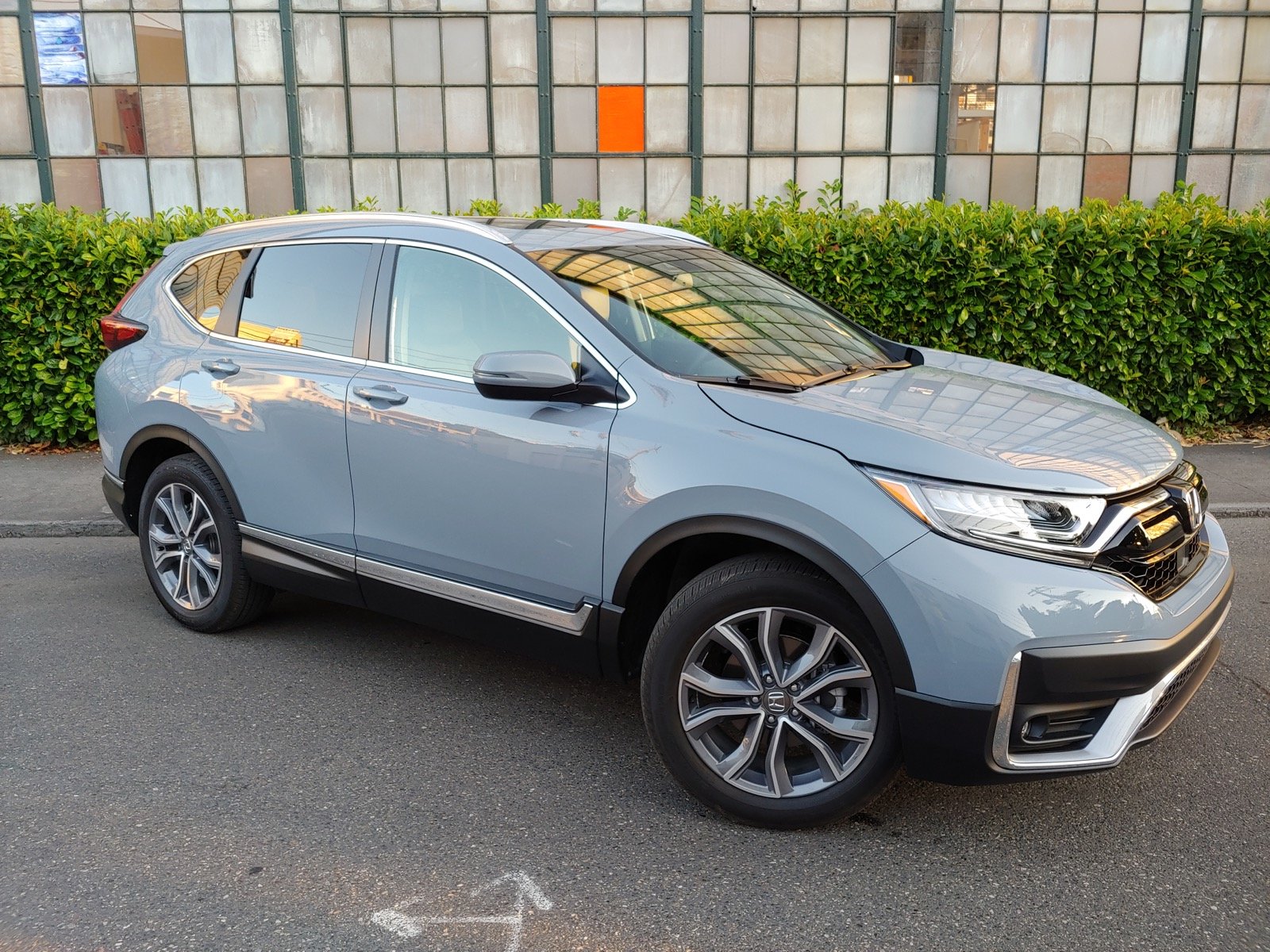
This fifth generation of Honda’s compact crossover has been on the market since the 2017 model year, so its design is now as familiar as it is fun. Honda’s designers have always taken a soft approach to penning the CR-V’s lines, which are as curvy and car-like as ever. With a family resemblance to Honda’s sedan lineup in its front and rear fascias and an overall look that leans more station wagon than SUV, the CR-V's styling defines the paradigm for modern family transportation—at least on the outside.
Inside, however, is another story. The CR-V’s interior is a mish-mash of textures and materials. Some are nice, like the wood-look trim and leather upholstery that can be found in the pricier models. But those upscale touches clash with some of the low-quality plastics, which remind the driver that an expensive version of the CR-V is a pricey upgrade of a commodity car, rather than a truly premium product.
Indeed, the base CR-V, a front-wheel-drive (FWD) model in LX trim, pricing starts at an MSRP before fees of just $29,970 Canadian. Just as it does with the rest of its lineup, Honda keeps things simple with the CR-V, which has just five trim levels: the aforementioned LX ($2,800 more with all-wheel drive for a total of $32,770), Sport (starting at $36,670), EX-L ($38,470), Touring ($42,070), and Black Edition ($43,870). Each comes with Honda’s standard three-year or 36,000-mile warranty. All-wheel drive (AWD) is standard on all CR-V trims except the entry-level LX.
A striking set of 17-inch alloy wheels is standard, while the CR-V EX-L trim get 18’s, and the 19-inchers are fitted to the CR-V Sport, Touring, and Black Edition grades. Fabric seating adorns the LX trim level, while Sport receives combination leatherette and fabric upholstery and higher grades receive real leather surfaces. Honda includes a retractable moonroof on the Sport and EX-L grades and a panoramic moonroof on Touring and Black Edition, and those same four trims also include roof rails. In keeping with the CR-V’s car-like mien, these are about as low profile as they come.

Performance
From the 2020 model year, Honda’s 1.5-litre turbocharged engine is standard on all grades. Making 190 horsepower and 179 pound-feet of torque, and mated to a continuously variable automatic transmission (CVT), this turbo four-cylinder powertrain is well matched to the CR-V.
Although some CVT’s have earned a reputation for sluggish response and a propensity to allow the engine to drone away at high revs, Honda’s engineers have done a good job in applying this fuel-saving technology. The CR-V does take a moment to get going, but once it’s moving, it feels quick, especially when it’s in the Sport drive mode. The transmission does a credible imitation of a conventional automatic well enough that most drivers will not notice the difference.
The CR-V’s car-like demeanor is reflected in its road manners, which are excellent. It drives much like a small sedan, with a nicely weighted steering feel and nimble handling. The CR-V is hardly sporty, but its chassis is well buttoned-down, firm yet comfortable, with minimal body roll. The CR-V never feels portly, in part because its curb weight is low—just 1,521 kilograms (3,353 pounds) for the FWD LX model, topping out at 1,641 kg (3,617 lb) for the AWD Touring and Black Edition models.
That the CR-V is among the lightest vehicles in its class helps not only with acceleration and handling, but fuel efficiency as well. FWD CR-V models are rated by Natural Resources Canada at 7.7 litres per 100 kilometres combined, while AWD CR-V’s manage 8.1. Those numbers put the AWD CR-V at the top of its class among non-hybridized models, matching the Toyota RAV4 with engine stop-start functionality and bettering the Ford Escape by 0.1 L/100 km. Hybrid models perform more efficiently, of course, but Honda doesn’t compete in this category: the CR-V Hybrid that’s available in the United States is not sold in Canada.

Form & function
Honda has a reputation for masterful packaging, and the CR-V is no exception. Its cabin is every bit as roomy as the class giant, the Volkswagen Tiguan, but without feeling like a one-size-larger vehicle. Head- and legroom is good in the driver's seat and in the passenger seats. Part of the reason is the CR-V’s excellent seating position, which is just right for taking advantage of its low cowl and excellent front visibility. The cargo compartment is also roomy, matching the Tiguan in volume despite the CR-V measuring 7.6 cm shorter.
The packaging excellence works on both the macroscopic and microscopic level, as clever storage solutions abound in the CR-V. The centre console between the front seats has a deep well with a sliding cover, a design clearly influenced by Honda’s Odyssey minivan, and made possible because the gearshift lever actually sticks out from the dashboard. This bin is great for stowing items that would otherwise bump around while driving, and it still permits cell phones and wallets to sit on top.
In the rear, a similarly smart two-position load floor lets owners choose between maximizing cargo space or creating a flat floor with the 60-40 split rear seats folded for a total of 1,065 litres of cargo space in the Touring and Black Edition and 1,110 litres in other grades. With the floor in its raised position, there’s quite a bit of room at the tops of the spare tire compartment, which works well for storing dirty or wet gear without soiling the carpet.
Even the door pockets in the CR-V are big, with the compartment extending behind the lower door panel for extra room. The bottom line is that it is easy to live with the CR-V because it is so good at swallowing all your stuff.

Technology
In its fourth year on the market, the CR-V is really showing its age when it comes to infotainment. The standard 7-inch touchscreen with Bluetooth seems tiny compared to the dazzling 8-inch screen that’s optional in the Tiguan. And Honda offers nothing that compares to the VW’s optional Digital Cockpit, a full LCD instrument panel.
Furthermore, the CR-V’s infotainment system was pretty miserable even when it was first introduced. It doesn’t have hard buttons outside of its single power and volume knob, unlike the system in the RAV4. This makes the Honda infotainment a challenge to operate, as it often requires two or more taps to change from one function to another. Even using Apple CarPlay or Android Auto—which are standard—is not a panacea, as the smartphone apps feel tacked on, rather than smartly integrated. Still, they both provide better navigation than Honda’s system, which can be found only in the CR-V Touring and Black Editions.
That said, Honda has done well to outfit the CR-V with plenty of USB ports. There are two in the front, one for the smartphone connection and one just for charging. An additional two in the backseat are high-powered, delivering 2.5 amps. Honda has also added a wireless phone charger to the Touring and Black Edition trims, giving those models the ability to charge as many devices as they have occupants.

Safety
The CR-V includes the “Honda Sensing” suite of safety features as standard equipment, meaning even the base LX trim gets forward-collision warning with automatic emergency braking and pedestrian detection, lane departure warning and road departure mitigation, and adaptive cruise control with lane-keeping assist. These systems are slowly but surely trickling down to almost every price-point. The RAV4 has Toyota’s version as standard equipment and VW will be making similar equipment standard on all grades of the next Tiguan.
Automatic high beams also come on all CR-Vs, although only Sport trims and above get any form of blind-spot monitoring and only Touring and Black Edition come with rear cross-traffic monitoring. Industry-mandated safety equipment such as stability control, LATCH anchors for car seats, and airbags are all standard, as well.
In crash testing by the National Highway Traffic Safety Administration (NHTSA), the 2020 Honda CR-V earned five stars, the highest rating. The CR-V scored five stars in the frontal crash test, five in the side crash, and it earned four stars in the rollover test. The Insurance Institute for Highway Safety (IIHS) also tested the CR-V, awarding it a Top Safety Pick designation, with caveats for trims below Touring. This is because the halogen headlights on those models scored only Marginal. The Touring and Black Edition are the only CR-V models with LED headlights, which do a much better job of illuminating the road, improving nighttime visibility.
NHTSA has issued one safety recall for the 2020 Honda CR-V for a possible rear subframe failure, although it affects only 358 total vehicles. The recall began in January 2020, and also applies to some 2019 model year CR-V’s.

Cost-effectiveness
Thanks to its new drivetrain, the base CR-V has become a much more attractive value proposition, but not enough to recommend the Honda CR-V LX. The extra $6,700 Honda charges to upgrade to the Sport is a lot, but the 19-inch wheels, a heated steering wheel, blind-spot display, a moonroof, 12-way power driver’s seat, and a few cosmetic enhancements makes it worth the money.
Moving up to the Honda CR-V EX-L primarily adds leather upholstery (that’s what the L stands for), but you also get heated rear outboard seats, wood-look inserts, and SiriusXM satellite radio capability. For $1,800, that’s not a bad deal.
Spending another $3,600 for Touring trim or $5,400 for the Black Edition, however, seems less worthwhile. The audio system upgrade that comes with this trim adds a subwoofer, but it doesn’t sound all that great, and the Honda navigation system is inferior in every way to what your smartphone can supply. A wireless phone charger is nice, as are rain-sensing wipers, panoramic moonroof, upgraded blind spot monitoring, and the cosmetic enhancements, such as ambient lighting and fancy exhaust pipes. However, it’s a shame that the Touring and Black Edition’s most important exclusive feature—its LED headlights, the ones that IIHS likes for their improved margin of safety at night—are unavailable without paying this much money.
For many years Honda has set the standard for the class—or at least been the one to craft the template that the rest of the industry follows. It’s no secret that vehicles in this segment are more similar than they are different. That this current generation of CR-V doesn’t stand too far apart from a crowded field of competitors, including the Subaru Forester, Ford Escape, Toyota RAV4, Mazda CX-5, Hyundai Tucson, Nissan Rogue, and Volkswagen Tiguan, is a testament to its merits.
Note: Images show a US model.


What owners say
"Overall, owners of the 2020 Honda CR-V are very satisfied with their purchase, highlighting its spaciousness, excellent features, and strong performance. Many appreciate the advanced technology and safety features offered at a fair price. However, some drivers mentioned the desire for additional options like parking sensors and a built-in navigation system. A few owners also expressed concerns about the vehicle being overpriced."
These cars have every imaginable safety feature standard, adequate power. Upscale interior with lots of room and cargo space comfortable seats, 32 MPG, and very comfortable ride. What more could you ask for?
September 21, 2021This is our second CR-V. Love it! It is just the right size with some cargo room. Really like sitting higher than I do in our sedan. Of course I am a huge fan of the heated seats and remote start here in Northeast Ohio. Good on gas. Looking forward to many years and miles with this car.
August 15, 2023I cant think of one thing to improve this car. It is so roomy for a midsize SUV and the features are excellent even on the base trim package. I love my new 2020 Honda CR-V!
August 27, 2020What owners say
These cars have every imaginable safety feature standard, adequate power. Upscale interior with lots of room and cargo space comfortable seats, 32 MPG, and very comfortable ride. What more could you ask for?
September 21, 2021This is our second CR-V. Love it! It is just the right size with some cargo room. Really like sitting higher than I do in our sedan. Of course I am a huge fan of the heated seats and remote start here in Northeast Ohio. Good on gas. Looking forward to many years and miles with this car.
August 15, 2023I cant think of one thing to improve this car. It is so roomy for a midsize SUV and the features are excellent even on the base trim package. I love my new 2020 Honda CR-V!
August 27, 2020Love it! Smooth ride! Great space while still being compact. Love that it will hold its value.
July 19, 2023The honda crv 2021 is beautyfull , it has many features and has execellent value for your money. the only complaint that I have against Honda is that wish they would install Parking sensors on all his cars. I think that is one of the most valuble safety Features
March 4, 2021This car was exactly what I was looking for. I haven’t driven it very far yet but it handles beautifully!
February 23, 2021I like the CRV EX-L because it offers a lot of standard options, like remote start for 2018 and above models. The L option comes with leather heated seats.
January 6, 2021This car has a number of technology innovations not found in similar models. It rides very smoothly and provides a stellar repair history.
January 5, 20211.5 L Turbo engine produces 190 hp which seemed adequate for my drive over the mountains to Half Moon Bay, down Highway 1 and back home over Highway 17 I believe the AWD gave the CR-V a feeling of being sure-footed on the downside of Highway 17 to San Jose. I thought for what I paid for the car it was a very good value. I did not test drive a Subaru or AWD Toyota RAV4 since I was pretty firm on getting another Honda. I had several Hondas previously
February 7, 2021My brother owns a 2018 w/o the turbo and after 120k miles it is still like new. I tested a 2021 model with the 1.5L turbo, and while I was hesitant about buying a turbo engine, it seems Honda has done an outstanding job with this in terms of throttle response (much better than the RAV4, a w/ 2.5L. Although I have owned two Toyota cars, a 96 Camry and 02 Sienna that both went well over 320k miles without ANY engine or transmission issues, so their durability is amazing) - but for a car that will likely last easily 150-200k without issue, I liked the overall layout and throttle response of the CR-V
September 16, 2021Trims & specs
Base MSRP $26,650 | Seating 5 |
Engine 1.5L 190 hp I4 | Cargo Capacity 39.2 cu ft |
Combined MPG 29 | Drivetrain AWD |
Base MSRP $25,150 | Seating 5 |
Engine 1.5L 190 hp I4 | Cargo Capacity 39.2 cu ft |
Combined MPG 31 | Drivetrain FWD |
Base MSRP $31,650 | Seating 5 |
Engine 1.5L 190 hp I4 | Cargo Capacity 39.2 cu ft |
Combined MPG 29 | Drivetrain AWD |
Base MSRP $30,150 | Seating 5 |
Engine 1.5L 190 hp I4 | Cargo Capacity 39.2 cu ft |
Combined MPG 31 | Drivetrain FWD |
Base MSRP N/A | Seating N/A |
Engine N/A | Cargo Capacity N/A |
Combined MPG N/A | Drivetrain N/A |
Base MSRP $34,850 | Seating 5 |
Engine 1.5L 190 hp I4 | Cargo Capacity 37.6 cu ft |
Combined MPG 29 | Drivetrain AWD |
Base MSRP $33,350 | Seating 5 |
Engine 1.5L 190 hp I4 | Cargo Capacity 37.6 cu ft |
Combined MPG 31 | Drivetrain FWD |
Base MSRP N/A | Seating N/A |
Engine N/A | Cargo Capacity N/A |
Combined MPG N/A | Drivetrain N/A |
Base MSRP $29,160 | Seating 5 |
Engine 1.5L 190 hp I4 | Cargo Capacity 39.2 cu ft |
Combined MPG 29 | Drivetrain AWD |
Base MSRP $27,660 | Seating 5 |
Engine 1.5L 190 hp I4 | Cargo Capacity 39.2 cu ft |
Combined MPG 31 | Drivetrain FWD |


Pricing trends
MSRP range
$25,150 - $34,850
Current avg. market price
$25,078
Trending down by 0.8% this month
May 2026 - October 2026


