2023 Toyota RAV4 Reviews, Pricing & Specs
Write a reviewPros
Attractive styling
Freshly updated infotainment system
Multiple powertrain options
Cons
Fairly pedestrian performance
Not as spacious as some competitors
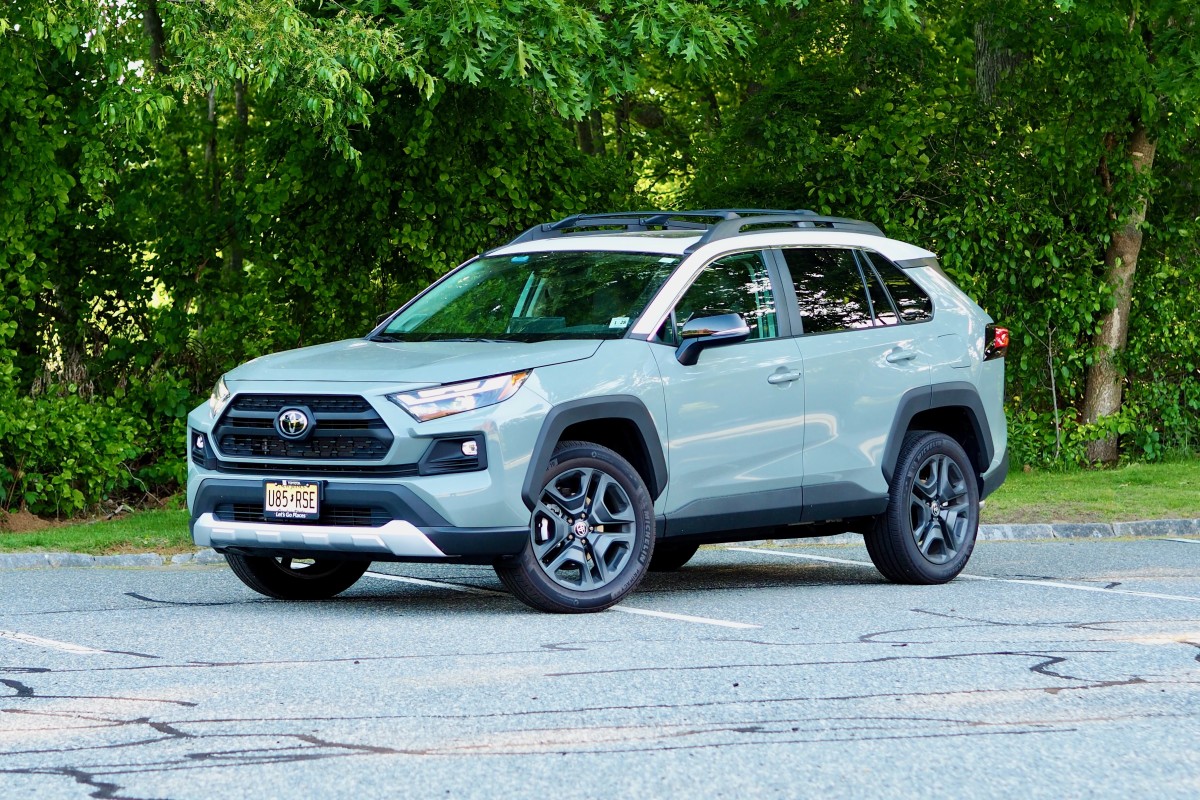
The Toyota RAV4 is one of the industry’s bestsellers. The Canadian-built compact crossover SUV, assembled in Cambridge, Ontario, is known as a well-rounded option which can be counted on to deliver, if not excitement, then at least a solid and dependable family-friendly vehicle.
The RAV4 was last revised for 2019, and Toyota takes the if-it-ain’t-broke approach for the new model year, retaining the well-reviewed styling while updating the frequently maligned infotainment system of yesteryear.
This review focuses on the gas-powered RAV4. The RAV4 Hybrid and the plug-in hybrid (PHEV) RAV4 Prime are each covered separately.

In gas-powered form, the RAV4 is offered in Canada in four trim levels for 2023, giving shoppers a range of options from the RAV4 LE for just over $35,000 to the ventilated-seat-sporting, $45,000-plus RAV4 Limited. An off-road-friendly trim is among those that fall in the middle of the pricing spectrum. The 2023 RAV4 sticks closely to the design introduced for 2019, particularly with the Trail trim, which is set apart from the others by its retention of the two-part face. (The TRD Off-Road trim was dropped from the Canadian line-up for 2023 and effectively replaced by the RAV4 Hybrid Woodland Edition.)
We tested the US equivalent of the Trail trim, which shifts the Toyota badge downwards closer to the centre of the more aggressively styled grille. It also blacks out the wheels and adds a faux skid plate, bridge type roof rails (painted black roof rails are included on most trims), and beefier, more obvious black cladding around the wheel arches, but this is more of a poseur than a doer. It’s wearing the jacket, but it’s not actually hitting the slopes.
The Trail trim also adds orange accents to the interior. The seats sport a stripe down the middle and are trimmed with contrast stitching, and orange plastic borders punch up the otherwise relatively basic centre console.
Our RAV4 sported a frameless rearview mirror, a touch that lended a sense of premium in an otherwise fairly pedestrian interior. Shoppers looking for a more premium feel might consider the relatively new Toyota Venza, which rides on the same platform but offers a more car-like experience compared to the RAV4’s somewhat more rough-and-tumble, truck-like nature.
LE and XLE trims get fabric upholstery and standard heated front seats in Canada, while the XLE Premium package upgrades to synthetic leather (SofTex) upholstery. A heated steering wheel and dual-zone automatic climate control are standard from the XLE (air conditioning is included on the LE AWD). Levels of manual and power adjustability vary by trim, culminating with heated and ventilated eight-way power-adjustable driver seat and four-way passenger seat complete with two-position seating memory for the driver in the Limited trim, where heated rear seats are also included.

Toyota Canada dropped the base front-wheel drive (FWD) LE grade for 2023. As a result, all-wheel drive (AWD) is now standard on every RAV4 regardless of powertrain, including its added Snow drive mode.
Treating the hybrids as separate models translates to a single engine choice for the 2023 RAV4 that runs purely on gas power. The 2.5-litre four-cylinder engine makes 203 horsepower and 184 lb-ft of torque. It’s paired with an eight-speed automatic transmission which, while preferable in our book to the continuously variable transmission (CVT) found in competitors like the Honda CR-V, does not do it any favours in the acceleration department. If you keep your foot matted, it’ll get there, but we’d place its performance closer on the spectrum to “unobjectionable” than “exciting.” What this setup may lack in pep it makes up for in noise. It’s not as loud as the boxer you’ll find in the Subaru Forester, but it’s definitely not quiet.
Again, the RAV4 Trail shows up as only the hopeful tagalong. Its 19-inch wheels come wrapped in all-season tires, and it has the same MacPherson independent front suspension and multi-link rear suspension that underpin the other RAV4s.

Like its competitors, the RAV4 is built to seat five. With the moonroof, it provides 958 millimetres of headroom in the front row and 1,001 mm in the back seats, meaning it offers less headroom for driver and front passenger than either the Honda CR-V or the Subaru Forester, but more for those in the rear seats. Leg room measures 1,039 mm in the front and 960 mm in the second row, placing front-row leg room in line with the CR-V’s but losing out to both the CR-V and the Forester in the back. The back seat is also significantly narrower than either of those two competitors.
Whether you prioritize head-, leg-, or hip room for that second row will likely depend on your most frequent passengers, but that may help inform your choice in a competitive segment. Do note that the 2023 RAV4 offers its front passenger plenty of convenient storage options, with a shelf running the length of the glove compartment and generous door pockets large enough for a water bottle. Front-row centre cupholders sit side by side, and we appreciate the lever-style gear shifter, particularly in a vehicle aspiring to a certain amount of ruggedness.
Of course, no discussion of storage is complete without addressing cargo space. The 2023 RAV4 provides 1,059 litres of space behind the second row, or 1,977 litres with the rear seats folded. That puts it around the middle of the pack, ahead of competitors like the Mazda CX-5, but behind the class-leading (on storage space, anyway) Honda CR-V.

For 2023, Toyota has finally brought a new infotainment system to the RAV4. Granted, tech may not have been top of its buyers’ priority lists, given the model’s more-than-respectable sales figures, but now, shoppers don’t have to actively back-burner it. Screen sizes are catching up with the modern era—an 8.0-inch Toyota multimedia touchscreen is standard, supplanted by a 10.5-inch touchscreen for the Limited trim—and the latest software supports over-the-air (OTA) updates. Wireless Apple CarPlay and Android Auto connectivity now come standard, along with voice command. All screens include Toyota’s Safety Connect, Service Connect, and Drive Connect connected services. Some are offered on an extended trial basis, while others require a subscription.
In Canada, the RAV4 Trail is not equipped with the upgraded multimedia system shown here. Instead, the larger screen is restricted to the Limited trim, along with an 11-speaker JBL Premium audio system instead of the base six-speaker stereo. A 7-inch driver-information display is standard for the 2023 RAV4, and the Limited trim gets a 12.3-inch version. Both the Trail and Limited trims receive a wireless charging pad.

Standard safety features for the full 2023 RAV4 lineup include lane-departure warning with steering assist (a combination also known as lane-keeping assist), automatic emergency braking, automatic high-beam LED headlights, and a pre-collision system with pedestrian detection, as well as higher-end driver-assistance features like adaptive cruise control. Blind-spot monitoring and rear cross-traffic alert are also standard.
While the 2022 RAV4 came with Toyota Safety Sense 2.0, the new RAV4 is equipped with the TSS 2.5 suite of advanced driver-assistance systems. The updated version includes Full-Speed Range Dynamic Radar Cruise Control, meaning the adaptive cruise control system can operate at speeds below 30 km/h.
This fifth-generation RAV4 performed well in evaluations with the Insurance Institute for Highway Safety (IIHS). The 2019 model achieved top scores in crash-testing, and its middling marks in the updated side and moderate overlap front crash tests did not prevent the 2023 RAV4 from earning a 2023 Top Safety Pick+ award. (The 2022 model was a Top Safety Pick, no plus.)

In Canada, new vehicle pricing for the 2023 Toyota RAV4 LE AWD starts at $32,590, not including an $1,930 destination charge and other fees, and goes up from there. We spent our test-drive time behind the wheel of the U.S. equivalent of the 2023 Toyota RAV4 Trail, which in Canada carries a total sticker price of $43,335, fees in.
Natural Resources Canada rates the fuel economy of the LE AWD trim at 8.7 litres per 100 kilometres in city driving, 6.9 on the highway, and 7.9 combined. Step up to the XLE AWD trim, and those figure lift slightly to 8.8 L/100 km city, 7.1 hwy, and 8.0 combined. In the Trail and Limited AWD RAV4 models, which come with larger 19-inch alloy wheels, fuel consumption adds up to 9.5 L/100 km city, 7.1 hwy, and 8.4 combined. To put this into context, the most-efficient version of the Nissan Rogue is rated at 7.6 L/100 km combined, and the Honda CR-V hits 8.4 L/100 km combined with AWD. If fuel-efficiency is a priority for you, consider the Toyota RAV4 Hybrid (base MSRP of $38,135, fees in) or the plug-in hybrid Toyota RAV4 Prime (from $54,235), each of which is reviewed separately.
Naturally, all three RAV4 variants come with Toyota’s three-year/30,000-kilometre basic and five-year/100,000-kilometre powertrain warranties. Toyota’s offering is respectable and on par with most Canadian rivals.
The RAV4 is a no-brainer for Toyota loyalists in the market for a compact SUV, and we’d argue that it deserves a look from more open-minded shoppers as well. It offers outstanding safety, and if it doesn’t earn breathless accolades in other areas, it also fails to collect any black marks. And that constitutes an accolade in and of itself.
Note: Images show a US model.