2025 Mazda CX-70 vs 2025 Toyota Sequoia
Overview | |
MSRP$40,445 | MSRP$62,425 |
Listings249 | Listings17 |
Ratings & Reviews | |
User Reviews | User Reviews |
Expert reviews8.2 out of 10 | Expert reviews5.5 out of 10 |
Pros
Cons
| Pros
Cons
|
2025 Mazda CX-70 Reviews SummaryThe CX-70 midsize SUV mimics the Lexus RX by offering two rows of seats, seating for five people, distinctive styling, an upscale interior, and gas or plug-in hybrid (PHEV) powertrains. If this new Mazda model looks familiar, you’re not mistaken. The 2025 CX-70 is the same as the CX-90, but without a third-row seat. Subtle styling changes help it to stand apart from its family-friendly sibling in the Mazda SUV lineup. Verdict: Mazda envisions itself as a premium brand and makes the necessary investments in its products to ensure credibility in that respect. However, its vehicles also cost less than luxury-badged alternatives, adding value to the equation. That value makes it easier to forgive the 2025 Mazda CX-70’s few shortcomings. | |
2025 Toyota Sequoia Reviews SummaryThe 2025 Sequoia is Toyota’s full-size SUV, based on the same platform as the Tundra pickup truck and using the same i-Force Max hybrid powertrain. It seats up to eight people, holds up to 2,460 litres of cargo, carries up to 640 kilograms (1,411 pounds) of payload, and tows up to 4,080 kilograms (9,000 pounds) of trailer. But the Toyota Sequoia comes with some fundamental flaws. Verdict: People buy full-size SUVs to carry lots of people, haul lots of cargo, and tow lots of weight. However, due to its packaging requirements, the Sequoia is a rock star only if you’re attaching a trailer to it, and even then, it’s not class-leading in capability. | |
No video found | |
Popular Features & Specs | |
Engine3.3L 280 hp I6 | Engine3.4L 437 hp V6 Hybrid |
DrivetrainAWD | Drivetrain4X2 |
Seating Capacity5 | Seating Capacity8 |
Horsepower280 hp @ 5000 rpm | Horsepower437 hp @ 5200 rpm |
EV Battery Capacity0.33 kWh | EV Battery Capacity1.9 kWh |
MPG City24 | MPG City21 |
MPG Highway28 | MPG Highway24 |
Engine | |
Engine Name3.3L 280 hp I6 | Engine Name3.4L 437 hp V6 Hybrid |
Torque332 lb-ft @ 2000 rpm | Torque583 lb-ft @ 2400 rpm |
Horsepower280 hp @ 5000 rpm | Horsepower437 hp @ 5200 rpm |
DrivetrainAWD | Drivetrain4X2 |
Fuel Economy | |
EV Battery Capacity0.33 kWh | EV Battery Capacity1.9 kWh |
MPG City24 | MPG City21 |
MPG Highway28 | MPG Highway24 |
Interior | |
Leather SeatsStandard | Leather Seats |
Seating Capacity5 | Seating Capacity8 |
Key Features | |
Sunroof/MoonroofStandard | Sunroof/MoonroofStandard |
Safety | |
Front Crash Overall4 | Front Crash Overall |
Side Crash Overall5 | Side Crash Overall |
Dimensions & Capacity | |
Cargo Space39.6 cu ft | Cargo Space22.3 cu ft |
Curb Weight4709 lbs | Curb Weight5620 lbs |
Height68.2 in | Height74.5 in |
Length200.8 in | Length208.1 in |
Width84.9 in | Width79.8 in |
Wheelbase122.8 in | Wheelbase122.0 in |
Maximum Payload1292 lbs | Maximum Payload1730 lbs |
Number of doors4 | Number of doors4 |
Maximum Towing Capacity3500 lbs | Maximum Towing Capacity9520 lbs |
Standard Towing Capacity3500 lbs | Standard Towing Capacity9520 lbs |
Overview | ||
MSRP | $40,445 | $62,425 |
Listings | ||
Ratings & Reviews | ||
User reviews | ||
Expert reviews | 8.2 out of 10Read full review | 5.5 out of 10Read full review |
Pros & cons | Pros
Cons
| Pros
Cons
|
Summary | The CX-70 midsize SUV mimics the Lexus RX by offering two rows of seats, seating for five people, distinctive styling, an upscale interior, and gas or plug-in hybrid (PHEV) powertrains. If this new Mazda model looks familiar, you’re not mistaken. The 2025 CX-70 is the same as the CX-90, but without a third-row seat. Subtle styling changes help it to stand apart from its family-friendly sibling in the Mazda SUV lineup. Verdict: Mazda envisions itself as a premium brand and makes the necessary investments in its products to ensure credibility in that respect. However, its vehicles also cost less than luxury-badged alternatives, adding value to the equation. That value makes it easier to forgive the 2025 Mazda CX-70’s few shortcomings. | The 2025 Sequoia is Toyota’s full-size SUV, based on the same platform as the Tundra pickup truck and using the same i-Force Max hybrid powertrain. It seats up to eight people, holds up to 2,460 litres of cargo, carries up to 640 kilograms (1,411 pounds) of payload, and tows up to 4,080 kilograms (9,000 pounds) of trailer. But the Toyota Sequoia comes with some fundamental flaws. Verdict: People buy full-size SUVs to carry lots of people, haul lots of cargo, and tow lots of weight. However, due to its packaging requirements, the Sequoia is a rock star only if you’re attaching a trailer to it, and even then, it’s not class-leading in capability. |
Video | No video found | |
Popular Features & Specs | ||
Engine | 3.3L 280 hp I6 | 3.4L 437 hp V6 Hybrid |
Drivetrain | AWD | 4X2 |
Seating Capacity | 5 | 8 |
Horsepower | 280 hp @ 5000 rpm | 437 hp @ 5200 rpm |
EV Battery Capacity | 0.33 kWh | 1.9 kWh |
MPG City | 24 | 21 |
MPG Highway | 28 | 24 |
Engine | ||
Engine Name | 3.3L 280 hp I6 | 3.4L 437 hp V6 Hybrid |
Torque | 332 lb-ft @ 2000 rpm | 583 lb-ft @ 2400 rpm |
Horsepower | 280 hp @ 5000 rpm | 437 hp @ 5200 rpm |
Drivetrain | AWD | 4X2 |
Fuel Economy | ||
EV Battery Capacity | 0.33 kWh | 1.9 kWh |
MPG City | 24 | 21 |
MPG Highway | 28 | 24 |
Interior | ||
Leather Seats | Standard | |
Seating Capacity | 5 | 8 |
Key Features | ||
Sunroof/Moonroof | Standard | Standard |
Safety | ||
Front Crash Overall | 4 | |
Side Crash Overall | 5 | |
Dimensions & Capacity | ||
Cargo Space | 39.6 cu ft | 22.3 cu ft |
Curb Weight | 4709 lbs | 5620 lbs |
Height | 68.2 in | 74.5 in |
Length | 200.8 in | 208.1 in |
Width | 84.9 in | 79.8 in |
Wheelbase | 122.8 in | 122.0 in |
Maximum Payload | 1292 lbs | 1730 lbs |
Number of doors | 4 | 4 |
Maximum Towing Capacity | 3500 lbs | 9520 lbs |
Standard Towing Capacity | 3500 lbs | 9520 lbs |
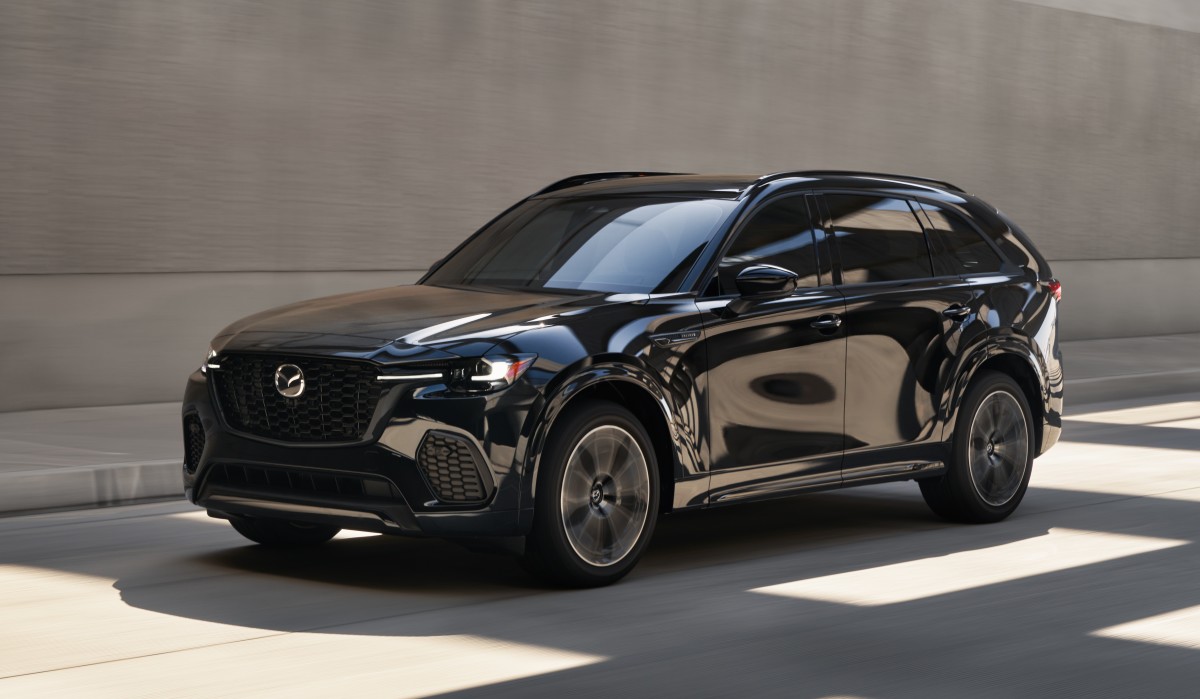
The 2025 Mazda CX-70 presented a sporty and appealing design, reminiscent of a sport appearance package for the CX-90. With redesigned front and rear fasciae, a unique grille insert, new wheels, and dark accents, the CX-70 managed to look slightly smaller than its CX-90 counterpart. Inside, the differences were subtle, with exclusive paint colours and a red leather interior option not available in the CX-90. The absence of a third-row seat distinguished the CX-70 further. Quality materials and appealing textures were evident, especially in higher trims, though the addition of soft-touch lower dashboard panels could enhance the luxury feel. Overall, the CX-70 offered an upscale experience without reaching the sophistication of luxury models, which was reasonable given its pricing.
In Canada, the CX-70 was available in four gas-only configurations: GS-L, GT, GT-P, and Signature, with the PHEV offered in GS-L and GT trims. Prices ranged from $51,831 to $66,831, including fees. The U.S. specification models tested included a gas-only Signature trim with Soul Red paint and a PHEV GT with Polymetal Grey paint. The Signature trim started at $64,381, while the PHEV GT's MSRP began at $66,431, both including fees.
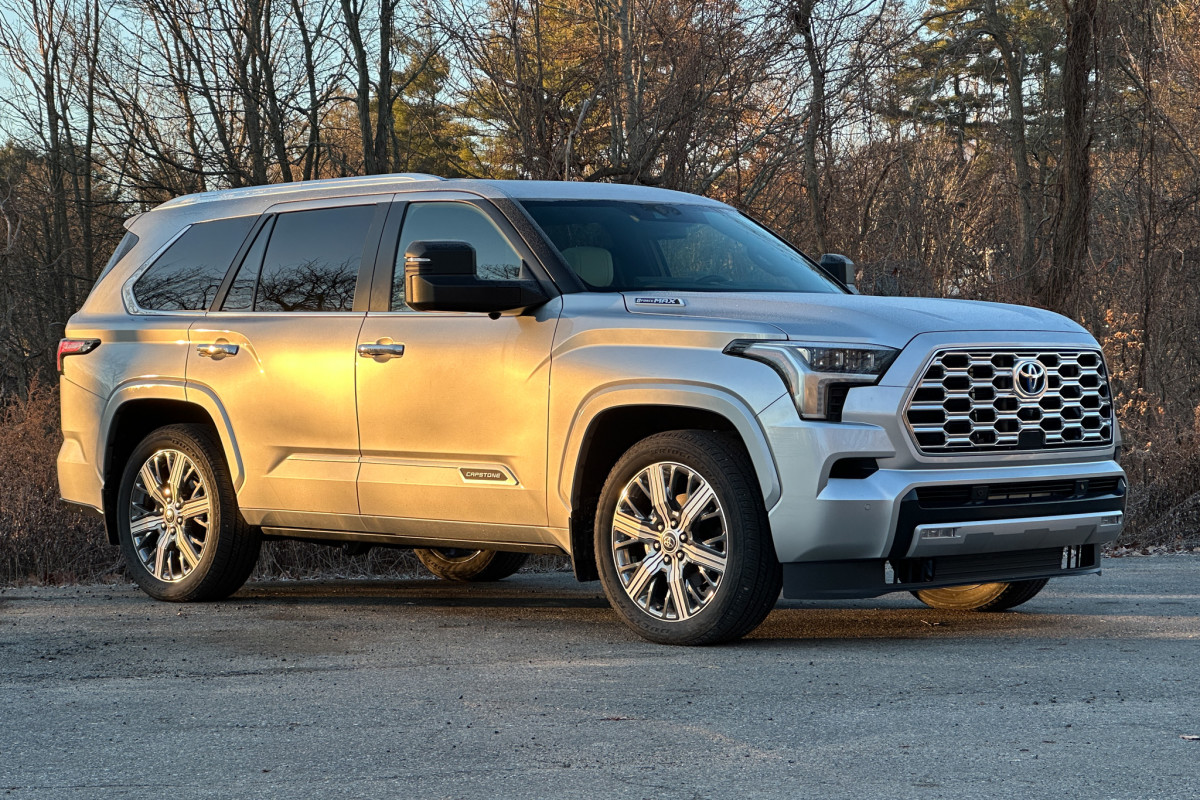
The 2025 Toyota Sequoia, particularly in the U.S.-only 1794 Edition trim, showcased a rugged and attention-grabbing design, especially with its Lunar Rock paint. This trim was equivalent to the Canadian Sequoia Platinum trim but featured unique elements like dark grey painted 20-inch wheels and less exterior chrome. Inside, the Sequoia offered Saddle Tan leather upholstery and open-pore walnut wood trim, not available in Canada. The Canadian lineup included the SR5 TRD Off-road, Limited, Platinum, and Capstone trims, with prices ranging from $87,174 to $106,175, including fees. Despite its current-generation design, the Sequoia remained a rarity on the road, drawing attention wherever it went. However, the interior was marred by typical Toyota-grade plastic, detracting from its overall appeal.

The 2025 Mazda CX-70 offered a choice between a turbocharged 3.3-litre inline six-cylinder engine and a plug-in hybrid (PHEV) powertrain. The gas-only engine produced 280 horsepower and 332 pound-feet of torque in the GS-L and GT models, while the GT-P and Signature trims delivered 340 hp and 369 lb-ft, requiring premium fuel. Fuel efficiency was estimated at 9.3 L/100 km for the lower-powered version and 9.5 L/100 km for the high-output version, both aided by 48-volt mild-hybrid technology. The PHEV combined a 2.5-litre four-cylinder engine with a 68-kilowatt electric motor, producing 323 hp and 369 lb-ft. It offered 42 km of electric-only range and a combined fuel consumption of 9.4 L/100 km. All models featured an eight-speed automatic transmission and standard AWD, with various drive modes available. The gas-only CX-70 could tow up to 2,268 kg, while the PHEV managed 1,587 kg. The CX-70's handling was athletic, though an adaptive damping suspension would have improved the ride quality.
The 2025 Toyota Sequoia came standard with an i-Force Max hybrid powertrain, featuring a twin-turbocharged 3.4-litre V6 engine, an electric motor, and a 10-speed automatic transmission. It delivered 437 horsepower and 583 pound-feet of torque, with a part-time 4WD system standard in Canada. Despite its weight of 2,790 kg, the Sequoia offered quick acceleration and a robust engine note. However, its fuel economy fell short, averaging 14.5 L/100 km compared to the estimated 11.7 L/100 km. The Sequoia's maximum towing capacity was 4,137 kg, with a peak payload of 640 kg. The SUV's packaging and driving dynamics were compromised by the rear-mounted battery pack and solid rear axle, affecting rear-seat room and cargo space. The ride was jittery and truck-like, with excessive lateral weight transfer on uneven roads. Ground clearance was 22.1 cm, but the front air dam limited the approach angle, affecting off-road capability.
The Mazda CX-70 accommodated up to five people, with standard heated front seats, a heated steering wheel, and triple-zone automatic climate control. Higher trims offered heated and ventilated front seats and heated rear seats. The front seats provided good support, though adjustable side bolsters and massagers would have been welcome additions. Small-item storage was limited, but cargo space was generous, with 1,122 litres behind the rear seats and 2,132 litres with the seats folded. Mazda offered various cargo-enhancing accessories, including an organizer and roof-rail crossbars.
The Toyota Sequoia could carry up to eight people, though seven or six would be more comfortable. The Platinum and Capstone trims featured 10-way power adjustable seats with heating, ventilation, and massage. Access to the second and third rows was facilitated by long rear doors, though they were cumbersome in tight spaces. The third row's stadium-style seating offered a good view but limited headroom. Cargo space was limited to 325 litres with the third row in use, expanding to 1,387 litres with the seats folded and 2,460 litres with both rows down. These figures were less than rival full-size SUVs, and even Toyota's Grand Highlander offered more room.
The Mazda CX-70 featured a 10.25-inch infotainment screen and a 7-inch partially digital instrument cluster, with the Signature trim offering 12.3-inch displays. The Mazda Connect system was user-friendly, though touch-sensing capability was limited to smartphone mirroring platforms. Alexa Built-in improved voice recognition, and a 12-speaker Bose sound system provided excellent audio quality. An Active Driving Display showed comprehensive information.
The Toyota Sequoia came with a 12.3-inch digital instrumentation panel and a 14-inch touchscreen infotainment system from the Limited trim. Connected services plans offered various features, though many required active subscriptions. Wireless Apple CarPlay and Android Auto were standard, and a 14-speaker JBL sound system was available. The Drive Connect's voice recognition system was reasonably capable but had limitations. A surround-view camera system and digital rearview mirror were helpful additions.
The Mazda CX-70 included a comprehensive suite of i-ActiveSense safety features, with additional semi-autonomous steering-assistance features available on higher trims. The GT-P trim offered a Cruising & Traffic Support system with Unresponsive Driver Support, providing hands-on semi-autonomous driving assistance. While crash-test ratings were unavailable, Mazda's safety track record was impressive.
The Toyota Sequoia featured Toyota Safety Sense 2.5, including adaptive cruise control, forward collision warning, automatic emergency braking, and lane assist features. While the tech was helpful, the lane assist features could be aggravating. Crash-test ratings were not available at the time of publication.
CarGurus highlights
According to CarGurus experts, the overall rating for the 2025 Mazda CX-70 is 8.2 out of 10, while the 2025 Toyota Sequoia scores 5.5 out of 10. Based on these ratings, the Mazda CX-70 is the recommended choice, offering a more balanced combination of design, performance, and technology.
Choose the 2025 Mazda CX-70 if:
- You value sporty design and upscale interior materials.
- You seek a balance of performance and fuel efficiency with hybrid options.
- You prioritize advanced safety features and semi-autonomous driving assistance.


Choose the 2025 Toyota Sequoia if:
- You need a full-size SUV with substantial towing capacity.
- You prefer a robust hybrid powertrain with quick acceleration.
- You require a spacious interior for up to eight passengers.


CarGurus highlights
According to CarGurus experts, the overall rating for the 2025 Mazda CX-70 is 8.2 out of 10, while the 2025 Toyota Sequoia scores 5.5 out of 10. Based on these ratings, the Mazda CX-70 is the recommended choice, offering a more balanced combination of design, performance, and technology.
Choose the 2025 Mazda CX-70 if:
Shop Now- You value sporty design and upscale interior materials.
- You seek a balance of performance and fuel efficiency with hybrid options.
- You prioritize advanced safety features and semi-autonomous driving assistance.
Choose the 2025 Toyota Sequoia if:
Shop Now- You need a full-size SUV with substantial towing capacity.
- You prefer a robust hybrid powertrain with quick acceleration.
- You require a spacious interior for up to eight passengers.

By: CarGurus + AI
At CarGurus, our team of experienced automotive writers remain at the heart of our content operation, conducting hands-on car tests and writing insightful guides that are backed by years of industry experience. To complement this, we are harnessing AI to make our content offering more diverse and more helpful to shoppers than ever. To achieve this, our AI systems are based exclusively on CarGurus content, ratings and data, so that what we produce is both unique to CarGurus, and uniquely helpful to car shoppers.
