2024 BMW 7 Series vs 2025 Mazda MAZDA3

Overview | |
Listings2 | Listings135 |
Ratings & Reviews | |
User Reviews | User Reviews |
Expert reviews6.7 out of 10 | Expert reviews7.5 out of 10 |
Pros
Cons
| Pros
Cons
|
2024 BMW 7 Series Reviews SummaryRedesigned for 2023, the 7 Series is BMW's full-size flagship sedan, arch-rival to the Mercedes-Benz S-Class, Audi A8, and newcomers like the Genesis G90. For 2024, BMW has added the plug-in hybrid (PHEV) 750e and lightly updated the infotainment system. Unfortunately, these additions don't change the 7 Series calculus. The 750e has a disjointed driving personality and quickly eats its electric charge. Despite the update, the car's digital systems remain frustratingly complex. Verdict: The 2024 BMW 7 Series has lots to offer luxury buyers, including features like a rear-seat theatre and cashmere upholstery, plus performance and fuel efficiency that are often superior to most rivals, few of whom offer PHEV options. But the car's frustrating digital systems and controls undermine the experience. | |
2025 Mazda MAZDA3 Reviews SummaryLast redesigned for the 2019 model year, the Mazda 3 is getting old, yet aging gracefully. It still looks, feels, and drives better than some of its rivals. In Canada, GT and above trims get Amazon Alexa Built-in for 2025, while the Sport hatchback adds the new Suna Edition as the top model based on the GT Turbo. Verdict: Available in four-door sedan and five-door hatchback body styles, there is a Mazda 3 to suit nearly anyone. Basic or upscale, turbocharged or not, and with front-wheel drive (FWD) or all-wheel drive (AWD), the common threads across all Mazda 3s are quality, refinement, sophistication, safety, and enjoyable driving dynamics. This is a terrific compact car. | |
No video found | No video found |
Popular Features & Specs | |
Engine3.0L 375 hp I6 | Engine2.5L 191 hp I4 |
DrivetrainRWD | DrivetrainFWD |
Seating Capacity5 | Seating Capacity5 |
Horsepower375 hp @ 5200 rpm | Horsepower191 hp @ 6000 rpm |
Fuel Economy (City)9.4 L(e)/100 km | Fuel Economy (City)8.7 L(e)/100 km |
Fuel Economy (Highway)7.6 L(e)/100 km | Fuel Economy (Highway)6.4 L(e)/100 km |
Engine | |
Engine Name3.0L 375 hp I6 | Engine Name2.5L 191 hp I4 |
Torque398 lb-ft @ 1850 rpm | Torque186 lb-ft @ 4000 rpm |
Horsepower375 hp @ 5200 rpm | Horsepower191 hp @ 6000 rpm |
DrivetrainRWD | DrivetrainFWD |
Fuel Economy | |
Fuel Economy (City)9.4 L(e)/100 km | Fuel Economy (City)8.7 L(e)/100 km |
Fuel Economy (Highway)7.6 L(e)/100 km | Fuel Economy (Highway)6.4 L(e)/100 km |
Interior | |
Seating Capacity5 | Seating Capacity5 |
Key Features | |
Navigation SystemStandard | Navigation System |
Sunroof/MoonroofStandard | Sunroof/Moonroof |
Safety | |
Front Crash Overall | Front Crash Overall5 |
Side Crash Overall | Side Crash Overall5 |
Dimensions & Capacity | |
Cargo Space541 L | Cargo Space374 L |
Curb Weight2141 kg | Curb Weight1417 kg |
Height1544 mm | Height1445 mm |
Length5390 mm | Length4661 mm |
Width2192 mm | Width1796 mm |
Wheelbase3216 mm | Wheelbase2725 mm |
Maximum Payload498 kg | Maximum Payload433 kg |
Number of doors4 | Number of doors4 |
Overview | ||
Listings | ||
Ratings & Reviews | ||
User reviews | ||
Expert reviews | 6.7 out of 10Read full review | 7.5 out of 10Read full review |
Pros & cons | Pros
Cons
| Pros
Cons
|
Summary | Redesigned for 2023, the 7 Series is BMW's full-size flagship sedan, arch-rival to the Mercedes-Benz S-Class, Audi A8, and newcomers like the Genesis G90. For 2024, BMW has added the plug-in hybrid (PHEV) 750e and lightly updated the infotainment system. Unfortunately, these additions don't change the 7 Series calculus. The 750e has a disjointed driving personality and quickly eats its electric charge. Despite the update, the car's digital systems remain frustratingly complex. Verdict: The 2024 BMW 7 Series has lots to offer luxury buyers, including features like a rear-seat theatre and cashmere upholstery, plus performance and fuel efficiency that are often superior to most rivals, few of whom offer PHEV options. But the car's frustrating digital systems and controls undermine the experience. | Last redesigned for the 2019 model year, the Mazda 3 is getting old, yet aging gracefully. It still looks, feels, and drives better than some of its rivals. In Canada, GT and above trims get Amazon Alexa Built-in for 2025, while the Sport hatchback adds the new Suna Edition as the top model based on the GT Turbo. Verdict: Available in four-door sedan and five-door hatchback body styles, there is a Mazda 3 to suit nearly anyone. Basic or upscale, turbocharged or not, and with front-wheel drive (FWD) or all-wheel drive (AWD), the common threads across all Mazda 3s are quality, refinement, sophistication, safety, and enjoyable driving dynamics. This is a terrific compact car. |
Video | No video found | No video found |
Popular Features & Specs | ||
Engine | 3.0L 375 hp I6 | 2.5L 191 hp I4 |
Drivetrain | RWD | FWD |
Seating Capacity | 5 | 5 |
Horsepower | 375 hp @ 5200 rpm | 191 hp @ 6000 rpm |
Fuel Economy (City) | 9.4 L(e)/100 km | 8.7 L(e)/100 km |
Fuel Economy (Highway) | 7.6 L(e)/100 km | 6.4 L(e)/100 km |
Engine | ||
Engine Name | 3.0L 375 hp I6 | 2.5L 191 hp I4 |
Torque | 398 lb-ft @ 1850 rpm | 186 lb-ft @ 4000 rpm |
Horsepower | 375 hp @ 5200 rpm | 191 hp @ 6000 rpm |
Drivetrain | RWD | FWD |
Fuel Economy | ||
Fuel Economy (City) | 9.4 L(e)/100 km | 8.7 L(e)/100 km |
Fuel Economy (Highway) | 7.6 L(e)/100 km | 6.4 L(e)/100 km |
Interior | ||
Seating Capacity | 5 | 5 |
Key Features | ||
Navigation System | Standard | |
Sunroof/Moonroof | Standard | |
Safety | ||
Front Crash Overall | 5 | |
Side Crash Overall | 5 | |
Dimensions & Capacity | ||
Cargo Space | 541 L | 374 L |
Curb Weight | 2141 kg | 1417 kg |
Height | 1544 mm | 1445 mm |
Length | 5390 mm | 4661 mm |
Width | 2192 mm | 1796 mm |
Wheelbase | 3216 mm | 2725 mm |
Maximum Payload | 498 kg | 433 kg |
Number of doors | 4 | 4 |
The 2024 BMW 7 Series presented a more conventional design compared to its predecessors, with a traditional luxury sedan shape from the windshield backward. However, its front featured a massive grille, similar to other recent BMW models, flanked by narrow LED headlights and large projector beams. This bold design was an acquired taste for many. The car offered a wide array of colour and trim choices, including two-tone schemes on the 760i trim, which varied its appearance significantly. The M Sport Shadowline Package turned the grille black, making the styling indistinct, while chrome options and matte paint schemes provided different visual effects. Inside, the cabin was less controversial, with beautifully made metal grilles hiding the speakers and seats available in various materials and colours. The interior featured a big curved-screen infotainment display and a crystalline-looking strip with customizable ambient lighting, adding to the luxurious feel. Novel amenities included a rear-seat theatre screen and a panoramic sunroof with patterned ambient lighting.
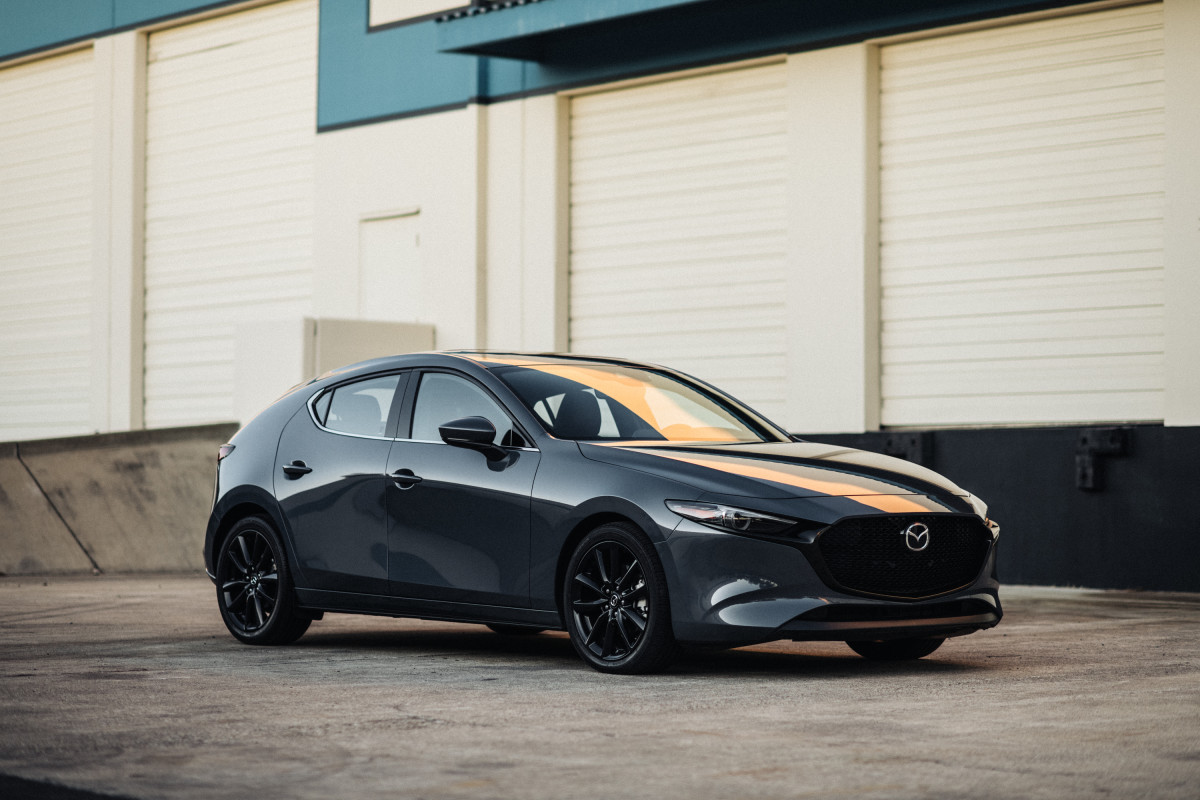
The 2025 Mazda MAZDA3 Sport hatchback had an organically shaped design with a long hood, tapered greenhouse, and stubby rear. Its sheetmetal swells created S-shaped reflections, indicating its suitability for mountain roads. Depending on the light and angle, it could appear odd, but it was a striking design. The test car featured Polymetal Grey paint over red leather, creating a terrific look. The interior was driver-oriented, with a clean design and soft, flowing forms creating a calming atmosphere. Materials quality was top-notch, though the gloss black plastic trim on the centre console showed wear easily. The test vehicle had classy metal speaker grilles, analog climate controls, and clear gauges. In Canada, the Mazda 3 Sport came in non-turbocharged and turbocharged varieties, with trims including GX, GS, GT, and the new Suna Edition. Prices ranged from $29,287 to $42,737, including destination charges. The U.S. equivalent of a GT model was evaluated, featuring a manual transmission, extra-cost paint, a rear bumper scratch guard, and a rear hatch spoiler.
The 2024 BMW 7 Series offered two potent powertrains in Canada. The 760i featured a twin-turbo 4.4-litre V8 with 536 hp and 553 lb-ft of torque, achieving 100 km/h in 4.2 seconds. The 750e plug-in hybrid combined a 3.0-litre twin-turbo six-cylinder engine with an electric motor, delivering 483 hp and 516 lb-ft of torque, reaching 100 km/h in approximately 4.7 seconds. The 750e provided fantastic fuel economy, rated at 3.6 litres-equivalent per 100 kilometres (electric) and 9.4 L/100 km (gas) combined, though real-world figures were closer to 8.4 L/100 km. The electric range was estimated at 42 kilometres, with a battery charging time of over three hours on a Level 2 AC charger. The 760i delivered 11.5 L/100 km combined. All versions handled like sports sedans, with precise steering and relatively little body roll, aided by the standard air suspension and optional rear-wheel steering.
The 2025 Mazda MAZDA3 offered a 2.5-litre four-cylinder engine in non-turbo models, producing 191 hp and 186 lb-ft of torque. Turbo models featured a turbocharged version, generating 250 hp and 320 lb-ft on premium gas, or 227 hp and 310 lb-ft on regular gas. The standard engine provided smooth, quiet, and refined power across its rev range. Most Mazda 3s had a six-speed automatic transmission with a Sport mode and manual shift control, while the GT trim offered a six-speed manual gearbox. The manual's fuel economy was rated at 7.8 L/100 km combined, though real-world figures were 9.7 L/100 km. The Mazda 3 featured G-Vectoring Control Plus technology for enhanced handling and stability. The car was communicative and predictable, though the torsion-beam rear suspension magnified sharper bumps. Steering response and effort were perfect, but the steering-wheel rim was thin. Elevated road noise was noted at highway speeds.
The 2024 BMW 7 Series was available only as a long-wheelbase sedan, offering comfort and opulence. The front seats were well-padded and supportive, with many adjustment settings and an optional massaging function. However, some settings were locked within the infotainment system, making adjustments less intuitive. Rear legroom was generous at 1,087 millimetres, with rear seats as comfortable as the front. Rear passengers had door-mounted control screens for comfort and entertainment functions, with options for ventilated and massaging seats. The 750e offered 523 litres of cargo volume, while gas-only models had 540 litres, with a pass-through for skis and a low load height. Interior storage was unremarkable.
The 2025 Mazda MAZDA3 felt small, with snug seating and limited stretch-out room. The seats were comfortable, with the test car's eight-way power-adjustable driver's seat allowing a perfect driving position. The red leather upholstery was soft and supple, and heated front seats provided warmth. Forward visibility was excellent, though the design compromised rear visibility. The reversing camera lacked guidance lines, but a surround-view camera system was standard on the GT trim. Rear-seat legroom was tight, with complaints about the lack of air vents, USB ports, and storage space. The Mazda 3 offered a sizable centre console storage bin with USB ports. Cargo space was practical, with 569 litres behind the back seat and 1,334 litres with the rear seat folded.
The 2024 BMW 7 Series featured a massive curved-screen display, combining a 12.3-inch driver's screen with a 14.9-inch infotainment display. The interface was primarily touchscreen-driven, with few hard controls. BMW updated the software to iDrive 8.5, offering a more smartphone-like interface, though it wasn't an upgrade over iDrive 8.0. The home screen featured customizable tabs, but many functions required navigating complex menus. A voice assistant was available, though it occasionally misunderstood inputs. Apple CarPlay and Android Auto were included but couldn't control most vehicle functions. An 18-speaker Bowers & Wilkins stereo was standard, with an optional 40-speaker system. A head-up display and a 31.3-inch theatre screen were optional.
The 2025 Mazda MAZDA3 retained its Mazda Connect infotainment system, with an 8.8-inch or 10.25-inch display, depending on the version. The display was elegantly integrated but out of easy reach. Mazda allowed touchscreen operation for Apple CarPlay and Android Auto, but other functions required physical controls or voice recognition. Alexa Built-in required internet access, and the native voice-recognition system had limitations. Apple CarPlay or Android Auto was recommended for a better experience, with wireless connectivity available on higher trims. The test car's 12-speaker Bose Centerpoint audio system sounded great. A two-year subscription to Mazda Connected Services was standard, though wireless charging was unavailable.
The 2024 BMW 7 Series had not been crash-tested by the IIHS or NHTSA, but it shared platform architecture with the BMW 5 Series, which earned a Top Safety Pick+ designation. Standard safety features included forward-collision warning, automatic emergency braking, blind-spot monitoring, traffic sign recognition, adaptive headlamps, parking sensors, safe exit warning, lane-departure warning, and lane-keep assist. The Advanced Driver Assistance Package added partially automated driving systems, though these cost extra. BMW's systems operated smoothly and reliably, with good pedestrian and hazard detection.
The 2025 Mazda MAZDA3 earned a Top Safety Pick+ rating from the IIHS and five stars in all NHTSA crash tests. Standard safety features included forward collision warning, automatic emergency braking, lane departure warning, lane-keeping assist, blind-spot monitoring, rear cross-traffic alert, adaptive cruise control, and driver attention alert. The manual transmission test car lacked stop-and-go capability and lane centring assist. The lane departure warning system issued inaccurate alerts, but the adaptive cruise control system reacted smoothly in traffic. The head-up display showed blind spot warnings, and the automatic high-beam headlights and adaptive front lighting system enhanced safety.
CarGurus highlights
According to CarGurus experts, the overall rating for the 2024 BMW 7 Series is 6.7 out of 10, while the 2025 Mazda MAZDA3 scores 7.5 out of 10. Based on these ratings, the 2025 Mazda MAZDA3 is the recommended choice, offering a better balance of style, performance, safety, and value for consumers.
Choose the 2024 BMW 7 Series if:
- You prioritize a luxurious and spacious interior with advanced comfort features.
- You desire powerful engine options with impressive performance and handling.
- You appreciate cutting-edge technology and infotainment systems, despite some complexity.


Choose the 2025 Mazda MAZDA3 if:
- You seek a stylish and sporty compact car with excellent driving dynamics.
- You value top-notch safety ratings and a comprehensive suite of standard safety features.
- You prefer a more affordable vehicle with a manual transmission option for driving enthusiasts.


CarGurus highlights
According to CarGurus experts, the overall rating for the 2024 BMW 7 Series is 6.7 out of 10, while the 2025 Mazda MAZDA3 scores 7.5 out of 10. Based on these ratings, the 2025 Mazda MAZDA3 is the recommended choice, offering a better balance of style, performance, safety, and value for consumers.
Choose the 2024 BMW 7 Series if:
Shop Now- You prioritize a luxurious and spacious interior with advanced comfort features.
- You desire powerful engine options with impressive performance and handling.
- You appreciate cutting-edge technology and infotainment systems, despite some complexity.
Choose the 2025 Mazda MAZDA3 if:
Shop Now- You seek a stylish and sporty compact car with excellent driving dynamics.
- You value top-notch safety ratings and a comprehensive suite of standard safety features.
- You prefer a more affordable vehicle with a manual transmission option for driving enthusiasts.

By: CarGurus + AI
At CarGurus, our team of experienced automotive writers remain at the heart of our content operation, conducting hands-on car tests and writing insightful guides that are backed by years of industry experience. To complement this, we are harnessing AI to make our content offering more diverse and more helpful to shoppers than ever. To achieve this, our AI systems are based exclusively on CarGurus content, ratings and data, so that what we produce is both unique to CarGurus, and uniquely helpful to car shoppers.
