2024 BMW 7 Series Reviews, Pricing & Specs


Pros & cons
What we like
Spacious, luxurious cabin
Potent powertrain options
Fuel-efficient
What to consider
Overly complex infotainment
Uneven performance in PHEV form
Polarizing design
The CarGurus verdict
The 7 Series is luxurious, fast, and efficient, but its complex systems and quirky styling aren't for everyone.
Redesigned for 2023, the 7 Series is BMW's full-size flagship sedan, arch-rival to the Mercedes-Benz S-Class, Audi A8, and newcomers like the Genesis G90. For 2024, BMW has added the plug-in hybrid (PHEV) 750e and lightly updated the infotainment system. Unfortunately, these additions don't change the 7 Series calculus. The 750e has a disjointed driving personality and quickly eats its electric charge. Despite the update, the car's digital systems remain frustratingly complex.
Verdict: The 2024 BMW 7 Series has lots to offer luxury buyers, including features like a rear-seat theatre and cashmere upholstery, plus performance and fuel efficiency that are often superior to most rivals, few of whom offer PHEV options. But the car's frustrating digital systems and controls undermine the experience.
out of 10 expert review
Look & feel
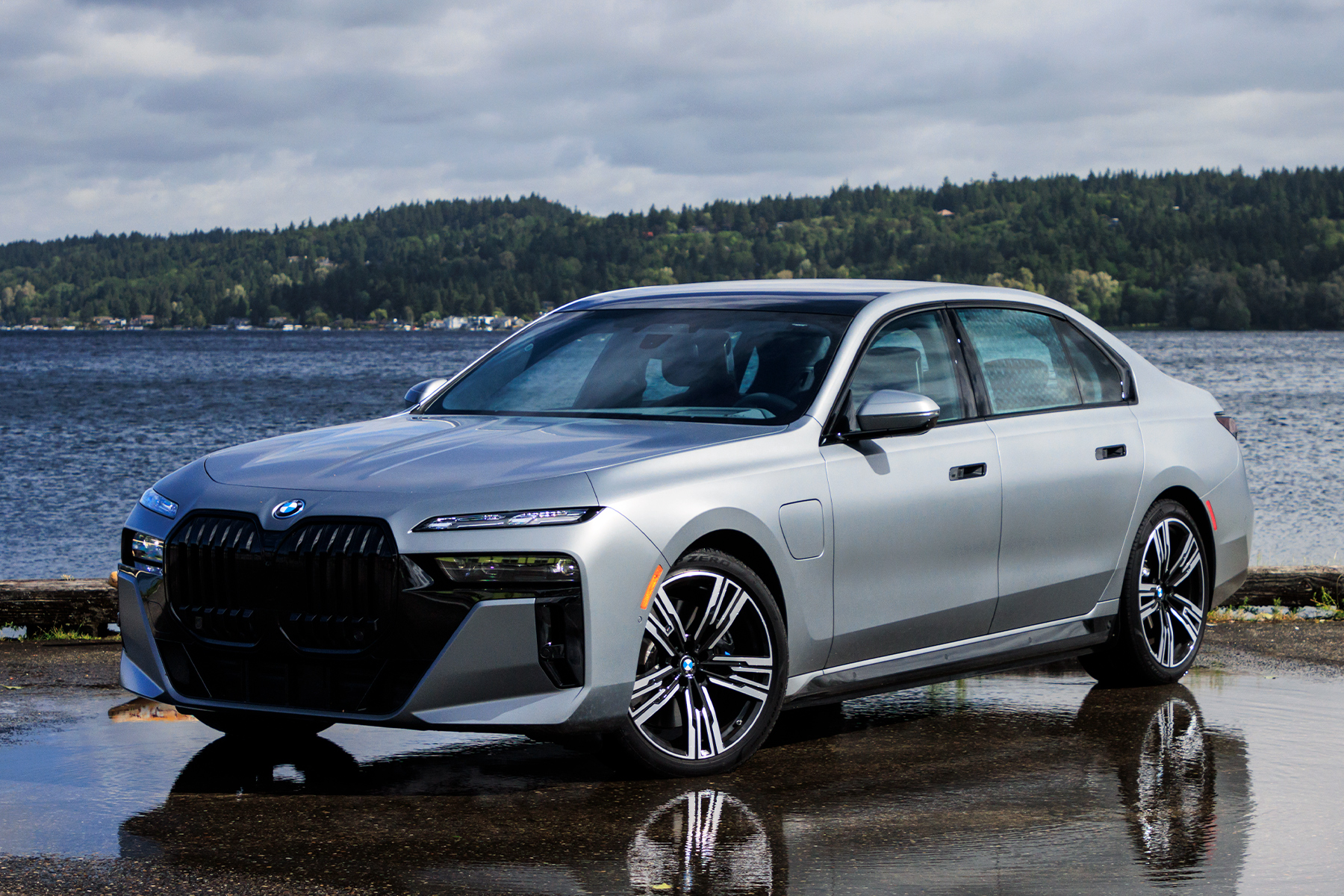
After years of stirring controversy with every 7 Series redesign, the current model seems more conventional than some of its 21st-century predecessors, at least from some angles. From the windshield backward, it's a handsome, understated, traditional luxury sedan shape. In front, however, this BMW has also gotten the massive grille treatment of other recent models (like the 4 Series), flanked by narrow LED headlights and large projector beams integrated into the bumper above functional trapezoid-shaped air inlets. Like other big-grille BMWs, the face on this 7 Series is an acquired taste, but it's certainly bold.
The car's wide array of colour and trim choices can also greatly vary its appearance. Some combinations, including the costly but very cool two-tone schemes on the 760i trim, look great. Others, not so much. Opt for the M Sport Shadowline Package, and the grille is turned black, which obscures it but also makes the styling very indistinct. Love it or hate it, it's better in chrome, and there's even an option to make it light up at night. The car's matte paint schemes also mute the visuals.
BMW also offers up to 10 wheel and tire options, all 19, 20 or 21-inch units with all-season or performance tires. They're pretty designs that blend well with the car's styling.
Inside, the BMW 7 Series cabin is much less controversial. Beautifully made metal grilles hide the speakers. The seats, offered in more than 19 different colours and patterns in vegan fake leather, a mixture with Merino leather inserts, full Merino leather, or Cashmere wool blend, look and feel up to their prices, which range as high as $2,900.
Below the big curved-screen infotainment display, there's a broad crystalline-looking strip running across the dash and onto the door panels that comes alive at night with customizable ambient lighting. The crystal theme is echoed throughout the cabin with seat adjusters and other details, and it looks and feels expensive. Among other novel amenities, there's also a rear-seat theatre screen that folds down from the roof and a panoramic sunroof with patterned ambient lighting.

Performance
For 2024, BMW offers two potent powertrains in the 7 Series in Canada. New in 2023 was the 760i, using a 48-volt mild hybrid assist system. This year, it’s joined by the 750e plug-in hybrid. The automaker also builds an all-electric version, the i7, which is covered separately on CarGurus. BMW Canada doesn’t offer the lower-powered 740i sold in the United States.
The 760i uses a twin-turbo 4.4-litre V8 with 536 hp and 553 lb-ft of torque with standard AWD. It can blast to 100 km/h in 4.2 seconds.
The new 750e mates the 3.0-litre twin-turbo six-cylinder from the 740i with an electric motor that's directly connected to the transmission and a 14.4-kWh battery pack. The plug-in hybrid system delivers 483 hp and 516 lb-ft of torque. Thanks to the electric motor, you feel that torque right away when you hit the pedal, and it'll hit 100 km/h in roughly 4.7 seconds. Even when the battery is depleted, it still has that punch. What's not so great about the 750e is how it delivers power and how it stops around town.
On the highway or speedy back roads, it's an effortless cruiser like the other 7s, maybe better because of its fantastic fuel efficiency. But around town, things are different.
Under 50 km/h, it's hard to modulate the 750e's brake pedal as the transition from regenerative braking to using the physical brakes yields inconsistent results. It's hard to stop smoothly. BMW's "adaptive braking" automatically slows down for traffic signs, which amplifies the feeling that the brakes have a mind of their own. It's similarly hard to modulate the gas pedal. Push the pedal lightly and everything is smooth and torquey. Push it a little more, and the gas engine roars to life for support as you'd expect, but the handoff can feel uncoordinated.
The 750e does, however, deliver fantastic fuel economy. Natural Resources Canada rates the 750e at 3.6 litres-equivalent per 100 kilometres (electric) and 9.4 L/100 km (gas) combined, but we saw closer to 8.4 L/100 km in a week of driving. BMW also claims a 55-kilometre electric range, but that seems optimistic. By our estimate, we got about 42 kilometres. The battery takes a little over three hours to juice on a Level 2 AC charger, but it can't use DC fast chargers.
This is well shy of the Mercedes-Benz S580e, the segment's only other plug-in hybrid, which offers up to 74 kilometres of electric range. Even if it gets 75% of that in actual use, it's still much more than the BMW. The Lexus LS 500h, a conventional hybrid, only returns 9.2 L/100 km combined and isn't nearly as fun or opulent as the 750e. The 760i is also relatively efficient, delivering 11.5 L/100 km combined.
All versions handle like sports sedans, with precise steering, relatively little body roll, and lithe handling from the standard air suspension. The moves belie this car's huge heft. There's not much steering feedback or feel, but this is, after all, a big luxo-barge. Rear-wheel steering is also optional, tightening up the big turning circle and adding stability at high speeds.

Form & function
The 7 Series is available only as a long-wheelbase sedan, and it's as comfy as it is opulent. Some features don't seem particularly useful or could be simpler to use, but in general, this big machine hits all the right comfort notes.
Up front, the seats are well-padded, comfy, and supportive for long distances. There are many adjustment settings and an optional massaging function, which is nice after six hours of cruising. The only issue is that the massaging controls (and a few other settings) are locked within the infotainment system, and finding and adjusting them quickly isn't intuitive. Also, you can adjust only one seat at a time via several taps on the centre screen, which is also true of the heated and ventilated front seat settings.
With 1,087 millimetres of rear legroom, even Nikola Jokić could probably get comfortable in the back seat of the 7 Series, and the rear seats are just as comfy as the fronts. Rear passengers also get door-mounted, smartphone-sized control screens for various comfort and entertainment functions. If this isn't enough, BMW also offers rear ventilated and massaging seats and a $2,800 rear executive lounge package (on the 760i) that adds a centre rear console and a lie-flat reclining rear passenger seat. The experience is akin to one of Lufthansa's lie-flat first-class seats.
The optional automatic doors are finicky to use and tried to close on a leg automatically at least once. They only sometimes work in crowded parking situations, too, or they only open a hair and then require more effort than normal to open. They seem like an answer to a question nobody asked.
Big luxury sedans prioritize passenger room, not freight space, but the 7 Series does well here. The 750e has 523 litres of cargo volume and the gas-only models have 540 litres. That's quite good for a vehicle in this class. By comparison, the Audi A8 and Genesis G90 only have about 350 litres. There's a pass-through for skis, and the load height is low, so the 7 Series trunk is easy to use, too. Interior storage, conversely, is unremarkable.

Technology
Behind the wheel, 7 Series drivers are greeted by a massive curved-screen display that melds a 12.3-inch driver's screen with a 14.9-inch infotainment display. There are control interfaces on the steering wheel and console, but the interface is primarily touchscreen-driven, with few hard controls. BMW recently updated the car's software to iDrive 8.5, which it says is a more smartphone-like interface with more customization options than iDrive 8.0, used in last year's redesigned 7 Series models. Having sampled both, iDrive 8.5 isn't an upgrade.
The home screen features customizable tabs for apps and info that you can easily swipe through, but they require time to get used to and set up. Many functions require navigating lots of menus or going to the apps within the system, which, when browsing to find them, look a bit like a busy desktop computer. There are many drive modes, including ones that add music and digital art to the screens. They look great, but you must take your eyes off the road to use them. Beyond "Sport," they seem redundant.
BMW supplements the complex menus with a helpful voice assistant. Simply say, "Hey, BMW," and dictate a command. It gets lots of things right, even if it mutes your music or podcast in the process. However, almost a quarter of the time, our inputs had it guessing, and it felt the need to introduce itself more than once despite an initial setup.
This interface is considerably more frustrating than systems from Audi or Genesis or previous iterations of iDrive. Apple CarPlay and Android Auto are included, but they can't control most vehicle functions.
An 18-speaker Bowers & Wilkins stereo is standard, but buyers can upgrade to a 40-speaker, 1,965-watt surround-sound Bowers & Wilkins system. A head-up display is optional, and so is the most dramatic item in the interior: the 31.3-inch theatre screen. It's gorgeous and lets rear passengers stream movies or browse the web, but it's also finicky to control, and when in use, it completely blocks the rearview mirror.

Safety
either the Insurance Institute for Highway Safety (IIHS) nor the National Highway Traffic Safety Administration (NHTSA) have yet crash-tested the 2024 BMW 7 Series. These agencies don’t evaluate many vehicles in this price class but have tested some of the 7 Series's smaller siblings. The car rides the same platform architecture as the new-for-2024 BMW 5 Series, which earned a Top Safety Pick+ designation from the IIHS. That rating doesn't apply to the 7, but its crash structures are robust.
BMW now offers a slate of standard active safety features, including forward-collision warning with automatic emergency braking, blind-spot monitoring, traffic sign recognition, adaptive headlamps, parking sensors, safe exit warning, lane-departure warning, and lane-keep assist. However, the automaker charges extra for its best systems.
The $3,750 Advanced Driver Assistance Package adds partially automated active driving assistant and highway assistant, which offers limited hands-free capability. These systems cost extra where some competitors include similar gear standard, like the Genesis G90 and Lexus LS, but neither of those offers a hands-free mode.
BMW's systems all work very well and operate smoothly and reliably. GM's Super Cruise is better than BMW's Highway Assistant, but Cadillac no longer offers a car in this class. The rest of the 7 Series electronic warning systems work unobtrusively but are good at detecting pedestrians and hazards. In other countries, BMW offers even more extensive semi-autonomous driving tech in the 7 Series, but it isn't available in North America yet.

Cost-effectiveness
For 2024, the BMW 7 Series starts at $154,905 (including a $2,480 destination fee, the federal luxury tax, and other dealer fees) for the 750e xDrive, while the V8 760i xDrive rings up at $165,705. That's substantially more than equivalent versions of the Genesis G90, Lexus LS, Audi A8 and entry-level Mercedes-Benz S-Class.
BMW offers some features its less-expensive rivals don't—like that big fold-down screen—but the automaker also makes you pay extra for certain features those competitors make standard, like adaptive cruise control. Most rivals also have more intuitive infotainment systems.
The new 750e is impressively fast and efficient, and it does offer that fully electric range. But it's also fussier to drive, and not everyone will actually plug it in, negating some of the benefits of a PHEV.
The 750e also has to contend with the i7, which sits in the same showroom. That fully electric version of what is largely the same car comes with a smoother and more powerful drivetrain, and essentially the same interior and exterior.
That said, the top-drawer V8-powered 760i xDrive offers the most vigorous driving experience and some luxury car options you can't get on the 750e model. If you really want the two-tone paint or Cashmere wool interior, you'll have to pony up for this trim and spend quite a bit on options.
Note: Images show a US model.

What owners say
Not feeling the automatic doors. I don't need my car to do that for me especially when I have to wait for it to open/close. The theater sceen looked like a must have but it is ridiculously large and blocks rearview mirror. I more thing to rattle.
October 22, 2026Unfortunately, the front end re-style is not as attractive as the prior car (2020-2022) and the dash layout looks like a Mercedes. Think Ill be keeping my 2020 750i which is a fantastic car. One of the best Ive ever owned. As a frame of reference Ive had Rolls Royce, Mercedes, Porsche, Audi, Ferrari and more. The 750i is the most serene ride ever.
September 2, 2023It is a beautiful car with great feature s and amazing technology. The ride was great minus the little road noise but the great audio system take care of that. Its 4 out of 5 car aesthetically, and with its options and functions.
February 13, 2024Trims & specs
Base MSRP $96,400 | Seating 5 |
Engine 3.0L 375 hp I6 | Cargo Capacity 19.1 cu ft |
Combined MPG 28 | Drivetrain RWD |
Base MSRP $107,000 | Seating 5 |
Engine N/A | Cargo Capacity 18.5 cu ft |
Combined MPG N/A | Drivetrain N/A |
Base MSRP $121,300 | Seating 5 |
Engine 4.4L 536 hp V8 | Cargo Capacity 19.1 cu ft |
Combined MPG 21 | Drivetrain AWD |
Base MSRP $99,400 | Seating 5 |
Engine 3.0L 375 hp I6 | Cargo Capacity 19.1 cu ft |
Combined MPG 27 | Drivetrain AWD |


