2026 Mercedes-Benz E-Class Reviews, Pricing & Specs


Pros & cons
What we like
Plug-in hybrid’s impressive electric range
Fun to drive
Impressive technology
What to consider
Squealing, grabby brakes
Cramped back seat
Advanced safety features are not standard
Expert review
The 2026 Mercedes-Benz E-Class proves that wagons aren’t extinct yet.
Available as a sedan or as a wagon, the 2026 E-Class lineup adds a new bit of kit in the form of a standard biometric fingerprint scanner to authenticate saved driver profiles. The bigger news is the debut of the AMG E 53 Hybrid wagon variant, which offers plug-in hybrid efficiency combined with AMG-engineered performance. It joins an E-Class family that also includes the E 350 Sedan, the E 450 Sedan, the E 450 All-Terrain Wagon, and the AMG E 53 Hybrid Sedan.
Verdict: Anyone suffering from SUV fatigue will find a lot to like about the 2026 Mercedes E-Class wagon, especially the AMG-tuned model. It offers electric-only propulsion for short trips, a gasoline engine for long-distance drives, impressive performance, and plenty of utility.
out of 10 expert review
Look & feel
With the debut of the 2026 Mercedes-AMG E 53 Hybrid, two E-Class wagons are now available. The E 450 All-Terrain is the less-expensive model, starting at $96,245 (including the rather excessive $3,995 destination charge). The All-Terrain features a more rugged look and technology that can assist with light off-road travel.
The subject of this review, the AMG E 53 Hybrid, is the performance upgrade with a base price of $113,895, a price that includes destination charges but not the federal government’s luxury tax that applies on the portion of the price above $100,000. Like the All-Terrain, the AMG E 53 Hybrid wagon has a height-adjustable air suspension, but the AMG E 53 Hybrid is engineered for driving on paved roads at a rapid pace.
Our test car arrived well-equipped with the Pinnacle Trim package, gorgeous 21-inch forged alloy wheels, and premium leather. Additionally, it had the AMG Dynamic Plus package, MBUX Superscreen, and Multicontour Seating option packages. Those upgrades inflated the manufacturer’s suggested retail price (MSRP) to just under $140,000 before the luxury tax.
In a world overrun by lookalike SUVs with black wheels, our AMG E 53 Hybrid wagon was a breath of fresh air. That low-slung stance. That rakish yet practical roofline. Those flashy wheels, with an intricate design you can actually see. It looks terrific, and during a week-long evaluation driving the car in some of the wealthier sections of our home city, we didn’t see another one on the road.
MB-Tex artificial leather upholstery is standard, but the test vehicle had genuine Nappa leather in Neva Grey over Black that looked, felt, and smelled like luxury. Natural grain wood trim is also standard, along with a 12.3-inch digital instrumentation panel and a 14.4-inch infotainment touchscreen. The evaluation car had the Superscreen Package, which adds a 12.3-inch touchscreen display for the front passenger as well as an interior selfie and video camera. Neither is essential.
The mix of materials and details exudes quality. However, on warm and sunny days, the metallic surfaces on some of the switchgear get hot enough to burn fingertips. Also, the screens and piano-black surfaces rapidly collect dust, fingerprints, and smudges. That will frustrate neat freaks who pride themselves on driving a clean car.
Performance
There is a lot to digest regarding the AMG E 53 Hybrid wagon’s plug-in hybrid powertrain and performance upgrades, so let’s dig in.
The heart of this PHEV is a turbocharged 3.0-litre inline-six engine paired with a 120-kilowatt electric motor and 21.2-kilowatt-hour battery. The motor makes 161 horsepower and 354 pound-feet of torque, and total system output, including the turbo six, measures 577 hp and 553 lb-ft (604 hp with Race Start active). Mercedes claims it takes as little as 3.9 seconds for this wagon to accelerate to 100 km/h.
Fully charge the battery and the E 53 wagon returns a Natural Resources Canada-rated 66 kilometres of electric range. It’s also rated at 10.5 litres per 100 kilometres combined in hybrid mode. We saw an indicated high of 70 km of range with a fully charged battery and an average of 10.3 L/100 km when exclusively using the gasoline engine.
Mercedes says it takes 20 minutes to bring the battery from 10% to 80% on a DC fast charger and 2.75 hours to juice it from 0% to 100% on a 9.6-kW AC home charger. For the first 400 kilometres of driving, we regularly recharged the AMG E 53 Hybrid after each trip (once to a full charge), and the car averaged 5.0 L/100 km with 52% of the distance traveled on electricity.
The list of AMG-enhanced hardware is long. It includes the AMG Speedshift nine-speed automatic transmission, a fully variable AMG Performance 4Matic all-wheel-drive (AWD) system, AMG Dynamic Select driving modes, AMG performance exhaust system, adaptive damping AMG Ride Control suspension, and rear-axle steering that can turn the back wheels up to 2.5 degrees.
Our test vehicle added the AMG Dynamic Plus Package, which includes AMG dynamic engine mounts, Race Start, an AMG electronic limited-slip rear differential, and an AMG high-performance composite braking system with larger 15.4-inch front discs and red, six-piston front calipers.
Collectively, this equipment transforms the E-Class wagon into an extraordinary real-world performance car, despite its hefty 2,435-kilogram (5,368-pound) curb weight. However, we’d skip the AMG Dynamic Plus Package simply because in our experience the brakes squealed, proved difficult to smoothly modulate in traffic, and were hard to trust when running the car hard in the mountains. Sometimes they would bite instantly to reduce speed. Other times they would not, forcing us to step on the brake pedal harder and more decisively. Such an inconsistent response to driver input is a distraction.
Otherwise, the AMG E 53 Hybrid Wagon covered ground like a guided missile. Its performance-tuned adaptive air suspension eradicated the potentially negative effects of the car’s extra electric motor and battery weight on the ride and handling. The ride is firm — as expected — but the car also shrugs off heaves, dips, divots, and cracks in the road as though they’re nonexistent. Beyond that, the P265/35ZR21 front and P295/30ZR21 rear tires supplied outstanding grip in the twists and turns of one of our favourite mountain roads. However, in typical driving situations, particularly on highways, the road noise inside the cabin is excessive.
Switch into Sport or Sport+ mode, and the power is incredible. Accelerate hard from a stop and all four wheels rush the car forward without a hint of slip or struggle. We did not venture into speeds well beyond legal with this rocket of a wagon, but we imagine it would feel remarkably stable and buttoned down at such velocities.
For those who love driving, need a family car, and want to park something different in a multi-car garage, this AMG-tuned wagon is a compelling pick.
Form & function
Station wagons are more practical than the sedans on which they’re usually based. According to Mercedes, the AMG E 53 Hybrid sedan has a 370-litre trunk, while the wagon boasts up to 460 litres of cargo space behind the rear seat. Fold the back seats down and 1,675 litres of cargo space opens up. That’s comparable to the GLE, the Mercedes midsize SUV.
An AMG GLE 53 Coupe has 655 litres of cargo space behind the back seat and 1,790 litres with the rear seats folded flat. The boxier GLE SUV can accommodate 630 litres of cargo behind the back seat and a maximum of 2,055 litres. The SUVs have taller liftover heights that could make loading cargo more difficult, but the wagon’s lower roofline could be a liability in some situations. Fitting in a full-size suitcase necessitates removal of the cargo cover, while the portable charging cord and the flat-tire inflator kit also take up valuable space.
The AMG E 53 Hybrid wagon’s standard heated front seats are robustly bolstered, but they’re not as restrictive as the available racing-inspired AMG Performance front seats. As such, we found them to be quite comfortable.
The test car’s optional Multicontour Seating Package — which gives the front seats rapid-heating, ventilation, and massagers, and includes heated outboard rear seats and Mercedes's Air Balance interior fragrance system — helped in that regard. Thoughtfully, when the massaging seats are activated, there is also the option of adding soothing heat for the backrest.
Still, the E-Class wagon feels like a snug fit compared to the GLE SUV. Rear-seat passengers may even feel cramped in this car, which doesn’t seem to offer the amount of legroom buyers might expect from a midsize luxury wagon. Furthermore, getting into and out of the E-Class can also pose a challenge because it's so low. Taller people must climb out past an intrusive centre roof pillar. From these standpoints, the GLE is easier to live with.
Interior storage space is clearly not a priority. Using the cupholders blocks the wireless phone charger, and we discovered that a large coffee cup can easily tip when it's inside them. The glove compartment is large and the bins in the lower door panels are roomy, but practical storage space is otherwise in short supply.
Technology
The standard AMG E 53 Hybrid wagon’s dashboard contains a 12.3-inch digital driver display, a 14.4-inch infotainment touchscreen, and a lovely panel of natural grain Black Ash wood in front of the passenger.
With the MBUX Superscreen option package, Mercedes swaps that wood paneling for a 12.3-inch touchscreen, effectively transforming the dashboard into a continuous glass surface that produces glare and reflections while collecting fingerprints and dust. During our week with the Superscreen-equipped car, passengers typically tried it once out of curiosity, then didn’t interact with it again.
All three screens are a part of the Mercedes-Benz User Experience (MBUX), one of the better infotainment systems available today. The driver display offers numerous data and appearance themes, and the centre touchscreen is reasonably intuitive to reference and use. As expected, wireless Apple CarPlay and Android Auto are standard, along with an augmented reality navigation system, music streaming, and a sensational Burmester 4D surround-sound system with Dolby Atmos technology.
MBUX also incorporates a natural-language digital voice assistant. However, when we told it we needed to go to a hospital, it could not filter out unrelated medical offices from the list of results. Modifying the request to find an emergency room produced the same results. Otherwise, the tech performed flawlessly, regardless of the complexity of the command or query. It even succeeded where most fail by finding a SiriusXM channel called Reggae Vibes when we asked for reggae music.
Analog controls for the stereo are absent, but we quickly adjusted to using the touch-sensing controls on the steering wheel. They work better than most of their ilk but lack the fine-tuned control of twisting a knob or pressing a button. For example, many times after turning up the stereo volume using the touch slider on the steering wheel, we then immediately turned the stereo back down as we pulled our fingertip away from the control surface.
The steering wheel controls are also finished in a glossy piano black, so they collect and show smudges, dust, spittle, sneeze spray, dandruff, and whatever else emanates from your follicles, face, and fingertips. Delightful.
The Pinnacle Trim option package adds an MBUX Interior Assistant. Translated, this is a gesture control system that attempts to predict what you might wish to use on the touchscreen as you reach for it. It also allows you to control certain in-cabin features through hand and arm movements. The trouble is that it isn't as effective or as consistent as using knobs and buttons — yet another case for implementing technology for technology’s sake.
Safety
For an expensive luxury car, the Mercedes E-Class doesn’t come with much standard safety tech. Our test car had high beam assist, forward collision warning, automatic emergency braking, blind spot monitoring, an exit warning system, a surround-view camera system, front and rear parking sensors, and a semi-autonomous self-parking system. In Canada, premium driver assist features are also standard including adaptive cruise control, active blind spot monitoring, active intersection assist, active emergency stop assist, active lane change assist, active lane keep assist, active steering assist, automatic lane change capability, evasive steering assist, and congestion emergency braking.
Like other Mercedes models, the E-Class also comes standard with Pre-Safe forward collision preparation technology and Pre-Safe Sound, which can emit a “pink noise” to protect your hearing during a collision. Pre-Safe collision preparation for rear and side impacts is included in Canada as well. An SOS emergency call service that a driver can manually activate or that can respond to an airbag deployment or seatbelt pre-tensioning event to check to see if everyone is OK is also standard.
We tested as many of these features as we safely could, except the route-based speed adaptation feature, which is detestable. We turned it off to save ourselves some aggravation. Drivers can elect to turn many other features off individually or adjust the sensitivity and operational levels to personal preferences.
Overall, we were impressed with the absolute transparency of these systems. From a refined distance management capability to smooth braking as traffic ahead came to a stop, they behaved in a natural and sophisticated manner without annoying notifications, inconsistent acceleration and braking, or artificial steering sensations. Together, these features operate like a partner instead of an adversary. And thanks to the touch-sensing steering wheel, they don’t require continual small steering inputs to confirm that you’re still in control and paying attention.
Additionally, our test car had active braking technology that automatically slowed it when driving to ensure a safe following distance or to reduce speed when we were traveling too fast. In some ways, it operated like similar tech in Lexus models but worked in a more refined and effective manner. We continued to use it throughout our week with the car.
At the time of writing, neither the U.S. National Highway Traffic Safety Administration (NHTSA) nor the Insurance Institute for Highway Safety (IIHS) has published safety ratings for the Mercedes E-Class wagon.
Cost-effectiveness
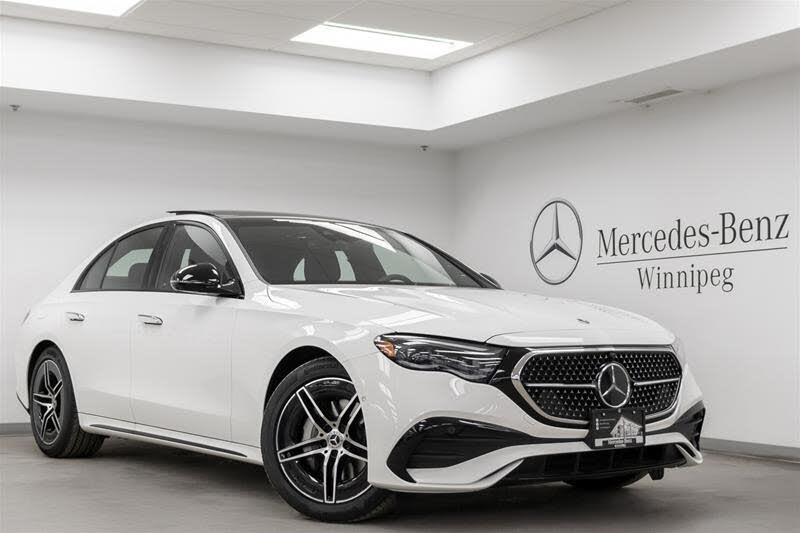
The 2026 Mercedes-AMG E 53 Hybrid is a bargain compared to its primary rivals, the Audi RS 6 Avant and the BMW M5 Touring. It costs more than $30,000 less than both of them and offers far superior efficiency. The Mercedes also offers more electric range than the BMW’s plug-in hybrid powertrain and provides more cargo space than both competitor performance wagons. Granted, buyers give up outright speed by choosing the Benz, but does anyone really need to get to 100 km/h in less than 3.9 seconds?
The more important question might be whether to get the AMG E 53 Hybrid wagon or one of the AMG GLE 53 SUV models. The GLEs don’t currently offer a plug-in hybrid powertrain, so they’re not as efficient. Neither are they as powerful, so acceleration is slower.
However, the GLEs sit higher off the ground, making them easier to enter and exit. Due to their extra ground clearance, they can also handle light off-roading and plow through fallen snow with greater ease. Also, the back seats offer more legroom than passengers will find in the E-Class Wagon. Mercedes is also planning AMG GLE 53e Hybrid versions for the 2027 model year, which is something to keep in mind.
The decision about what to buy comes down to what buyers want from a luxurious and practical performance vehicle. For those leaning away from an SUV on principle or because they want to drive something uncommon, the Mercedes-AMG E 53 Hybrid wagon makes good financial sense when compared to rivals from Audi and BMW.

What owners say
Trims & specs
Base MSRP $72,300 | Seating 5 |
Engine 3.0L 375 hp I6 | Cargo Capacity 12.7 cu ft |
Combined MPG 26 | Drivetrain AWD |
Base MSRP $66,400 | Seating 5 |
Engine 2.0L 255 hp I4 | Cargo Capacity 12.7 cu ft |
Combined MPG 28 | Drivetrain AWD |
Base MSRP $63,900 | Seating 5 |
Engine 2.0L 255 hp I4 | Cargo Capacity 12.7 cu ft |
Combined MPG 29 | Drivetrain RWD |
Base MSRP $89,600 | Seating 5 |
Engine 3.0L 577 hp I6 Hybrid | Cargo Capacity 12.7 cu ft |
Combined MPG 57 | Drivetrain AWD |



Pricing trends
MSRP range
$63,900 - $89,600
Current avg. market price
$99,984
Trending down by 2.2% this month
May 2026 - October 2026