2026 Hyundai Venue Reviews, Pricing & Specs


Pros & cons
What we like
Small and easy to park
Fuel efficient
Good space for the size
What to consider
Underpowered
Lots of plastic inside
Excessive interior noise
The CarGurus verdict
The Hyundai Venue replaces the fading subcompact car with a crossover aesthetic that brings higher prices but just as much cost cutting.
Automakers have traditionally had a hard time making money on entry-level subcompact cars because they have low profit margins. But North America has largely moved away from cars to crossover SUVs — and higher prices. That allows car companies to offer an entry-level subcompact SUV for thousands more than a similar sedan or hatchback.
Such is the case with the Hyundai Venue, which costs more than its predecessor, the subcompact Accent that was dropped in Canada after the 2020 model year. While the price is higher, the advantage for buyers is a vehicle that generally has more cargo space and is more practical. We recently drove the 2026 Hyundai Venue to find out if a subcompact crossover is a better buy than a cheaper subcompact car.
Verdict: The Hyundai Venue sacrifices refinement for a price point that isn’t as low as a comparable subcompact car. We’d be tempted to spend a little more for a slightly larger compact car with more power, features, and refinement.
out of 10 expert review
Look & feel
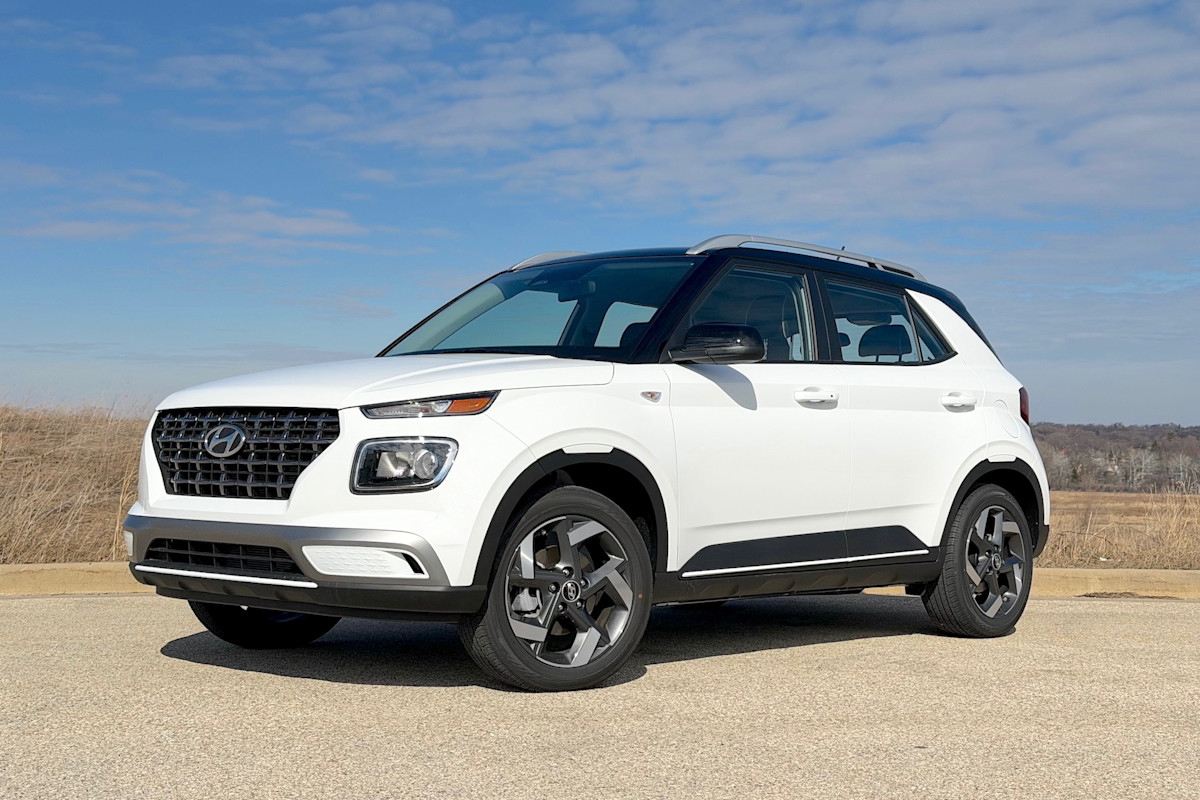
Hyundai classifies the Venue as a crossover SUV, but an argument can be made that it’s a tall hatchback. It offers only front-wheel drive (FWD) and while its 17 centimetres of ground clearance is higher than a car, it’s not as tall as a typical crossover SUV.
The design, however, is more crossover than car. The Venue looks small and narrow at first blush, like the type of runabout you’d expect to see in Europe more than North America. The rather upright windshield looks frumpy but SUV-like, and other SUV cues include the bluff nose and available roof rails.
The high nose is flanked by lower headlights and high-set daytime running lights, and a lower air intake is set within a satin metallic lower fascia. Along the sides, the Venue is defined top and bottom by roof rails and black rocker panels topped by a black trim piece to visually lighten the profile. Black wheel flares around small 15- or 17-inch wheels also nod to an SUV. The rear pillars angle sharply forward, and a two-tone roof is available for a little flair. (Note the test car shown is the U.S. equivalent of Canada’s Ultimate trim, but the two-tone roof is not available with this trim in our market.)
Inside, the look is simple and functional. The digital instrument cluster brings a modern element, but the small touchscreen looks like an iPad tacked onto the dash. Body-colour trim surrounds the air vents and shifter to bring some of the outside feel inside the vehicle.

Performance
Performance is basically a misnomer when describing the Hyundai Venue as it’s one of the least powerful vehicles on the market. It’s powered by a naturally aspirated 1.6-litre four-cylinder engine that musters only 121 horsepower and 113 pound-feet of torque. The power flows through a continuously variable transmission (CVT) to the front wheels exclusively. No all-wheel drive (AWD) here.
The Venue isn’t quick, with a 0-100 km/h time in the 8.5–8.8-second range based on testing performed by Car and Driver and Road & Track. That’s better than the power might suggest because this tiny crossover checks in at a featherweight 1,251 kilograms (2,757 pounds).
The power feels peppy from a stop, making it easy to keep up with city traffic. It’s not so easy to tap into at highway speeds, where the slushy transmission is slow to change down a gear for more thrust. Plus, 113 lb-ft of torque just isn’t enough for a kick in the pants, so passing requires space and planning.
The transmission isn’t noticeable during city driving, but it is when digging deep into the throttle. Hyundai provides stepped gear ratios, but the “shifts” feel slurred. Heavy throttle causes the engine to drone, which is especially annoying because the Venue has precious little sound deadening to keep it in check. Sport mode raises the rev range to make power more accessible but with even more noise.
Handling benefits from the small size and low weight. The Venue is 4,040 millimetres long on a short 2,250-mm wheelbase. That makes it easy to slip in and out of traffic, fit into tight parking spots, and change direction quickly. The 17 cm of ground clearance means there is some lean in corners, but the steering is stable and direct. The ride is generally comfortable, but a solid rear axle makes it jiggly on broken pavement.

Form & function
The cloth and synthetic leather seats of our Venue test car did a decent enough impersonation of sport seats with their black upholstery and white contrast stitching. They’re comfortable enough, and the six-way manual adjustments should allow most drivers to tailor a natural driving position. Power adjustments are easier to use, but most drivers will just set it and forget it. Standards front seat heating is a welcome amenity. Headroom is plentiful, but legroom is lacking for tall folks in the front seat.
The rear seat has just enough room for average-sized adults to fit front and rear. However, anyone six-foot or more — front or rear — will fight with occupants in the other row for legroom. The rear seat will fit two adults, but three will only fit across if they’re waifs. The rear seat bottoms sit high enough to be comfortable on long trips, but there is no fold-down armrest.
Those second-row seats fold flat in a 60/40 split to open up a modest 528 litres of cargo space. Capacity is even more modest with the rear seats up, coming in at 902 litres. While that’s still useful, it’s about half as much as a typical compact crossover, and even the Kia K4 hatchback and Honda Civic hatchback have more. The Venue’s rear cargo floor lifts up to access the compact spare tire. Revealingly, the spare sits in a well that has no sound deadener, which is a clear indication of cost-cutting.
That's also obvious from any seat in the Venue. The dash, the door panels, and the centre console are rendered almost entirely in hard black plastic that sounds hollow, while only the top of the centre console and the door armrests have soft-touch surfaces.

Technology
Hyundai equips the Venue with a simple 8-inch touchscreen for basic infotainment features. A few years ago, even luxury vehicles had screens of this size, but it now feels small. Still, it’s big enough to be useful. The icons are large enough to tap without a struggle, and it reacts quickly enough to inputs. It has limited functionality that includes phone, radio, media, and phone projection connections, as well as voice memos, settings controls, and the user manual.
It lacks some features taken for granted in most of the market these days, including navigation, a Wi-Fi hotspot, and SiriusXM satellite radio, but those features aren’t necessarily expected at these prices. It does have wireless Apple CarPlay and Android Auto, so for those who pair their phones, some of those features aren’t needed anyway. The digital instrument cluster also displays a limited amount of information and is not programmable. Impressively, a wireless charging pad is also standard in Canada, an unusually premium feature at this price point.
The audio system is a simple six-speaker unit, and Hyundai doesn’t offer a more premium choice. Drivers won’t be able to rock the tunes with the crystal clarity of better audio systems. That doesn’t matter much for podcasts, though.

Safety
The Venue may be a budget choice, but Hyundai supplies a good set of standard safety features. These include forward collision warning, automatic emergency braking, lane keep assist, and a driver attention monitor. All but the base Essential also have blind spot monitoring and rear cross-traffic alert, but adaptive cruise control isn’t available.
The safety systems worked well during our test drive, but we found the driver attention monitor too sensitive. It flashed warnings when we were looking at the gauges, for instance.
The Venue has mediocre safety ratings. It's rated four out of five stars by the U.S. National Highway Traffic Safety Administration (NHTSA), while most vehicles on the market today get five stars. The Insurance Institute for Highway Safety (IIHS) hadn’t released full safety ratings at the time of writing. The 2026 Venue received a top “Good” score in the small front overlap test, but ratings for the updated moderate front overlap test and the side test were unavailable. Its headlights also got “Acceptable” or “Marginal” ratings depending on the trim level.

Cost-effectiveness
In Canada, the Hyundai Venue is offered in Essential, Preferred, and Ultimate trim levels. The Hyundai Venue Essential is the most affordable new car in Canada in 2026 starting at $24,199 including a $2,200 destination fee. The Preferred costs $26,299, and the Ultimate runs $28,799. The Essential is very basic. Its limited standard features include cloth upholstery, heated front seats and exterior mirrors, halogen headlights, a six-way manually adjustable driver’s seat, a urethane steering wheel and shift knob, a tilt/telescoping steering column, remote keyless entry (but turn-key start), hill start assist, air conditioning, the 8-inch touchscreen, six-speaker audio system, wireless Apple CarPlay and Android Auto, a wireless charging pad, front USB-C ports, and 15-inch steel wheels. It’s also one of the very few new cars with rear drum brakes.
The Preferred adds useful, more premium features such as a heated steering wheel, a leather-wrapped shift knob and steering wheel, a Snow mode, a proximity key with push-button start, 15-inch alloy wheels, roof rails, a covered centre console, blind spot monitoring, and rear cross-traffic alert.
On the Ultimate trim, a power sunroof is added as well as cloth and leatherette upholstery, automatic temperature control, front auto up-down windows, 17-inch alloy wheels, rear disc brakes, LED headlights and daytime running lights, and chrome grille accents.
In today’s automotive market, the Hyundai Venue Essential offers decent value. Features like heated front seats, wireless Apple CarPlay and Android Auto, and a wireless charging pad are unusual at this price point and will especially appeal to young buyers on a budget. For $2,100 more, the Preferred trim’s blind spot monitoring and rear cross-traffic alert, centre console, heated steering wheel, and push-button start are worthwhile add-ons.
Fuel economy will also play into that budget. The Venue is rated by Natural Resources Canada at 7.9 litres per 100 kilometres in the city, 6.9 on the highway, and 7.5 combined. We averaged 8.3 L/100 km over 175 km of mixed city and highway driving — even with our heavy right foot. Not bad.

What owners say
Trims & specs
Base MSRP N/A | Seating N/A |
Engine N/A | Cargo Capacity N/A |
Combined MPG N/A | Drivetrain N/A |
Base MSRP $22,825 | Seating 5 |
Engine 1.6L 121 hp I4 | Cargo Capacity 18.7 cu ft |
Combined MPG 31 | Drivetrain FWD |
Base MSRP N/A | Seating N/A |
Engine N/A | Cargo Capacity N/A |
Combined MPG N/A | Drivetrain N/A |
Base MSRP $20,550 | Seating 5 |
Engine 1.6L 121 hp I4 | Cargo Capacity 18.7 cu ft |
Combined MPG 31 | Drivetrain FWD |
Base MSRP N/A | Seating N/A |
Engine N/A | Cargo Capacity N/A |
Combined MPG N/A | Drivetrain N/A |
Base MSRP $22,600 | Seating 5 |
Engine 1.6L 121 hp I4 | Cargo Capacity 18.7 cu ft |
Combined MPG 31 | Drivetrain FWD |


