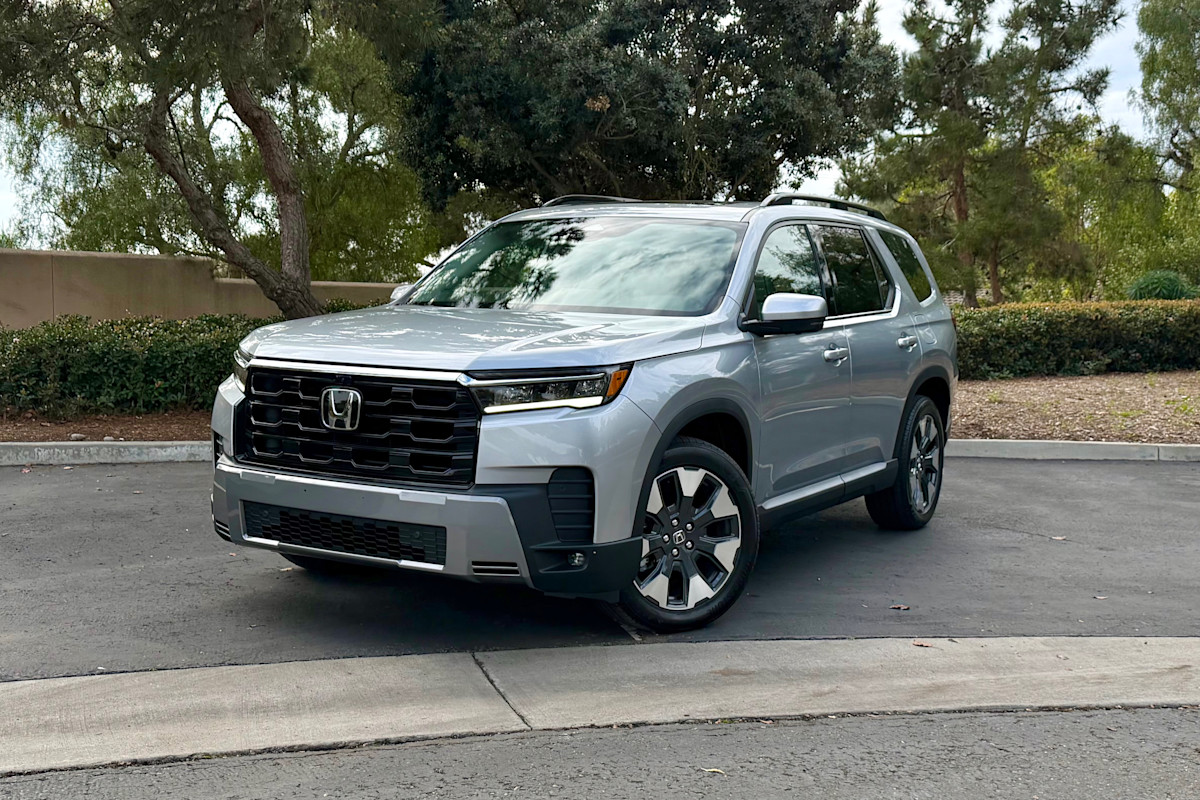
2025 Mitsubishi Outlander Reviews, Pricing & Specs


Pros & cons
What we like
Impressive stereo
Comfortable
Quiet cabin
What to consider
Potentially polarizing design
Cramped third row
Sluggish performance
Expert review
Mitsubishi's best-selling Outlander receives a few updates for 2025.
Mitsubishi Outlander PHEV has driven a sales surge in Canada in recent years, but the rest of the company’s line-up doesn’t get as much attention. Take, for example, the gas-only Mitsubishi Outlander. The PHEV sold more than 14,000 units and is the best-selling plug-in hybrid in the country, but the internal combustion engine (ICE) Outlander sold just over 9,000 units.
For 2025, this midsize crossover gets a refresh. While the lower trim levels won’t likely stress your pocketbook, it’s a little tough to find the value in the top-most trim. The most obvious changes are inside, with some new tech and a bumping new sound system. However, those with a keen eye will find some differences in the exterior styling as well. Mitsubishi also improves the suspension tuning for 2025, but neglects the powertrain.
Verdict: The 2025 Mitsubishi Outlander still isn’t the best-driving crossover you can buy, and the front fascia might turn you off. But the small improvements and excellent sound system might inspire some buyers to visit the dealership.
out of 10 expert review
Look & feel
In Canada, the Outlander is available in six trims: ES, SE, LE, SEL, GT, and GT Premium. On all trims, Mitsubishi’s Super All-wheel Control (S-AWC) all-wheel drive (AWD) system is standard.
Regardless of trim, you can’t miss the face. It almost looks as if it was created by two different designers who refused to compromise. The thin upper eyebrow functions as a daytime running light while the large, square headlight is underneath, offset just a bit and highlighted by a chrome bezel. It’s all a little much, but if your goal is to stand out in a crowd, you’ll love it.
Though the lighting design remains the same, there are a few changes to the front end for 2025. You’d have to be pretty eagle-eyed to notice them, but the upper part of the grille is smooth, not punctuated by faux vents, and the diffuser gets a few light modifications. If you were hoping for a complete makeover, sorry. With such subtle changes, the Outlander is still a bit of an ugly duckling.
The story is much better inside, at least in the top GT Premium trim. Here you’ll find quilted leather seats and plenty of soft-touch surfaces. There are physical controls for the HVAC system, so you don’t have to go digging through the infotainment just to increase the temperature a few degrees. Especially nice are the Yamaha speaker faces in the doors, inspired by traditional Japanese geometric patterns. There are a few bits of unfortunate plastic trying to masquerade as high-dollar textured pieces, but that’s par for the course in a mid-tier crossover like the Outlander.
Performance
Mitsubishi’s S-AWC AWD system was developed through many winning years of rally racing in the 1980s and 1990s. Although our test drive did not take place on low-traction surfaces, the Outlander displayed poise and stability on curvy roads. The suspension has been retuned for 2025, offering up more comfort and less body roll. There are modes for Eco, Normal, Tarmac, Gravel, Snow and Mud. Most of this drive was spent in Tarmac mode for the sportiest acceleration and a heavier steering feel. When the drive transitioned to the city streets, it felt a tad harsh over broken pavement, once bottoming out the shocks with a decided clunk. Still, the vehicle handled most everything with aplomb.
Under the hood of the Outlander lives a 2.5-litre four-cylinder engine producing 181 horsepower and 181 pound-feet of torque. This is comparable to offerings like the Mazda CX-50, Honda CR-V, and Kia Sportage. While the Outlander is also available as a more powerful plug-in hybrid, Honda offers an even more powerful CR-V via a standard hybrid, while Mazda expands from the CX-50's naturally aspirated to also offer a turbocharged option and also a hybrid option. If you want the most choice, look at the Kia and Hyundai's offerings with gas, hybrid and PHEV options of their compact and midsize SUVs.
The Outlander just needs a bit more power to make it an enjoyable drive. As it stands, accelerating away from stop lights or on to the highway is a chore, and the continuously variable transmission (CVT) suffers from the same droning rubber-band feeling as others in the market. It is divided into eight steps, so it “shifts” a bit like a standard automatic (it’s even equipped with paddle shifters), but within those steps it still groans under its own duress.
Oftentimes a less-powerful motor paired with a CVT will result in excellent fuel economy, but here the Outlander falls beneath the heavy hitters in the class. Natural Resources Canada gives the Outlander a fuel rating of 8.8 litres per 100 kilometres combined, more than the non-hybrid Honda CR-V and Toyota RAV4 with AWD. However, the Outlander does better than the gas AWD Kia Sorento and Sportage.
The engine’s poor performance is the best advertisement for the plug-in hybrid Outlander. In this guise you’ll get 248 horsepower and 332 pound-feet of torque with a fuel rating of 3.6 litres-equivalent per 100 kilometres and 61 kilometres of all-electric range.
Form & function
Every Outlander gets a third row of seating, but it’s suitable for only very small children or your worst adult enemies. There is only 475 millimetres of legroom back there, so it’s a tight squeeze indeed. It’s not easy getting in or out of that third row and keeping it in place means there you get less than 308 litres of cargo space. Your best bet is to just leave the third row seats folded and stowed in order to take advantage of 866 litres of storage space.
From the driver's seat, although the HVAC display is digital, the physical controls are within easy reach below the infotainment screen. It’s great to have actual push buttons for fan control and seat heating, as well as chunky knobs to control the temperature.
Our top-line tester came with heated and ventilated seats that worked well, as well as a heated steering wheel and heated rear seats. The cup holders can accommodate two large cups without the tops hitting each other, but there was a problem with just an average bottle of soda. When braking before a turn, the soda went flying forward. Fortunately, the cap was on, but making the cup holders a little deeper would solve this problem.
Technology
The Outlander’s most noteworthy upgrade is a new Yamaha premium sound system. It comes standard with eight speakers, although upper trims get a 12-speaker, 1,650-watt system for even more audio joy. You can customize it with four different sound modes that do everything from emphasizing heavy bass on your favourite hip-hop jam or highlighting the screaming vocals of a heavy metal love ballad. And if the kids want less of your New Wave, you can also direct the sound to just the driver, passenger, front seats, rear seats or everywhere. The system can even adjust the volume based on the car’s speed, the noise of the rain and even the sound from the HVAC vents. Further, Mitsubishi added more sound deadening and sealing to the doors, ensuring that they function like a speaker box for optimum sound quality.
Otherwise, there isn’t much here that stands out from the class, Every Outlander gets a 12.3-inch infotainment screen with wireless Apple CarPlay and Android Auto. On the bottom part of the screen there is a physical volume knob as well as a real button to turn the camera system on and off. The infotainment system is simple and easy to navigate and the inclusion of the expanded listening options of SiriusXM 360L is a nice touch. Charging is courtesy of USB-C ports and a wireless charging pad.
Upper trims get a large digital gauge cluster and the tippy top GT Premium has an available rear camera mirror for a wide-angle view of what’s behind the car, as well as a head up display. Every purchase comes with a five-year trial of Mitsubishi Connect and a one-year trial of Remote Services. Although not available to test on this drive, Mitsubishi says that Remote Services can now start the heated seats and front and rear defrosters in addition to priming the HVAC system, turning on the lights and remote-starting the vehicle. Drivers can also check if their vehicle is locked, send a destination to the car, check out live traffic information and get an alert if the vehicle is towed. The service requires an annual fee after the trial period.
Safety
Mitsubishi doesn’t offer a full suite of advanced driver assistance system (ADAS) features as standard like you get in many other midsize crossovers. At the base level you’ll get blind-spot monitoring, forward collision warning and automatic braking, rear cross-traffic alert, rear emergency braking, and lane departure warning. You have to move up to the LE to get adaptive cruise control, while lake keep assist, traffic sign recognition, front parking sensors, and adaptive cruise control with stop and go capability start at the GT grade. The adaptive cruise control and lane centring can work together for a bit of extra help on the highway, although it had a hard time keeping the Outlander directly in the centre of the lane on sweeping turns on the highway.
The National Highway Traffic Safety Association (NHTSA) has not given the 2025 Mitsubishi Outlander ratings for overall safety or side and frontal crashes, but it gave it four out of five stars in a rollover. However, the 2024 model year received five out of five stars in a side crash and four out of five stars in a frontal crash and as an overall rating.
The Insurance Institute for Highway Safety (IIHS) has given the 2025 Mitsubishi Outlander a top score of “Good” for its headlights, but it hasn’t rated anything else. However, the previous year’s model gets a “Good” rating in driver and passenger side crashworthiness. Current testing for front crash prevention received a “Poor” rating, but front crash prevention with a pedestrian merited a rating of “Good.” Seat belt reminders for the 2024 Outlander received an overall rating of Average, while child-seat anchors received an overall rating of “Good.”
Cost-effectiveness
The 2025 Mitsubishi Outlander starts in Canada at $38,394, including destination charges and dealer fees. Features are added incrementally until you reach the top grade GT Premium, which is priced at $50,294 including fees.
While competitive on the lower end (particularly when you factor in the third row of seats, as cramped as they may be), it’s tough to justify the upper trim price with all the bells and whistles when competitors like the Kia Sportage top out at a few thousand less. You can get a top-trim hybrid Toyota RAV4 or near-top Honda CR-V with more power and better fuel economy for about the same money. Heck, you can even get a turbocharged Mazda CX-50 GT with a way sportier driving experience for about the same price.
All 2025 Outlander models come standard with a 10-year/160,000-kilometre limited powertrain warranty, which is the longest powertrain warranty available in Canada. A 5-year/100,000-kilometre new vehicle warranty and 5-year/unlimited-kilometre roadside assistance are also included.
When looked at as a single entity, the 2025 Mitsubishi Outlander is a decent vehicle. Its AWD system is great, it handles better than previous models, and the standard sound system is a dream. However, this is a crowded segment and the competition just does it better. You can find more engine options, better fuel economy, and less polarizing design and spend comparable or even less money. If your heart is set on an Outlander, we recommend the more powerful PHEV, but keep in mind that it has yet to receive the same refresh as the gas-powered model.
Note: Images show a US model.

What owners say
Trims & specs
Base MSRP $37,995 | Seating 7 |
Engine 2.5L 181 hp I4 | Cargo Capacity 10.9 cu ft |
Combined MPG 27 | Drivetrain AWD |
Base MSRP $31,445 | Seating 7 |
Engine 2.5L 181 hp I4 | Cargo Capacity 10.9 cu ft |
Combined MPG 27 | Drivetrain AWD |
Base MSRP $32,395 | Seating 7 |
Engine 2.5L 181 hp I4 | Cargo Capacity 10.9 cu ft |
Combined MPG 27 | Drivetrain FWD |
Base MSRP $36,995 | Seating 7 |
Engine 2.5L 181 hp I4 | Cargo Capacity 10.9 cu ft |
Combined MPG 27 | Drivetrain FWD |
Base MSRP $38,795 | Seating 7 |
Engine 2.5L 181 hp I4 | Cargo Capacity 10.9 cu ft |
Combined MPG 27 | Drivetrain AWD |
Base MSRP $43,145 | Seating 7 |
Engine 2.5L 181 hp I4 | Cargo Capacity 10.9 cu ft |
Combined MPG 27 | Drivetrain AWD |
Base MSRP $34,195 | Seating 7 |
Engine 2.5L 181 hp I4 | Cargo Capacity 10.9 cu ft |
Combined MPG 27 | Drivetrain AWD |
Base MSRP $29,645 | Seating 7 |
Engine 2.5L 181 hp I4 | Cargo Capacity 10.9 cu ft |
Combined MPG 27 | Drivetrain FWD |


Pricing trends
MSRP range
$29,645 - $43,145
Current avg. market price
$34,048
Trending down by 1.2% this month
April 2026 - October 2026