2025 Land Rover Defender Reviews, Pricing & Specs


Pros & cons
What we like
Multiple body styles
Multiple powertrain options
Fun to drive
What to consider
Poor fuel economy
Poor handling (on pavement)
Poor visibility (to the rear)
Expert review
Got someplace to go? A 2025 Land Rover Defender can get you there, no matter where “there” is.
The 2025 Defender lineup includes the 90, 110, and 130. The 90 is the short and stubby two-door, the 110 is the standard four-door, and the 130 is the extended four-door. They’re available with turbocharged four-cylinder and six-cylinder engines, as well as a turbocharged or supercharged V8. They’re all equipped for off-roading right out of the box, but you can add more tech for more challenging situations. The big news for this model year is the high-performance 2025 Land Rover Defender OCTA.
Verdict: There is a Land Rover Defender for almost anyone, and any of them can take you farther into the wilderness than you expect. They’re rugged but refined, comfortable yet capable, and plenty of fun to drive. But the Defender comes at a cost, both on the window sticker and at the pump.
out of 10 expert review
Look & feel
Defenders can look a little strange. The Land Rover Defender 90 appears to be too stubby, while the 130 carries too much visual mass over its rear wheels. The 110 four-door represents the sweet spot with this design. However, they’re all appealingly rugged, and Land Rover gives buyers seemingly endless ways to customize them.
Base prices in Canada range from $79,050 for a 90 without any options to $160,720 for a 130 V8, including the $2,790 destination charge and other fees, as well as the federal government’s luxury tax on the amount of the price above $100,000 where applicable. The new Defender OCTA is a different story, available only as a 110 and priced at $198,460, including destination, fees, and luxury tax. Our Land Rover Defender 130 test vehicle arrived in X trim ($125,500), which includes the black exterior elements, upgraded interior materials, and all of Land Rover’s off-roading technology as standard equipment.
The test vehicle swapped the standard 22-inch wheels for 20s wrapped in pavement-friendly Pirelli Scorpion Zero tires. Options included the Towing Pack, Cold Climate Pack, second-row captain’s chairs, and a handful of additional features. In Canada, those extras bring the manufacturer’s suggested retail price (MSRP) to just over $130,000 with destination and other charges.
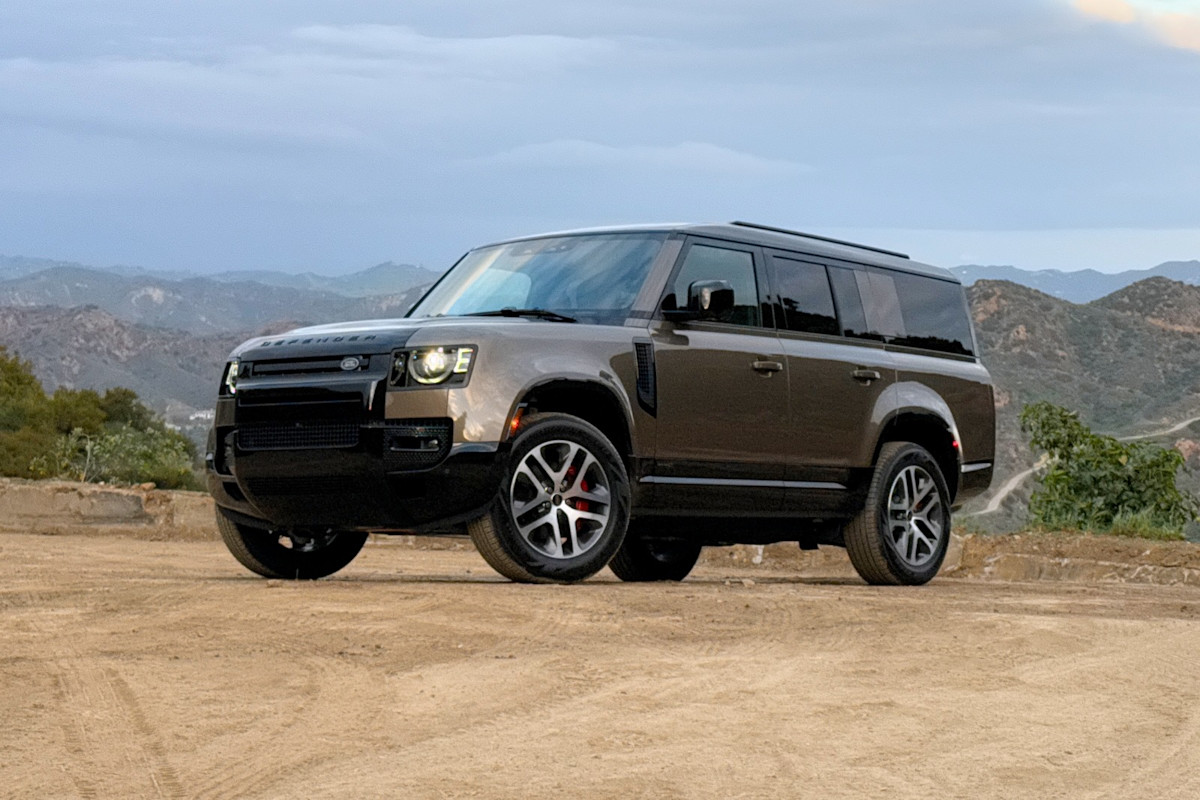
Dressed in Gondwana Stone paint, our test model did not have the new-for-2025 matte paint protection film. This murky brown colour also doesn’t look good with the Defender X’s orange brake calipers, and neither do the delicate-looking twin-spoke, machined-finish 20-inch wheels. We think you should stick with Woolstone Green, Santorini Black, or Borasco Grey, the only other colours available for the Defender X. Oh, and the 22-inch wheels are a must.
Inside, the Defender X gets an upgrade from artificial leather to premium Windsor hides featuring Kvadrat fabric for the sides of the bottom cushions. It comes in Ebony or Caraway (think caramel), or you can select an Ultrafabric upholstery in a Light Cloud colour. In addition, the X comes with illuminated door sill treadplates and metal pedal covers.
No matter which Defender you choose, the interior has an industrial theme. Quality materials are the rule, but the Defender isn’t a luxury SUV in the traditional sense. We liked the cabin for its purposeful rather than frivolous look, though.
Performance
The test vehicle’s turbocharged 3.0-litre six-cylinder engine — one of four powertrain options for the 2025 Defender — is where power, refinement, and efficiency meet to provide robust and smooth acceleration with fuel economy that aligns with admittedly low expectations.
Coupled to a mild-hybrid system, the inline-six makes 395 horsepower and 406 pound-feet of torque. An eight-speed automatic transmission with Sport and manual shift modes connects to a standard all-wheel-drive (AWD) system with a low-range setting for off-roading. The maximum tow rating is 3,720 kilograms (8,200 pounds), and a Defender 130 X with this drivetrain accelerates to 100 km/h in a claimed 6.6 seconds.
An adaptive air suspension is also standard on the Defender X, along with hill descent control and Terrain Response 2 driving modes, including Comfort, Grass/Gravel/Snow, Mud/Ruts, Sand, and Rock Crawl. This model also includes the Off-Road Pack’s electronic active differential and wade-sensing technology. In addition, the standard Advanced Off-Road Pack adds a Configurable setting to the Terrain Response drive modes, and Land Rover’s All-Terrain Progress Control, which is a low-speed cruise control system designed for off-roading.
We’ve taken various Defenders off-roading in the past, and they’re incredibly capable and confidence-inspiring. Generally, their off-road capability exceeds the typical skill level of their drivers, and we’ve tackled trails and terrain we wouldn’t have felt comfortable exploring in most other vehicles.
This time around, mindful of the test vehicle’s 20-inch wheels, insubstantial-looking Pirellis, and the 130’s shallower departure angle due to its big butt, we drove the Defender like so many of its owners do — mostly on pavement in a suburban environment. We did take a short jaunt off-road on trails rutted by travelers who’d driven them after rain turned them to mud, and the Defender 130 unsurprisingly blasted along like those ruts weren’t even there.
No discussion of a Land Rover Defender would be complete without mentioning clearances. With the air suspension, the Defender 130 provides 29 centimetres of ground clearance, a 37.5-degree approach angle, a 27.9-degree breakover angle, and a 28.8-degree departure angle. For comparison, a Defender 110 offers a substantially better 40-degree angle of departure. The Defender 130’s maximum wading depth is 90 centimetres.
The Defender’s six-cylinder engine supplies plenty of power. In city driving, it can occasionally surge the SUV forward unexpectedly, and sometimes the brakes are a challenge to smoothly modulate. However, it rides nicely on its adaptive air suspension, especially with the 20-inch wheels. In addition, the suspension’s ability to soak up ruts and rocks off-road translates to the urban jungle, where the Defender shrugs off bumps, dips, cracks, and potholes while effortlessly absorbing speed bumps and humps.
The downside to the 20s is that nothing about how the Defender 130 drives encourages you to travel a twisty mountain road with enthusiasm. Try it, and a few curves later you’ll think to yourself: “Nah, I don’t need to go fast.”
We tested the 130 in its Comfort driving mode, Medium air suspension height setting, and with the transmission in Normal mode. On a twisty mountain road, we were continually aware of the tester’s 2,578-kilogram (5,685-pound) curb weight. It sloshed around like a swimming pool after an earthquake despite the adaptive air suspension’s efforts to quell body motion.
Furthermore, the fluid but slow steering is of no help in the on-road fun department, and the test vehicle’s Pirellis weren’t up to frolicking. A dip in one part of the road caused the stability control system to activate, which isn’t unheard of but is a relatively rare occurrence in the vehicles we test.
On the highway, the Defender 130 cruises like a Cadillac, but it does suffer wind noise, as you might expect with its boxy shape. Also, we noticed something unusual that we almost never comment upon. The washer jets seem weak for a vehicle equipped with a windshield angled in a way that will accumulate significant bugs, mud, and whatnot.
According to Natural Resources Canada, we should have gotten 13.0 litres per 100 kilometres in combined driving. Our observed fuel economy on our testing loop was an even 14.5 L/100 km.
Form & function
Unless you program the air suspension to automatically lower, getting in and out of a Defender 130 takes some effort, especially if you’re short. However, your reward is three rows of spacious seating on towering thrones of excellence.
In front, our test vehicle provided the driver and passenger with 12-way power-adjustable seats featuring heating and ventilation. The ventilation system is remarkably effective. It’s one of the few we’ve ever had to turn off because it was making us too cold.
You sit tall with outstanding forward visibility, and it’s easy to see the corners of the hood and what’s near the sides of the vehicle. However, the Defender’s square side mirrors seem undersized, so position them properly and pay attention to the blind-spot monitoring system warnings. The view to the rear is not good, though the high-resolution reversing camera and parking sensors help. The test vehicle had Land Rover’s Clearsight digital rearview mirror providing a panoramic view of what was behind the Defender, and a surround-view camera system made it easy to park the SUV in locations we might not have tried otherwise.
A panoramic sunroof bathes the first two rows of seats in natural light, and Land Rover includes a fixed glass panel over the third row. These features, combined with the tall seating and large windows, make the Defender 130 feel open and airy at all times. Storage space is plentiful for the driver and passenger, and the shelf running the width of the dashboard is genuinely useful. As you move further back, the Defender 130 is less accommodating of your passengers’ stuff. Most three-row SUVs do a better job in this regard.
A heated second-row bench seat is standard in the Defender X, but the test vehicle had the new-for-2025 captain’s chairs, which are heated and ventilated, and feature inboard adjustable armrests for added comfort. You can upgrade the standard triple-zone automatic climate control system to a four-zone version as well. Land Rover places the cupholders on the floor near the climate panel, where they’re impossible for children in car seats to use.
The point of the Defender 130 is additional passenger and cargo space, and it excels regarding third-row seat accessibility and comfort in comparison to the Defender 110. The third-row seat is heated, roomy, supportive, and anything but a penalty box — even if you’re an adult.
At the back, the Defender has a side-hinged cargo door that swings from left to right. It is heavy, awkward, and makes loading in certain situations close to impossible. In addition, the load floor is quite high, though a button in the cargo area lets you lower the air suspension to make this easier. The cargo door also has a large storage bin built into it.
Behind the third-row seats, the Defender 130 provides a scant 433 litres of cargo space. But a 40/20/40-split folding third row lets you carry long items and extra passengers at the same time. Fold the third row down, and the cargo room expands to 1,237 litres. Maximum cargo volume, with all rear seats folded, measures 2,520 litres.
Technology
Land Rover equips the 2025 Defender with its Pivi Pro infotainment system, accessible via an 11.4-inch touchscreen mounted on the centre of the dashboard like a tablet. It pairs with a configurable digital driver display and offers expected features like wireless Apple CarPlay, wireless Android Auto, SiriusXM 360L satellite radio, and connected services including remote engine start, emergency collision notification, a stolen vehicle locator, and more.
In the past, Pivi Pro has failed to impress us. From its slow response to inputs to its convoluted user interface, the technology simply hasn’t proven itself competitive. This time around, however, it was terrific.
Response to voice commands remains slower than we prefer, but the system’s accuracy is outstanding. For example, when we told Pivi Pro we needed to go to a hospital, it rapidly listed the eight closest hospitals on the screen, without adding unwanted medical facilities, veterinary hospitals, or cosmetic surgeon offices. Not only that, it passed every one of our standard voice prompt tests with flying colours, except when we told the digital assistant we wanted to listen to reggae music on SiriusXM. It couldn’t help with that one, despite the availability of several such stations with the SXM 360L service.
In addition, the user experience seems more intuitive. Pivi Pro looks the same, but it appears Land Rover has refined the tech so the user travels to fewer dead ends than before. As a result, satisfaction replaces frustration. We also found it almost ridiculously easy to program our favourite radio stations. Too many automakers make this task needlessly complex.
Now, it is always possible that our test vehicle’s Pivi Pro system was having the equivalent of a great hair day. Also, we had just finished testing a 2025 Lincoln Navigator before driving the Defender 130, and the Lincoln has a complicated infotainment and digital instrumentation system, so maybe Pivi Pro’s comparative simplicity made it seem more intuitive. In any case, we don’t have much to complain about, and the Defender’s Meridian premium sound system is also impressive.
In addition to Pivi Pro, the test vehicle had a head-up display, a ClearSight digital rearview mirror, and a surround-view camera system with a 3D view setting. The mirror and surround-view cameras proved exceptionally helpful while living with the Defender, making the poor rearward visibility a non-issue. We also felt more comfortable squeezing the 130 in parking spaces we would not have been comfortable attempting otherwise. Our test vehicle also had the optional Towing Pack, which adds a hands-free trailer reverse-steering system that automatically steers once you pick a given direction.
Safety
Land Rover equips the Defender with several driver aids, and they work in a refined manner with few reasons to complain about them. Highlights include: automatic high beam headlights, forward collision warning, automatic emergency braking, blind spot monitoring, rear cross-traffic alert, lane departure warning, lane keep assist, and adaptive cruise control with stop-and-go functionality. When using adaptive cruise control, a lane-centring assist feature is available.
A button on the steering wheel calls up a Driver Assistance Mode menu. You can choose from High (maximum assistance), Low (minimal assistance), or Custom (tailor settings to your preferences). Deeper adjustments are available through the Driver Assistance menu in the vehicle settings.
As is common with European vehicles, the lane keep assist decisively corrects potential lane departures. Oddly, though, in this test vehicle, that same technology attempted to steer the Defender into a turnout area on a local highway.
When using the adaptive cruise and lane centring assist, the technology operated in a transparent manner. When slower traffic ahead cleared, the Defender quickly responded and accelerated back up to the preferred speed. In a few heavy-traffic situations, the adaptive cruise appeared to struggle a little bit when trying to smoothly maintain a safe following distance, but this was a minor issue.
Crash-test ratings for the Defender were unavailable at press time. Typically, the National Highway Traffic Safety Administration (NHTSA) and the Insurance Institute for Highway Safety (IIHS) do not perform testing on low-volume models like this one.
Cost-effectiveness
You might think a Land Rover Defender is too expensive. However, before jumping to that conclusion, consider what a Ford Bronco, Jeep Wrangler, Toyota 4Runner, and Toyota Land Cruiser will cost. You’ll still pay a premium for the Defender, but it might not be as significant as you think unless you’re getting one of the V8-powered models.
Want an apples-to-apples comparison? Take a look at the Lexus GX. It has a higher base price than the Land Rover Defender 110 and isn’t available in an extended version like the 130, or a two-door configuration like the 90. But Lexus models enjoy a well-earned reputation for long-term reliability that Land Rover lacks, and the GX is known to hold its value well. The Defender does have a more distinctive personality, superior cargo and passenger space, and a broader lineup that buyers can leverage to tailor the vehicle to specific preferences, though.
Over at the Mercedes-Benz dealership, you could get a G-Class, which starts at nearly $190,000. That’s where the new Defender OCTA makes a compelling case for itself. Why roll around Yorkville in the same box on wheels as everyone else, when you could be driving a rarity like the OCTA?
Ultimately, there is value to be had in a 2025 Land Rover Defender. We’re fans of this SUV and have been since it reappeared in North America in 2020. And if you’re worried about dependability, keep in mind that it has a four-year/80,000-kilometre warranty and roadside assistance plan that will summon help and cover unexpected repairs during a typical lease term.
Note: Images show a US model.

What owners say
Trims & specs
Base MSRP $69,700 | Seating 8 |
Engine 3.0L 296 hp I6 | Cargo Capacity 15.3 cu ft |
Combined MPG 18 | Drivetrain AWD |
Base MSRP $77,700 | Seating 8 |
Engine 3.0L 395 hp I6 | Cargo Capacity 15.3 cu ft |
Combined MPG 19 | Drivetrain AWD |
Base MSRP $152,000 | Seating 5 |
Engine 4.4L 626 hp V8 | Cargo Capacity 34.0 cu ft |
Combined MPG 17 | Drivetrain AWD |
Base MSRP $68,100 | Seating 7 |
Engine 3.0L 395 hp I6 | Cargo Capacity 34.0 cu ft |
Combined MPG 19 | Drivetrain AWD |
Base MSRP $118,900 | Seating 8 |
Engine 5.0L 493 hp V8 | Cargo Capacity 15.3 cu ft |
Combined MPG 16 | Drivetrain AWD |
Base MSRP $56,900 | Seating 5 |
Engine 2.0L 296 hp I4 | Cargo Capacity 15.6 cu ft |
Combined MPG 19 | Drivetrain AWD |
Base MSRP $113,500 | Seating 5 |
Engine 5.0L 518 hp V8 | Cargo Capacity 34.0 cu ft |
Combined MPG 16 | Drivetrain AWD |
Base MSRP $83,500 | Seating 5 |
Engine 3.0L 395 hp I6 | Cargo Capacity 34.0 cu ft |
Combined MPG 19 | Drivetrain AWD |
Base MSRP $109,800 | Seating 5 |
Engine 5.0L 518 hp V8 | Cargo Capacity 15.6 cu ft |
Combined MPG 17 | Drivetrain AWD |
Base MSRP $100,900 | Seating 8 |
Engine 3.0L 395 hp I6 | Cargo Capacity 15.3 cu ft |
Combined MPG 19 | Drivetrain AWD |
Base MSRP $60,800 | Seating 7 |
Engine 2.0L 296 hp I4 | Cargo Capacity 34.0 cu ft |
Combined MPG 19 | Drivetrain AWD |
Base MSRP $167,800 | Seating 5 |
Engine 4.4L 626 hp V8 | Cargo Capacity 34.0 cu ft |
Combined MPG 17 | Drivetrain AWD |
Base MSRP $68,500 | Seating 5 |
Engine 3.0L 395 hp I6 | Cargo Capacity 15.6 cu ft |
Combined MPG 19 | Drivetrain AWD |
Base MSRP $85,500 | Seating 5 |
Engine 3.0L 395 hp I6 | Cargo Capacity 43.7 cu ft |
Combined MPG 17 | Drivetrain AWD |
Base MSRP $72,100 | Seating 7 |
Engine 3.0L 395 hp I6 | Cargo Capacity 34.0 cu ft |
Combined MPG 19 | Drivetrain AWD |
Base MSRP $91,800 | Seating 7 |
Engine 3.0L 395 hp I6 | Cargo Capacity 34.0 cu ft |
Combined MPG 19 | Drivetrain AWD |
Base MSRP $81,400 | Seating 8 |
Engine 3.0L 395 hp I6 | Cargo Capacity 15.3 cu ft |
Combined MPG 19 | Drivetrain AWD |
Base MSRP $95,000 | Seating 5 |
Engine 5.0L 493 hp V8 | Cargo Capacity 34.0 cu ft |
Combined MPG 16 | Drivetrain AWD |


Pricing trends
MSRP range
$56,900 - $167,800
Current avg. market price
$85,041
Trending up by 1.4% this month
May 2026 - October 2026