2026 Land Rover Defender Reviews, Pricing & Specs


Pros & cons
What we like
Stylish design
Multiple body styles
Impressive off-road capability
What to consider
Poor fuel economy
Gets expensive quickly
Expert review
The Defender is what a Land Rover should be.
As the rest of the lineup has trended toward luxury, the Land Rover Defender has stayed true to the brand’s roots of tough off-roaders ideal for the military and farmers alike. That’s mainly because Land Rover put off updates for decades. But a redesigned Defender that’s more passenger car than farm implement arrived for 2020, bringing the nameplate back to North America. Changes for 2026 include subtle styling updates, a larger touchscreen, and new colour and accessory options.
Verdict: The Defender offers an unmatched combination of off-road capability and everyday civility.
out of 10 expert review
Look & feel
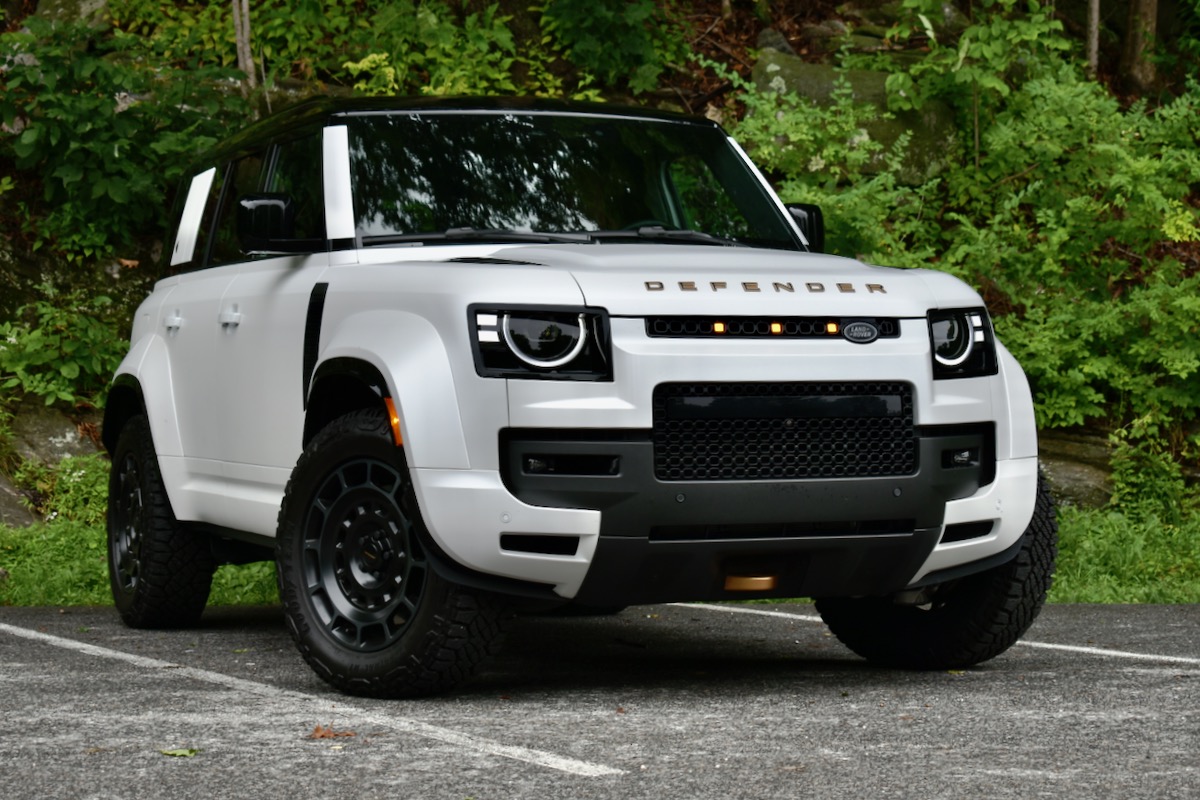
The Defender embodies the ruggedness of its predecessors without being retro. The boxy shape, squared-off wheel arches, and flat hood bring to mind Land Rovers of the past, but the curved edges and minimalist lighting give it a modern touch. Land Rover made some changes for 2026 including a new headlight design and revised front and rear bumpers, but they don’t make much of an impression. That’s OK, though, because the Defender still looks impressively fresh for a six-year-old design.
Like the original Defender, buyers can get two-door 90 and four-door 110 versions, although the numbers no longer correspond to wheelbase length as they did on the old-school models. There’s also a stretched Defender 130 body style, and the 110-derived Octa high-performance model has massive fender flares that make room for enormous all-terrain tires. The latter also has optional “chopped” carbon fibre exterior trim with a marbled appearance instead of the neat cross hatching of regular carbon.
Those who want a more traditional look can equip a Defender with a white contrasting roof, white-painted 20-inch wheels meant to look like the steel wheels on older models (19-inch wheels are standard and various other 20-inch and 22-inch wheel designs are available), or exterior storage boxes and roof racks. The Trophy Edition takes things even further with Sandglow Yellow paint that recalls the Camel Trophy (a famously grueling off-road event). The Defender X adds more black trim including a blackout treatment for the front fascia and hood that looks like an oversized racing stripe.
The interior is an excellent blend of rugged style and upscale quality. From the concave dashboard with embossed “Defender” lettering to the purposely exposed hardware on the doors, the design is distinctive while helping to sell the Defender as an off-road adventure vehicle. It may not be as posh as a fully optioned Range Rover cabin, but drivers don’t have to be as precious with it, either. And while there are screens, this is one of the few new-car cabins that isn’t designed around them, keeping distractions to a minimum.
Windsor leather or textile upholstery options are available along with a massive glass roof that is thankfully equipped with a power sunshade. Fit and finish and material quality are also excellent, justifying the Defender’s premium pricing compared to similar off-roaders such as the Ford Bronco, Jeep Wrangler, and Toyota Land Cruiser.
Performance
Land Rover offers several powertrain options for the 2026 Defender, but that’s about to change. The base turbocharged 2.0-litre four-cylinder engine and the supercharged 5.0-litre V8 are slated for the axe in 2027. The inline-four is good for 296 horsepower and 295 pound-feet of torque, while the V8 produces 518 hp and 461 lb-ft of torque. All Defender models have an eight-speed automatic transmission and standard four-wheel drive (4WD).
The most widely available powertrain is a turbocharged 3.0-litre inline-six that produces 395 hp and 406 lb-ft of torque. It’s teamed with a 48-volt mild hybrid system that provides more robust engine start/stop operation to help improve fuel economy. Land Rover’s spec sheet says it should get a Defender from 0 to 100 km/h in exactly or just over six seconds, depending on the body style. The top speed of six-cylinder models is 191 km/h.
Naturally for Land Rover, off-road capability is standard. The standard coil-spring suspension affords 22.6 cm of ground clearance, rising to 29.2 cm with the optional air suspension and 32.3 cm for the Defender Octa. Land Rover’s Terrain Response 2 system groups settings into easy-to-understand drive modes to take the guesswork out of off-roading. For 2026, the All Terrain Progress Control system evolves into Adaptive Off-Road Cruise Control, allowing the driver to set a certain speed much like cruise control used on highways.
For this test drive, though, we grabbed the key fob to a Defender Octa, the high-performance version of the Defender 110 introduced for the 2025 model year. The Octa is powered by a twin-turbo 4.4-litre V8 sourced from BMW that produces 626 horsepower and 553 pound-feet of torque. That gets it from 0 to 100 km/h in 4.0 seconds and on to a top speed of 250 km/h on the standard 22-inch wheels and all-season tires, according to Land Rover. Optional 33-inch all-terrain tires on 20-inch wheels enhance off-road capability. Ride height and track width are wider, and the Octa swaps out the standard suspension for the 6D Dynamics system from the Range Rover Sport SV.
This complex suspension system — which adds hydraulic interlinked dampers with air springs — actively counteracts body roll, achieving the wheel articulation and travel needed for high-speed running on rough terrain along with the compliance and mechanical grip that come into play on pavement. So, while it was designed for off-roading, the Octa was surprisingly fun on ordinary roads, and we could toss it into corners like an oversized sports car without the chassis getting out of sorts.
A major advantage of the Defender over other hardcore off-roaders is refinement. Aside from the expected high level of noise from our test car’s all-terrain tires, the interior was as quiet as those of less rugged luxury crossovers. The optional air suspension provides an equivalent level of ride smoothness, and the extra compliance afforded by the Octa’s lack of anti-roll bars enhanced that further. The only blemish was what seemed like an artificial engine soundtrack that started out as a natural V8 rumble but transitioned to what sounded like a tinny recording of a V6 at higher rpm.
Form & function
Depending on the body style, a Defender can seat five (90), seven (110), or eight (130). The two-door 90 is obviously the least practical, but it still has decent rear seat space. The back seats are just harder to access than in the four-door models, and carving out enough legroom to make them habitable eats into cargo space.
Available in both two-row and three-row configurations, the Defender 110 has interior space closer to current midsize SUVs. The 963 litres of cargo space behind the second row and 2,231 litres behind the first row in two-row models are both more than in a BMW X5, for example. Entry and exit are more of a process than less-rugged crossovers, though. The driver and front passengers do get grab handles cleverly integrated with the dashboard, and the air suspension has a lower access height.
The Defender 130 is only available with three rows of seats in either seven-seat or eight-seat configurations. It’s also 35.8 centimetres longer than the 110 but rides on the same 3,022-millimetre wheelbase. The extra length is all in the back, negatively affecting the 130’s departure angle when off-roading but providing more cargo space with a full complement of passengers. The 433 litres of cargo space in a seven-seat 130 — without folding any seats—is 130 litres more than in a seven-seat 110.
The rear seats lack some of the amenities of current luxury crossovers. Up front, though, the driver and front passenger get plenty of storage space including small channels in the dashboard perfect for holding loose change. We also appreciate Land Rover’s continued use of analog controls. Several knobs and buttons are grouped with the shifter in a compact and easy-to-reach pod jutting out of the dashboard.
Certain Defender models also have an 3,720-kilogram (8,200-pound) towing capacity, rivalling that of full-size SUVs such as the Cadillac Escalade.
Technology
For 2026, the Defender receives a larger 13.1-inch touchscreen that slots into the same place on the dashboard as the previous 11.4-inch screen and continues to integrate wireless Apple CarPlay and Android Auto. A 12.3-inch digital instrument cluster is also standard on most trim levels. The three-pane touchscreen main menu remains one of the most stylish of its kind thanks to a well-chosen typeface and a muted colour palette. It’s as easy to use as it is appealing to look at, although it sometimes takes a while to boot after starting the car and requires fairly deliberate finger pokes. The digital instrument cluster also impresses with its crisply rendered graphics and sensible layout.
Land Rover offers multiple Meridian-branded audio systems, from a 10-speaker version on lower trim levels to the 14-speaker, 700-watt system in our Defender Octa test car. Audio quality was reasonable considering that some competitors offer way more speakers and power. What really set the experience apart were Land Rover’s “Body and Soul” front seats, which vibrate in time with the music. It’s a silly feature, but it’s also kind of fun.
The array of available cameras is more useful. It includes one that offers a low-angle front view that will definitely come in handy when off-roading or negotiating a tight parking lot.
Safety
When it comes to standard driver-assistance tech, Land Rover covers the bases. Expected features such as adaptive cruise control, lane keep assist, blind spot monitoring, rear cross-traffic alert, forward collision warning, and automatic emergency braking are all standard, along with a surround-view camera system. A driver attention monitor is new for 2026, giving the Defender a feature that’s been available on certain non-luxury vehicles for some time.
The Insurance Institute for Highway Safety (IIHS) and U.S. National Highway Traffic Safety Administration (NHTSA) hadn’t released safety ratings for the current-generation Defender at the time of writing.
Cost-effectiveness
Even with the mild-hybrid turbo-four and turbo-six powertrains, the Defender isn’t very efficient. The Defender 110 is rated by Natural Resources Canada at 12.0 litres per 100 kilometres combined (13.1 city, 10.6 highway) with the four-cylinder and just a tick higher with the six, while the two-door Defender 90 is actually a little less fuel efficient with the smaller engine.
Models with the supercharged 5.0-litre V8 are rated at 14.2 to 14.9 L/100 km combined, which doesn’t seem like much of a penalty compared to the underperforming inline-four and inline-six. With its BMW-sourced, twin-turbo 4.4-litre V8, our Defender Octa test car was rated at 14.2 L/100 km combined (15.8 city, 12.1 highway). In mixed driving conditions, we came reasonably close to that with an indicated 14.4 L/100 km average.
Canadian pricing ranges from just over $80,000 for a base Defender 90 S to around $183,000 for an Octa. These figures include the $3,500 destination charge but exclude other fees and the federal luxury tax, which applies to the portion of the purchase price above $100,000. The number of available powertrain, body style, and trim options mean buyers should be able to calibrate a Defender to pretty much any price point in between. But this SUV always errs on the side of ruggedness regardless of trim level. For sheer luxury, a Range Rover or Range Rover Sport is the way to go.
Considering how expensive a Ford Bronco or Jeep Wrangler can get with a few options, a base Defender is a comparatively pretty good value and much more pleasant to drive thanks in part to a fixed roof. And while the Toyota Land Cruiser offers that as well, its interior feels cheap compared to the Land Rover. The Ineos Grenadier was inspired by the original Defender, but as a result it may be too old school for the average buyer. Its base price is also about $20,000 higher than the Defender.
For close to half the price of a Defender Octa, shoppers could have a Ford Bronco Raptor that’s also built for high-speed off-roading and doesn’t trigger nearly as much luxury tax. Its interior and road manners are definitely a step down, but if buyers just want an off-road toy, it’s a much better value. The Mercedes-Benz G-Class offers a luxurious interior, an all-electric option, and its own high-performance variant, but even the least expensive version costs about as much as a Defender Octa. In other words, Land Rover has done a good job of carving out a niche for the Defender. There are many SUVs out there, but nothing else is quite like it.

What owners say
Trims & specs
Base MSRP $87,400 | Seating 5 |
Engine 3.0L 395 hp I6 | Cargo Capacity 34.0 cu ft |
Combined MPG 17 | Drivetrain AWD |
Base MSRP $86,700 | Seating 5 |
Engine 3.0L 395 hp I6 | Cargo Capacity 43.7 cu ft |
Combined MPG 18 | Drivetrain AWD |
Base MSRP $168,700 | Seating 5 |
Engine 4.4L 626 hp V8 | Cargo Capacity 34.0 cu ft |
Combined MPG 17 | Drivetrain AWD |
Base MSRP $63,500 | Seating 7 |
Engine 2.0L 296 hp I4 | Cargo Capacity 34.0 cu ft |
Combined MPG 20 | Drivetrain AWD |
Base MSRP $99,100 | Seating 5 |
Engine 5.0L 493 hp V8 | Cargo Capacity 34.0 cu ft |
Combined MPG 16 | Drivetrain AWD |
Base MSRP $75,200 | Seating 7 |
Engine 3.0L 395 hp I6 | Cargo Capacity 34.0 cu ft |
Combined MPG 20 | Drivetrain AWD |
Base MSRP N/A | Seating N/A |
Engine N/A | Cargo Capacity N/A |
Combined MPG N/A | Drivetrain N/A |
Base MSRP N/A | Seating N/A |
Engine N/A | Cargo Capacity N/A |
Combined MPG N/A | Drivetrain N/A |
Base MSRP $118,300 | Seating 5 |
Engine 5.0L 518 hp V8 | Cargo Capacity 34.0 cu ft |
Combined MPG 16 | Drivetrain AWD |
Base MSRP $114,400 | Seating 5 |
Engine 5.0L 518 hp V8 | Cargo Capacity 15.6 cu ft |
Combined MPG 17 | Drivetrain AWD |
Base MSRP $123,900 | Seating 8 |
Engine 5.0L 493 hp V8 | Cargo Capacity 15.3 cu ft |
Combined MPG 16 | Drivetrain AWD |
Base MSRP $73,000 | Seating 8 |
Engine 3.0L 296 hp I6 | Cargo Capacity 15.3 cu ft |
Combined MPG 19 | Drivetrain AWD |
Base MSRP N/A | Seating N/A |
Engine N/A | Cargo Capacity N/A |
Combined MPG N/A | Drivetrain N/A |
Base MSRP $84,400 | Seating 8 |
Engine 3.0L 395 hp I6 | Cargo Capacity 15.3 cu ft |
Combined MPG 18 | Drivetrain AWD |
Base MSRP $87,400 | Seating 5 |
Engine 3.0L 395 hp I6 | Cargo Capacity 34.0 cu ft |
Combined MPG 17 | Drivetrain AWD |
Base MSRP $158,300 | Seating 5 |
Engine 4.4L 626 hp V8 | Cargo Capacity 34.0 cu ft |
Combined MPG 17 | Drivetrain AWD |
Base MSRP $95,600 | Seating 7 |
Engine 3.0L 395 hp I6 | Cargo Capacity 34.0 cu ft |
Combined MPG 20 | Drivetrain AWD |
Base MSRP $105,000 | Seating 8 |
Engine 3.0L 395 hp I6 | Cargo Capacity 15.3 cu ft |
Combined MPG 18 | Drivetrain AWD |
Base MSRP $68,500 | Seating 5 |
Engine 3.0L 395 hp I6 | Cargo Capacity 15.6 cu ft |
Combined MPG 20 | Drivetrain AWD |


Pricing trends
MSRP range
$63,500 - $168,700
Current avg. market price
$90,640
Trending down by 3.2% this month
May 2026 - October 2026

