2021 Toyota Sienna Reviews, Pricing & Specs



Expert review
Toyota’s minivan, the 2021 Sienna, gets new style, and a hybrid powertrain—finally.
Toyota’s minivan got a major makeover for 2021, now entering its fourth generation of production since debuting as a 1997 model. For the first time, the Sienna gets a hybrid gasoline-electric powertrain, and not only that—it’s standard equipment. The Sienna Hybrid is built on the Toyota New Global Architecture (TNGA-K) platform, shared with the Highlander and other current Toyota models.
out of 10 expert review
Look & feel
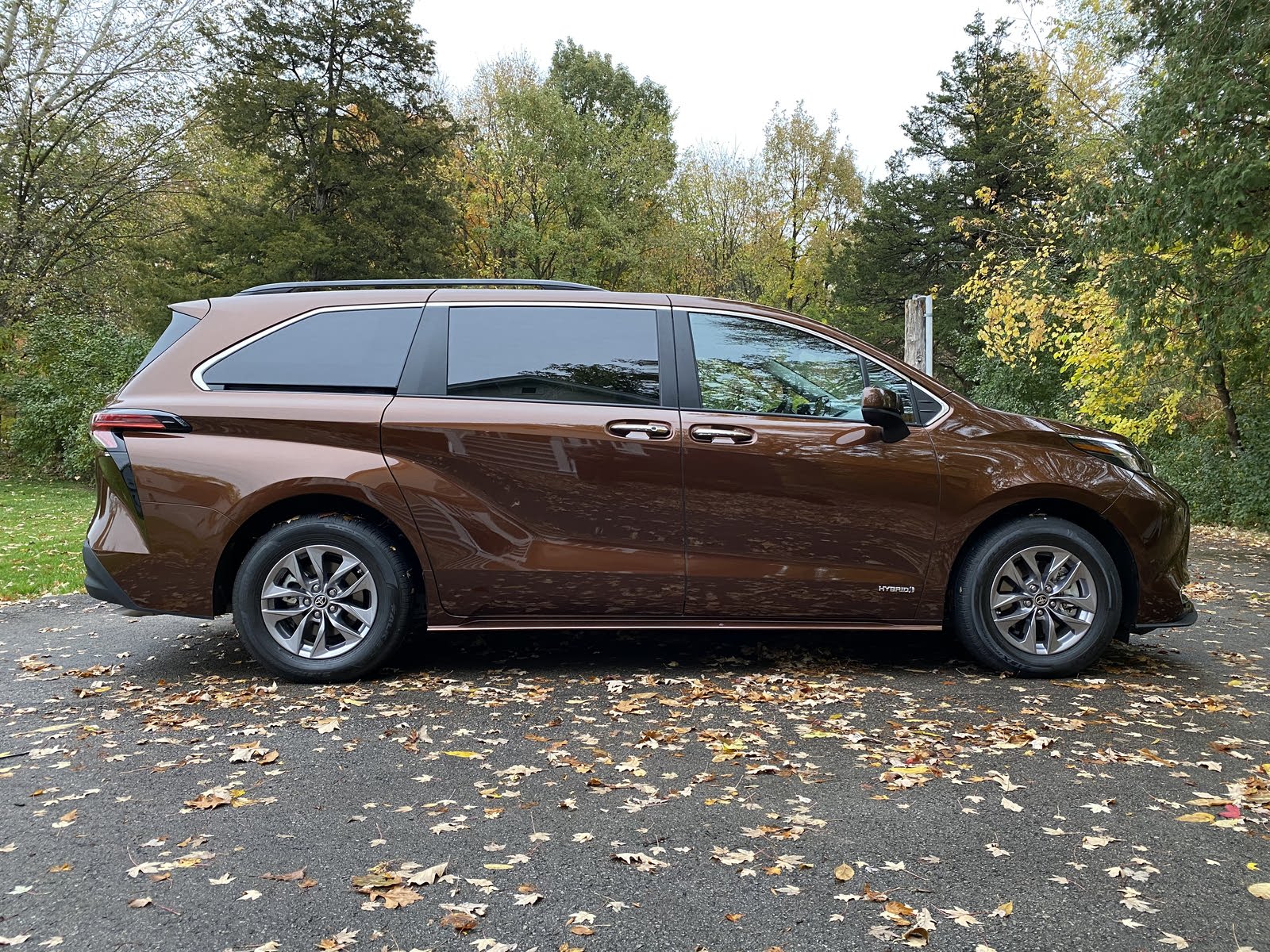
Outside of John Travolta’s praise of the Oldsmobile Silhouette in 1995’s Get Shorty, minivans have never been fashion icons. Toyota’s designers have done their best to change that with the new Sienna Hybrid, within the confines of the genre. At first glance, the Sienna manages to present with more SUV-like styling. A wide grille helps emphasize the minivan’s width, and LED headlamp arrays give a sleek look, horizontally arranged and integrated into a panel that also houses a proud Toyota logo. From the side, the Sienna actually manages to have an assertive stance. Many engineering resources have been expended on reworking the sliding side doors, which have a nicely sculpted redesign with a body line that swoops up from the rocker panels to bulge over the rear wheels. This change from slab-sided flat doors required rethinking the hinges and slides to tuck the door in, and it’s a great look. Alloy wheel sizes from 17-inch (LE and XLE), 18-inch (XSE AWD and Limited), and 20-inch (XSE FWD) fill the arches, and look great in bright, metallic and dark finishes, depending on grade. From the rear, the Sienna has a big rear window but still manages to look wide and low (for a minivan). Fit and finish on the exterior is Toyota quality—which is to say, superb.
Inside, there’s a similar emphasis on width with horizontal lines. While not quite managing the SUV feel, the Sienna doesn’t feel like a school bus, either. The seating position is higher than a sedan’s, not quite the command seating of a full-size SUV, but pleasant for a comfortable ride. The dashboard is simple and uncluttered, with most of the controls clustered on the upper part of the centre stack, just below the infotainment screen. The centre console houses the gear selector lever with a few controls below, a pair of open cupholders, another pair of cupholders covered by a hinged lid, and a big storage compartment beneath the centre armrest. The console forms a bridge between the dash and the storage compartment, leaving a tray below, big enough for a handbag—a very smart touch. The leather-wrapped steering wheel is nice and beefy, and the materials and surfaces throughout have a good feel.
The second and third row seats are both comfortable for adults, and the second row seats (either a pair of captain’s chairs in seven-passenger versions or a bench seat in eight-passenger) slide fore and aft to configure the space for maximum utility and comfort.

Performance
Even though Toyota has long been a leader in hybrid vehicles, the 2021 Sienna Hybrid is the company’s first hybrid minivan. The long wait has been agonizing, but the good news is the engine, motor, and battery combination in the Sienna is a proven one, very similar to the setup available in the current Highlander Hybrid. A 2.5-litre four-cylinder engine and two electric motors combine to produce 243 horsepower. Front-wheel drive (FWD) is standard, and an all-wheel drive (AWD) drivetrain is available on all trim levels. AWD is accomplished by a separate electric motor driving the rear wheels with 54 hp and 89 lb-ft of torque, which eliminates much mechanical complication.
The Sienna uses an electronically controlled continuously variable automatic transmission (CVT), as opposed to a conventional stepped gear automatic transmission. CVTs have their fans, as they can deliver power smoothly and efficiently, and help maximize fuel efficiency. In the Sienna Hybrid, the CVT is a little disappointing, as it tends to blunt throttle response, droning up to speed rather than leaping. But that’s the tradeoff of a hybrid and a minivan—a little less fun behind the wheel. Many drivers will never miss the lack of punch. Four selectable drive modes (Normal, EV, Eco, and Sport) can be punched up with a centre console toggle; “Sport” being a euphemism for “somewhat livelier.”
Handling has been improved significantly over the outgoing Sienna, thanks to new TNGA front suspension and steering and independent rear trailing arm suspension. Body roll is minimal, and the Sienna Hybrid eats up the miles with comfort and ease.
Which brings us to the big news for the Sienna Hybrid: Natural Resources Canada fuel efficiency numbers. FWD Sienna Hybrid models are predicted to use 6.6 litres per 100 kilometres in city driving, 6.5 on the highway, and 6.5 combined, while AWD models are rated at 6.8 city, 6.6 hwy, 6.7 combined.

Form & function
Perhaps more than any other class of vehicle, minivans are judged heavily on their convenience functions. A minivan has to cater to its driver, sure, but it also has to provide a high level of function to its front-seat passenger, second-row passengers, and even to the peanut gallery in the third row. The third row, by the way, is standard on all grades. It’s a 60/40-split bench that stores away into the floor easily. The second row slides up to 63.5 centimetres (25 inches), which creates flexible legroom and makes it super easy to get into the third row when necessary. Each row has storage cubby space and cupholders, and all four side doors have bottle holders. All told, the cabin has 16 cupholders (15 with the spare tire included on the base grade).
Another minivan function is cargo handling. The Sienna is ready to be the family workhorse, actually capable of carrying a full four-by-eight sheet of plywood inside with the tailgate completely closed. Because of the capability of the second row, there’s plenty of flexibility for loading luggage and freight, either behind the second row through the tailgate, or in front of the second row, through the side doors. Nominal cargo measurements are 949 litres behind the third row; 2,129 litres behind the second row; and 2,860 litres behind the first row. With that sliding second row, though, those measurements can be juggled to fit cargo. If you have to tow, Sienna can handle towing up to 1,587 kilograms (3,500 pounds). As a hybrid, the Sienna must carry a big battery, which could have eaten up cargo space. Its 288-volt Nickel Metal Hydride (Ni-MH) battery pack is cleverly tucked in under the front seats in a single stack design, and it doesn’t impact cargo space at all. It comes with a 10-year/240,000 kilometre warranty, so it should be conveniently tucked away for the majority of most families’ ownership.
Both side sliding doors and the rear liftgate are power-operated and respond to kick motions to open and close—a family-friendly feature that will be greatly appreciated by parents of small kids.

Technology
Beyond the technology in its hybrid powertrain, the Sienna packs in a ton of standard and available technology features. A nine-inch touchscreen is standard in all grades, giving access to standard Apple CarPlay and Android Auto compatibility, available SiriusXM (with a three-month trial), one USB media port, and six more USB ports throughout the cabin.
In terms of standard connectivity, the Sienna comes with a year’s trial of Safety Connect and Remote Connect (on Toyota Sienna XLE and above), plus Service Connect. Bluetooth hands-free and audio streaming is included on all trim levels. Qi-compatible charging is part of the XSE’s Technology Package and is standard on Toyota Sienna Limited models, as is a 1500-watt inverter with a 120-volt AC outlet to power and charge devices (or a coffee maker).
Audio and multimedia systems march upwards with trim levels, from a six-speaker stereo on LE up to a Premium Audio + JBL package on Limited (available on XSE) with 12 speakers, Dynamic Navigation, and surround sound. A rear-seat entertainment system is available on XSE and standard on Limited, with a ceiling-mounted wide-screen 11.6-inch 1080p display that folds down for viewing. The system includes a remote and two wireless headphones and accepts an HDMI input on the back of the centre console.
The driver is treated to several tech features. A colour multi-information display in the centre of the instrument panel (4.2-inch on LE, XLE, and XSE; 7-inch on Limited) features the odometer, fuel efficiency, trip information, and alert messages. XSE Technology and Limited models include a digital rearview mirror, a feature that swaps out the actual reflected view in the mirror with the rear video camera feed. This can be a great feature when carrying a full load of passengers, or when passengers are using the rear-seat entertainment system, which can block the view of a conventional mirror. Remote keyless entry is standard with push-button start, upgraded to Smart Key System on XLE and above.

Safety
The Sienna Hybrid comes with Toyota Safety Sense 2.0, which includes a suite of safety features such as full-speed range dynamic radar adaptive cruise control, lane-tracing assist, pre-collision system with bicyclist and pedestrian detection, lane-departure alert, and automatic high beams. This suite of driver assistance systems is standard on all trim levels, as is the Star Safety System (enhanced vehicle stability control, traction control, anti-lock brakes, electronic brake-force distribution, brake assist, and smart stop technology) and blind spot monitoring. The Sienna gets fitted with 10 airbags and has LATCH (Lower Anchors and Tethers for Children) connectors—five locations for eight-passenger vans, four locations for seven-passenger models with second-row captain's chairs.
A tire pressure monitoring system (TPMS) is also standard across the board. An inflator kit is standard on all models. Buyers can still find a spare tire in the LE grade. The spare tire location (in the wall of the cargo space) has been changed for safety and convenience—it used to be mounted underneath the vehicle, which was not ideal for roadside tire changes.
The 2020 Sienna received a “Top Safety Pick+” rating from the Insurance Institute for Highway Safety (IIHS), receiving “Good” ratings across the board. It also receives a Five-Star Overall Rating from NHTSA, though it gets four stars for overall front and rollover resistance.

Cost-effectiveness
The 2021 Toyota Sienna Hybrid is available in four trim levels in Canada at launch, each with standard FWD or available AWD. Pricing starts at an MSRP of $39,990 for the Sienna LE FWD/$41,990 for LE AWD; $42,990 for XLE FWD/$45,390 for XLE AWD; $45,690 for XSE FWD/$47,690 for XSE AWD; $56,190 for Limited FWD/$58,190 for Limited AWD. (The Platinum grade has not yet been launched in Canada.) All prices exclude the $1,860 destination charge. The Technology package available on XSE models brings the prices to $51,190/$53,190. By comparison, the model year 2020 Toyota Sienna started at $35,750, but that was for the budget CE grade that didn’t carry over into the new generation.
The only other current direct competitor for the Sienna Hybrid is the 2021 Chrysler Pacifica Hybrid, which is a plug-in hybrid and starts at $57,090. The remainder of the field of minivans is gas-powered, no hybrid options available, including the Honda Odyssey (starting at $43,605); Kia Carnival (starting at $34,795); Chrysler Grand Caravan (starting at $40,685); and the gas-only Chrysler Pacifica (starting at $47,860).
The Sienna Hybrid carries Toyota’s 36-month/60,000-kilometre basic new vehicle warranty, 60-month/100,000-kilometre powertrain warranty, and 96-month/160,000-kilometre hybrid-related component warranty.
If you’re at a life stage where a minivan is a smart choice, you should definitely consider the 2021 Toyota Sienna Hybrid when you’re shopping. It’s not an SUV; it’s not a station wagon; it’s one of the best minivans Toyota has built so far. And that’s saying something.


What owners say
"Overall, drivers love the 2021 Toyota Sienna for its roomy interior, excellent gas mileage, and smooth handling. Many find the AWD and hybrid combination satisfying for their needs, especially for road trips. However, some drivers have concerns about the acceleration and the quality of the interior materials. There are also mentions of missing features like a spare tire and lacking tech options for connectivity."
Good cars and valuable for big family easy access
January 25, 2023Excellent gas mileage, very roomy, and stylish interior.
October 12, 2021HUD, Gas mileage, Radar cruise with lane trace assist etc. makes it a great vehicle for long road trips. Wish the BSM indicators appear on the HUD and have more options displayed on the HUD as well. Also the Android Auto\Apple Car Play navigation is not projected into HUD. Wish that was included as well.
May 11, 2021What owners say
Good cars and valuable for big family easy access
January 25, 2023Excellent gas mileage, very roomy, and stylish interior.
October 12, 2021HUD, Gas mileage, Radar cruise with lane trace assist etc. makes it a great vehicle for long road trips. Wish the BSM indicators appear on the HUD and have more options displayed on the HUD as well. Also the Android Auto\Apple Car Play navigation is not projected into HUD. Wish that was included as well.
May 11, 2021I love to drive. This car floats! It turns on a dime and has some power. All the room you’ll ever need, kids not required! This car is the only car I will ever buy again!
December 28, 2023Car satisfies all my needs handsomely. AWD & hybrid perfect combination. I’ve seen no other that can compare.
March 4, 2021Great MPGs, comfortable ride, great everyday and long distance ride.
November 8, 2023Love it. 4cyl is actually pretty peppy. Able to overtake with confidence. XSE handles like a sports car. Tech is a little lacking at this price but is typical for Toyota. Kinda disappointed that CarPlay isn’t wireless. Kinda negates the Qi charger.
August 7, 2021Not enough acceleration, less horsepower. Dont like rearview and cheap interior.
March 2, 2021I like the van the reason I gave 4 star is that the van is missing spare tire for family van I had bad experiences without spare tire when I get flat tire in middle high way at night time and got stuck so if buying the van I would recommend with spare tire imagine with your family and kids in the van on road trip and get flat tire at night time..
December 6, 2022Trims & specs
Base MSRP $50,460 | Seating 7 |
Engine 2.5L 245 hp I4 Hybrid | Cargo Capacity 33.5 cu ft |
Combined MPG 35 | Drivetrain AWD |
Base MSRP $48,500 | Seating 7 |
Engine 2.5L 245 hp I4 Hybrid | Cargo Capacity 33.5 cu ft |
Combined MPG 35 | Drivetrain AWD |
Base MSRP $39,750 | Seating 7 |
Engine 2.5L 245 hp I4 Hybrid | Cargo Capacity 33.5 cu ft |
Combined MPG 36 | Drivetrain FWD |
Base MSRP $46,700 | Seating 7 |
Engine 2.5L 245 hp I4 Hybrid | Cargo Capacity 33.5 cu ft |
Combined MPG 36 | Drivetrain FWD |
Base MSRP $36,460 | Seating 8 |
Engine 2.5L 245 hp I4 Hybrid | Cargo Capacity 33.5 cu ft |
Combined MPG 35 | Drivetrain AWD |
Base MSRP $34,460 | Seating 8 |
Engine 2.5L 245 hp I4 Hybrid | Cargo Capacity 33.5 cu ft |
Combined MPG 36 | Drivetrain FWD |
Base MSRP $42,000 | Seating 7 |
Engine 2.5L 245 hp I4 Hybrid | Cargo Capacity 33.5 cu ft |
Combined MPG 36 | Drivetrain FWD |
Base MSRP $42,760 | Seating 7 |
Engine 2.5L 245 hp I4 Hybrid | Cargo Capacity 33.5 cu ft |
Combined MPG 35 | Drivetrain AWD |
Base MSRP $39,750 | Seating 8 |
Engine 2.5L 245 hp I4 Hybrid | Cargo Capacity 33.5 cu ft |
Combined MPG 36 | Drivetrain FWD |
Base MSRP $49,900 | Seating 7 |
Engine 2.5L 245 hp I4 Hybrid | Cargo Capacity 33.5 cu ft |
Combined MPG 36 | Drivetrain FWD |
Base MSRP $41,750 | Seating 7 |
Engine 2.5L 245 hp I4 Hybrid | Cargo Capacity 33.5 cu ft |
Combined MPG 35 | Drivetrain AWD |


Pricing trends
MSRP range
$34,460 - $50,460
Current avg. market price
$41,340
Trending up by 0.5% this month
May 2026 - October 2026

