2026 Toyota Sienna Reviews, Pricing & Specs


Pros & cons
What we like
Fuel efficient
Comfortable seats
Easy-to-use technology
What to consider
Boring to drive
Interior materials feel cheap
Unimpressive safety ratings
The CarGurus verdict
Minivans like the 2026 Toyota Sienna are great family vehicles.
With power sliding side doors, three rows of comfortable seats, and plenty of expandable cargo room, the 2026 Sienna checks off the minivan must-haves — even though its maximum cargo room pales in comparison to other minivans. It offers standard hybrid power, too, accompanied by the best-in-class fuel economy for a minivan. There's even an available all-wheel-drive (AWD) system that adds extra traction in the winter.
Verdict: The 2026 Toyota Sienna’s safety ratings are a concern, but rivals don’t offer significantly better overall performance in this area. So, if shoppers want a fuel-efficient minivan equipped with AWD, here it is.
out of 10 expert review
Look & feel
In Canada, Toyota sells the 2026 Sienna in LE, XLE, XSE (with available XSE Technology Package), and Limited (with available Platinum Package). Prices span from $52,350 to $74,148, including the destination charge of $1,930. (Note the U.S.-specification test vehicle is in Woodland Edition trim, which is not offered in Canada.)
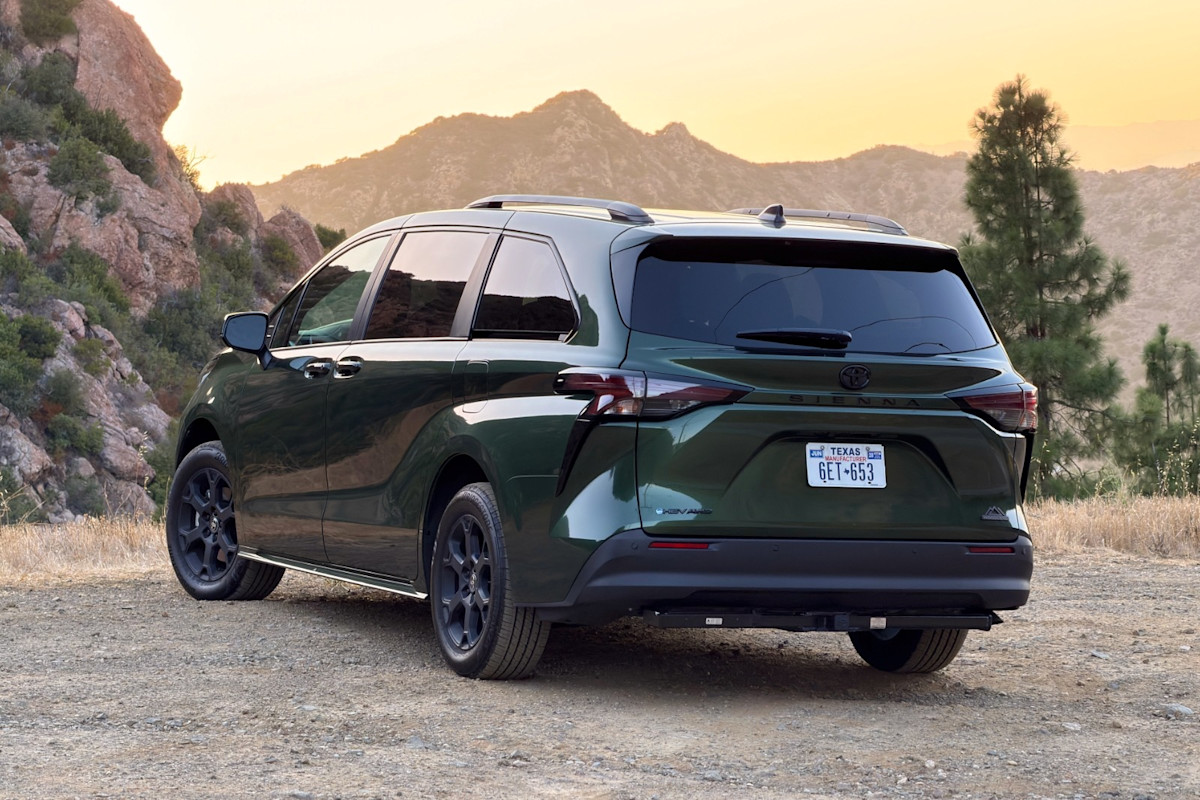
Apart from red and blue, the rest of the paint colours available for the Sienna in Canada are white, black, or shades of grey. Interiors offer more interest with Macadamia and Grey upholstery available in addition to the typical black finish.
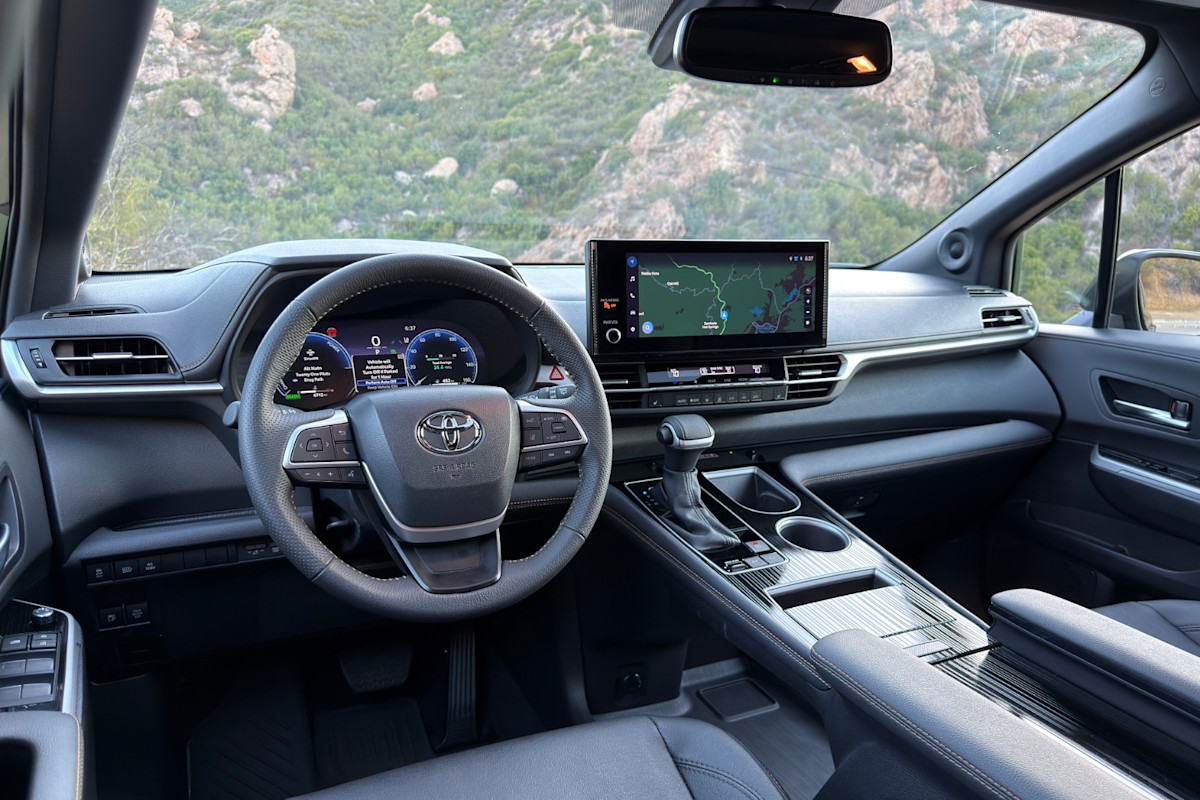
There’s a notable amount of cheap plastic in this thing. Toyota really needs to step up its interior game for the Sienna. The shifter — a touchpoint an owner experiences with every single drive — has a junky sound and feel. The glove compartment door sounds and feels just as flimsy. Many storage areas are unlined, contributing to unwanted noise when items are placed there.
One good thing about the Sienna is that it doesn’t look or feel like a minivan from behind the wheel. Drivers can’t see the hood, of course, but the wide and low dashboard, combined with the wide centre console, is more like a crossover SUV.
Performance
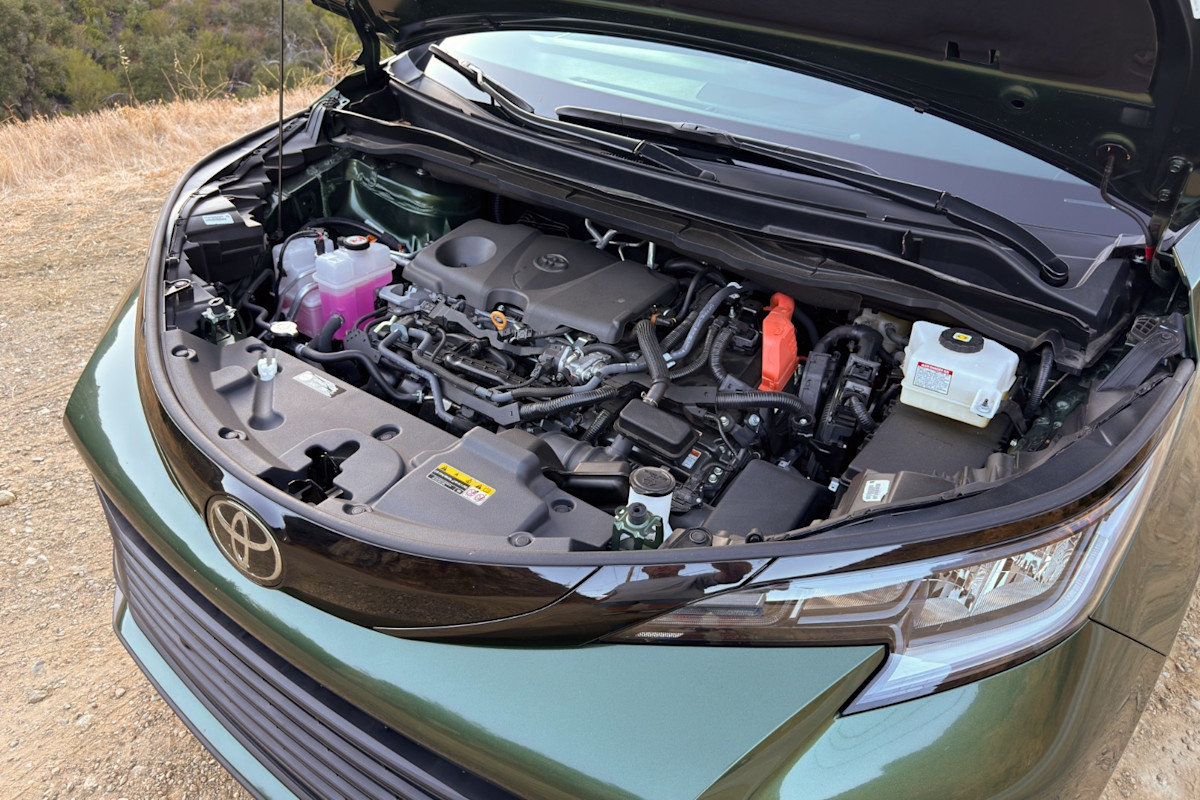
Every Sienna is a hybrid with a 2.5-litre four-cylinder gas engine, a nickel-metal hydride battery pack, and an electric motor that can power the vehicle at low speeds for short distances when drivers prod the EV Mode button. (Other modes are Eco, Normal, and Sport.) An e-AWD system, which adds an electric motor for the rear axle, is available on the LE and XSE trims and standard on the Limited trim in Canada.
The powertrain provides 245 horsepower, which isn’t much in a vehicle weighing up to 2,185 kilograms (4,817 pounds) that seats seven or eight people and tows up to 1,587 kilograms (3,500 pounds). The instant torque from the electric motor(s) makes the Sienna agreeable to drive in urban and suburban settings, but there simply isn’t much in reserve for passing on highways or climbing mountain grades.
According to Natural Resources Canada, an AWD Sienna should consume 6.8 litres per 100 kilometres combined. Testing day was extremely hot and humid, putting the van’s available four-zone automatic climate control system into overdrive. That undoubtedly contributed to a result of 7.6 L/100 km on our fuel-efficiency driving loop and 8.8 L/100 km on the mountainous evaluation route. Had we switched from Normal to Eco mode, that may have helped a little. Driving the Sienna is boring, even for a minivan. A Honda Odyssey at least feels lively and playful. By comparison, the Sienna is soft, numb, and uncommunicative. And every time the engine revs, it complains loudly.
Still, the Sienna provides a smooth ride in most situations. Though handling limits are low, the Sienna’s behaviour on a mountain road is extremely predictable. The underlying vehicle architecture is foundationally sound, and the extra weight of the electric motors and battery pack low in the chassis contributes to impressive stability in corners and curves.
If there’s something Toyota really needs to address here, it’s the feel of the brake pedal. We found it hard to modulate, making it difficult to smoothly slow and stop the Sienna. Also, the brakes lack bite, requiring too much muscle on the pedal.
Form & function
As with any minivan, practicality is the name of the Sienna’s game — unless shoppers think they’ll regularly require a lot of cargo space.
Our test vehicle had a four-zone climate control system, which is standard on all but the base LE grade. We put it to good use during a heat wave. It did not have ventilated front seats, and Toyota’s SofTex artificial leather typically does not breathe well. Ventilated front seats are available with the real leather upholstery on Limited models.
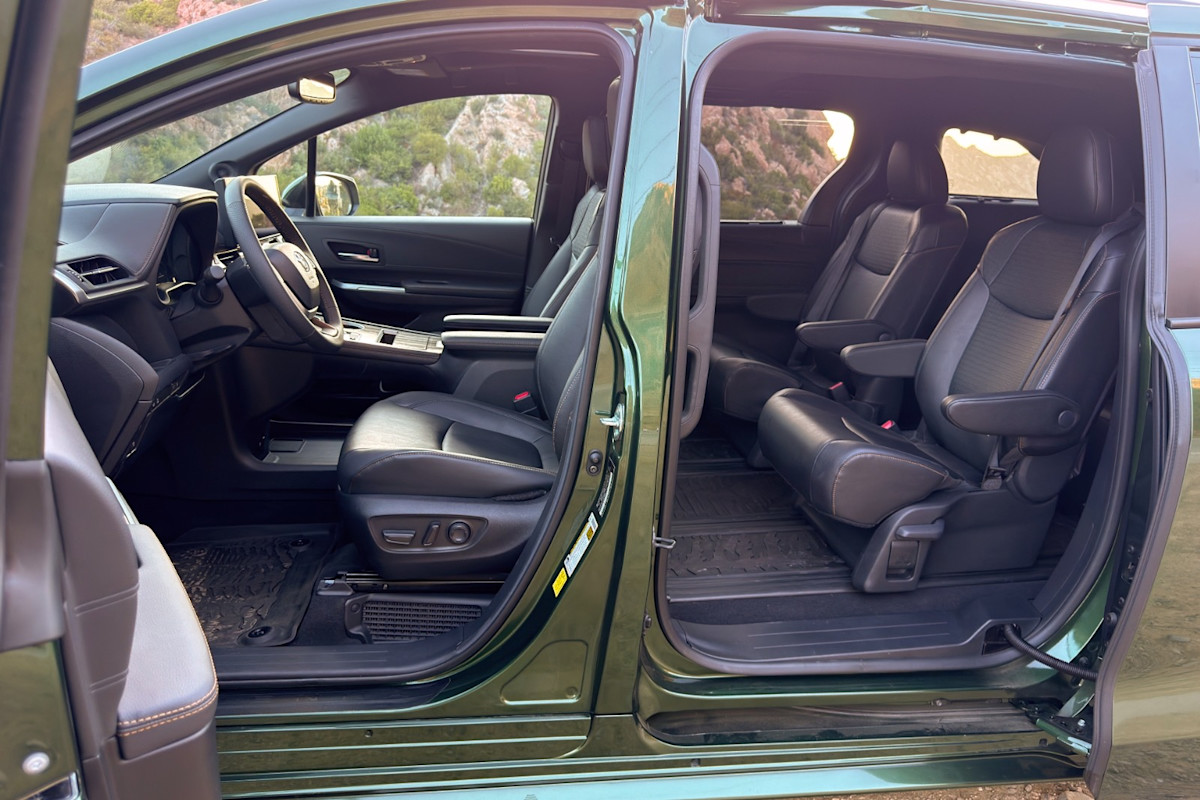
Power sliding doors are standard with hands-free operation on all but the base Sienna LE, granting easy access to the second and third rows. Optional “super-long-slide” second-row captain’s chairs are ideal for long family of four road trips. Why not a family of six? Super-long slide the captain’s chairs back, and they make the Sienna’s third-row seat uninhabitable. The captain’s chairs are quite comfortable and recline for napping. For those planning to carry infants or toddlers, the sliding door window shades leave a huge gap in coverage, so buyers will need a second shade to block out the sun.
Place the second-row seats in a middle position in their tracks, and the Sienna’s third-row seat offers plenty of room. Unfortunately, the rear side windows are small, and it felt tight back there in combination with our test vehicle's all-black interior. Still, the third-row bench offers decent leg support and a proper backrest angle.
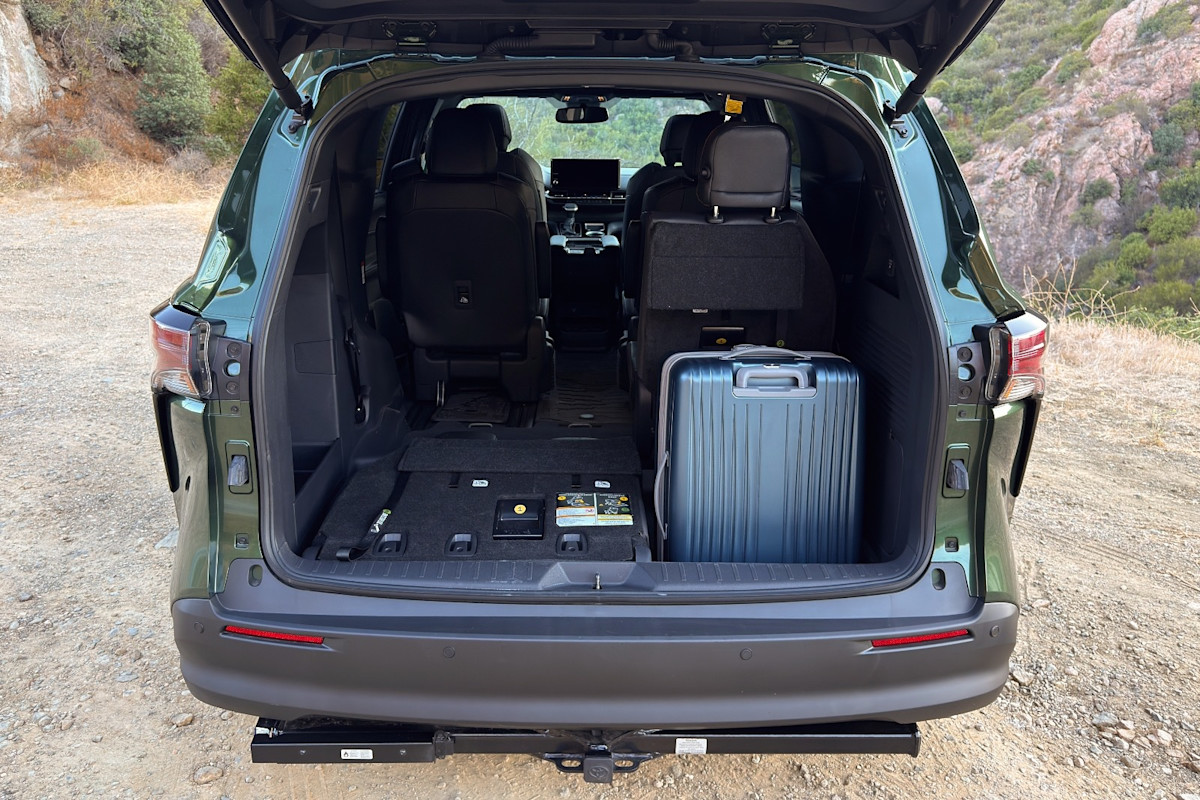
A power liftgate is standard, and it comes with hands-free operation on all trim levels except the base LE. As with other minivans, there is a deep storage well behind the third row, contributing to 949 litres of mostly vertical cargo space. If anyone tried to use it all, most of the items they had loaded would fall out the moment they opened the liftgate.
For big cargo jobs, fold the third row into the well and expand the cargo space to its maximum of 2,129 litres, depending on the placement of the second-row captain’s chairs. That’s as much volume as many SUVs offer with the second row down, illustrating one of the many benefits of choosing a minivan.
Maximum cargo volume measures 2,860 litres, which is much less than other minivans and not much more than the 2,761 litres of a Toyota Grand Highlander. There is a good reason for this: the second-row seats are not removable as they are in the Honda Odyssey and most versions of the Kia Carnival, and they don’t collapse into the floor like they do in most versions of the Chrysler Pacifica. Instead, they slide forward and vertically stack against the front seats.
Technology
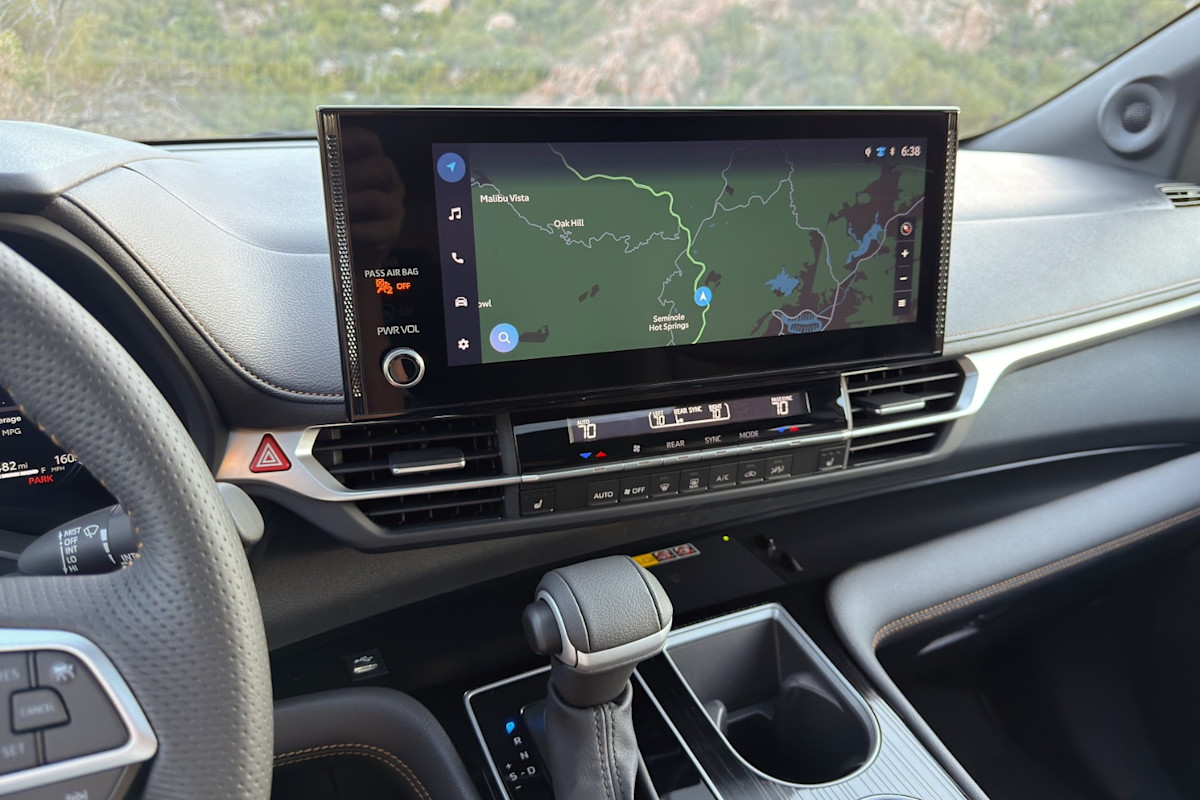
The base screen configuration in the Toyota Sienna is an 8-inch infotainment touchscreen and a 7-inch partially digital instrument panel. A 12.3-inch touchscreen and 12.3-inch digital instrument cluster become standard at the XLE and XSE trims respectively. The centre screen resides over the centre air vents and front climate control panel but doesn't integrate those functions.
Standard infotainment features include wireless Apple CarPlay and Android Auto, SiriusXM satellite radio, and multiple connected service plans with complimentary trial subscriptions. They are Service Connect and Safety Connect for five years, Remote Connect for three years, and Drive Connect, which requires a subscription from day one on all trims but Limited, where a three-year trial is included.
Wireless smartphone charging is also standard, while a 12-speaker JBL premium sound system and a 1,500-watt power inverter with two household-style 120-volt AC power outlets are available on higher trims. Toyota offers an onboard vacuum and a FridgeBox refrigerated box in the Sienna Limited with the Platinum Package.
We found the Toyota Audio Multimedia (TAM) infotainment system hard to view in its daytime illumination mode. Delicate fonts against a light background, coupled with reflections, made it hard to see. Switching to night mode cured that. An optional voice recognition system (part of Drive Connect) worked well but tripped up when requesting a specific SiriusXM station.
Safety
The Sienna is one generation behind most other Toyotas when it comes to driver assistance technology. The minivan has Toyota Safety Sense (TSS) 2.0, while other models have version 3.0. But shoppers aren’t necessarily missing out.
This minivan still has all the safety features expected of a modern vehicle. They include high beam assist, forward collision warning with pedestrian detection, automatic emergency braking, adaptive cruise control, lane departure warning, lane keep assist, and lane centring assist. The latter system was unable to interpret temporary lane markings in a construction zone, but the driver assist tech otherwise worked well.
Separately from TSS 2.0, the Sienna also has standard blind spot monitoring and rear cross-traffic alert. Higher trim levels have a surround-view camera and front and rear parking sensors with low-speed automatic braking to prevent bumps when parking.
What’s missing from TSS 2.0 are some predictive technologies that in our experience tend to be more annoying than helpful anyway. For example, the Sienna doesn’t have Toyota’s Proactive Driving Assist, which automatically slows the vehicle for upcoming curves and highway transition ramps. But in other Toyota models, we’ve found it tends to reduce speed by far too much for prevailing traffic conditions.
The Sienna’s safety ratings need improvement, though. In testing by the U.S. National Highway Traffic Safety Administration (NHTSA), the 2026 Sienna earned a mediocre three-star driver protection rating and a four-star front passenger protection rating. It did get five-star ratings in each side impact test and a four-star rollover resistance rating as well, which were apparently enough to bump its overall safety rating to five stars. But that rating doesn’t tell the whole story in this case.
The Sienna got a Marginal result in the updated Insurance Institute for Highway Safety (IIHS) moderate overlap front impact test that measures second-row occupant protection, but it received higher scores in other IIHS tests. It does not qualify for a Top Safety Pick or Top Safety Pick+ award, but neither do any other minivans currently on sale.
Cost-effectiveness
Considering the 2026 Toyota Sienna has a standard hybrid powertrain, class-leading fuel economy ratings, and includes generous trial subscriptions to connected services, it’s the most cost-effective minivan on the market. Not only that, but Toyota enjoys a well-deserved reputation for long-term reliability, and AWD is available.
For the 2026 model year, only three competitors exist. The Kia Carnival Hybrid comes close to matching the Sienna’s value equation but doesn’t quite measure up. A Chrysler Pacifica might make sense if it’s heavily discounted but can’t come close on fuel economy. The Honda Odyssey is appealing for its better driving dynamics and unique Magic Seat utility but is otherwise aging rapidly.
None of these minivans earns a Top Safety Pick rating from the IIHS. Given their missions as family-friendly haulers, this could tip the scales toward three-row crossover SUVs. For those trying to decide between the Sienna and a Toyota Grand Highlander Hybrid, the minivan’s power sliding side doors make loading and unloading children significantly easier, especially in tight parking spaces. Owners will save their backs years of extra wear and tear, especially since the Grand Highlander’s long rear doors are almost impossible to open when parking is in any way tight.
The Grand Highlander Hybrid earns better crash test ratings, and while it is slightly less efficient than the Sienna with AWD at 7.0 L/100 km combined versus 6.8 L/100 km for the minivan, it’s essentially a wash. The Sienna is more affordable to buy, though.
With that said, Toyota’s Hybrid Max powertrain is available in the Grand Highlander, an upgrade that could cure some of what ails the Sienna. The Grand Highlander also offers 20.3 centimetres of ground clearance — four centimetres more than the Sienna.
Our advice? Young parents with limber backs who are just starting to build their families should seriously consider those sliding side doors. Grandparents on daycare duty might decide they don’t have any choice but to get the Sienna.
What owners say
It’s a spacious and comfortable ride with an unrivaled tested and true Toyota ecvt hybrid design. You can check the pluses and minuses in various YouTube reviews, but for us, it’s a winner!
June 27, 2026Trims & specs
Base MSRP $50,135 | Seating 7 |
Engine 2.5L 245 hp I4 Hybrid | Cargo Capacity 33.5 cu ft |
Combined MPG 35 | Drivetrain AWD |
Base MSRP N/A | Seating N/A |
Engine N/A | Cargo Capacity N/A |
Combined MPG N/A | Drivetrain N/A |
Base MSRP $41,320 | Seating 8 |
Engine 2.5L 245 hp I4 Hybrid | Cargo Capacity 33.5 cu ft |
Combined MPG 36 | Drivetrain FWD |
Base MSRP $46,020 | Seating 8 |
Engine 2.5L 245 hp I4 Hybrid | Cargo Capacity 33.5 cu ft |
Combined MPG 36 | Drivetrain FWD |
Base MSRP $48,020 | Seating 7 |
Engine 2.5L 245 hp I4 Hybrid | Cargo Capacity 33.5 cu ft |
Combined MPG 35 | Drivetrain AWD |
Base MSRP $46,020 | Seating 7 |
Engine 2.5L 245 hp I4 Hybrid | Cargo Capacity 33.5 cu ft |
Combined MPG 36 | Drivetrain FWD |
Base MSRP $43,320 | Seating 8 |
Engine 2.5L 245 hp I4 Hybrid | Cargo Capacity 33.5 cu ft |
Combined MPG 35 | Drivetrain AWD |
Base MSRP $49,245 | Seating 7 |
Engine 2.5L 245 hp I4 Hybrid | Cargo Capacity 33.5 cu ft |
Combined MPG 36 | Drivetrain FWD |
Base MSRP $54,005 | Seating 7 |
Engine 2.5L 245 hp I4 Hybrid | Cargo Capacity 33.5 cu ft |
Combined MPG 35 | Drivetrain AWD |
Base MSRP $52,005 | Seating 7 |
Engine 2.5L 245 hp I4 Hybrid | Cargo Capacity 33.5 cu ft |
Combined MPG 36 | Drivetrain FWD |
Base MSRP $58,710 | Seating 7 |
Engine 2.5L 245 hp I4 Hybrid | Cargo Capacity 33.5 cu ft |
Combined MPG 35 | Drivetrain AWD |
Base MSRP $52,100 | Seating 7 |
Engine 2.5L 245 hp I4 Hybrid | Cargo Capacity 33.5 cu ft |
Combined MPG 35 | Drivetrain AWD |


Pricing trends
MSRP range
$41,320 - $58,710
Current avg. market price
$61,875
Trending down by 1.8% this month
May 2026 - November 2026

