Hyundai Tucson vs Chevrolet Bolt
Overview | |
Years produced2005-Present | Years produced2027 |
MSRP$27,500 | MSRP$27,600 |
Listings4876 | Listings1690 |
Ratings & Reviews | |
User Reviews | User Reviews |
Expert reviews8.5 out of 10 | Expert reviews6.3 out of 10 |
Pros
Cons
| Pros
Cons
|
Reviews SummaryWith the growth and evolution of the compact SUV market, shoppers have seemingly endless options. And the growth of this segment has allowed for different models to grow in their own unique ways. The Mazda CX-5 is upscale and athletic, while the Ford Bronco Sport is a surprisingly capable off-roader. So, what if you aren’t seeking a well-honed niche vehicle? What if you are looking for a small SUV that’s an overall great vehicle? The 2024 Hyundai Tucson answers that question as a well-rounded compact SUV that doesn’t excel in any one particular area, but instead covers a lot of what modern consumers demand out of their vehicle. This format is one that has been embraced by perennial segment standouts like the Toyota RAV4 and Honda CR-V. Verdict: The Tucson is a well-rounded small SUV and a good value. It does not shine in any particular area, instead blending good performance with a comfortable and spacious cabin, impressive tech and safety features, and an attractive price tag. | |
Reviews SummaryWith more range, more power, and improved technology, the Chevrolet Bolt EV returns after a three-year hiatus. It’s also one of the most affordable EVs in Canada, but it’s due to remain in production only until mid-2027. Verdict: The 2027 Chevrolet Bolt EV is an excellent choice for shoppers seeking an electric vehicle that won't break the bank. It may not be all that fancy or refined, but it gets the basics right when it comes to range and capabilities. | |
No video found | |
Popular Features & Specs | |
Engine2.5L 187 hp I4 | Engine |
DrivetrainFWD | Drivetrain |
Seating Capacity5 | Seating Capacity5 |
Horsepower187 hp @ 6100 rpm | Horsepower |
EV Battery Capacity | EV Battery Capacity65 kWh |
MPG City25 | MPG City |
MPG Highway32 | MPG Highway |
Battery Charge Time (120V) | Battery Charge Time (120V)64 hours |
Battery Charge Time (240V) | Battery Charge Time (240V)9.8 hours |
Engine | |
Engine Name2.5L 187 hp I4 | Engine Name210 hp Electric |
Torque178 lb-ft @ 4000 rpm | Torque |
Horsepower187 hp @ 6100 rpm | Horsepower |
Battery Charge Time (120V) | Battery Charge Time (120V)64 hours |
Battery Charge Time (240V) | Battery Charge Time (240V)9.8 hours |
DrivetrainFWD | DrivetrainFWD |
Fuel Economy | |
EV Battery Capacity | EV Battery Capacity65 kWh |
MPG City25 | MPG City |
MPG Highway32 | MPG Highway |
Interior | |
Seating Capacity5 | Seating Capacity5 |
Key Features | |
Navigation System | Navigation SystemStandard |
Safety | |
Front Crash Overall5 | Front Crash Overall |
Dimensions & Capacity | |
Cargo Space38.7 cu ft | Cargo Space16.2 cu ft |
Curb Weight3346 lbs | Curb Weight3776 lbs |
Height65.6 in | Height63.9 in |
Length182.3 in | Length169.6 in |
Width73.4 in | Width80.1 in |
Wheelbase108.5 in | Wheelbase105.3 in |
Maximum Payload1283 lbs | Maximum Payload873 lbs |
Number of doors4 | Number of doors4 |
Maximum Towing Capacity2000 lbs | Maximum Towing Capacity |
Standard Towing Capacity2000 lbs | Standard Towing Capacity |
Overview | ||
Years produced | 2005-Present | 2027 |
MSRP | $27,500 | $27,600 |
Listings | ||
Ratings & Reviews | ||
User reviews | ||
Expert reviews | 8.5 out of 10Read full review | 6.3 out of 10Read full review |
Pros & cons | Pros
Cons
| Pros
Cons
|
Summary | With the growth and evolution of the compact SUV market, shoppers have seemingly endless options. And the growth of this segment has allowed for different models to grow in their own unique ways. The Mazda CX-5 is upscale and athletic, while the Ford Bronco Sport is a surprisingly capable off-roader. So, what if you aren’t seeking a well-honed niche vehicle? What if you are looking for a small SUV that’s an overall great vehicle? The 2024 Hyundai Tucson answers that question as a well-rounded compact SUV that doesn’t excel in any one particular area, but instead covers a lot of what modern consumers demand out of their vehicle. This format is one that has been embraced by perennial segment standouts like the Toyota RAV4 and Honda CR-V. Verdict: The Tucson is a well-rounded small SUV and a good value. It does not shine in any particular area, instead blending good performance with a comfortable and spacious cabin, impressive tech and safety features, and an attractive price tag. | With more range, more power, and improved technology, the Chevrolet Bolt EV returns after a three-year hiatus. It’s also one of the most affordable EVs in Canada, but it’s due to remain in production only until mid-2027. Verdict: The 2027 Chevrolet Bolt EV is an excellent choice for shoppers seeking an electric vehicle that won't break the bank. It may not be all that fancy or refined, but it gets the basics right when it comes to range and capabilities. |
Video | No video found | |
Popular Features & Specs | ||
Engine | 2.5L 187 hp I4 | |
Drivetrain | FWD | |
Seating Capacity | 5 | 5 |
Horsepower | 187 hp @ 6100 rpm | |
EV Battery Capacity | 65 kWh | |
MPG City | 25 | |
MPG Highway | 32 | |
Battery Charge Time (120V) | 64 hours | |
Battery Charge Time (240V) | 9.8 hours | |
Engine | ||
Engine Name | 2.5L 187 hp I4 | 210 hp Electric |
Torque | 178 lb-ft @ 4000 rpm | |
Horsepower | 187 hp @ 6100 rpm | |
Battery Charge Time (120V) | 64 hours | |
Battery Charge Time (240V) | 9.8 hours | |
Drivetrain | FWD | FWD |
Fuel Economy | ||
EV Battery Capacity | 65 kWh | |
MPG City | 25 | |
MPG Highway | 32 | |
Interior | ||
Seating Capacity | 5 | 5 |
Key Features | ||
Navigation System | Standard | |
Safety | ||
Front Crash Overall | 5 | |
Dimensions & Capacity | ||
Cargo Space | 38.7 cu ft | 16.2 cu ft |
Curb Weight | 3346 lbs | 3776 lbs |
Height | 65.6 in | 63.9 in |
Length | 182.3 in | 169.6 in |
Width | 73.4 in | 80.1 in |
Wheelbase | 108.5 in | 105.3 in |
Maximum Payload | 1283 lbs | 873 lbs |
Number of doors | 4 | 4 |
Maximum Towing Capacity | 2000 lbs | |
Standard Towing Capacity | 2000 lbs | |
The 2024 Hyundai Tucson, introduced as part of the fourth generation in 2022, maintained its striking design into 2024. Its styling was characterized by taut angles and unique elements like headlights that seamlessly blended into the grille, creating a contemporary and handsome appearance. Even in a typically unflattering white, the Tucson managed to look sharp. Unlike some luxury brands that scale designs across models, Hyundai gave each vehicle a distinct style. The Tucson's interior mirrored its exterior's modernity, with a refined cabin packed with technology. However, the absence of a volume dial in favour of touch-capacitive buttons was a minor inconvenience. The layout of controls, particularly those near the shifter and cupholders, was thoughtfully designed, though it required some familiarization.
In contrast, the 2027 Chevrolet Bolt retained a familiar look with slight styling changes, resembling a conventional gas-powered car more than an EV. The Bolt EUV body style returned, offering a tall and narrow stance that prioritized utility and interior space. The RS model added gloss black exterior trim for a touch of flair. Inside, the Bolt underwent a more dramatic makeover, featuring a larger digital instrument panel and infotainment touchscreen. The push-button gear selector moved to the steering column, freeing up storage space. While the cabin was dominated by hard plastics, the Bolt maintained a budget-friendly feel with some padded touchpoints. The RS trim upgraded to Evotex synthetic leather with red stitching, adding a sporty touch to the interior.

The 2024 Hyundai Tucson in Canada came equipped with a 2.5-litre four-cylinder engine, producing 187 horsepower and 178 pound-feet of torque. This power was delivered through an eight-speed automatic transmission to standard all-wheel drive. While the non-hybrid powertrain was adequate for city driving, it struggled to accelerate quickly on highways, requiring heavy throttle input and generating noticeable engine noise. For those seeking more power, the Tucson Hybrid and Plug-In Hybrid offered 226 and 261 horsepower, respectively. Despite its power limitations, the Tucson excelled in handling and ride quality, providing a comfortable and well-rounded driving experience.
The 2027 Chevrolet Bolt featured a new 65-kilowatt-hour lithium-iron phosphate battery pack, reducing costs and reliance on rare earth minerals. Its motor, borrowed from the Chevy Equinox EV, delivered 210 horsepower and 169 pound-feet of torque to the front wheels. The Bolt's acceleration, estimated in the low seven-second range for 0-100 km/h, was quick compared to gas-powered subcompact SUVs. One-pedal driving was available, with adjustable brake regeneration levels. The ride was firm but not overly stiff, and the Bolt's low centre of gravity contributed to its agility on curvy roads. With a full charge, the Bolt offered an estimated range of 422 kilometres, an improvement over previous models. The Bolt also featured a Tesla-derived North American Charging Standard (NACS) charge port, with increased charging speed from 55 kW to 150 kW.
The 2024 Hyundai Tucson offered impressive cargo space, with up to 2,119 litres available with the rear seats folded and 1,097 litres with them in use. The Preferred trim featured a manual liftgate, while higher trims included a hands-free power liftgate, which operated intuitively by simply standing near the rear bumper with the key fob. The Tucson accommodated up to five passengers comfortably, with ample headroom and legroom in both rows. The front seats were particularly spacious, making it suitable for long trips. The cabin featured deep cup holders and a centre tray with a wireless charging pad.
The 2027 Chevrolet Bolt provided a more upright driving position, offering ample space for larger occupants. Taller drivers might have wished for more telescopic extension from the steering wheel. The rear seats were also upright, with sufficient headroom and thigh support. The Bolt's cargo capacity was 459 litres behind the rear seats, which was small for the class but still practical for most users. A large bin under the floor and easy-to-reach release latches for the rear seatbacks added to its versatility. While there was no frunk, the Bolt offered ample storage for personal items, including a large bin with movable dividers, a big floor tray, and a deep centre armrest bin.
The 2024 Hyundai Tucson featured a standard infotainment system with a fully digital instrument panel and a 10.25-inch touchscreen. While the layout was intuitive, the lack of wireless connectivity for Android Auto and Apple CarPlay was a drawback. The volume control was a haptic toggle, which some found less convenient than a traditional dial. However, the touchscreen and haptic buttons were glove-friendly, a practical feature in cold weather. Hyundai's remote start system was also noteworthy, allowing drivers to start the vehicle remotely and simply drive away once inside.
The 2027 Chevrolet Bolt came equipped with an 11-inch digital instrument panel and an 11.3-inch centre touchscreen, running on a Google-based operating system. While Apple CarPlay and standalone Android Auto were not supported, the system offered enough browsing control via Bluetooth. The optional Technology package added features like a surround-view camera system, a digital rear-view mirror, and a wireless charging pad. The infotainment system was user-friendly, with logical menus and quick responses. It also included navigation assistance for finding charging stations and preconditioning the battery for optimal charging rates. The Bolt's vehicle-to-load charging capability allowed it to serve as a backup power source for a home.
The 2024 Hyundai Tucson came with a comprehensive suite of standard driver assistance features, including automatic emergency braking, forward collision warning, pedestrian and cyclist detection, adaptive cruise control, lane-departure warning, lane-keeping assist, automatic high beams, driver attention monitoring, blind-spot monitoring, and rear cross-traffic alert. The Ultimate trim added front and rear parking sensors, a 360-degree parking camera system, and Hyundai's Smart Park remote-parking feature. The Tucson received high safety ratings, with the IIHS awarding it a "Good" score in most crash tests and a "Superior" rating for crash-prevention technology.
The 2027 Chevrolet Bolt's crash test results were not available at the time of writing, but it was expected to perform well based on its platform. Standard safety features included forward-collision warning with automatic emergency braking, adaptive cruise control, lane-keep assist, blind-spot monitors with active steering assist, and a safety alert seat. The optional Technology package added a surround-view camera system, a digital rear-view mirror, rain-sensing wipers, rear pedestrian alert, and traffic-sign recognition. GM's Super Cruise hands-free automated highway driving system was available for an additional cost.
CarGurus highlights
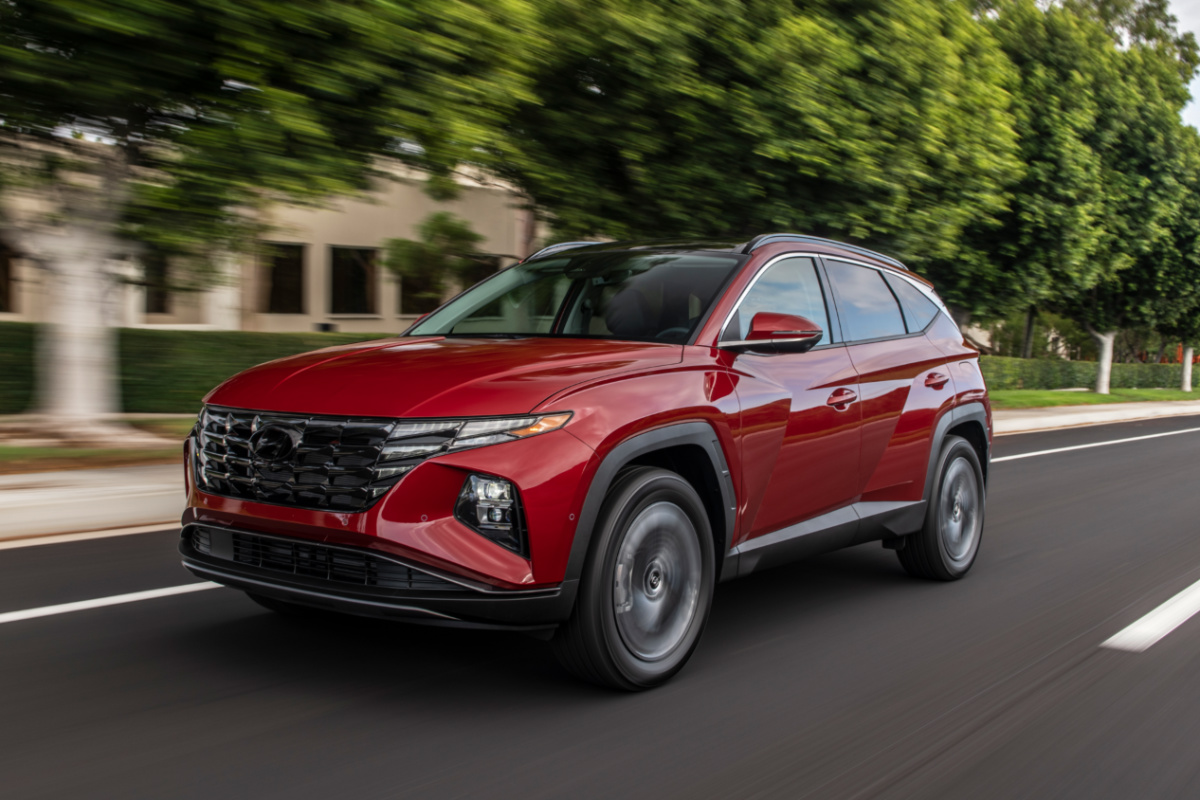
According to CarGurus experts, the overall rating for the 2024 Hyundai Tucson is 8.5 out of 10, while the 2027 Chevrolet Bolt scores 6.3 out of 10. Based on these ratings, the Hyundai Tucson is the recommended choice, offering a more well-rounded package with superior safety features, comfort, and driving dynamics.
Choose the 2024 Hyundai Tucson if:
- You prioritize a spacious and comfortable interior with ample cargo capacity.
- You value a comprehensive suite of standard safety features and high safety ratings.
- You appreciate a well-rounded driving experience with excellent handling and ride quality.


Choose the 2027 Chevrolet Bolt if:
- You seek an electric vehicle with a respectable range and quick acceleration.
- You want a budget-friendly EV with advanced technology features like vehicle-to-load charging.
- You prefer a compact vehicle with a tall, narrow stance for urban driving.


CarGurus highlights
According to CarGurus experts, the overall rating for the 2024 Hyundai Tucson is 8.5 out of 10, while the 2027 Chevrolet Bolt scores 6.3 out of 10. Based on these ratings, the Hyundai Tucson is the recommended choice, offering a more well-rounded package with superior safety features, comfort, and driving dynamics.
Choose the 2024 Hyundai Tucson if:
Shop Now- You prioritize a spacious and comfortable interior with ample cargo capacity.
- You value a comprehensive suite of standard safety features and high safety ratings.
- You appreciate a well-rounded driving experience with excellent handling and ride quality.
Choose the 2027 Chevrolet Bolt if:
Shop Now- You seek an electric vehicle with a respectable range and quick acceleration.
- You want a budget-friendly EV with advanced technology features like vehicle-to-load charging.
- You prefer a compact vehicle with a tall, narrow stance for urban driving.

By: CarGurus + AI
At CarGurus, our team of experienced automotive writers remain at the heart of our content operation, conducting hands-on car tests and writing insightful guides that are backed by years of industry experience. To complement this, we are harnessing AI to make our content offering more diverse and more helpful to shoppers than ever. To achieve this, our AI systems are based exclusively on CarGurus content, ratings and data, so that what we produce is both unique to CarGurus, and uniquely helpful to car shoppers.
