2021 Volkswagen Atlas vs 2020 Audi Q7

Overview | |
MSRP$54,800 | MSRP$31,545 |
Listings6 | Listings103 |
Ratings & Reviews | |
User Reviews | User Reviews |
Expert reviews7.7 out of 10 | Expert reviews6.5 out of 10 |
Pros
Cons
| |
2020 Audi Q7 Reviews SummaryFrom its styling and interior to its powertrain and technology, the 2020 Audi Q7 gets a thorough update that brings it in line with other high-end cars and SUVs wearing four chrome rings on their grilles. Simultaneously, the changes for the 2020 model year keep this Audi competitive against the BMW X5 and Mercedes-Benz GLE-Class, its primary rivals in the midsize luxury SUV class. We packed a Q7 Technik full of family and luggage and set off to assess this Audi’s improvements on the open road. | |
2021 Volkswagen Atlas Reviews SummaryIntroduced for the 2018 model year, the Volkswagen Atlas is the automaker's latest attempt to win over North American buyers. Built in Chattanooga, Tennessee, the VW Atlas competes in the three-row crossover SUV segment against well-established nameplates like the Ford Explorer, Honda Pilot, and Toyota Highlander. Changes for 2021 are limited to exterior styling tweaks and a reshuffled option list. VW also offers the two-row Volkswagen Atlas Cross Sport. | |
No video found | |
Popular Features & Specs | |
Engine2.0L 248 hp I4 | Engine2.0L 235 hp I4 |
DrivetrainAWD | DrivetrainFWD |
Seating Capacity7 | Seating Capacity7 |
Horsepower248 hp @ 5000 rpm | Horsepower |
MPG City19 | MPG City21 |
MPG Highway23 | MPG Highway24 |
Engine | |
Engine Name2.0L 248 hp I4 | Engine Name2.0L 235 hp I4 |
Torque273 lb-ft @ 1600 rpm | Torque |
Horsepower248 hp @ 5000 rpm | Horsepower |
DrivetrainAWD | DrivetrainFWD |
Fuel Economy | |
MPG City19 | MPG City21 |
MPG Highway23 | MPG Highway24 |
Interior | |
Leather SeatsStandard | Leather Seats |
Seating Capacity7 | Seating Capacity7 |
Key Features | |
Navigation SystemStandard | Navigation System |
Sunroof/MoonroofStandard | Sunroof/Moonroof |
Safety | |
Front Crash Overall | Front Crash Overall4 |
Side Crash Overall5 | Side Crash Overall5 |
Dimensions & Capacity | |
Cargo Space14.2 cu ft | Cargo Space20.6 cu ft |
Curb Weight4784 lbs | Curb Weight4248 lbs |
Height68.5 in | Height70.1 in |
Length199.6 in | Length200.7 in |
Width87.1 in | Width78.4 in |
Wheelbase117.9 in | Wheelbase117.3 in |
Maximum Payload1367 lbs | Maximum Payload1080 lbs |
Number of doors4 | Number of doors4 |
Maximum Towing Capacity4400 lbs | Maximum Towing Capacity2000 lbs |
Overview | ||
MSRP | $54,800 | $31,545 |
Listings | ||
Ratings & Reviews | ||
User reviews | ||
Expert reviews | 7.7 out of 10Read full review | 6.5 out of 10Read full review |
Pros & cons | Pros
Cons
| |
Summary | From its styling and interior to its powertrain and technology, the 2020 Audi Q7 gets a thorough update that brings it in line with other high-end cars and SUVs wearing four chrome rings on their grilles. Simultaneously, the changes for the 2020 model year keep this Audi competitive against the BMW X5 and Mercedes-Benz GLE-Class, its primary rivals in the midsize luxury SUV class. We packed a Q7 Technik full of family and luggage and set off to assess this Audi’s improvements on the open road. | Introduced for the 2018 model year, the Volkswagen Atlas is the automaker's latest attempt to win over North American buyers. Built in Chattanooga, Tennessee, the VW Atlas competes in the three-row crossover SUV segment against well-established nameplates like the Ford Explorer, Honda Pilot, and Toyota Highlander. Changes for 2021 are limited to exterior styling tweaks and a reshuffled option list. VW also offers the two-row Volkswagen Atlas Cross Sport. |
Video | No video found | |
Popular Features & Specs | ||
Engine | 2.0L 248 hp I4 | 2.0L 235 hp I4 |
Drivetrain | AWD | FWD |
Seating Capacity | 7 | 7 |
Horsepower | 248 hp @ 5000 rpm | |
MPG City | 19 | 21 |
MPG Highway | 23 | 24 |
Engine | ||
Engine Name | 2.0L 248 hp I4 | 2.0L 235 hp I4 |
Torque | 273 lb-ft @ 1600 rpm | |
Horsepower | 248 hp @ 5000 rpm | |
Drivetrain | AWD | FWD |
Fuel Economy | ||
MPG City | 19 | 21 |
MPG Highway | 23 | 24 |
Interior | ||
Leather Seats | Standard | |
Seating Capacity | 7 | 7 |
Key Features | ||
Navigation System | Standard | |
Sunroof/Moonroof | Standard | |
Safety | ||
Front Crash Overall | 4 | |
Side Crash Overall | 5 | 5 |
Dimensions & Capacity | ||
Cargo Space | 14.2 cu ft | 20.6 cu ft |
Curb Weight | 4784 lbs | 4248 lbs |
Height | 68.5 in | 70.1 in |
Length | 199.6 in | 200.7 in |
Width | 87.1 in | 78.4 in |
Wheelbase | 117.9 in | 117.3 in |
Maximum Payload | 1367 lbs | 1080 lbs |
Number of doors | 4 | 4 |
Maximum Towing Capacity | 4400 lbs | 2000 lbs |
The 2020 Audi Q7 presented a refined and modern aesthetic, with its updated front and rear styling aligning it with the flagship Q8 model. The Q7 55 TFSI, priced at $86,100 with the Technik trim, featured 21-inch wheels and a high-tech interior. The cabin, adorned in Okapi Brown leather and Gray/Brown Fine Grain Ash wood inlays, exuded luxury and sophistication. The dashboard and instrumentation borrowed from the Q8, replacing physical controls with three digital displays, including Audi’s Virtual Cockpit. The ambient lighting added a soothing ambiance, enhancing the upscale feel of the vehicle.
In contrast, the 2021 Volkswagen Atlas underwent a styling refresh, gaining a more extroverted look with new front and rear bumpers, LED headlights and taillights, and a new grille. The Atlas grew by 6 centimetres in length, offering a sportier R-Line trim with enhanced bumpers and side skirts. Despite its cosmetic changes, the Atlas retained its MQB platform, shared with other VW models. The interior was minimalist, with controls logically laid out, but the material quality was below average, with cheap plastics and faux wood and metal trim. The Atlas offered a spacious cabin with a standard seven-seat configuration, though the second-row legroom was limited.


The 2020 Audi Q7 55 TFSI featured a new 3.0-litre turbocharged V6 engine, producing 335 horsepower and 369 pound-feet of torque. The engine was paired with an eight-speed automatic transmission and Audi’s Quattro all-wheel-drive system. The Q7 accelerated from zero to 100 km/h in 5.9 seconds and had a towing capacity of just under 3,500 kilograms. The 48-volt mild-hybrid system improved fuel efficiency, with the Q7 averaging 11.2 L/100 km during testing. The adaptive air suspension and Audi Drive Select offered various driving modes, enhancing the SUV’s agility and comfort on different terrains.
The 2021 Volkswagen Atlas offered two engine options: a 2.0-litre turbocharged inline-four with 235 horsepower and a 3.6-litre VR6 with 276 horsepower. Both engines were mated to an eight-speed automatic transmission and standard 4Motion all-wheel drive. The Atlas’s driving experience was underwhelming, with rough shifts and poor ride quality. The AWD system included drive modes for different conditions, but the suspension tuning was lacking. The VR6 models had a towing capacity of 2,267 kilograms, while the four-cylinder models were limited to 900 kilograms. Fuel efficiency was unimpressive, with the VR6 models rated at 12.9 L/100 km combined.
The 2020 Audi Q7, while offering three rows of seats, was best suited for five passengers due to the cramped third-row space. With the third row folded, cargo capacity increased from 402 litres to 1,010 litres, and further to 1,970 litres with both rows down. The Q7 provided a comfortable ride for a family of four, with heated and ventilated front seats and ample second-row legroom. However, interior storage was limited, with the centre console and dashboard screen occupying most of the space.
The 2021 Volkswagen Atlas excelled in passenger and cargo space, offering 2,741 litres behind the front seats and 583 litres with all seats up. The third-row legroom was generous, but the second-row legroom was lacking. The Atlas featured a straightforward folding mechanism for the seats and easy third-row access. The interior controls were driver-focused, with up to five USB ports and a wireless charging pad. The Atlas boasted up to 17 cupholders, though forward visibility was limited.
The 2020 Audi Q7 introduced the MMI Touch Response system, combining a 10.1-inch and an 8.6-inch touchscreen for infotainment. The system included voice and handwriting recognition, wireless Apple CarPlay, and Audi Connect services. The Technik trim featured a head-up display and a Bose sound system, though the latter was replaced by a Bang & Olufsen system in 2021. The user interface was intuitive, but dry fingertips occasionally caused unresponsive virtual buttons.
The 2021 Volkswagen Atlas came with Bluetooth and Apple CarPlay/Android Auto compatibility. Higher trims featured an 8-inch touchscreen and Volkswagen’s Digital Cockpit. The Atlas was set to receive the MIBIII infotainment system later in the year, offering improved features. The base audio system was decent, with a 12-speaker Fender system available on the Execline trim. The menus were easy to navigate, but the displays were plain and text-heavy.
The 2020 Audi Q7 was equipped with advanced driving-assistance systems, including Emergency Assist, Turn Assist, and Adaptive Cruise Assist. The HD Matrix LED headlights provided excellent illumination, though rated "poor" by the IIHS for glare. The Q7 received top ratings from the IIHS, except for the headlights, preventing a "Top Safety Pick+" award. The adaptive cruise control and lane assist features were not well-received due to their inconsistent performance.
The 2021 Volkswagen Atlas received "good" ratings in IIHS crash tests, with mixed headlight ratings. The NHTSA awarded the 2020 model a five-star overall rating. Standard safety features included automatic emergency braking and blind-spot monitoring, with adaptive cruise control and lane-keep assist available on higher trims. The Atlas was set to receive more advanced driver aids later in the year, including Travel Assist and Emergency Assist.
CarGurus highlights
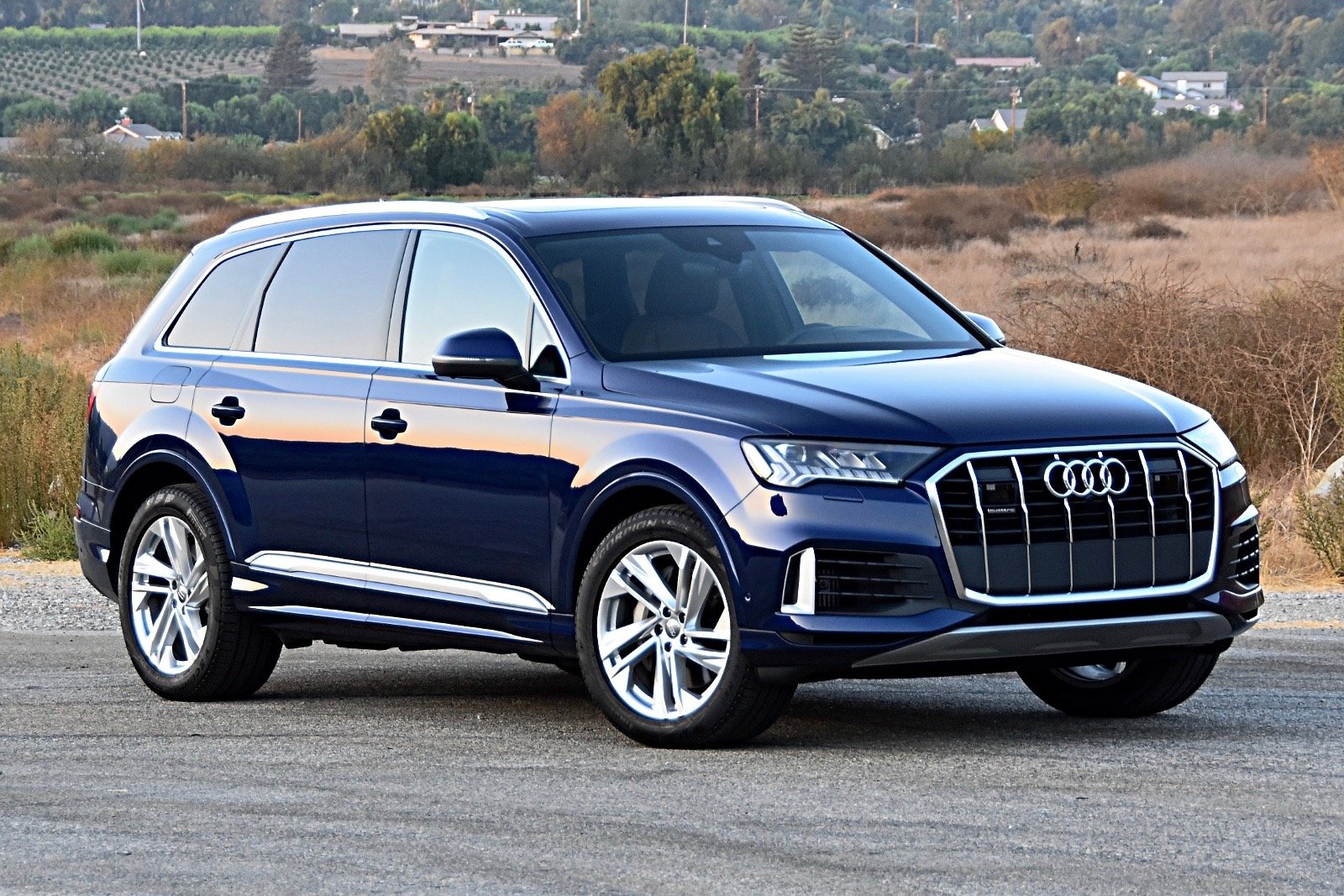
According to CarGurus experts, the overall rating for the 2020 Audi Q7 is 7.7 out of 10, while the 2021 Volkswagen Atlas scores 6.5 out of 10. Based on these ratings, the Audi Q7 is the recommended choice, offering a more luxurious and well-rounded driving experience with superior performance and technology features.
Choose the 2021 Volkswagen Atlas if:
- You require ample passenger and cargo space with easy third-row access.
- You prefer a straightforward and user-friendly infotainment system with multiple connectivity options.
- You want a family-friendly vehicle with numerous cupholders and practical interior features.


Choose the 2020 Audi Q7 if:
- You prioritize a luxurious and high-tech interior with advanced infotainment features.
- You need a powerful engine with excellent towing capacity and fuel efficiency.
- You value a quiet and comfortable ride with adaptive suspension and multiple driving modes.


CarGurus highlights
According to CarGurus experts, the overall rating for the 2020 Audi Q7 is 7.7 out of 10, while the 2021 Volkswagen Atlas scores 6.5 out of 10. Based on these ratings, the Audi Q7 is the recommended choice, offering a more luxurious and well-rounded driving experience with superior performance and technology features.
Choose the 2021 Volkswagen Atlas if:
Shop Now- You require ample passenger and cargo space with easy third-row access.
- You prefer a straightforward and user-friendly infotainment system with multiple connectivity options.
- You want a family-friendly vehicle with numerous cupholders and practical interior features.
Choose the 2020 Audi Q7 if:
Shop Now- You prioritize a luxurious and high-tech interior with advanced infotainment features.
- You need a powerful engine with excellent towing capacity and fuel efficiency.
- You value a quiet and comfortable ride with adaptive suspension and multiple driving modes.

By: CarGurus + AI
At CarGurus, our team of experienced automotive writers remain at the heart of our content operation, conducting hands-on car tests and writing insightful guides that are backed by years of industry experience. To complement this, we are harnessing AI to make our content offering more diverse and more helpful to shoppers than ever. To achieve this, our AI systems are based exclusively on CarGurus content, ratings and data, so that what we produce is both unique to CarGurus, and uniquely helpful to car shoppers.
