2020 Honda CR-V vs 2019 BMW X5
Overview | |
MSRP$60,700 | MSRP$25,150 |
Listings67 | Listings209 |
Ratings & Reviews | |
User Reviews | User Reviews |
Expert reviews7.8 out of 10 | Expert reviews7.5 out of 10 |
Pros
Cons
| |
2019 BMW X5 Reviews SummaryThe BMW X5 redefined SUVs 20 years ago, leaning into the idea that you could have truck form and car function all in one package. In fact, BMW branded the original X5 as an SAV—a Sports Activity Vehicle—to help emphasize the fact that it drove as well as the company's famous sport sedans. And while that claim was a bit of an overreach, the original X5 did outperform its luxury SUV competitors on the road. Now in its fourth generation, BMW’s midsize crossover continues to deliver on that two-decade-old promise: The X5 delivers car-like handling in an SUV form. And while the 2019 X5 stretches 2.5 centimetres longer, 7.5 centimetres wider, and 2.5 centimetres taller than last year's model, you’d have to look closely to notice the differences. Most obvious is a new and bigger kidney grille with active shutters. It has already received flak for being “comically large,” though in our opinion, it seems proportional to the rest of the vehicle—enough to make us wonder if the grilles on previous iterations of the X5 were too small. Inside, you’ll find a redesigned interior with an updated version of the iDrive system and a suite of Level 2 autonomous technology that unfortunately leaves a lot to be desired. But that shouldn’t dissuade you from BMW’s revolutionary recreational vehicle, because there’s still a lot to love. | |
2020 Honda CR-V Reviews SummaryHonda’s compact SUV has been satisfying buyers for more than two decades, with more than five million CR-V’s sold. Such a legacy means the CR-V has long had its wrinkles smoothed out into a comfortable and capable crossover package that’s only downside may be its sheer inoffensiveness. The 2020 model year saw engine and safety upgrades, which improve fuel efficiency and help to make Honda’s bestseller an even better value. | |
No video found | |
Popular Features & Specs | |
Engine3.0L 335 hp I6 | Engine1.5L 190 hp I4 |
DrivetrainAWD | DrivetrainFWD |
Seating Capacity7 | Seating Capacity5 |
Horsepower335 hp @ 5500 rpm | Horsepower190 hp @ 5600 rpm |
MPG City20 | MPG City28 |
MPG Highway26 | MPG Highway34 |
Engine | |
Engine Name3.0L 335 hp I6 | Engine Name1.5L 190 hp I4 |
Torque330 lb-ft @ 1500 rpm | Torque179 lb-ft @ 2000 rpm |
Horsepower335 hp @ 5500 rpm | Horsepower190 hp @ 5600 rpm |
DrivetrainAWD | DrivetrainFWD |
Fuel Economy | |
MPG City20 | MPG City28 |
MPG Highway26 | MPG Highway34 |
Interior | |
Seating Capacity7 | Seating Capacity5 |
Key Features | |
Navigation SystemStandard | Navigation System |
Sunroof/MoonroofStandard | Sunroof/Moonroof |
Safety | |
Front Crash Overall4 | Front Crash Overall5 |
Side Crash Overall5 | Side Crash Overall5 |
Dimensions & Capacity | |
Cargo Space33.9 cu ft | Cargo Space39.2 cu ft |
Curb Weight4813 lbs | Curb Weight3337 lbs |
Height69.0 in | Height66.1 in |
Length194.3 in | Length182.1 in |
Width87.3 in | Width73.0 in |
Wheelbase117.1 in | Wheelbase104.8 in |
Maximum Payload849 lbs | Maximum Payload1358 lbs |
Number of doors4 | Number of doors4 |
Maximum Towing Capacity7209 lbs | Maximum Towing Capacity1500 lbs |
Standard Towing Capacity6603 lbs | Standard Towing Capacity |
Overview | ||
MSRP | $60,700 | $25,150 |
Listings | ||
Ratings & Reviews | ||
User reviews | ||
Expert reviews | 7.8 out of 10Read full review | 7.5 out of 10Read full review |
Pros & cons | Pros
Cons
| |
Summary | The BMW X5 redefined SUVs 20 years ago, leaning into the idea that you could have truck form and car function all in one package. In fact, BMW branded the original X5 as an SAV—a Sports Activity Vehicle—to help emphasize the fact that it drove as well as the company's famous sport sedans. And while that claim was a bit of an overreach, the original X5 did outperform its luxury SUV competitors on the road. Now in its fourth generation, BMW’s midsize crossover continues to deliver on that two-decade-old promise: The X5 delivers car-like handling in an SUV form. And while the 2019 X5 stretches 2.5 centimetres longer, 7.5 centimetres wider, and 2.5 centimetres taller than last year's model, you’d have to look closely to notice the differences. Most obvious is a new and bigger kidney grille with active shutters. It has already received flak for being “comically large,” though in our opinion, it seems proportional to the rest of the vehicle—enough to make us wonder if the grilles on previous iterations of the X5 were too small. Inside, you’ll find a redesigned interior with an updated version of the iDrive system and a suite of Level 2 autonomous technology that unfortunately leaves a lot to be desired. But that shouldn’t dissuade you from BMW’s revolutionary recreational vehicle, because there’s still a lot to love. | Honda’s compact SUV has been satisfying buyers for more than two decades, with more than five million CR-V’s sold. Such a legacy means the CR-V has long had its wrinkles smoothed out into a comfortable and capable crossover package that’s only downside may be its sheer inoffensiveness. The 2020 model year saw engine and safety upgrades, which improve fuel efficiency and help to make Honda’s bestseller an even better value. |
Video | No video found | |
Popular Features & Specs | ||
Engine | 3.0L 335 hp I6 | 1.5L 190 hp I4 |
Drivetrain | AWD | FWD |
Seating Capacity | 7 | 5 |
Horsepower | 335 hp @ 5500 rpm | 190 hp @ 5600 rpm |
MPG City | 20 | 28 |
MPG Highway | 26 | 34 |
Engine | ||
Engine Name | 3.0L 335 hp I6 | 1.5L 190 hp I4 |
Torque | 330 lb-ft @ 1500 rpm | 179 lb-ft @ 2000 rpm |
Horsepower | 335 hp @ 5500 rpm | 190 hp @ 5600 rpm |
Drivetrain | AWD | FWD |
Fuel Economy | ||
MPG City | 20 | 28 |
MPG Highway | 26 | 34 |
Interior | ||
Seating Capacity | 7 | 5 |
Key Features | ||
Navigation System | Standard | |
Sunroof/Moonroof | Standard | |
Safety | ||
Front Crash Overall | 4 | 5 |
Side Crash Overall | 5 | 5 |
Dimensions & Capacity | ||
Cargo Space | 33.9 cu ft | 39.2 cu ft |
Curb Weight | 4813 lbs | 3337 lbs |
Height | 69.0 in | 66.1 in |
Length | 194.3 in | 182.1 in |
Width | 87.3 in | 73.0 in |
Wheelbase | 117.1 in | 104.8 in |
Maximum Payload | 849 lbs | 1358 lbs |
Number of doors | 4 | 4 |
Maximum Towing Capacity | 7209 lbs | 1500 lbs |
Standard Towing Capacity | 6603 lbs | |
The 2019 BMW X5 was designed with a focus on delivering a sedan-like driving experience, despite its substantial 2,250-kilogram weight and tall stature. BMW's approach was to prioritize on-road comfort over off-road capabilities, a decision that initially drew criticism but ultimately aligned with consumer preferences for smooth pavement rides. The X5 offered a five-passenger layout, expandable to seven, though the third row was notably cramped. It featured two turbocharged engine options: a 3.0-litre inline six-cylinder and a 4.4-litre V8, both paired with a ZF eight-speed automatic transmission. The base xDrive40i model came with a host of features, including adaptive LED headlights, a panoramic sunroof, and a digital gauge cluster, with numerous optional upgrades available.
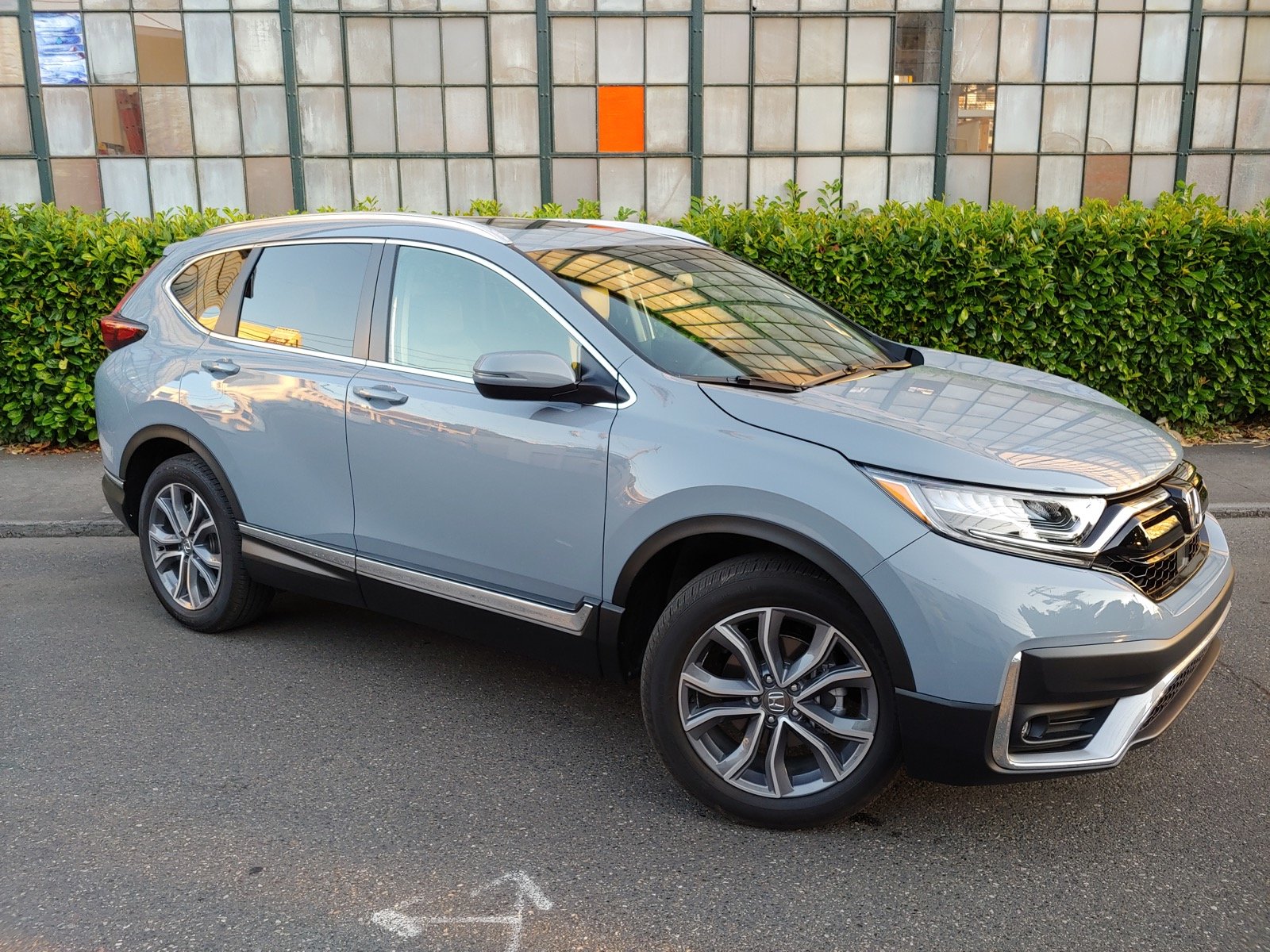
In contrast, the 2020 Honda CR-V, part of the fifth generation of Honda’s compact crossovers, presented a familiar and fun design with curvy, car-like lines. Its exterior resembled Honda’s sedan lineup, offering a modern family transportation aesthetic. Inside, the CR-V's interior was a mix of textures and materials, with upscale touches like wood-look trim and leather upholstery in higher trims, but also some low-quality plastics. The CR-V was available in five trim levels, with the base LX starting at $29,970 Canadian. It featured a standard 1.5-litre turbocharged engine across all trims, with AWD available on all but the base model. The CR-V's design emphasized practicality, with a spacious interior and clever storage solutions, making it a versatile choice for families.


The 2019 BMW X5 excelled in performance, thanks to its smooth turbocharged inline six-cylinder engine in the xDrive40i, delivering 335 horsepower and 330 pound-feet of torque. The eight-speed ZF automatic transmission was praised for its efficiency and smooth gear changes, contributing to an impressive fuel economy of 11.7 litres per 100 kilometres in the city and 9.1 on the highway. The xDrive50i variant offered even more power with a twin-turbo 4.4-litre V8, producing 456 horsepower and 479 pound-feet of torque, achieving 100 km/h in around 4.7 seconds. The X5's ride quality was enhanced by its Cluster Architecture platform, combining steel, aluminum, and carbon fibre for strength and performance. The optional air suspension allowed for adjustable ride height, improving both cargo loading and aerodynamics.
The 2020 Honda CR-V featured a 1.5-litre turbocharged engine standard across all trims, producing 190 horsepower and 179 pound-feet of torque, paired with a CVT. While CVTs often have a reputation for sluggishness, Honda's implementation provided a responsive and efficient driving experience, especially in Sport mode. The CR-V's car-like handling was complemented by its low curb weight, ranging from 1,521 to 1,641 kilograms, contributing to its nimble road manners. Fuel efficiency was a strong point, with FWD models rated at 7.7 litres per 100 kilometres combined, and AWD models at 8.1, making it one of the most efficient non-hybrid options in its class.
Inside the 2019 BMW X5, the design shifted to aggressive angles and dual 12.3-inch screens for the iDrive infotainment system. While the design was appealing, some materials felt less premium unless upgraded. The seating comfort was mixed, with some difficulty in finding the right position and a lack of ventilation in the upgraded leather seats. However, space was ample, with generous head and legroom in the front and second rows. The cargo area offered 960 litres, expandable to 2,047 litres with the seats down, and the air suspension facilitated easier loading. The X5 could tow up to 3,000 kilograms when properly equipped.
The 2020 Honda CR-V was lauded for its masterful packaging, offering a spacious cabin comparable to larger vehicles like the Volkswagen Tiguan. The seating position provided excellent visibility, and the cargo area was versatile, with a two-position load floor and up to 1,110 litres of space with the rear seats folded. Clever storage solutions, such as a deep centre console and large door pockets, enhanced practicality. The CR-V's design made it easy to accommodate various needs, from family trips to daily commutes.
The 2019 BMW X5's technology offerings were somewhat disappointing. The gesture control was inconsistent, and the iDrive interface, while well-designed, was less customizable than competitors. The driving-assistance features, including Level 2 autonomy, were problematic at high speeds, with issues in lane-keeping and overcorrection. However, the adaptive cruise control and stop-and-start traffic feature were praised. Optional features like Parking Assistant Plus and a Harman Kardon stereo added value, but the overall tech experience was mixed.
In contrast, the 2020 Honda CR-V's infotainment system showed its age, with a standard 7-inch touchscreen that felt small compared to competitors. The lack of hard buttons made it challenging to operate, and while Apple CarPlay and Android Auto were standard, they felt tacked on. However, the CR-V offered ample USB ports and a wireless phone charger in higher trims, catering to modern connectivity needs.
The 2019 BMW X5 featured a new brake-by-wire setup, providing a nearly natural feel. It received a four-star rating from the NHTSA, with five stars in side crash tests, and was named a Top Safety Pick+ by the IIHS, with top scores in all tests.
The 2020 Honda CR-V came standard with the Honda Sensing suite, including forward-collision warning, lane departure warning, and adaptive cruise control. It earned five stars from the NHTSA and a Top Safety Pick designation from the IIHS, with LED headlights improving visibility in higher trims. A recall for a rear subframe issue affected a small number of vehicles.
CarGurus highlights

According to CarGurus experts, the overall rating for the 2019 BMW X5 is 7.8 out of 10, while the 2020 Honda CR-V scores 7.5 out of 10. Based on these ratings, the BMW X5 is recommended for those seeking a more luxurious and performance-oriented vehicle, while the Honda CR-V remains a strong choice for practicality and efficiency.
Choose the 2020 Honda CR-V if:
- You seek a practical and spacious vehicle with excellent fuel efficiency.
- You want a family-friendly crossover with clever storage solutions and ample interior space.
- You prefer a vehicle with comprehensive standard safety features and a strong safety record.


Choose the 2019 BMW X5 if:
- You prioritize a powerful and smooth driving experience with advanced engine options.
- You need a vehicle with substantial towing capacity and versatile cargo space.
- You value a premium feel with optional luxury features and a sophisticated design.


CarGurus highlights
According to CarGurus experts, the overall rating for the 2019 BMW X5 is 7.8 out of 10, while the 2020 Honda CR-V scores 7.5 out of 10. Based on these ratings, the BMW X5 is recommended for those seeking a more luxurious and performance-oriented vehicle, while the Honda CR-V remains a strong choice for practicality and efficiency.
Choose the 2020 Honda CR-V if:
Shop Now- You seek a practical and spacious vehicle with excellent fuel efficiency.
- You want a family-friendly crossover with clever storage solutions and ample interior space.
- You prefer a vehicle with comprehensive standard safety features and a strong safety record.
Choose the 2019 BMW X5 if:
Shop Now- You prioritize a powerful and smooth driving experience with advanced engine options.
- You need a vehicle with substantial towing capacity and versatile cargo space.
- You value a premium feel with optional luxury features and a sophisticated design.

By: CarGurus + AI
At CarGurus, our team of experienced automotive writers remain at the heart of our content operation, conducting hands-on car tests and writing insightful guides that are backed by years of industry experience. To complement this, we are harnessing AI to make our content offering more diverse and more helpful to shoppers than ever. To achieve this, our AI systems are based exclusively on CarGurus content, ratings and data, so that what we produce is both unique to CarGurus, and uniquely helpful to car shoppers.
