2026 Toyota Prius Plug-In Hybrid Reviews, Pricing & Specs


Pros & cons
What we like
Stylish design
Fuel-efficient
Great handling
What to consider
Cheap interior materials
Lack of headroom for taller drivers
Not much cargo space
Expert review
A plug-in hybrid powertrain makes Toyota’s eco icon even greener.
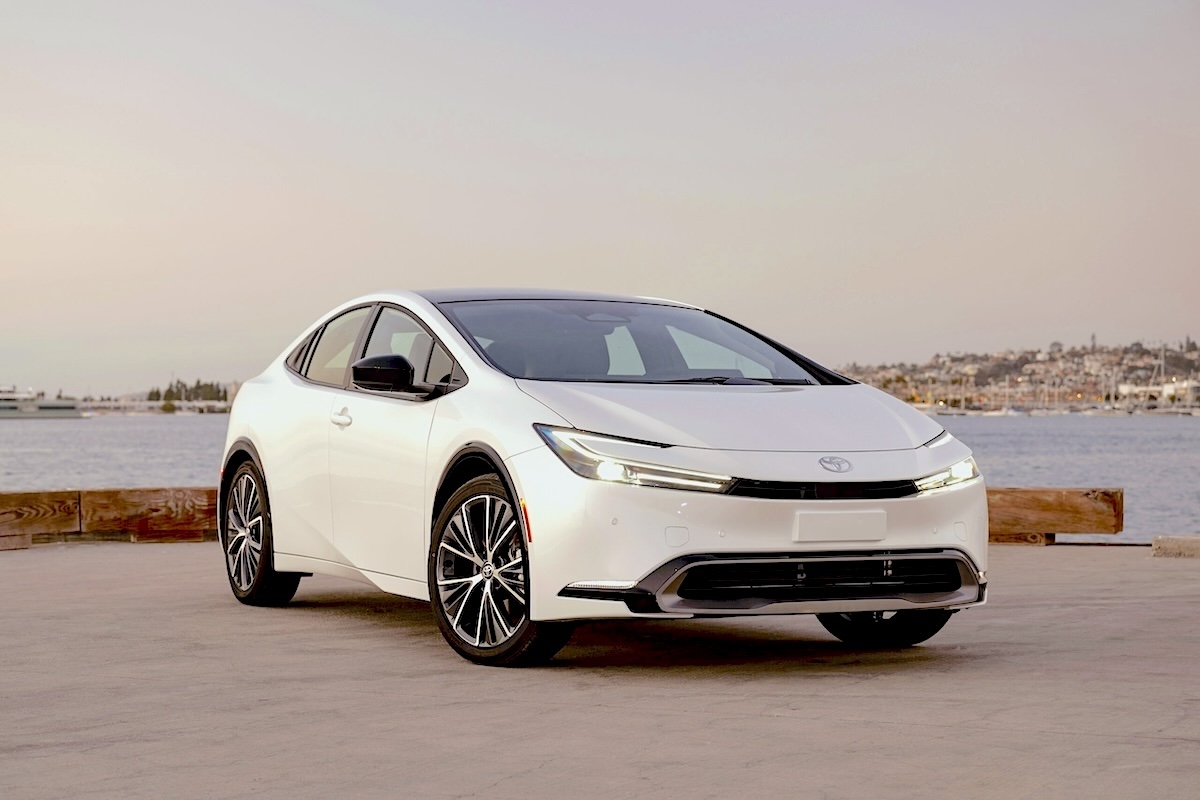
The Toyota Prius Plug-In Hybrid is, as the name states, a plug-in hybrid version of the seminal Toyota Prius, further boosting efficiency with up to 72 kilometres of all-electric driving range. This model was known as the Toyota Prius Prime up to the 2025 model year, and for 2026 a new Nightshade package joins the lineup. While other mainstream brands like Hyundai and Kia offer plug-in hybrids, the Prius stands out with svelte styling.
Verdict: A stylish alternative to other plug-in hybrids and an efficient commuter car, the Prius Plug-In Hybrid is let down by a chintzy interior.
out of 10 expert review
Look & feel
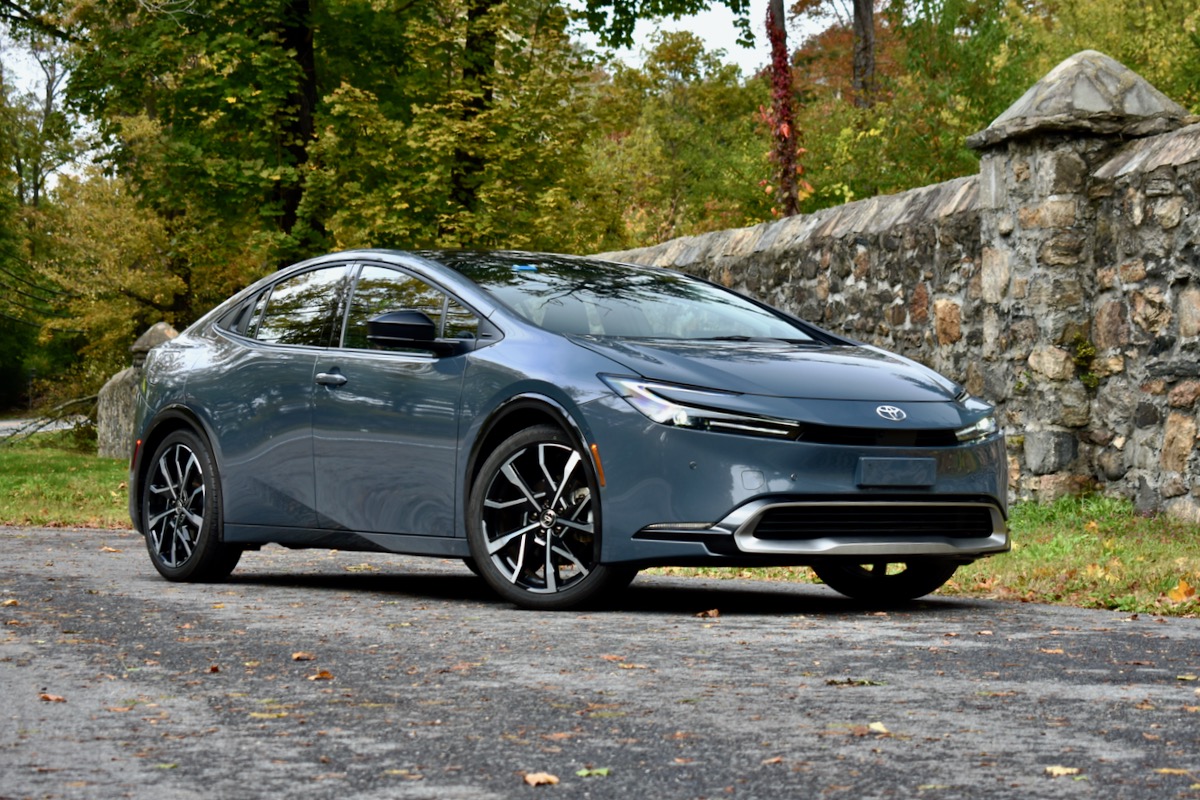
Even three model years after its introduction, it’s still hard to believe this is a Prius. The fifth generation of Toyota’s hybrid icon made a clear break from the awkward styling of previous generations. From its pointed nose and swept-back windshield to its stretched wheelbase and low roofline, it’s a hybrid hatchback that wishes it was a supercar. Perhaps just as important as the overall shape, Toyota kept extraneous detailing to a minimum. The cacophony of lines from the previous generation is no more. Even the LED headlights and taillights are reduced to elegant shapes.
Toyota has gone back and forth about giving plug-in hybrid models different styling. The original Prius Plug-In Hybrid (from model years 2012 to 2015) shared sheet metal with the standard Prius, but the Prius Prime that followed it (from model years 2017 to 2022) got a unique look. The current Prius Plug-In Hybrid (nee Prime) reverts to shared styling. The only differences are badging and an extra hatch (on the passenger side) for the charge port.
For the 2026 model year, the Prius Plug-In Hybrid gets the Nightshade package treatment. Also available on several other Toyota models, the Nightshade package brings darkened exterior trim — in this case including black badging, door sills, bumper trim, door handles, and 19-inch wheels. The Nightshade package is based on the XSE trim level and adds $895 to that model’s MSRP. The full lineup includes SE, XSE, and XSE Premium trim levels.
Our test car is a top XSE Premium. While the cabin is feature-rich, it doesn’t exactly live up to its “premium” billing. Red swatches on the SofTex artificial leather upholstery and the air vents are the only hint of colour, and the array of plastic trim pieces is unremarkable. The interior does have an unusual look with a small gauge cluster similar to the one in the all-electric Toyota bZ and a wing-like dashboard. However, that futuristic design is brought down by the rideshare-grade materials.
Performance
Toyota previously used Prius Prime badging for this model because it not only dialed up efficiency but also power. That’s still true of the 2026 Toyota Prius Plug-In Hybrid, which is mechanically unchanged from its last redesign for the 2023 model year.
The plug-in hybrid model uses a version of the Toyota hybrid system from the standard Prius. A 2.0-litre four-cylinder engine running on the more efficient Atkinson cycle is connected to what Toyota calls an “electronically controlled continuously variable transmission” or “eCVT.” However, it has nothing to do with the CVTs found in other cars, which rely on belts to provide the equivalent of various gear ratios (hence the name). Here, a pair of electric motors — one helping to propel the car, the other serving as a generator — work through a planetary gearset, replacing a conventional multi-speed transmission.
The plug-in hybrid has a larger 13.6-kilowatt-hour battery pack and a total system output of 220 horsepower, which is about 25 hp more than the Prius without a plug. Toyota also says the Prius Plug-In Hybrid will do zero to 100 km/h in 7.2 seconds. However, this version isn’t available with all-wheel drive (AWD) like the standard Prius. It’s front-wheel drive (FWD) only.
The driving experience defies Prius stereotypes but not as positively as the exterior design. In hybrid mode, the Prius Plug-In Hybrid feels as quick as the specs suggest, meaning it won’t hold up traffic but isn’t exactly a tire-shredding performance car. The gasoline engine cuts in seamlessly but with an exhaust note that makes it sound like it’s labouring harder than it is. In electric mode, the gasoline engine doesn’t cut in even when flooring it. This would normally be a good thing, but acceleration also trails off significantly past initial pedal tip-in.
Our XSE Premium test car has taut-feeling suspension with impressive body control and a well-damped feel on most road surfaces. However, the dampers are no match for big bumps and more severe road imperfections, and the XSE Premium’s 19-inch wheels don’t help. The suspension combines with quick steering to give the Prius Plug-In Hybrid a surprisingly playful feel, albeit with a floaty quality that compromises handling precision a bit. Strong regenerative braking (for a plug-in hybrid) got us close to one-pedal driving in stop-and-go traffic, but that wasn’t the case at higher speeds.
Form & function
The Prius is an outlier among plug-in hybrids from mainstream brands, which tend to limit these powertrains to crossover SUVs or something close. That makes for a very different kind of experience, although given the nameplate’s history, that’s likely what many Prius customers are expecting.
The Prius Plug-In Hybrid is longer than a Kia Niro PHEV in both overall length and wheelbase, but the Kia is wider and taller. That translates to less headroom across both rows compared to the Kia. While the Toyota has more front seat legroom, the Kia has substantially more space in the second row. The 575 litres of cargo space behind the rear seats is about the same as in the Niro, but fold the back seats and the 756 litres available trails the Niro dramatically. A 60/40 split-folding bench is standard, and a power tailgate is added on the XSE Premium trim level.
If you’re not looking at one of these two plug-in hybrid models, other choices are more traditional crossovers such as the Hyundai Tucson, Kia Sportage, Mitsubishi Outlander, or Toyota’s own RAV4. The Prius is the exact opposite of those high-riding vehicles. Its laid-back driving position brings to mind mid-engine sports cars. You sit low to the ground with a panoramic view of the road ahead through the windshield. That windshield picks up reflections of dashboard lights at night, though, and the steering wheel needs to be pretty much in your lap to see the instrument cluster. But even with those trade-offs, this is a lovely way to drive, one that makes you feel more connected to the road.
The centre console storage bin is small, but that’s not unusual for a regular car. The cupholders are reasonably sized, but the driver’s drink will be rubbing shoulders with the compact shifter. Toyota also includes a large phone tray, but it doesn’t have wireless charging. For that, you need to insert your phone into the available slot in the side of the console.
Technology
A 7-inch digital instrument cluster is standard on all 2026 Toyota Prius Plug-In Hybrid models along with wireless Apple CarPlay and Android Auto compatibility and over-the-air (OTA) update capability. An 8-inch infotainment touchscreen is standard on SE models, while a 12.3-inch touchscreen is standard on the XSE (including the Nightshade package) and XSE Premium. That top model also gets an eight-speaker JBL audio system in place of the unbranded six-speaker system in other models.
Like other Toyota infotainment systems, this one performs quite well in part because its features are limited. Toyota wasn’t as ambitious with the tech as it was with the styling, but that means you don’t have to go hunting through on-screen menus to find what you need. Analog climate controls are a big plus, and while the screen is tilted away from the front passenger, they at least get easier access to the volume knob. There’s a steering wheel control for the driver that proved crucial as our test car’s JBL sound system had a very narrow envelope between being too quiet and too loud.
Natural language voice recognition and cloud-based navigation with Google-sourced points of interest are available as a three-year free trial on models with the larger screen. Beyond that, or if you opt for the SE model, a subscription to the Drive Connect data plan is required to access these features. Digital key functionality is also standard on the XSE Premium, but only with an active subscription to the Remote Connect plan, which also comes with a three-year trial.
A 360-degree camera system and digital rearview mirror are both exclusive to the top XSE Premium model, but they felt like necessities due to the small rear window and a hood that’s hard to see the end of from behind the wheel.
Safety
The standard Toyota Safety Sense 3.0 suite of driver assist features includes: forward collision warning (with pedestrian and cyclist detection), automatic emergency braking, adaptive cruise control, lane departure warning (with steering assist), blind spot monitoring, rear cross-traffic alert, traffic sign recognition, and automatic high beams. Also included are Lane Tracing Assist, which provides steering input to help keep the car centred in its lane, traffic jam assist, and Proactive Driving Assist, which helps maintain a set distance from vehicles ahead even when adaptive cruise control isn’t engaged.
Front cross-traffic alert and lane change assist are standard beginning at the XSE grade along with front and rear parking sensors.
The Insurance Institute for Highway Safety (IIHS) didn’t have complete ratings for the 2026 Toyota Prius Plug-In Hybrid at the time of publication. The identical 2025 model received top “Good” ratings in the small overlap front and updated side-impact crash tests as well as for the performance of its front crash prevention tech, and its headlights received an “Average” rating.
The U.S. National Highway Traffic Safety Administration (NHTSA) also hadn’t released 2026-model-year ratings at the time of publication, but it gave the 2025 model a five-star overall safety rating with five stars in side and rollover testing and four stars in frontal crash testing.
Cost-effectiveness
The main reason to choose a Prius Plug-In Hybrid over the standard version is its Natural Resources Canada-estimated EV range of up to 72 kilometres for SE models and 64 kilometres for the other trim levels. That’s enough to cover daily trips for many drivers, so if you can charge at home, it’s possible to really stretch the time between visits to the gas station. Toyota estimates it takes four hours to fully recharge at a 240-volt Level 2 charging station, and that is easily achievable in our experience. However, even the 11-hour estimated charge time from a standard 120-volt household outlet means overnight recharges are achievable.
In hybrid mode, the Prius Plug-In Hybrid is expected to get 4.5 litres per 100 kilometres combined in SE trim or 4.9 L/100 km combined in other specs. We regularly saw 16.8 kilowatt hours per 100 kilometres in electric mode, which shows the Prius is efficient no matter what power source is being used, along with an indicated 4.0 L/100 km that factors in the kilometres driven under electric power.
Like other Toyota models, the Prius Plug-In Hybrid is backed by a three-year/60,000-kilometre new vehicle warranty and five-year/100,000-kilometre powertrain warranty. An additional eight-year/160,000-kilometre warranty covers hybrid-system components, while a 10-year/240,000-kilometre warranty covers the battery pack. The battery warranty is also transferrable to subsequent owners.
Pricing in Canada for the 2026 Toyota Prius Plug-in Hybrid starts at $43,094 for the SE base model (all prices include a mandatory $1,860 destination charge and other fees). The XSE is priced at $47,829 (and the Nightshade package adds $895 to that price), while the XSE Premium costs $51,579. These prices allow the Prius Plug-in Hybrid to qualify for provincial and territorial EV rebate programs where they still exist. The most expensive Prius without a plug, the Prius Limited, starts at $47,324. Note that all-wheel drive is standard on standard Prius models in Canada but is not available with the plug-in hybrid powertrain.
Compared to other plug-in hybrids, the Prius is a good value. The well-equipped XSE Premium costs less than a base Hyundai Tucson Plug-In Hybrid but offers more electric range, for example. For 2026, the Toyota RAV4 plug-in hybrid gets an estimated 80 kilometres of electric range and more trim options, but it’s unlikely to cost less than the Prius. So, for new car buyers who want to save fuel with style, it’s hard to beat this iconic nameplate.

What owners say
Trims & specs
Base MSRP $33,775 | Seating 5 |
Engine N/A | Cargo Capacity 20.3 cu ft |
Combined MPG N/A | Drivetrain N/A |
Base MSRP $37,025 | Seating 5 |
Engine N/A | Cargo Capacity 20.3 cu ft |
Combined MPG N/A | Drivetrain N/A |
Base MSRP $37,795 | Seating 5 |
Engine N/A | Cargo Capacity 20.3 cu ft |
Combined MPG N/A | Drivetrain N/A |
Base MSRP $40,470 | Seating 5 |
Engine N/A | Cargo Capacity 20.3 cu ft |
Combined MPG N/A | Drivetrain N/A |


Pricing trends
MSRP range
$33,775 - $40,470
Current avg. market price
$39,325
Trending down by 4.1% this month
May 2026 - October 2026