2026 Rivian R1T Reviews, Pricing & Specs


Pros & cons
What we like
Impressive off-road abilities
Fun to drive
Smart cargo and storage solutions
What to consider
Unintuitive technology
No Apple CarPlay or Android Auto
The CarGurus verdict
Justifying a price tag north of $130,000 isn't easy, but the Rivian R1T does.
The Rivian R1T, Rivian’s first product, continues to impress with great driving dynamics, tech, and practicality. This review is based on the priciest Quad version, but dual-motor and tri-motor versions are also available along with Standard Pack, Large Pack, and Max Pack options, at lower prices. No version of the R1T is cheap, but the same can be said for most other electric trucks.
Verdict: With an absurd amount of power, pleasing on-road manners, and nearly unstoppable off-road abilities, the 2026 Rivian R1T Quad is easily one of the best vehicles we've driven — but it’s not cheap.
out of 10 expert review
Look & feel
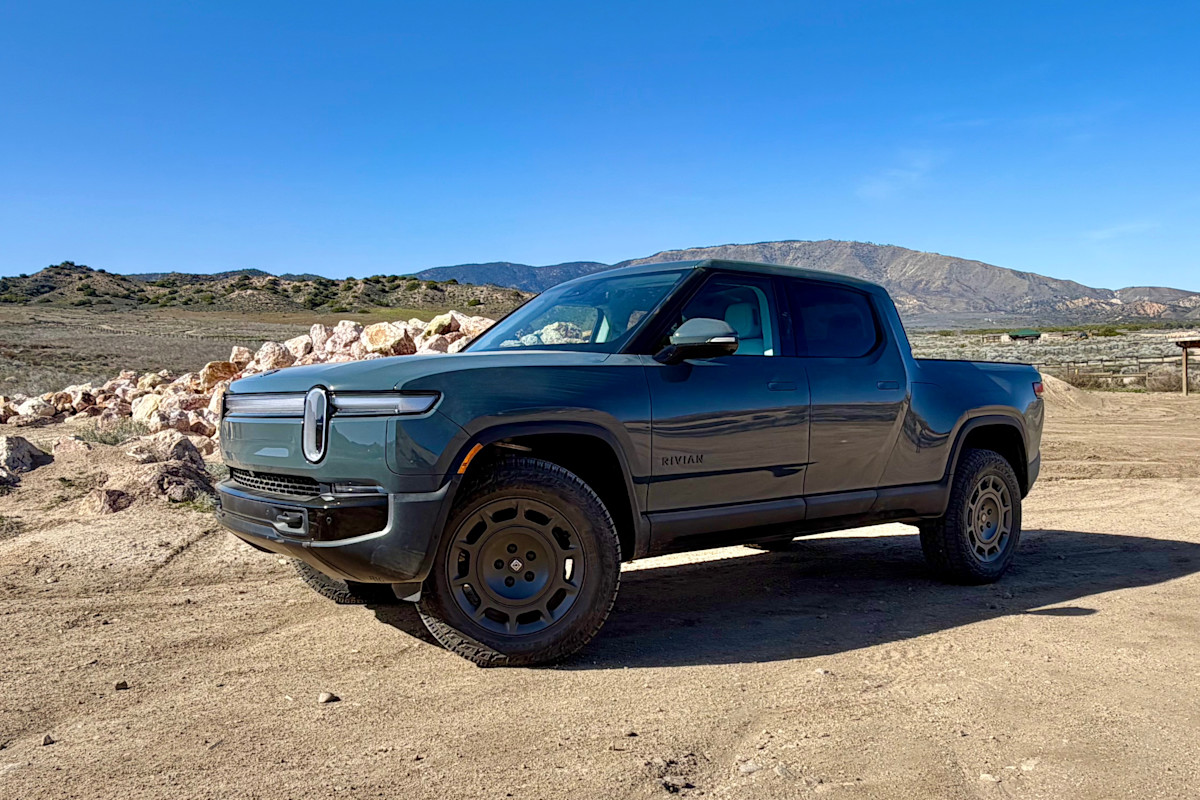
While the 2026 Rivian R1T has classic pickup truck proportions, it has a uniquely modern take on styling. Its rounded corners give it a sleeker, less broad-shouldered feel than the average pickup, while the distinctive ovoid headlights set it apart from anything else on the road. There's a certain charm about the front fascia and its friendly robot vibes that tends to draw people in rather than intimidate them.
From the side, the R1T continues the sleek design language with flush-mounted door handles, while the air suspension can vary its ride height by a sizable margin. At its highest setting, the R1T looks like it can conquer any terrain on the planet, while in the lowest setting it looks sporty and hunkered down. The body panels feature subtle creases and sculpting to maintain a clean look, which is echoed around the back. A single, bold taillight spans the tailgate, and our particular R1T didn't shout that it was the top quad motor variant. Instead, it has tasteful hints in the R1T badge, as well as Rivian's orange Yeti-like mascot "Gear Guard Gary."
The R1T's interior is comparable to many other EVs with a stark cockpit featuring very few physical buttons or knobs. The dashboard is dominated by a beautifully carved wood section that adds warmth to the entire cabin. Our optional Slate Sky and Walnut Wood palette blended rustic charm with modern perfection and had us admiring it tactilely as much as visually.
The synthetic leather upholstery clearly isn’t the genuine article, but it looks and feels sturdy, suggesting durability and longevity. The backs of the seats feature a coarse textile that reinforces a sense of durability while remaining more refined than the same material used elsewhere in the cabin. Even the floor mats deserve a shout out as the widely spaced plaid pattern reminded us of a well-worn flannel shirt. The coarse weave also did an amazing job of hiding dirt and dust after a long day of off-roading.

Performance
There are few, if any, vehicles with the versatility of the Rivian R1T Quad Motor. With one electric motor for each wheel, it produces an otherworldly 1,025 horsepower and 1,198 pound-feet of torque. It also goes well beyond the typical all-wheel drive (AWD) drivetrain. The tri-motor powertrain makes a still-impressive 850 hp and 1,103 lb-ft of torque, while the entry-level dual-motor models produce between 533 and 665 hp, and 610 to 829 lb-ft.
With those kinds of specs, it’s no wonder the R1T Quad is blindingly quick, and it beats the Tesla Cybertruck with a claimed 0-100 km/h time of 2.7 seconds. This feat is only possible with the 22-inch Super Sport wheels and Michelin Pilot Sport tires, but even with beefy all-terrain tires, acceleration was breathtaking. We noticed the tires rubbing against the fender liners at the vehicle's lowest ride height when turning as sharply as possible during parking maneuvers, but that's a very small price to pay for its off-road abilities.
The R1T doesn't require the driver to know much about off-roading. Buyers really only need to select the appropriate drive mode, and the system takes care of all the adjustments. For more experienced terrain nerds, the RAD Tuner screen allows for an impressive level of adjustments for power delivery, wheel slippage, ride height, steering, and suspension stiffness/compliance. On the same course where we’ve tested other off-road rigs, the R1T scaled a steep and deeply rutted hill with ease thanks to 37.8 centimetres of ground clearance. The Ford Bronco Raptor made the same climb but required us to select low range from the transfer case, lock the differentials, and disconnect the front stabilizer bar with a series of button pushes. The R1T also has a Kick Turn feature that allows it to pirouette in place as the left and right wheels spin in opposition to each other. This has some limited use on tight trails, but we're convinced it's more of a cool party trick. That's not to say we didn't thoroughly enjoy the absurd novelty, though.
As capable as the R1T is off-pavement, it doesn't sacrifice on-road manners. It rides more smoothly than traditional pickup trucks, though there's still some slight bounciness from the rear suspension with the bed unloaded. It also tracks straight on the highway with no intervention needed to keep it centred in its lane. Bumps are smoothed over, and the only noise we heard on the highway was a slight whistling from the mirrors. The R1T also corners with more confidence than a typical truck, thanks in large part to having the heavy battery pack mounted low in the floor as well as clever suspension and torque vectoring.
As for range, the Quad returns a Natural Resources Canada-estimated 415 to 676 kilometres of range depending on wheels, tires, and options. The dual motor version is the range leader with up to 676 km on a single charge. All R1Ts are capable of DC fast charging at up to 220 kilowatts, which should bump the charge from 10% to 80% in 30 to 40 minutes depending on the size of the battery. The 2026 R1T has a Tesla-derived North American Charging Standard (NACS) charge port, and drivers can access the Tesla Supercharger network.

Form & function
The Rivian R1T has plenty of space in the front or rear seats for larger adult passengers, and the sense of spaciousness is enhanced by the large, upright windows. The panoramic glass roof further adds a sense of airiness and features electrochromic dimming to switch between mostly transparent and opaque at the touch of a button. We'd prefer a traditional sunshade to keep the midday sun at bay, but the dimming works well enough.
The R1T really shines when it comes to cargo hauling. The 4.5-foot bed is equivalent to that of a midsize truck like the Toyota Tacoma, but clever engineering makes it more versatile and useful. The 127-centimetre space between the wheel humps facilitates laying sheets of plywood or drywall flat, but transporting them means they'll need to be strapped down or angled against the upright tailgate. A gooseneck hinge in the tailgate allows it to extend further aft than buyers might expect, and Rivian claims it's long enough to accommodate a dirt bike. The R1T has a payload rating of up to 800 kilograms (1,764 pounds) and can tow up to 4,990 kilograms (11,000 pounds), but expect range to plummet when towing.
The tailgate can be remotely lowered, but shutting it requires some muscle. Under the composite bed is a full-size spare, which is especially helpful when off-roading. A powered tonneau cover is standard equipment on the tri-motor trim and above, greatly improving aerodynamics on the highway. Sturdy tie-down cleats add more utility, as do the integrated air compressor and power outlets.
Between the bed and rear doors is a large gear tunnel that could be a perfect place for items such as tripods, snowboards, or camping gear. It's well hidden behind a large flip-down panel that can support up to 113 kilograms (250 pounds), which means it can be used as a step to access the bed or roof. There's also an 311-litre frunk, but it has a rather tall liftover height since only the hood opens, which means reaching over the front fascia. There's adequate but not generous storage for personal items inside. The door and seatback pockets are notably narrow, while the other bins and cupholders are about average.

Technology
The Rivian R1T's infotainment system is very advanced and packed with features, but it's not very intuitive for new users. The sheer depth of its capabilities can be intimidating at first, but it begins to make more sense with time, much like the first time you used a smartphone or a tablet. Almost all functions are controlled via the touchscreen, including the most basic items. Adjusting the steering wheel and mirrors requires a few screen taps and then using the unmarked buttons and roller knobs on the steering wheel. It seems needlessly complicated, but most owners will only have to deal with it once.
This is one of the few vehicles where we needed to consult the owner's manual to figure out how to work certain features. At least it’s built right into the infotainment system and has a very handy search function. Across the bottom of the display are anchored controls for climate and customizable shortcuts for your most commonly used features.
Rivian doesn't offer Apple CarPlay or Android Auto, which made us realize how much some users rely on phone integration. Not having all your contacts and content in an easily accessible and familiar interface is an inconvenience. Rivian is working on alternatives including its own texting feature, which will debut in the new Rivian R2 and could make it to the R1T via a software update.
The 16-speaker premium audio system in our Quad tester fills the cabin with potent bass, and the high notes don't fall apart when the volume is cranked up. This is especially impressive since we were only using a Bluetooth connection to our phone to stream music, and we were able to charge it with one of the dual wireless charging trays that’s standard on all R1T models.

Safety
The U.S. National Highway Traffic Safety Administration (NHTSA) had not released crash test results for the Rivian R1T at the time of writing. The Insurance Institute for Highway Safety (IIHS) awarded its highest score of "Good" in its small frontal overlap and side impact tests and its second-best score of "Acceptable" in the newer moderate frontal overlap evaluations. It named the R1T a Top Safety Pick for the 2025 calendar year, the institute's second-highest honour.
Standard driver assistance features include forward collision warning with automatic emergency braking, adaptive cruise control, lane keep assist, blind spot monitoring with rear cross-traffic alert, a surround-view camera system, parking proximity sensors, and the hands-on Highway Assist system. Owners also receive a limited free trial of Rivian Autonomy+, a hands-free highway driving system.
All these systems functioned just as they should during our time with the R1T. The Autonomy+ driving system is particularly well executed as it stays centred within its lane and smoothly maintains a consistent following distance to vehicles ahead. Our only minor complaint is the parking proximity sensor display is in the instrument panel, making it difficult to see when the steering wheel is turned.

Cost-effectiveness
Prices in Canada for the 2026 Rivian R1T start at $136,107 (including $2,695 in destination charges and other fees) for the entry-level dual-motor version with the Standard Pack battery. The top Quad motor model we evaluated has a starting price of $194,107, and with the optional Storm Blue paint and the Slate Sky/Walnut Wood interior ($4,400 each), its as-tested price rises to $202,907. Not only does the R1T not qualify for any EV rebates, but buyers need to pay the federal luxury tax on the portion of the price above $100,000. This makes the R1T an especially expensive proposition in the Canadian market.
For buyers who need more seats, the Rivian R1S SUV is nearly identical in terms of specs but costs a few thousand dollars more.
The GMC Hummer EV is the most direct competitor among all-electric pickup trucks, with starting prices from just under $135,000. It's quite a bit wider and heavier than the R1T, and that's noticeable from behind the wheel. It's also one of the least efficient EVs on the market, but it’s wildly powerful and seriously capable off-road (though not through narrow obstacles).
The Ford F-150 Lightning is significantly less expensive and is estimated to return up to 515 kilometres of range, but it was discontinued at the end of 2025. The Chevrolet Silverado EV is priced competitively with the Lightning (to start, at least) and estimated at a maximum range of 793 km.
As much as we're fans of the Rivian R1T Quad, we realize it's out of reach for most shoppers, and the more sensibly priced versions still offer great performance. That said, this $200,000 truck is one of the quickest and most capable vehicles we've ever driven.