2026 Hyundai Elantra N Reviews, Pricing & Specs


Pros & cons
What we like
Engaging and powerful
Impressive grip and steering
Useful performance tech and snug seats
What to consider
Front axle fails to prevent axle hop and torque steer
Imprecise clutch
Plastic-heavy interior
The CarGurus verdict
Hyundai's raucous tuner car has learned some manners since its introduction, and it's now more fun to drive.
In Canada, there are five new compact cars on sale today for less than $50,000 that pack powerful turbocharged engines and performance upgrades. The Hyundai Elantra N, as one of the most affordable, transforms an ordinary small car into a thrilling sports sedan with a high level of power and poise that can be safely extracted on a public road.
As a noisy lowered car with a thirst for high-test gas, the Elantra N appeals solely to enthusiasts who want a track-tuned model from the factory at an affordable price. Despite some obvious faults, the latest Elantra N has been much improved since its first model year in 2022. Remarkably, it’s even better with an automatic transmission.
Verdict: Serious performance at an enticing price.
out of 10 expert review
Look & feel
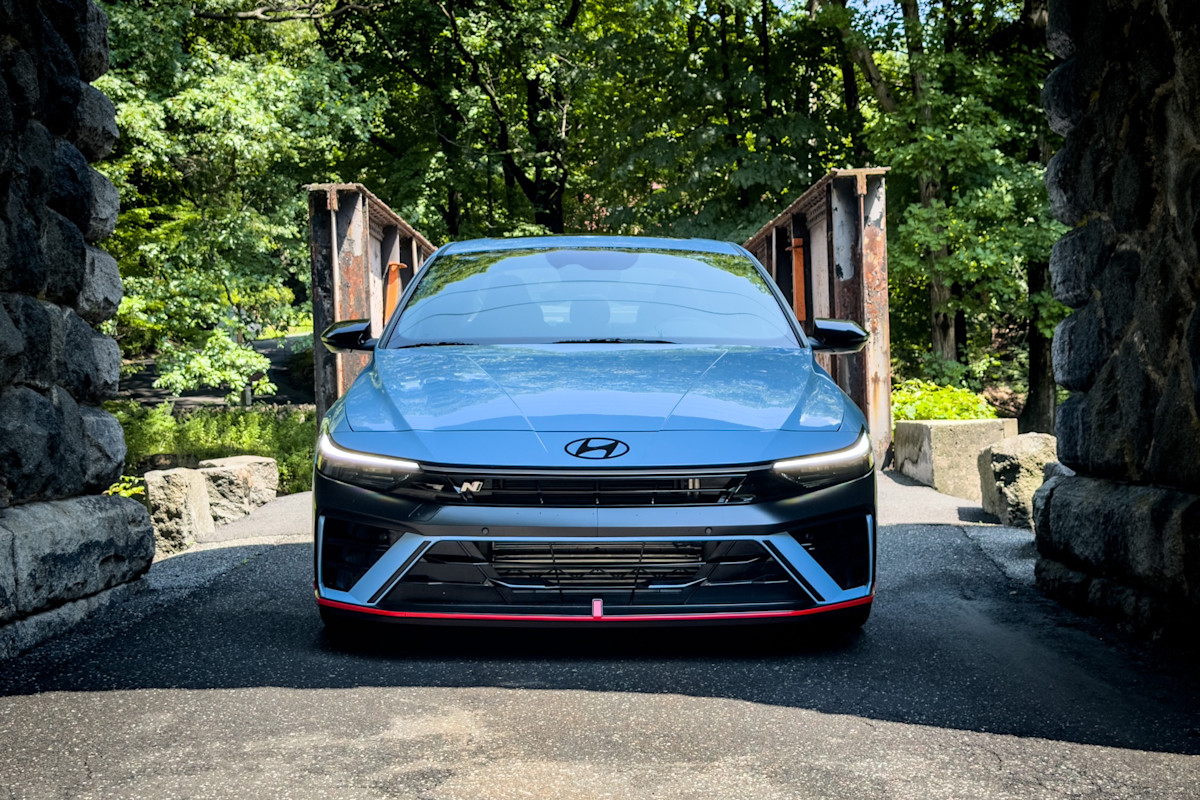
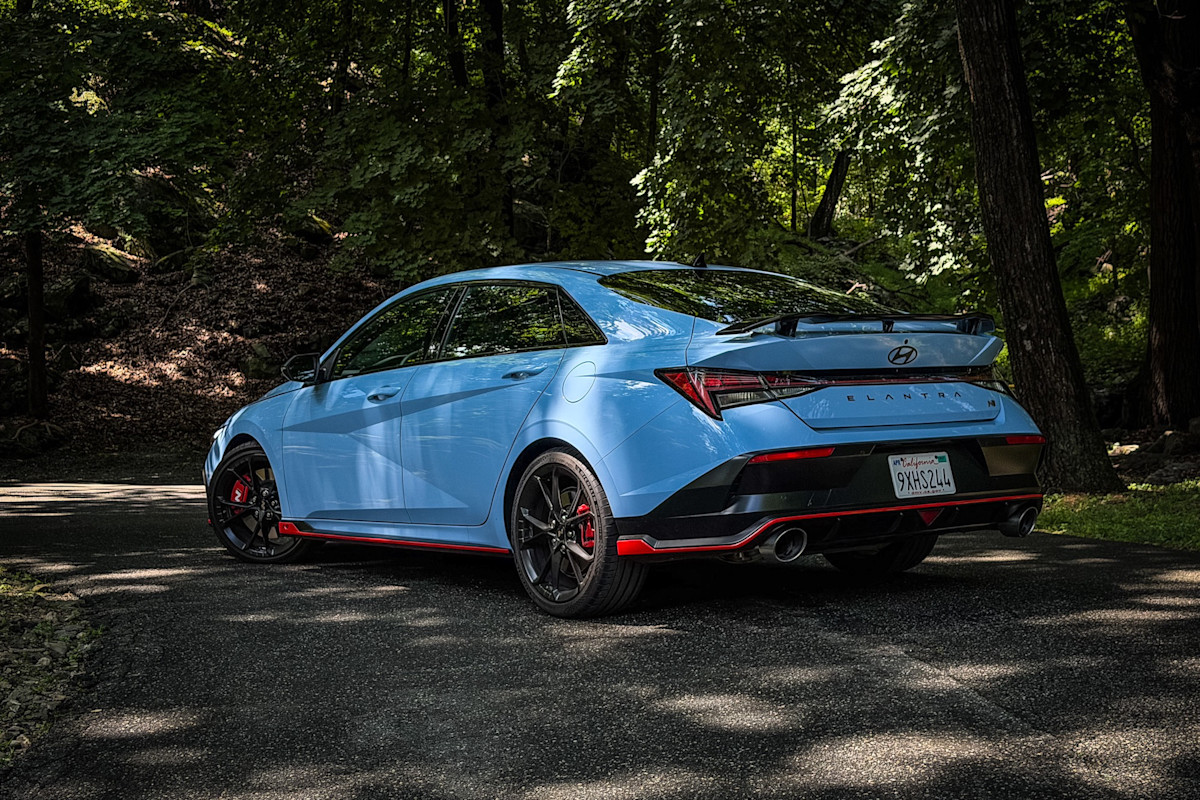
Styling doesn’t change for 2026, meaning the Elantra N remains as polarizing as ever. A new nose for 2024 gave the Elantra N a sleeker and slipperier appearance (and improved airflow), but this sedan is still festooned with a comical number of slashes, creases, and jagged edges that mean the design will likely age rapidly. We praise Hyundai for being original, but were we invited to consult for the next-generation Elantra, we would strongly advise the designers to tone things down.
Still, this is a distinctive model meant for people who don't want to disappear in a boring car. All the sills, spoilers, and window trim are gloss black with red accents. The exhaust outlets are wide. The forged wheels and red brake calipers are the classiest bits. These extraneous lines disappear into the paint in dark colours, but they're in plain sight in Hyundai's Performance Blue, and it's a perfectly proportioned small sedan. Aside from the Volkswagen Golf R, there isn't a competitor that looks polished or expensive, to be fair. They all come off cheap, even though the added vents and aero are there for a purpose.
Inside, the Elantra N keeps every plastic surface from the base Elantra, including a passenger grab handle that's as hard as a broomstick. Hustle along and the driver's knees knock against hollow and unforgiving plastic. The dashboard is no better as it creaks and groans in reaction to any imperfect road surface. Other performance cars in this class feel like they won't become instant rattle traps. Honda, Acura, Volkswagen, and Toyota do a superior job with construction, but most competitors from those brands are significantly pricier. Buyers should take that into consideration when purchasing an Elantra N and ask if they're here for a good time or a long time.
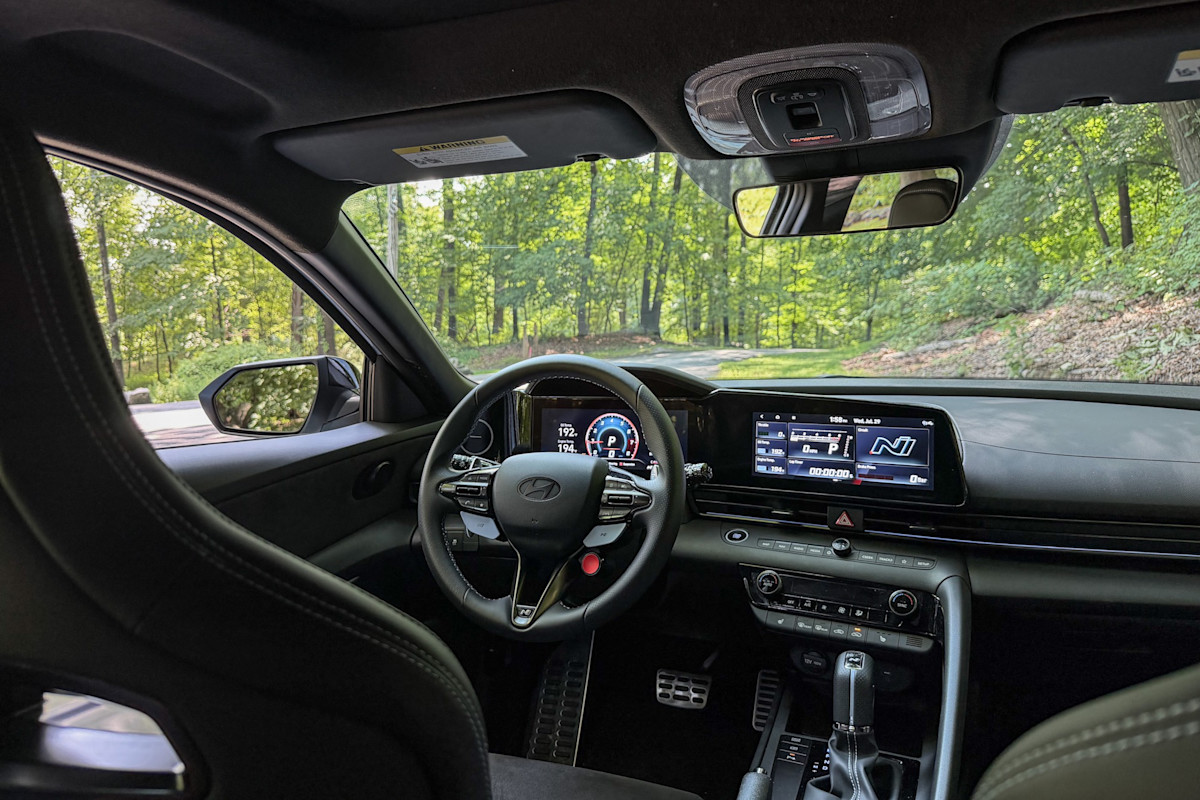
The interior design itself is elevated with a canted centre stack, two crisp displays, and plenty of analog controls. One-piece Alcantara front seats with glowing backrests, a leather-wrapped steering wheel with BMW-like drive buttons, and a hefty shifter are where the money was spent. But the competition matches the Elantra N with these specialty items while doing a notably better job with the rest of their cabins.
Performance
Hyundai has a factory team in the IMSA Michelin Pilot Challenge series, specifically in the TCR class with modified production sedans such as the Audi RS 3 and the Honda Civic Type R. The company has won the manufacturers' championship six times in a row with the Elantra N. That says a lot about its racing partner, Bryan Herta Autosport, and the engineers in South Korea responsible for the production car.
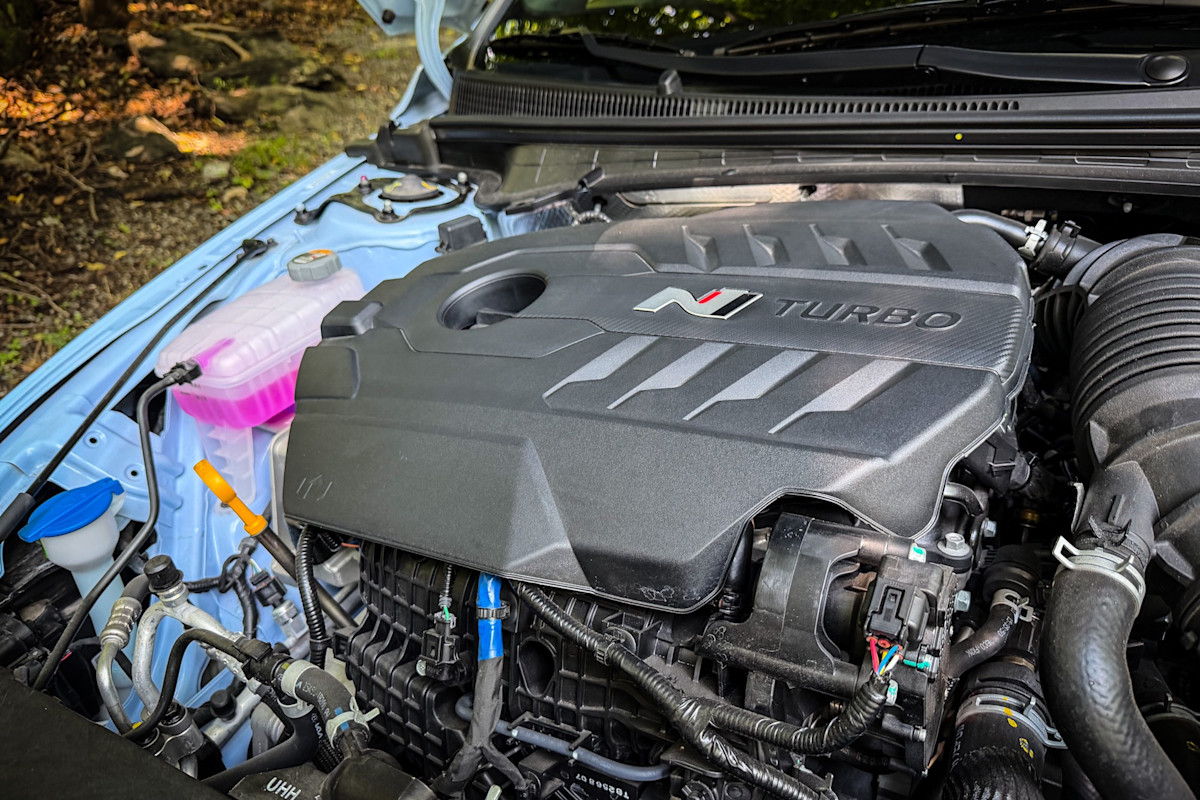
The Elantra N is powered by a 2.0-litre turbocharged inline-four making 276 horsepower and 289 pound-feet of torque. This is sent to the front wheels through a limited-slip differential and either a six-speed manual or eight-speed dual-clutch automatic transmission. A dropped and retuned suspension with three-way adaptive dampers, 14.2-inch front brake rotors, and forged 19-inch wheels on Michelin Pilot Sport 4 S tires ensure the driver always receives maximum feedback. Everything, from the steering to the chassis brace behind the rear seat to the programmable driving modes, is unique to the Elantra N.
The first 2022 model we tested was a beast, and not in an entirely endearing way. The vague clutch engagement, heavy turbo lag, brittle ride, and gunshot exhaust felt more like an aftermarket experiment than a factory effort. It was still loads of fun, but it was incomplete. Hyundai has since revised the steering and suspension, remapped the electronics, and dropped 15 kilograms (33 pounds) of unsprung weight from the forged wheels, which adds to the N's eagerness to turn in.
We tested the automatic for this review. Sorry to the three-pedal fans out there, but Hyundai doesn't make a good manual transmission. Its performance-tuned dual-clutch — which is fitted only to this car — is a gem. It smooths out the N's power delivery, reduces turbo lag to almost nothing, and makes the car easier to launch while calming the powertrain at high speeds. We did not experience jerkiness or clunking as some other reviewers have noted.
The three shift maps — which can be programmed in two custom driving modes, accessed on the touchscreen or by tapping either of the blue buttons on the steering wheel — range from daily comfort to neck-snapping fun. Plus, the dual-clutch comes with launch control (and an adjustable rev limit) and an F1-style "push to pass" button on the steering wheel that immediately drops to the lowest possible gear and allows 10 extra horsepower for 20 seconds at a time. It's a brilliant way to rip by slow traffic without worrying about what driving mode you're currently using.
Fuel economy is reasonable at 11.8 litres per 100 kilometres in the city, 8.6 on the highway, and 10.4 combined (or 11.0 L/100 km city, 8.1 highway, and 9.7 combined with the manual). There's still some axle hop and torque steer, even in dry conditions, that are non-existent in the best front-wheel drive (FWD) competitors. Hyundai's suspension arrangement, while great on the track, doesn't fully measure up to hard use on the road where surfaces can be in constant flux. The Elantra N lacks all-wheel drive (AWD), which the Subaru WRX, the Volkswagen Golf R, and the Toyota GR Corolla use as an absolute ace up the sleeve, though the latter two crest $50,000 in Canada. This is not a car buyers will want to drive even moderately hard in the wet, let alone the snow.
Steering and braking are exemplary, and body movements are well controlled and nicely damped. They are the parts of the Elantra N that feel the most expensive and always satisfy. While the exhaust is quieter under full throttle, it's just as loud at city speeds in low gears, which may signal the ultimate intention for this car. We enjoyed the overruns and pops in first and second gear, and the low thrum at idle is addictive, not annoying. In just a few years, this high-strung Hyundai has matured in all the best ways.
Form & function
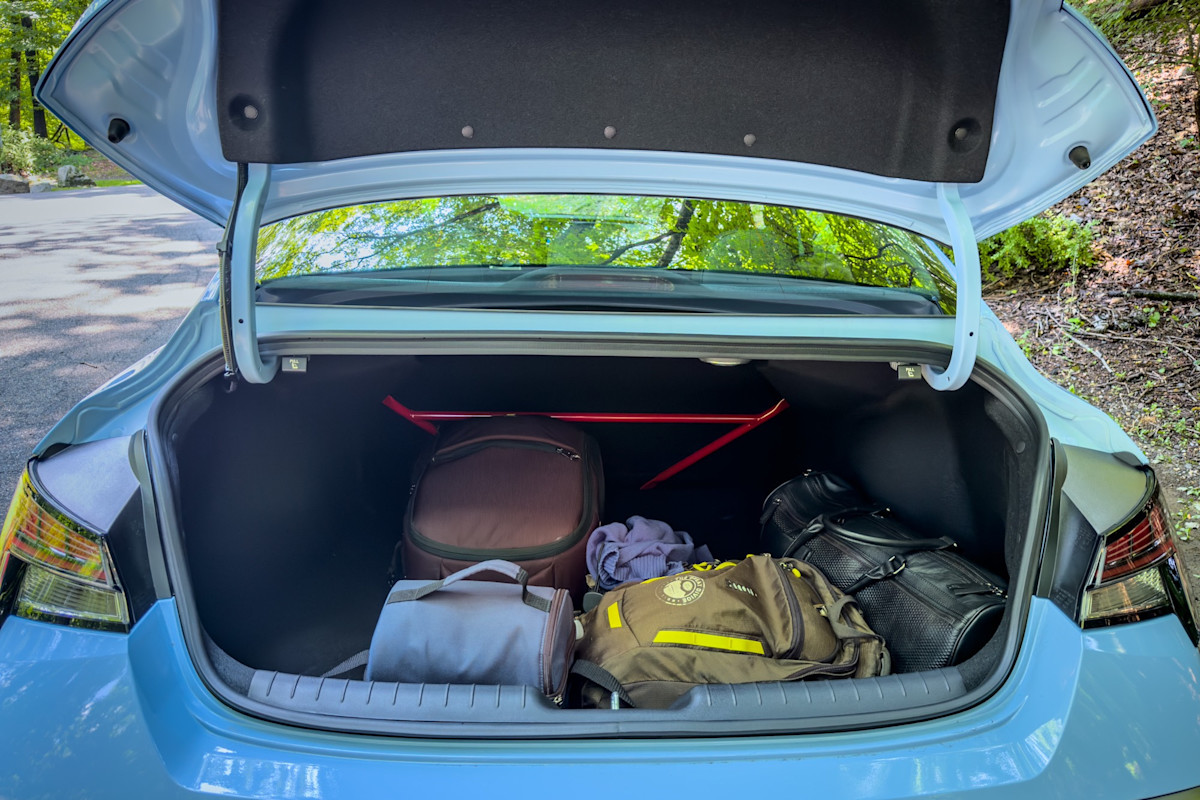
The Elantra N has a lot of interior space for a small car, especially in the back seat where it has significantly more legroom than any of its competitors. Sightlines are excellent in all directions. The trunk swallows 402 litres of cargo, which is more than many midsize sedans, but the chassis brace will block taller and longer items from extending into the cabin with the seats folded.
Analog controls for the climate and stereo, and shortcut buttons for all the major functions (and most importantly, the many driving modes), are extremely welcome. Four of these buttons can be reprogrammed to call up a dozen or more functions that you can preselect in the main touchscreen. Seat comfort is excellent, too. While the bolsters are fixed, they hug a 32-inch waist just right, so Elantra N buyers should watch their diet.
The Elantra N comes in one trim with nearly every convenience feature as standard except for power seats. Full LED exterior lighting, heated front seats, a heated steering wheel, power heated mirrors, a sunroof, a proximity key, dual-zone climate control, a wireless charging pad, and four USB ports are all standard. Adaptive cruise control, ventilated front seats, and heated rear seats are unavailable, though.
Technology
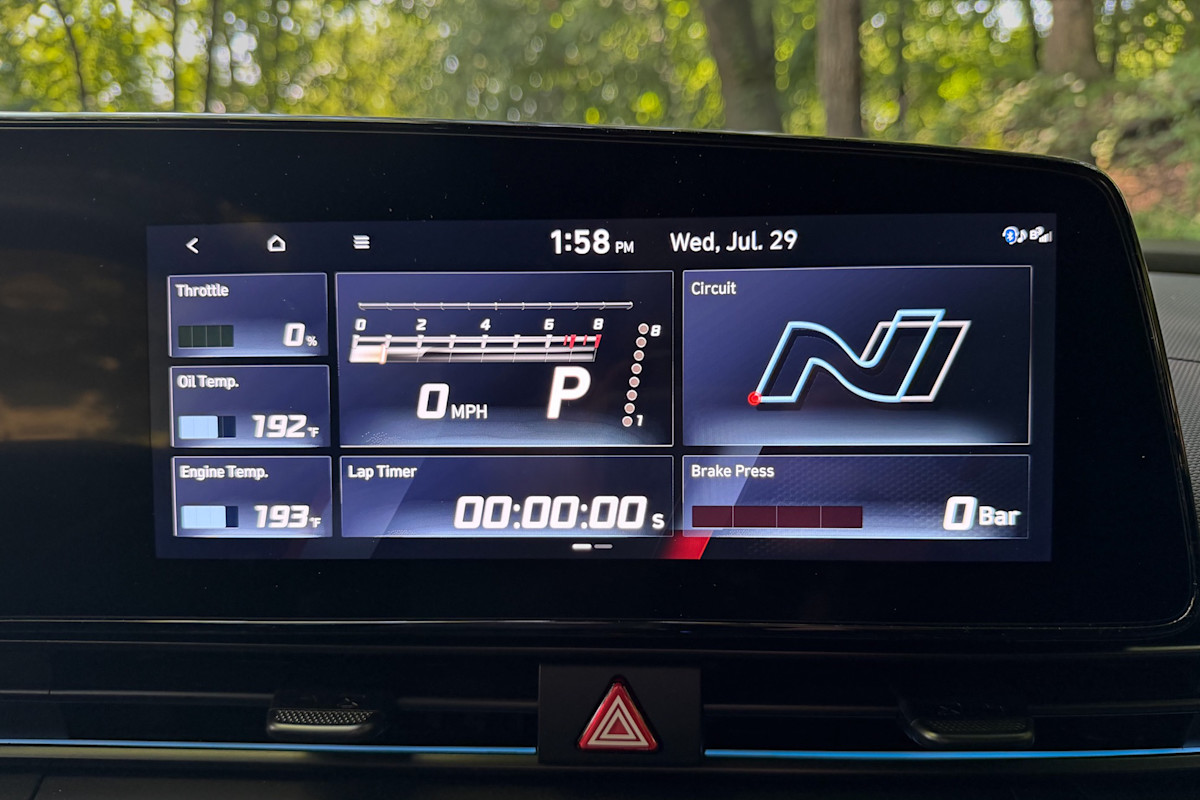
The Elantra N's shining tech feature is the N app, which displays real-time data on the current gear, throttle position, brake pedal pressure, horsepower, and much more. Built-in presets can optimize the car for specific racetracks, while additional options allow the driver to set shift warning lights, launch control revs, and the N Grin Shift (the "push to pass" fast-shifting function) and also record acceleration and lateral Gs.
It's especially easy to set up the two custom driving modes. Multiple tiles for each adjustment (throttle, steering, suspension, transmission, differential, exhaust) make the ramp-up from Normal to Sport+ easy to decipher. The dual 10.25-inch displays are crisp, especially the instrument panel, which in N mode shifts to a single central tachometer with readouts of the turbo pressure, oil temperature, and other vitals.
The downside is the infotainment software, which is an older version than in many other Hyundai models. Small and unclear icons in the same colour are difficult to view at a glance. Apple CarPlay and Android Auto are not wireless, and only the older USB-A port supports phone projection, not the USB-C port, which is for power only. Hyundai’s blind view monitor and surround-view camera systems are not here, either. But the setup menus are clear and make customizing the Elantra N's functions very easy.
An eight-speaker Bose stereo, SiriusXM, and HD radio are standard. Additional remote connectivity is available with the Bluelink+ app on a smartphone or smartwatch.
Safety
While the Elantra N is not separately rated in crash tests, it is identical to the Elantra and Elantra Hybrid models that have been tested in this generation. The U.S. National Highway Traffic Safety Administration (NHTSA) rated the 2026 Elantra and Elantra Hybrid five stars overall. The Insurance Institute for Highway Safety (IIHS) tested the 2021 Elantra and applied those tests to the 2026 model, which received a Top Safety Pick award including the best Good rating in three crash tests. There are no rear side airbags or front knee airbags, and only the front seats are equipped with seat belt pre-tensioners.
The Elantra N isn’t available with every driver assist feature in Hyundai’s catalogue with the Highway Driving Assist system being one notable absence. The list is nonetheless comprehensive and includes automatic emergency braking with pedestrian detection, front and rear parking sensors, lane keep assist, a driver attention monitor, blind spot monitoring, rear cross-traffic alert, high beam assist, and a safe exit warning for the rear doors.
Cost-effectiveness
In Canada, the 2026 Hyundai Elantra N comes in two trims. The base model starts at $42,849 including the $1,900 destination charge. Adding the automatic transmission costs $1,600, and paint colours other than Atlas White add $350. The 2026 Elantra N TCR Edition — which adds race-inspired details like an adjustable carbon fibre rear wing, N Performance brakes with two-piece rotors and monoblock four-piston calipers, and custom badging — is priced at $49,499 with the manual and $51,099 with the DCT.
Fully loaded, the Elantra N is roughly $10,000 less than a loaded Toyota GR Corolla and the starting price of a Volkswagen Golf R. The Subaru WRX, however, represents the segment's best value and starts at $1,500 less than the Elantra N. All those competitors have AWD, which is a huge benefit that should not be overlooked. Ultimately, the Elantra N is very satisfying and would continue to be a great pick even if it were more expensive.
What owners say
Trims & specs
Base MSRP $35,300 | Seating 5 |
Engine N/A | Cargo Capacity 14.2 cu ft |
Combined MPG N/A | Drivetrain N/A |
Base MSRP $39,450 | Seating 5 |
Engine N/A | Cargo Capacity 14.2 cu ft |
Combined MPG N/A | Drivetrain N/A |