2022 Hyundai Elantra N Reviews, Pricing & Specs
Write a reviewPros
Powerful engine
Great handling
Excellent value for money
Cons
All-wheel drive not available
Weird clutch setup
Rear strut brace affects cargo usability/space
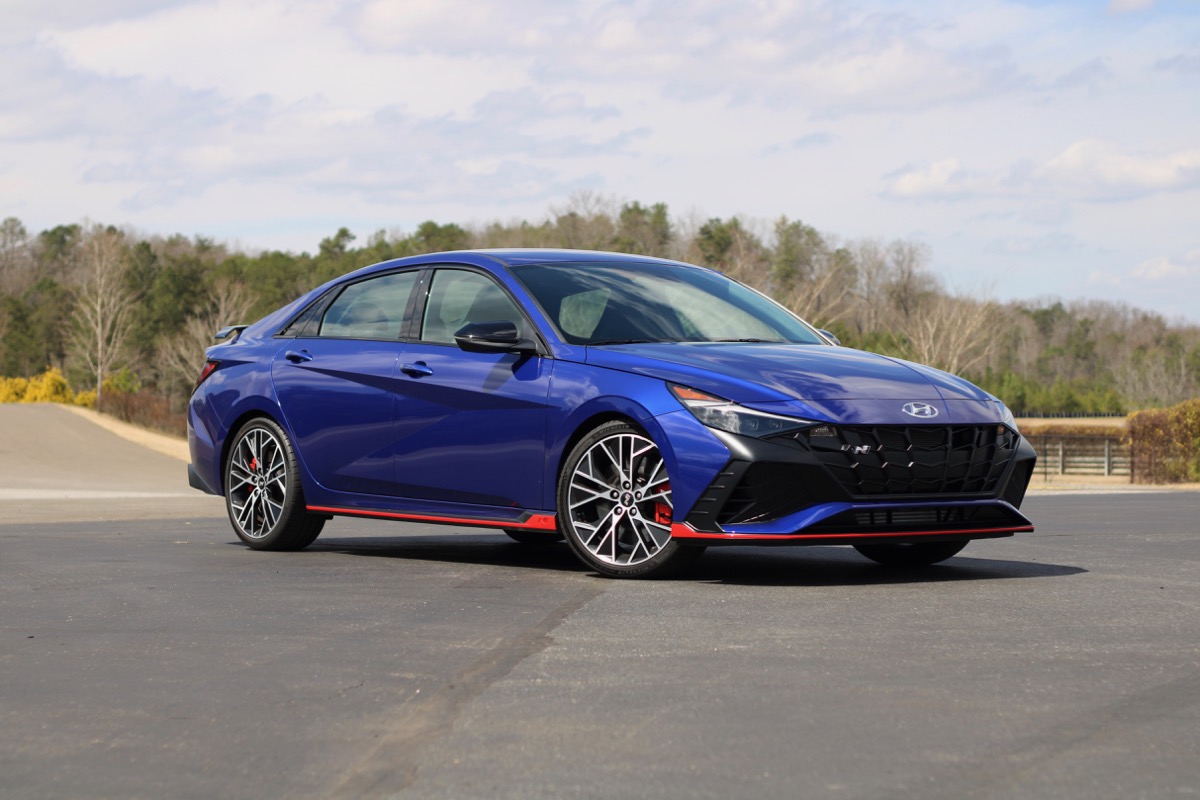
The Hyundai Elantra N is a comfortable daily driver that doubles as a racetrack-capable hooligan.

The Hyundai Elantra received a complete overhaul just last year. But instead of being a standard “carryover” model year, for 2022, Hyundai decides to introduce its most powerful, most fun, most motorsports-infused Elantra ever. Let’s welcome the all-new 2022 Hyundai Elantra N to the family. Specifically, the car-enthusiast family. Not that its styling is a dead giveaway.
At first glance, the Elantra N just looks like any of the other Elantra models. It features the same “Sensuous Sportiness” design language, including a “Parametric Dynamic” grille. These are Hyundai’s words, of course, hence the quotes. But Hyundai has done justice with the Elantra’s design in that even the base model is infused with sporty enthusiasm. The all-new platform provides a longer, wider, and lower canvas to befit bold character lines and that ever distinctive grille.
Where the Elantra N differs is that it’s black and red with “N” all over. But not obnoxiously so. Oh, and there’s a wing-type rear spoiler. Don’t worry. It won’t block your field of view like the massive wings of comparable hot hatchbacks or sedans. Because, again, the Elantra N doesn’t have to look like an obnoxious goon even though it has the ability to drive like one.
The Elantra N enhances the low-slung appeal of the standard Elantra by utilizing lots of black in place of chrome. The grille is fashioned in a matte finish while semi-gloss black is used for the front lip spoiler, rear diffuser, window trim, and spoiler. Red accents are added to lower moldings of the front and rear bumpers as well as the side skirts and brake calipers. The most obvious N detail, though, is the brand logo on the wheel centre caps and on the front calipers.
Exterior colour choices are limited to six, of which Cyber Grey is exclusive to the Elantra N. The hero colour, Performance Blue, is available on the Elantra N and Veloster N, while a similar soft blue called Sonic Blue is offered on Kona N models. Moving into the cabin and you’ve got one vibe: black. Thankfully, it’s not a chasm of darkness and dread.
The sport seats are leather-trimmed with microsuede inserts. They feel premium and offer great support, especially the well-bolstered front bucket seats. They are also 10 millimeters lower than in the standard Elantra for improved positioning during high-performance driving.
Cutting through all the black is light blue contrast stitching. The colour is tastefully applied to the seats, shifter boot, and steering wheel. The same hue also appears on the shifter itself as well as represents the N drive mode buttons on the steering wheel.
The N logo, of course, appears throughout the cabin, making its way onto the front seat upholstery, steering wheel, gear shifter, and aluminum door scuff plate. The N Brand inserts of the front seats also illuminate when the doors are opened. But if it all still feels too black, a power moonroof is available.

The 2022 Elantra N is the top-of-the-line Elantra. Not just in price but in performance. By the numbers, the standard Elantra (Essential, Preferred, and Luxury trim levels) is equipped with a 2.0-litre four-cylinder that produces 147 horsepower and 132 pound-feet of torque paired with a continuously variable transmission (CVT). A suitable engine and transmission for a suitable commuter car.
Then we have the Elantra N Line, which packs a little more power and handling. The upgraded turbocharged 1.6-litre four-cylinder offers up 201 hp and 195 lb-ft of torque. The Elantra N Line also wears bigger shoes, featuring 18-inch wheels and tires versus the 15- to 17-inch offerings on the non-turbo Elantras. Standard is a six-speed manual transmission or optional seven-speed dual-clutch transmission (DCT). You also get updated suspension bits like new springs and dampers. But the Elantra N is a completely different beast.
Featuring a 2.0-litre turbo-four and optioned with either a six-speed manual or eight-speed N-tuned wet DCT, the Elantra N boasts 276 hp and 289 lb-ft of torque—in a front-wheel-drive (FWD) car that weighs less than 1,500 kilograms or 3,300 pounds. You’ll reach 100 kilometres per hour in 5.3 seconds. That’s faster than the official numbers of competitive performance compacts like the Honda Civic Type R, Subaru WRX, Volkswagen Jetta GLI, and Volkswagen Golf GTI.
The Elantra N offers multiple drive modes: Eco, Normal, Sport, and two N options (standard and customized). In Eco and Normal, the Elantra N acts like an everyman Elantra. The digital instrument cluster wears a serene blue; steering is light but precise; the engine hums rather than growls; and driving comfort is cushy. Select Sport mode and you channel the vehicle’s inner N Line. The instrument panel turns crazy-eyes red. Then the suspension stiffens a wee bit for tighter corners, the rev-matching kicks in, and the engine note reverberates more. But if you want that sonorous “snap, crackle, pop” sound that is familiar to motorsports junkies and car tuners the world over, then you need to switch to N mode for that backfire melody.
There are two dedicated steering-wheel-mounted N drive buttons, which can be customized. The instrument cluster and infotainment screen will go into racer mode, displaying vehicle status and performance data. You can keep one button reflecting the Hyundai-spec N mode or change up both to your preference. When equipped with a DCT, in N mode the Elantra N mostly uses gears one through six with higher RPMs while the other modes will utilize all eight gears. Speaking of that DCT, it’s actually superior to the stick shift. Blasphemous? No. Here’s why:
The wet eight-speed DCT was first introduced in the 2020 Veloster N. The “wet” term comes from the fact that the DCT employs electronic actuators and oil, which aid in clutch efficiency, gearing, and cooling. And it shows because in the Elantra N, the shifts remain smooth regardless of drive mode or use of paddle shifters. The vehicle just knows where the proper shift points are.
On an autocross course, for example, we left the Elantra N in automatic. Throughout the rapid acceleration and last-minute braking that are the pride and joy of an autocross, the Elantra N downshifted quickly without hesitation and upshifted in a similar fashion when we jammed on the throttle. With the six-speed manual, the issue is more with the clutch than the stick shift itself. The manual shifts are equally on point even if the shift throws are on the long side. But the clutch is just goofy.
While the standard rev-matching is great on the track or during a daily drive, how it manages the clutch ruins the stick shift experience. The clutch has a high bite point but the rev-matching cuts off just before it. You’re given the impression that you’re applying enough throttle to catch first gear that you let the clutch go. However, when you do that, the rev-matching drops and you end up stalling. Again. And again.
Initially, we thought it was just driver error. But after stalling multiple times while moving the vehicle around for photography, we realized it wasn’t us. And that was upsetting. Use it daily, and you'll eventually figure out its rev-matching clutch nuances. Hopefully. But in our short time with it, we were not a fan.
Overall, though, Hyundai has done a great job with its in-house performance modifications to create a track-ready sports compact. The large brakes of the Elantra N are borrowed from the Sonata (14.2 inches in front, 12.4 inches in back) but the calipers are tuned to N specifications. And they are paired with 19-inch wheels wearing Michelin Pilot Sport 4S performance summer tires—the first time offered on an N vehicle.
The engineering team enhanced the attributes of the new Elantra platform by further adding features like a rear strut tower brace, an electronic suspension system, reconfigured steering, electronic limited-slip differential, an integrated drive axle, and an overboost system called N Grin Shift (NGS). As goofy as the name sounds, it’s accurate. NGS temporarily will shift into the lowest gear to increase boost pressure for an extra 10 hp for a total of 286 hp. This feature works for 20 seconds and has a 40-second cooldown time. But you’ll be grinning for much, much longer than that.

The Hyundai Elantra N offers up the same practicality of a five-passenger compact sedan as the rest of the Elantra lineup. The front seats offer multi-way height and seat back adjustments. They’re also heated. No ventilated-seat option, though.
Passenger volume remains at 2,814 litres. Legroom for front and rear occupants are 1,074 and 964 millimetres, respectively. Rear headroom is steady at 947 mm but drops to 989 mm in the front seats of the Elantra N. All other Elantra models, including the N Line and hybrids, have up to 1,030 mm of headroom or 989 mm when optioned with a power sunroof.
The bucket front seats don’t create any ingress and egress issues. Rear-seat passengers should have no trouble getting comfortable. The rear seat itself, however, is a single-piece bench seat with fixed headrests similarly found in the Elantra Essential, Preferred, and hybrid models. Elantra N Line Ultimate cars are equipped with 60/40-split rear seats that have adjustable headrests. The Elantra N is the heaviest of the Elantra lineup with a curb weight that tops out at 1,495 kg (3,296 pounds). The lightest of the non-turbo Elantra models weigh in at 1,221 kg (2,725 pounds). But, hey, it’s all muscle mass with the Elantra N since it is the quickest and most powerful of its siblings.
If there are any demerits in terms of practicality, they would be in the trunk. The Elantra N is the only Elantra that does not come with a spare tire. Instead, you get a tire mobility kit and access to roadside assistance. The cargo space is still 402 litres but with the rear bench folded down, the total usable space can become tricky. That’s because the rear strut tower brace is located directly behind the rear seats. It’s an important performance feature for additional body reinforcement but it also literally gets in the way of using the full cargo capacity of the sedan. Loading long items will be an issue if they cannot fit between the bars of the bright-red chassis brace. Four-by-fours, curtain rods, and the like will fit fine. But for something large and wide like a flatscreen TV or furniture from IKEA, you’ll need to phone a friend.

If you want sport-infused dynamics and a high level of technology, you opt for the Elantra N and not the Elantra N Line. In the Elantra N, the digital instrument cluster and infotainment touchscreen are both 10.25 inches. Neither are available in the lower Elantra trims, which get a 4.2-inch driver information panel and an 8-inch touchscreen. Only the Elantra N Line Ultimate can be equipped with the larger screens. Cloud-based navigation is included.
The N-exclusive graphic interface also comes into play when in N drive mode. The digital instrument panel will display oil temperature, engine temperature, boost, torque, RPM, and gearing as well as steering and suspension status. The infotainment screen can display similar info along with other performance data like a shift timer indicator, track map, lap time, G-force measurement, launch control, and N mode settings. You know, in case you forgot you’re in a sports sedan.
Android Auto and Apple CarPlay connectivity and wireless Qi device charging are standard features on the Elantra N, but note that smartphone apps require a cord. There are two USB ports plus a 12-volt outlet. Other tech niceties include Bluetooth, a 90-day trial of SiriusXM, an eight-speaker premium Bose audio system, AI-learning dynamic voice recognition, and Hyundai Digital Key, which lets owners unlock and start the vehicle using their smartphone. However, it’s currently only available for Android-based smartphones.
For added convenience, the Elantra N is equipped with a hands-free smart trunk release, a proximity key with keyless entry as well as a Connect Car System and Connected Care & Remote Package.

As with all Hyundai Elantra models, the Elantra N comes standard with Hyundai SmartSense. This collection of driver-assist features includes automatic emergency braking, automatic high beams, a driver attention warning system, forward collision warning with pedestrian detection, lane-departure warning, lane-keeping assistance, lane-centring assistance, and rear cross-traffic alert with avoidance assist.
Also standard are a Rear Occupant Alert system and a Safe Exit Warning system. The former is activated whenever a rear door is opened prior to driving; the latter notifies occupants when it’s unsafe to open a door due to approaching traffic. Another safety feature available only on Elantra Ultimate and N is reverse parking distance warning with collision avoidance. What the Elantra N doesn’t have is adaptive cruise control with stop/go, which is a definite bummer.
The 2022 Hyundai Elantra lineup has been named a Top Safety Pick by the Insurance Institute for Highway Safety (IIHS). The IIHS does not recognize the Elantra N as a separate model. However, the National Highway Transportation Safety Administration (NHTSA) does. The Elantra N has not yet been rated but the standard Elantra has received a five-star NHTSA crash safety rating.

The 2022 Hyundai Elantra N is an all-inclusive model that gives you two choices: colour and transmission. And while the Elantra N Line offers up sporty mannerisms, it lacks the capability, sound, and pure performance prowess bestowed upon the Elantra N. But the price jump is hefty. You’re looking at either plus-$11,400 in Canada for the stick shift or plus-$13,000 for the DCT.
However, it’s not an apples-to-apples comparison within the Elantra family. The Elantra N is essentially an Ultimate trim in terms of amenities with a very boosted ego. We mean, engine. Still, when the base Elantra has a starting MSRP of $18,099 (not including the $1,725 destination fee), asking as much as $38,799 for an Elantra N with an eight-speed DCT seems steep. But look outside the family tree to other automakers and the Elantra N turns a value-oriented offering.
While next-generation Honda Civic Type R pricing hasn’t yet been announced in Canada, the Subaru WRX is all-wheel drive and starts at $30,995 but comes with 17-inch wheels and a 7-inch infotainment display. And you’ll have to pay even more for safety features like blind-spot monitoring and rear cross-traffic alert. Eventually, you get to the WRX Sport-tech with EyeSight, which maxes out at $41,895.
It’s the same situation with the pair of Volkswagens. The Golf GTI starts at $31,495 but its price will climb to $40,890 for the GTI Performance seven-speed DCT variant. The Jetta GLI is like the Elantra N in that it’s offered in a single trim level with two transmission choices. When optioned with the seven-speed DCT, the Jetta GLI comes out to $33,295. It’s the cheapest competitor but keep in mind that both Volkswagens also produce less horsepower from their 2.0-litre turbo-fours. It’s 228 hp for the Jetta GLI and 241 hp for the Golf GTI. Sure, you can opt for the Golf R but you’re also looking at more than 47-grand to start.
But now there’s the just-announced 2023 Toyota GR Corolla. Although full specs and pricing aren’t available yet, the few nuggets we do know are impressive. From a 1.6-litre three-cylinder turbo, the GR Corolla punches out 300 hp and 273 lb-ft of torque. The hot hatch also comes with standard AWD and a six-speed manual gearbox. Pricing will likely be similar to 300-hp brethren the Civic Type R and Golf R.
In this little but loud segment of non-luxury compact performance cars, the deal-breaker isn’t going to be fuel economy figures or a lack of wireless charging. Those shopping in this segment are looking for a daily-driver-slash-sports-car. And Hyundai offers a compelling from-the-factory product with the new Elantra N.
The Elantra N checks off all the boxes for performance, comfort, track tech, connectivity, and safety. And if you don’t want to have an obvious tuner car in your driveway, the Elantra N’s design is tastefully reserved compared to the bold style of large-winged hatches. Also, its popping backfire grunts can be turned down simply by selecting any drive mode but N. So, you can have all the track day fun you want, extra money in your pocket, and still blend in when grocery shopping.
Note: Images show a US model.

User reviews for 2022 Hyundai Elantra N
Write a review2022 Hyundai Elantra N Pricing
Trims & specs
Air Conditioning
Automatic climate control front air conditioning · Dual front air conditioning zones
Airbags
Dual front airbags · Passenger airbag deactivation: occupant sensing deactivation · Front side airbags · Front side curtain airbags
Audio System
Antenna Type: diversity · Voice recognition audio system · Bluetooth auxiliary audio input · Premium Brand: Bose · Touch screen display radio · Satellite Radio: SiriusXM · 1 subwoofer · Total Number of Speakers: 7
Brakes
ABS: 4-wheel · Braking assist: hill start assist · Front brake diameter: 14.2 · Front brake width: 1.2 · Front brakes: ventilated disc · Rear brake diameter: 12.4 · Rear brake width: 0.8 · Rear brakes: ventilated disc
Comfort Features
Door sill trim: scuff plate · Door trim: alloy · Floor Material: carpet · Foot pedal trim: alloy · Shift knob trim: leather · Steering wheel trim: leather
Convenience Features
Ambient lighting: color-adjustable · Assist handle: rear · Autonomous lane guidance: lane centering · Center console: front console with armrest and storage · Cupholders: rear · Footwell lights: color-adjustable · Multi-function remote: keyless entry with panic alarm · One-touch windows: 1 · Power outlet(s): 12V front · Power steering: electric · Power windows: lockout button · Reading lights: front · Steering wheel: tilt and telescopic · Steering wheel mounted controls: phone · Storage: accessory hook · Vanity mirrors: dual illuminating
Driver Seat
Manual adjustments: 6
Drivetrain
Axle ratio: 4.15
Engine
Alternator: 150 amps · Battery: maintenance-free
Exterior Features
Door handle color: body-color · Exhaust: dual exhaust tips · Exhaust tip color: chrome · Front bumper color: black · Grille color: black · Mirror color: black · Rear bumper color: black · Rear spoiler: wing · Rear spoiler color: black · Rear trunk/liftgate: power operated · Rocker panel color: black · Window trim: black
Headrests
Front headrests: integrated · Number of front headrests: 2 · Number of rear headrests: 3
In Car Entertainment
Connected in-car apps: app marketplace integration · Infotainment: Blue Link · Infotainment screen size: 10.25 in. · Smartphone integration: wireless Apple CarPlay
Instrumentation
Fuel economy display: range · Instrument cluster screen size: 4.2 in. · Warnings and reminders: low battery
Lights
Daytime running lights: LED · Headlights: LED · Tail and brake lights: LED
Mirrors
Exterior mirrors: manual folding · Inside rearview mirror: manual day/night
Passenger Seat
Manual Adjustments: 4
Rear Seats
Type: bench
Roof
Moonroof: tilt/slide
Safety
Automatic emergency braking: front · Camera system: rearview · Child seat anchors: LATCH system · Cross Traffic Alert: rear · Crumple zones: rear · Parking sensors: rear · Pre-Collision Warning System: visual warning · Pre-collision warning system: pedestrian detection · Rearview monitor: in dash
Seatbelts
Emergency locking retractors: front · Front seatbelts: 3-point · Seatbelt force limiters: front · Seatbelt pretensioners: front · Seatbelt warning sensor: driver and passenger · Second row seatbelts: 3-point
Seats
Driver seat manual adjustments: height · Front seat type: sport bucket · Passenger seat manual adjustments: reclining · Rear headrests: adjustable · Rear seat folding: one-piece · Upholstery: suede · Upholstery accents: leather-trimmed
Security
Power door locks: anti-lockout
Spare Tire
Kit: tire sealant
Steering
Steering ratio: 12.2 · Turns lock-to-lock: 2.2
Suspension
Front Arm Type: lower control arms · Front Shock Type: gas shock absorbers · Front Spring Type: coil springs · Front Stabilizer Bar: diameter 23 mm · Front Suspension Classification: independent · Front Suspension Type: MacPherson struts · Rear Spring Type: coil springs · Rear Stabilizer Bar: diameter 24 mm · Rear Suspension Classification: independent · Rear Suspension Type: multi-link · Rear shock type: monotube · Suspension control: electronic
Telematics
Driver assistance app: roadside assistance · Electronic messaging assistance: with voice recognition · Navigation system: with voice recognition · Phone: voice activated · Phone wireless data link: Bluetooth · Smart device app compatibility: MyHyundai with Blue Link · Smart device app function: horn/light operation
Tires
Type: summer performance
Tires and Rims
Wheel type: aluminum alloy
Windows
Front wipers: intermittent
