2025 Porsche 911 Reviews, Pricing & Specs



Pros & cons
What we like
Excellent overall performance
Comfortable, simplistic interior
Solid daily livability
What to consider
Wind buffeting on the highway
Slightly confusing tech
No more manual transmission for the base model
Expert review
The latest Porsche 911 proves that this sports car formula still works incredibly well.
The 2025 model year marks the beginning of the refreshed 992.2-generation Porsche 911. It brings a handful of subtle changes throughout, particularly when it comes to the face, interior, and power output. While it’s dimensionally much larger than 911s or yore, that characteristic rear-engine shape is still there as well.
Verdict: Between its thrilling performance, excellent ride, great usability, and handsome looks, it’s hard to fault the latest-generation Porsche 911 Carrera.
out of 10 expert review
Look & feel
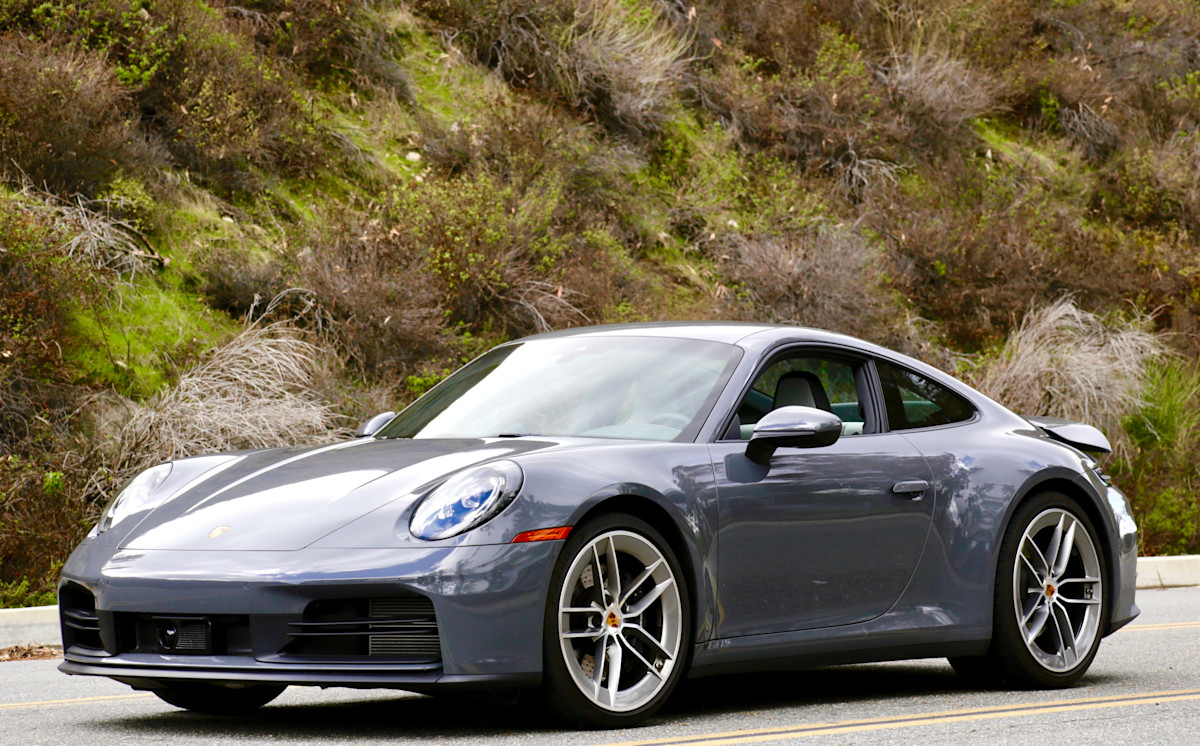
The 2025 Porsche 911 represents a mild progression in styling, even for a car that’s known for its emphasis on familiarity over fashion. Like the pre-facelift 992.1, it still features throwback badging situated square in the middle of its rear taillight arrangement, and for the most part, the front bumper doesn’t look different. But chic Matrix Design LED headlights are now standard and really clean up the overall look — not that the 992.1 was lacking in any way in this department.
This new Porsche coupe maintains the 911’s unique/aerodynamic body style and, while looks are subjective, it wears it rather well. Overall, the shape is not too bulbous or awkward, but rather elegant and athletic. This is particularly exemplified in the now-standard wide rear haunches and pronounced front fenders. Previous generation 911s required moving up a trim or two to the Carrera 4 or 911 Turbo to get a wider body style.
The entry-level 992.2 Carrera’s interior begs the question: Why can’t all new cars be this simple? It’s clean and aesthetically pleasing, materials quality is great, and the layout of the various controls is nearly perfect. Our tester’s extra-cost Sport Chrono package features a handsome analog clock, which was joined by soft-touch leather occupying the majority of surfaces. We especially dug its presence on the 911’s thin-rimmed steering wheel. There are clearly labeled physical buttons for drive modes and HVAC control in the centre console, and a modest, 10.9-inch infotainment display sits back into the dash, blended in nicely with the 911’s overall simplistic interior theme.
Performance
To those who’ve kept up with the Porsche 911 Carrera’s progress over the years, this may sound like a broken record. This latest iteration’s high card is versatility — and it may be the most versatile generation ever, even in our tester’s base spec with surprisingly few options tacked on.
Take, for instance, its 3.0-litre twin-turbo flat-six powertrain. Sporting the former Turbo model’s intercoolers and former GTS’s turbochargers, it now puts out 389 horsepower — 10 more than the 2024 model — and 332 pound-feet of torque that peaks a tad earlier in the rev band over last year’s model, too. Redline is an aurally entertaining 7,500 rpm. Power is sent through an eight-speed PDK (Porsche Doppelkupplungsgetriebe, or Porsche double-clutch gearbox) to the rear wheels. With only 1,515 kilograms (3,342 pounds) to shove forth, the base Carrera will hit the 100 km/h mark from a standstill in 4.1 seconds, cover the quarter mile in 12.3, and reach a top speed of 295 km/h. Natural Resources Canada-rated fuel economy comes in at 12.9 litres per 100 kilometres in the city, 9.2 on the highway, and 11.3 combined. Yet during our time with it, we saw a shade above the former due to it being so unbelievably fun to rip around in.
We were excited to get underway in our base grey tester as it was one of the less-optioned high-end sports cars we’ve ever driven. The only enhancements to its road manners were bigger 19-inch front and 20-inch rear Carrera Exclusive Design wheels, a sport exhaust system, and a larger, 84-litre fuel tank as opposed to the default 63-litre unit.
In-town ride quality was quite good. We never forgot we were in a proper sports car, but even when faced with some of our area’s most heinous stretches of asphalt, overall damping maintained a smooth yet connected ride. The front end glided over rougher undulations well thanks to the 911’s rear-engine layout, and steering action was easy and effortless. Porsche Active Suspension Management (PASM) adaptive dampers are standard, and while there isn’t much to differentiate between Comfort and Sport mode around town, Sport+ definitely battens down the hatches.
Finally, we really dug the flat-six’s more voracious tone exiting our tester’s optional sport exhaust system. While higher in pitch than other recent 911s that we’ve driven, it still had that unmistakable growl that’s characteristic of the brand’s flat-six engines. No matter the rpm, it was never too loud. In fact, we went out of our way to crack the window while cruising around on cold nights just to hear its soundtrack bounce off nearby parked cars and walls.
Once the road opened up and gained more twist, that same growl morphed into a mighty baritone scream all the way up to redline. Interrupting such beautiful music via the eight-speed PDK was a real treat, too, as shifts were smooth and impressively fast. This was all the perfect accompaniment to our base tester’s brilliant dynamics — steering, handling, and braking far exceeded our expectations.
The mighty Carrera’s tack-sharp steering possessed top-notch feedback and weight, despite being electrically assisted. Chassis response was equally brilliant thanks to a steel, aluminum, and magnesium monocoque, fitted with MacPherson-strut front and multi-link rear suspension, plus anti-roll bars on each axle. High-speed lateral grip was impressive, and body control scoffed at any degree of mid-corner bump. The amount of time it took to reach certain landmarks on our main test route was similar to far pricier carbon-fibre clad supercars.
The far higher-tier Porsche 911 GT3 RS is probably next-level thrilling, but we can’t help but wonder how a base Carrera like ours could compare with some stickier rubber, sturdier track-centric brake pads, and more aggressive alignment.
Classic Porsche 911s are known for having unique handling characteristics thanks to the engine hanging off the rear axle, often characterized as pendulum-like under cornering. This latest 992.2 exhibited nothing of the sort, instilling endless confidence.
The brakes felt incredibly solid under heavy use, and the firm pedal made for easy modulation. On paper, the Carrera’s front and rear 13.7-inch rotors, with six-piston front and four-piston rear calipers, seem like they might not stand up to an afternoon of enthusiastic motoring. In practice, they were very good for standard equipment.
Form & function
The 2025 Porsche 911 Carrera’s environment is proof that not all sports cars need to feel cavernous inside. Instead, front seat passengers are met with generous head, shoulder, and legroom, and a brilliant performance driving-ready seating position. Previous generations were every-body-type-friendly too, but this latest model is downright spa-like for any tall person who’s ever tried to cram themselves into other sports cars.
For anyone inclined to take their 992.2 911 on track, factoring in clearance for a helmet most likely won’t cause any spatial issues, either. The same can’t be said about the rear seats (a no-cost option); small children will fit without issue, but any adult blessed with the gift of legs will have trouble both climbing in and getting comfortable in this comically small corner of the cabin. Porsche purists won’t be surprised as this has always been characteristic of 911s. Overall visibility is very good, and while the driving position was on the low-slung side, we never had an issue quickly figuring out its dimensions while driving down the road, or climbing in and out. Our only mild issue was taking a quick look over our left shoulder before changing lanes. The sloped roof meant having to peer back just a tad longer than usual.
While cruising around on a perfect sunny day, we noticed that having one or both windows fully down produced quite a bit of wind buffeting at highway speed. It took a little fine-tuning with the windows to reduce this, including cracking the passenger’s window while keeping the driver’s dropped, which may be a turn-off for those who savour all the fresh air when the weather is nice.
As the 911 is a rear-engine sports car, cargo room is found up front under the hood. Here, occupants have 132 litres of cargo room. This isn’t exactly generous, and any owner looking at the Carrera for extended road trip service will most likely have to factor in the back seats for stowing luggage. But there’s enough room under the hood for a week’s grocery run — three large paper grocery bags line up nicely in there — and there’s enough space for a couple’s weekend getaway.
Technology
One of the 992.2 Carrera’s biggest changes over the 992.1 is a fully digital 12.6-inch instrument cluster. It’s on-trend for every manufacturer, but it was refreshing that Porsche held out with offering at least a couple of analog gauges for so long. Brand purists will be sad to see these gone. However, it does feature nice, clear graphics, and it was devoid of lag while moving through different menus and appearances.
Once we figured out how to change the interface, it was great to use. Before that, however, it was a little confusing paging through screens, and reading the oil level took some digging (even after referring to the owner's manual). Sure, 95 percent of consumers won’t bother with the latter, but careful and attentive owners might get a little frustrated.
The same can’t be said about the centre 10.9 inch infotainment screen, dubbed Porsche Communication Management (PCM). It’s brilliantly simple and relatively barebones compared to the latest-and-greatest offered by other automakers. Sporting a great layout and excellent haptic feedback, it’s so easy to page through different settings. Pairing an iPhone via wireless Apple CarPlay was quick and easy, and we then never had to re-pair during the duration of our time with the car. Combined with its out-of-the-way placement, we wish more automakers would take this less distracting approach to screens.
Safety
The 2025 Porsche 911 Carrera comes standard with traffic sign recognition, pedestrian protection, forward-collision warning and automatic emergency braking. To expand this suite of driver assistance technology, the Premium Package includes adaptive cruise control, a 360-degree camera system with active parking assistance, and lane-change assist. All functions performed well in our tester, and adaptive cruise control was especially smooth in its operation.
Going one step further, our tester alerted us to the fact that it was raining while out and about on a stormy day. It suggested we adjust our driving style, as well as turn on the wet driving mode, which we found a little overzealous. Normal traction control exuded confidence, and the car’s Pirelli summer tires had great overall grip considering the lower ambient temperature and particularly wet conditions.
At the time of this writing, the 2025 Porsche 911 Carrera has not been tested by either the National Highway Traffic Safety Administration (NHTSA) or Insurance Institute for Highway Safety (IIHS).
Cost-effectiveness
Kicking off the latest Porsche 911 Carrera’s trim hierarchy in Canada is the base model at $135,600. (Note these prices do not include destination charges or other fees, which were not available for 2025 models as of this writing. This pricing also does not factor the federal government’s luxury tax, which applies to the portion of the price above $100,000.) Here, a manual transmission is sadly no longer available, but you do get the lightning-fast dual-clutch gearbox, powerful twin-turbo 3.0-litre flat-six, rear-wheel drive (RWD), handsome overall looks, and brilliant driving dynamics.
Living the convertible Cabriolet life starts at $150,000 before fees, and then moving up to the Porsche 911 Carrera T — where the manual transmission is available — costs $149,200.
Next up is the Porsche 911 Carrera GTS T-Hybrid, starting at $182,900, which features a 3.6-litre flat-six, larger turbochargers and a plug-in hybrid system, which increase horsepower and torque to 533 hp and 450 lb-ft, respectively.
All-wheel drive (AWD) is available with only the Carrera 4 GTS, which increases the price to $191,700. A Targa roof is also available on the GTS, starting at $206,000.
As one climbs the Carrera ladder, the specs get spicier and the standard equipment list increases. But honestly, there’s so much value in the base model as far as its overall driving experience goes — including impressive performance, ride, handling, and braking — we couldn’t help but ask “what more does one need?” during our week with it.
When it comes to luxury sports car competition, BMW, Aston Martin, and Chevrolet have some serious entries. It may not be considered a premium-brand entry, but the Chevrolet Corvette Stingray is a contender, beating the lot in price-per-horsepower from $91,133. To achieve a similar level of equipment and athleticism as the base Carrera, the Z51 MagneRide Performance Package must be fitted, which brings the total to $98,628, fees in.
The 2025 Aston Martin Vantage sports a Mercedes-AMG-sourced twin-turbo V8 with 656 hp and 590 lb-ft of torque, RWD, conventional automatic gearbox, and perhaps the sharpest looks of the bunch. However, this British brute starts at a lofty $229,200 before fees. Finally, the 2025 BMW M4 starts at $94,300 before fees and sports a twin-turbo inline-six with 473 hp and 406 lb-ft of torque. It’s quite a bit portlier than the 911 at 1,746 kilograms (3,850 pounds) and dimensionally much larger, but it does have a more usable rear seat and a far larger cargo area.

What owners say
Best vehicle ever! So responsive, powerful and fun to drive with the top down. Ther is no substitute for!
June 6, 2026Trims & specs
Base MSRP $120,100 | Seating 4 |
Engine 3.0L 388 hp H6 | Cargo Capacity 4.8 cu ft |
Combined MPG 21 | Drivetrain RWD |
Base MSRP $197,200 | Seating 4 |
Engine 3.8L 572 hp H6 | Cargo Capacity 4.5 cu ft |
Combined MPG 17 | Drivetrain AWD |
Base MSRP $159,600 | Seating 4 |
Engine 3.0L 473 hp H6 | Cargo Capacity 4.8 cu ft |
Combined MPG 20 | Drivetrain RWD |
Base MSRP $241,300 | Seating 2 |
Engine N/A | Cargo Capacity 4.6 cu ft |
Combined MPG N/A | Drivetrain N/A |
Base MSRP $164,900 | Seating 4 |
Engine 3.6L 532 hp H6 Hybrid | Cargo Capacity 4.8 cu ft |
Combined MPG 20 | Drivetrain RWD |
Base MSRP $133,400 | Seating 4 |
Engine 3.0L 388 hp H6 | Cargo Capacity 4.8 cu ft |
Combined MPG 21 | Drivetrain RWD |
Base MSRP $222,500 | Seating 4 |
Engine N/A | Cargo Capacity 4.8 cu ft |
Combined MPG N/A | Drivetrain N/A |
Base MSRP $186,000 | Seating 4 |
Engine 3.6L 532 hp H6 Hybrid | Cargo Capacity 4.8 cu ft |
Combined MPG 20 | Drivetrain AWD |
Base MSRP $261,100 | Seating 4 |
Engine 3.8L 640 hp H6 | Cargo Capacity 4.5 cu ft |
Combined MPG 17 | Drivetrain AWD |
Base MSRP $222,500 | Seating 2 |
Engine N/A | Cargo Capacity 4.8 cu ft |
Combined MPG N/A | Drivetrain N/A |
Base MSRP $146,400 | Seating 4 |
Engine 3.0L 473 hp H6 | Cargo Capacity 4.8 cu ft |
Combined MPG 20 | Drivetrain RWD |
Base MSRP $147,300 | Seating 4 |
Engine 3.0L 388 hp H6 | Cargo Capacity 4.8 cu ft |
Combined MPG 21 | Drivetrain RWD |
Base MSRP $210,000 | Seating 4 |
Engine 3.8L 572 hp H6 | Cargo Capacity 4.5 cu ft |
Combined MPG 17 | Drivetrain AWD |
Base MSRP $134,000 | Seating 4 |
Engine 3.0L 388 hp H6 | Cargo Capacity 4.8 cu ft |
Combined MPG 21 | Drivetrain RWD |
Base MSRP $230,400 | Seating 4 |
Engine 3.8L 640 hp H6 | Cargo Capacity 4.5 cu ft |
Combined MPG 17 | Drivetrain AWD |
Base MSRP $243,200 | Seating 4 |
Engine 3.8L 640 hp H6 | Cargo Capacity 4.5 cu ft |
Combined MPG 17 | Drivetrain AWD |
Base MSRP $178,200 | Seating 4 |
Engine 3.6L 532 hp H6 Hybrid | Cargo Capacity 4.8 cu ft |
Combined MPG 20 | Drivetrain RWD |
Base MSRP $186,000 | Seating 4 |
Engine 3.6L 532 hp H6 Hybrid | Cargo Capacity 4.8 cu ft |
Combined MPG 20 | Drivetrain AWD |
Base MSRP $172,700 | Seating 4 |
Engine 3.6L 532 hp H6 Hybrid | Cargo Capacity 4.8 cu ft |
Combined MPG 20 | Drivetrain AWD |


Pricing trends
MSRP range
$120,100 - $261,100
Current avg. market price
$271,684
Trending up by 2.3% this month
April 2026 - October 2026


