2025 Hyundai Kona Electric Reviews, Pricing & Specs



Pros & cons
What we like
Stylish design
Standard advanced safety features
Multiple powertrain options
What to consider
Fairly pedestrian performance
All-wheel drive not available
The CarGurus verdict
Great value is at the ready with Hyundai’s smallest EV.
If you’re shopping for an electric vehicle, you might think all battery-powered options are priced out of reach. Heck, it’s tough to find a gas-powered vehicle that won’t break the bank, let alone one powered by the latest and greatest technology.
That’s where the 2025 Hyundai Kona EV comes in. This second-generation subcompact crossover was redesigned for the 2024 model year and now comes with more features and value than before, all wrapped up in a sleek little package. Sure, there are others that might perform better, but if you’re cost-conscious and willing to settle for slightly slower acceleration, you’ll be rewarded with a competent and comfortable electric car.
Verdict: The 2025 Hyundai Kona Electric goes big on value with fresh styling, myriad features, and an excellent starting price.
out of 10 expert review
Look & feel
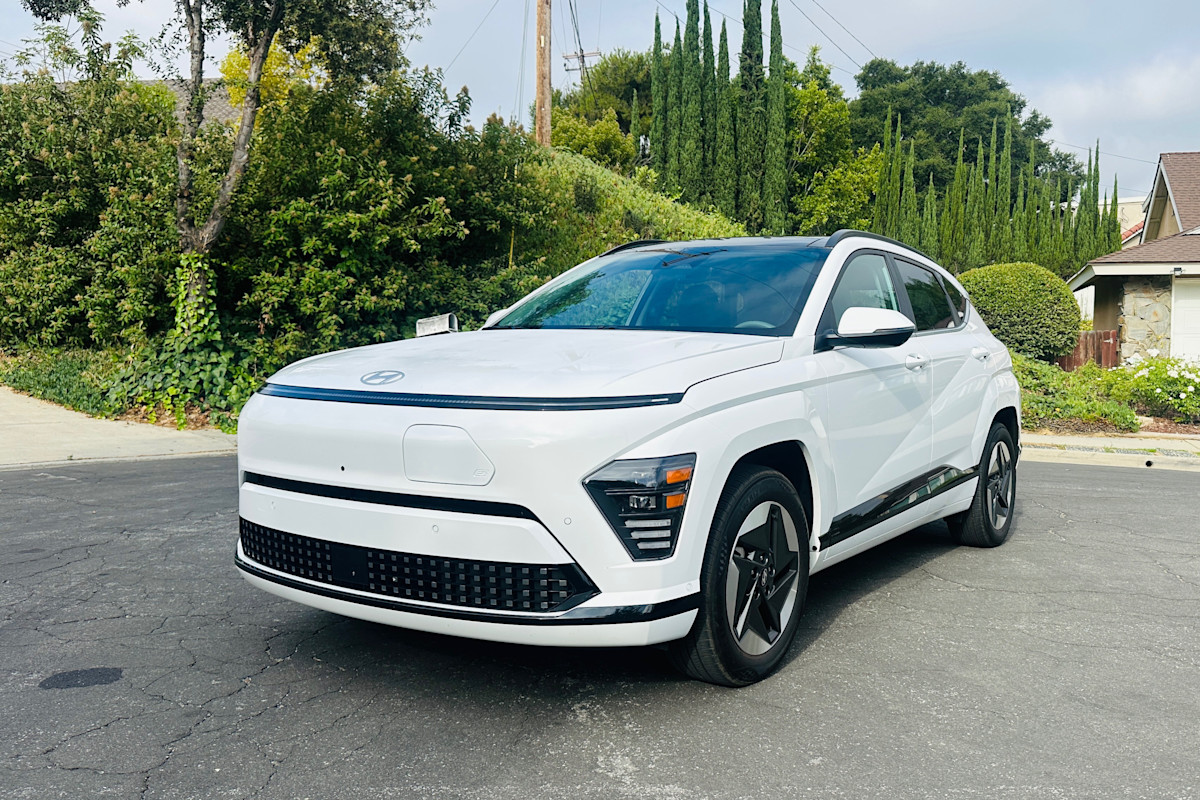
From the outside, the Hyundai Kona EV looks like a space-age art project with long, slender pixelated LED lighting front and back, chiseled fenders, and strong creases along the silhouette. It’s grown quite a bit from the previous generation, but that just translates to more room inside for a well-appointed, airy cabin. We like the built-in shelf along the passenger side of the dash. (Note our test vehicle is in U.S. specification and the sage green and lime interior shown is not offered in Canada).
In Canada, the sole trim level is Preferred, while Trend, Ultimate, and N Line Ultimate packages are available. Setting equipment up in packages rather than trims allows every version of the 2025 Hyundai Kona Electric to qualify for EV rebates where they still exist.
For a sporty look, choose the N Line Ultimate package with special 19-inch wheels, unique front and rear fasciae, and an exclusive bumper with a diffuser.
Cloth seating is standard in the Kona Electric, but the Trend and Ultimate packages come with leatherette and the N Line gets its own faux-leather and Alcantara design. The leatherette has a high-quality feel to it. The cabin is finished with some metallic-looking trim and a stylish three-spoke steering wheel. We appreciate the physical HVAC controls, as digging through screen menus to change the temperature can be distracting.

Performance
The Kona Electric is available only with front-wheel drive (FWD), and if it’s an all-wheel drive (AWD) Kona you want, you’ll need to switch to the traditional ICE powertrain. In Canada, all Kona Electrics come with a 64.8-kWh battery pack. Not only will that get you up to 420 kilometres of driving per charge but you’ll also receive 201 hp and 291 lb-ft of torque. Note the N-Line Ultimate package has a reduced range of 370 kilometres due to its larger wheels.
While the Kona has a curb weight of up to 1,765 kilograms (or nearly 3,900 pounds), it’s still pretty heavy for a small SUV. As a result, it’s not the quickest thing off the line, at right around seven seconds from 0-100 km/h, even in Sport mode. Other EVs do it better, but then again, Hyundai has never marketed the Kona as a sporty electric SUV.
Instead, it’s a competent commuter. The ride is comfortable and never harsh, the cabin is quiet, and the handling is good enough. There are paddle shifters behind the steering wheel, but instead of shifting gears, they’re used to adjust the regenerative braking system. Drivers can choose anything from coasting to one-pedal driving to get those sweet free electrons. A pull on the left paddle gives instant max regen regardless of what mode you’re in, while pulling on the right paddle switches it to a default mid-level. We spent nearly our entire time in the car using one-pedal mode, hardly ever needing the friction brakes.
The Kona sits on a 400-volt electrical architecture, so DC fast-charging times are merely adequate, and you’ll spend more time at public charging stations than with the 800-volt system offered in the Hyundai Ioniq 5. The good news is that the Kona has a battery pre-conditioning system to get everything up to snuff before the charging session starts, but you’ll still wait for more than 40 minutes to go from a 10-percent to an 80-percent state of charge at a DC fast charger. The 11-kW onboard charger means that filling up at home should take anywhere from five to six hours. The Kona comes with a CCS port, but a NACS adaptor is available so owners can use the Tesla charging network.
Form & function
The base Preferred trim level with no packages is well equipped. It comes standard with heated front seats, a heated steering wheel, dual-zone climate control, a proximity key, and solar front glass. The Trend package adds key features such as a wireless charging pad, a wide sunroof, Hyundai’s smartphone-driven digital key technology, a front passenger seat height adjuster, and more. But for all the bells and whistles, the Ultimate package is where it’s at with ventilated front seats, a Bose premium sound system, a proximity-activated smart power liftgate, and more. The N Line Ultimate includes the same interior features as the Ultimate and is best considered a sporty appearance package.
The cupholder design is nifty. They can be rotated away if you don’t want to use them and would prefer more open space in the console between the seats. Press a button and they circle back around to hold your beverage. However, the centre armrest reveals only a small storage compartment, while most of the space beneath the padded surface is open to the centre console. If you want to store things out of sight, you’ll need to use the glove box.
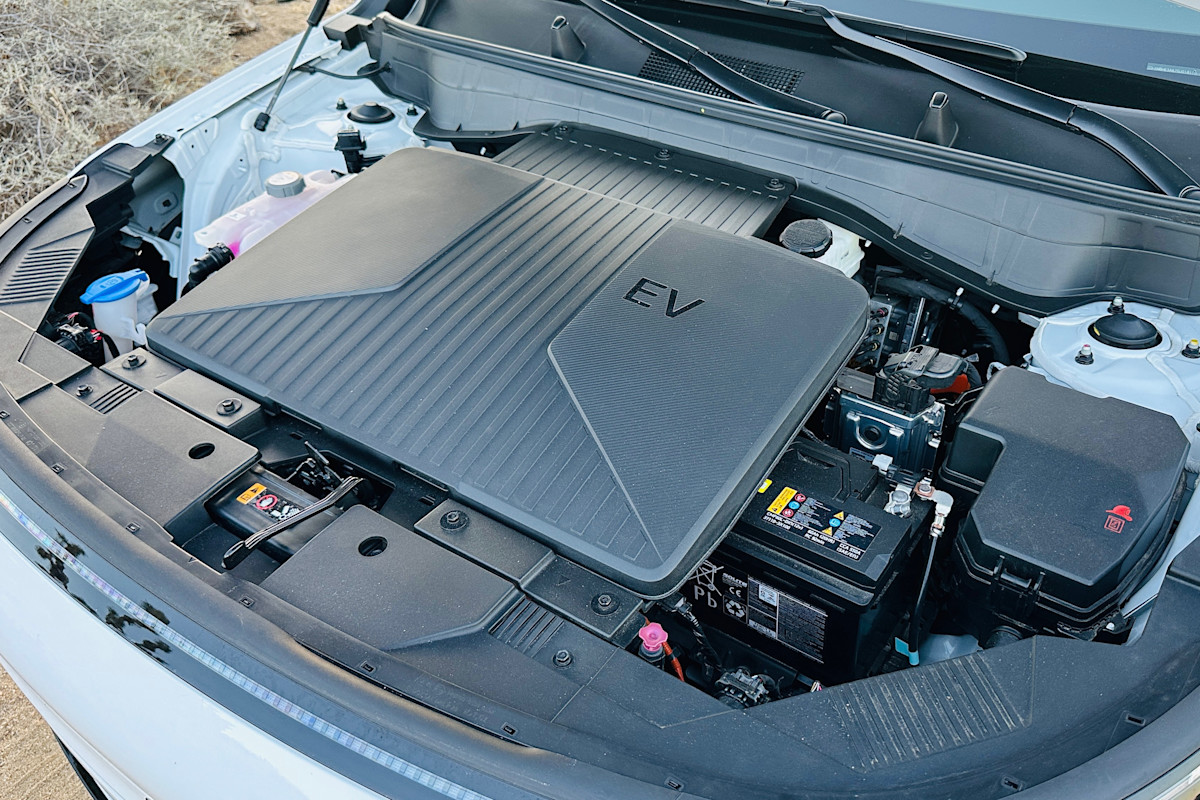
The Kona EV has more space than in its previous generation. The small frunk is only big enough to carry the portable charging cables, although the 723 litres of space behind the second row of seats—opening up to 1,803 litres with the rear seats folded—is above average for the subcompact SUV class.

Technology
Every Kona Electric gets dual 12.3-inch displays that are clear and easy to use. The digital gauge cluster sits right behind the steering wheel and offers plenty of information, while the infotainment system’s touchscreen sits directly next to it, complete with wireless Apple CarPlay and Android Auto. We especially like the EV page with a breakdown of both cumulative and instant battery usage. Who knew we’d use eight percent of our battery on climate control? This information is super-handy if you want to nerd out on hypermiling.
The native navigation system, standard on the Kona Electric, can predict your charging needs and suggest places to charge, even giving you the option of an economical route (say, with fewer hills) or a faster option. Again, this is all very handy, so you don’t get caught unaware in a charging desert.
The touchscreen itself reacts quickly, and the graphics are clean and crisp, but we noticed that it continuously switched back and forth between daytime and nighttime mode during sunset. Just pick a time and stick with it, Hyundai.
Device charging is taken care of by four USB-C ports, two up front and two for rear-seat passengers. The Ultimate and N Line Ultimate packages include wireless device charging. The Kona Electric also has vehicle-to-load capability to charge items outside the car. Just plug in the adapter to the illuminated charging port at the front of the car and you can add electrons to e-bikes, scooters, Starlinks—you name it. It’s a small load of power, just 1.7 kW, but great to have as an option.
For those who don’t want to mess around with a fob, all versions but the base model have Hyundai’s Digital Key, which allows owners to unlock their car with their smart phone or smart watch.

Safety
Hyundai always goes all-in on driver-assistance tech, and the Kona Electric is no different. Each trim comes with automatic emergency braking, blind-spot monitoring, rear cross-traffic alert, lane-keeping assist, adaptive cruise control with stop and go, safe exit warning, a driver attention monitor, and more. Even Hyundai’s Highway Driving Assist is standard, where adaptive cruise control and lane-keeping assist work together at higher speeds. It’s a hands-on/eyes-up system but still takes some of the stress out of longer commutes.
If you really want to go the distance, the Ultimate and N Line Ultimate packages get parking aids such as a surround-view camera system, parking alerts, and Remote Smart Parking Assist, which pulls a car into and out of a perpendicular parking space without the driver onboard. Also appreciated is the Blind View Monitor, which sends a video feed of your blind spot directly to the gauge cluster when signaling. Sure, you could turn your head and look over your shoulder, but that is so 2000s.
Neither the U.S. National Highway Traffic Safety Association (NHTSA) nor the Insurance Institute for Highway Safety (IIHS) had rated the 2025 Hyundai Kona EV at the time of writing. The gas version of the Kona, which has many similarities to the EV, received a Top Safety Pick+ rating from the IIHS.

Cost-effectiveness
In Canada, the 2025 Hyundai Kona Electric is covered by a five-year, 100,000-kilometre limited warranty and an eight-year, 160,000-kilometre warranty for the battery and other components related to the electric drive system.
The 2025 Hyundai Kona Electric starts at $49,488 in Canada, including the $2,050 delivery charge and other fees. Choosing the Trend package adds $1,400 to the price, while the Ultimate package adds $4,800 to the base price and the N Line Ultimate package adds $5,700 to the Preferred base model. Every version of the Hyundai Kona Electric is priced to qualify for EV rebate programs where they still exist.
The Kona is $4,000 more affordable than a Volvo EX30 and more than $10,000 cheaper than the Mini Countryman SE. That said, those two can be had with AWD and have more power than the Hyundai.
The 2025 Hyundai Kona EV is a decent option for those looking for an affordable subcompact, battery-powered SUV. It’s not the quickest of the bunch, nor does it have the most range, but those looking to save a buck or two might just find it worth their while.

What owners say
Trims & specs
Base MSRP N/A | Seating N/A |
Engine N/A | Cargo Capacity N/A |
Combined MPG N/A | Drivetrain N/A |
Base MSRP $41,050 | Seating 5 |
Engine 201 hp Electric | Cargo Capacity 25.5 cu ft |
Combined MPG 117 | Drivetrain FWD |
Base MSRP N/A | Seating N/A |
Engine N/A | Cargo Capacity N/A |
Combined MPG N/A | Drivetrain N/A |
Base MSRP N/A | Seating N/A |
Engine N/A | Cargo Capacity N/A |
Combined MPG N/A | Drivetrain N/A |
Base MSRP N/A | Seating N/A |
Engine N/A | Cargo Capacity N/A |
Combined MPG N/A | Drivetrain N/A |
Base MSRP $36,875 | Seating 5 |
Engine 201 hp Electric | Cargo Capacity 25.5 cu ft |
Combined MPG 117 | Drivetrain FWD |
Base MSRP N/A | Seating N/A |
Engine N/A | Cargo Capacity N/A |
Combined MPG N/A | Drivetrain N/A |
Base MSRP N/A | Seating N/A |
Engine N/A | Cargo Capacity N/A |
Combined MPG N/A | Drivetrain N/A |
Base MSRP $32,875 | Seating 5 |
Engine 133 hp Electric | Cargo Capacity 25.5 cu ft |
Combined MPG 119 | Drivetrain FWD |
Base MSRP $38,275 | Seating 5 |
Engine 201 hp Electric | Cargo Capacity 25.5 cu ft |
Combined MPG 104 | Drivetrain FWD |