2023 Volvo XC90 Reviews, Pricing & Specs


Pros & cons
What we like
Stylish design
Beautiful interior
Impressive technology
What to consider
Limited cargo space
Third-row seats are difficult to access
Technology is too touchscreen-dependent
Expert review
The 2023 Volvo XC90 returns as an understated entrant in the luxury three-row crossover segment.
In sophisticated circles, the Volvo XC90 can feel like an old friend. Its design has evolved subtly over the past twenty years, making it recognizable without looking old. For 2023, the XC90’s powertrains have evolved, too. Out with the T5 and T6 engines, in with the B5 and B6 mild-hybrid powertrains. Finally, Google lovers will absolutely want to investigate the new XC90’s forward-thinking infotainment technology.
out of 10 expert review
Look & feel
Stylistically, Volvo Car used to make rolling bricks. Cars like the 240dl, wagons like the 700 series, and even the early iteration of the 700’s successor, the V70, may have been adored by their owners, but you’d be hard-pressed to find a bystander who’d call them beautiful. These were sedans and station wagons with great, safe reputations but all the style of a toaster. One look at the 2023 XC90, and it’s clear Volvo has come a long way.
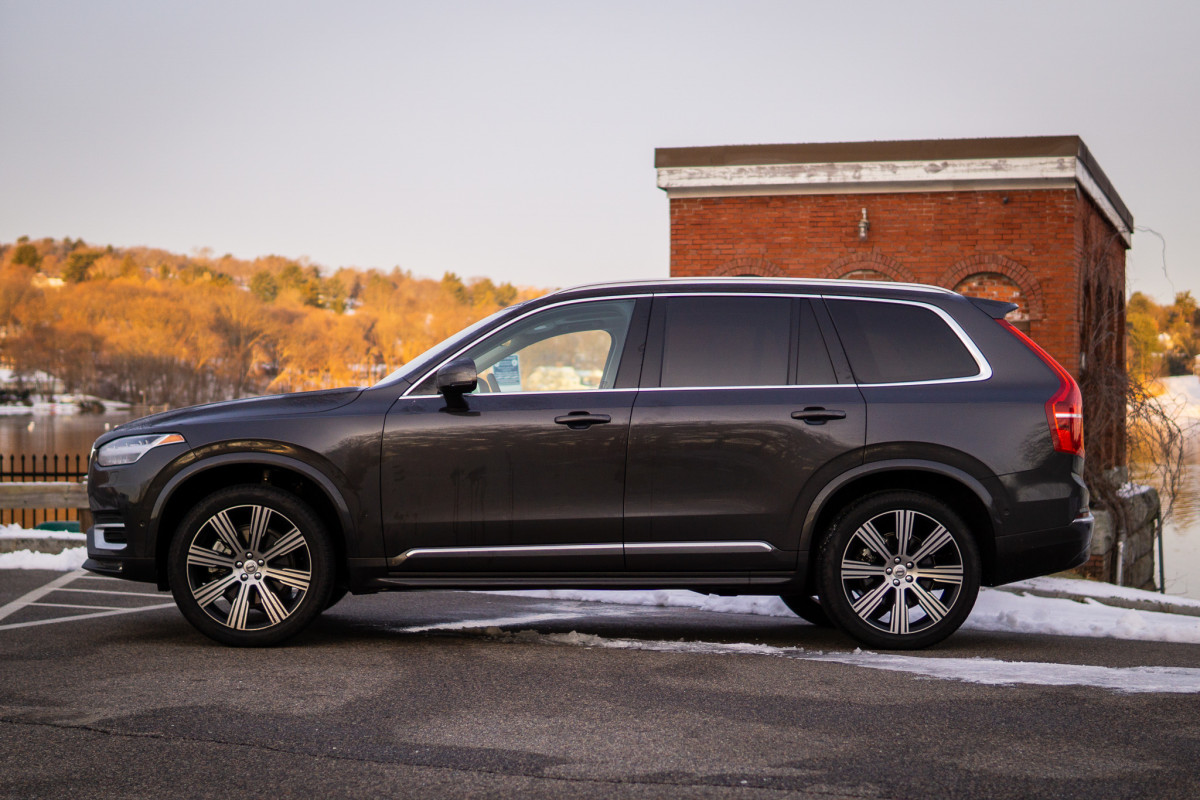
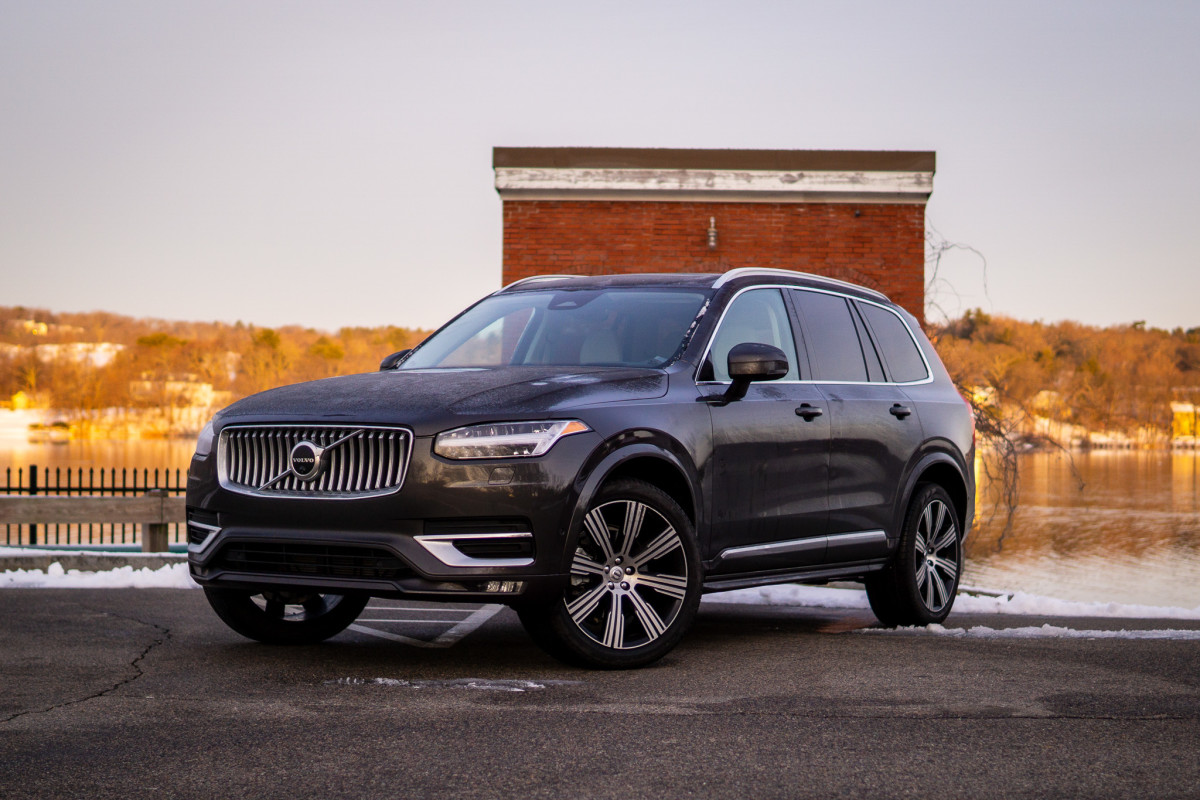
The 2023 Volvo XC90 looks purposeful but not boastful. Its front end appears stout and solid, yet not at all shouty. Similarly, the grille is assertive and bold without looking too big or too flashy. The headlights, by now easily recognizable as Volvo lights thanks to their “Thor’s Hammer” design, add a modern flair that is missing from Volvos of the 1980s and 90s. Overall, the XC90’s dimensions and shape still lean toward rectilinear, but you wouldn’t confuse it for a toaster, not anymore.
Our XC90 test vehicle for this review—in Ultimate trim, which, like all trims, comes with a standard all-wheel drive (AWD) drivetrain in Canada—had big, 21-inch wheels wrapped in low-profile Pirelli Scorpion all-season tires. They fill the wheel wells nicely and lend a bit of drama to the otherwise stoic XC90.
Our car’s Platinum Grey paint has some brown undertones in it, most noticeable in direct sunlight. It gives the colour a little bit of richness and depth, which we appreciate. Volvo still isn’t known for an overly exciting palette of paint colours. They technically offer a blue, but even they refer to it as a “smoky” blue. The other options are basically black, white, off-white, silver, and another shade of grey.
Inside, the XC90’s design is extremely elegant. The steering wheel looked gorgeous with two-tone leather and a three-spoke design, and everything is just a delightful blend of wonderful materials. We delighted in the metal Bowers and Wilkins speaker covers on the door (a Harman Kardon system is also available), the Orrefors crystal shift knob, and the luxurious Nappa leather upholstery covering the seats, which include heated front seats as standard. You can have your XC90 upholstered in black or white leather, but of course, those tasteful Swedes refer to it as “charcoal” and “blond.”
Everything inside the XC90 has a beautiful and clean look. There’s a touch of nature, courtesy of wood deco inlays across the dash and covering the centre console’s hidden cupholders.
Throughout the front cabin, there are only a few buttons or other physical controls, giving it a decidedly minimalist feel.
Performance
For the 2023 model year, Volvo discontinued its older, turbocharged 2.0-litre four-cylinder (known as the T5) and its turbocharged-and-supercharged version of the engine (known as the T6) in the XC90. In their place is the new B6 engine: an iteration of the previous powertrain, but now equipped with mild-hybrid technology. (A lower-powered B5 is available in the US but not offered in Canada.)
What does that mean, exactly? It means that the ’23 XC90 minimally sacrifices horsepower and torque specs in exchange for better fuel efficiency and smoother operation. Truthfully, the fuel-economy benefits are minimal (nothing more than a few litres at most), but critically, the pivot puts Volvo further along its path toward electrifying its entire lineup of cars.
Like the T6, the B6 powertrain makes use of a supercharger and a turbo with the mild-hybrid tech to churn out 295 horsepower and 310 pound-feet (down from 316 hp, 295 lb-ft).
Volvo’s mild-hybrid powertrains aren’t to be confused with a full-hybrid setup, which you’d find in SUVs like the Toyota RAV4 Hybrid or the Kia Sorento Hybrid. The electric motors aren’t used for propulsion. Instead, a lithium-ion battery pack powers a 13-volt starter generator to take some of the load off the engine. Things like climate control and, critically, ignition are handled by the generator rather than the engine.
Because they can’t drive on electricity alone, mild hybrids don’t deliver the same excellent fuel economy as full hybrids, but they do have significant advantages over regular gas cars. For one, because the ignition is powered by the electrical system, the XC90’s fuel-saving auto stop-start technology is almost imperceptible.
Overall, the 2023 XC90 delivers an enjoyable, if reserved, driving experience. With its big wheels and thin tires, the XC90 doesn’t roll as much through corners as we expected, particularly given its rather bulky dimensions—the XC90 stands 1,776 millimetres tall.
The XC90 also accelerates quickly and its eight-speed automatic transmission rarely skips a beat. Road and wind noise are kept nicely at bay, no doubt due to some serious insulation between the cabin and the outdoors. The XC90’s brakes are also great. They inspire confidence with a good, solid pedal feel, nothing squishy.
In today’s market, it can seem like every new car has multiple drive modes, plus low-range four-wheel drive (4WD) and hill-descent control to be considered a “real” SUV. The XC90 bucks this off-roader trend. While our test car had a manual shift feature and an off-road mode, it didn’t have much else in terms of customizable driving dynamics. Mostly, you just put the XC90 into Drive and head off on your way. Some drivers may like that simplicity, some may find it a bit underwhelming.
Form & function
We love sitting in the front seats of a Volvo because it feels peaceful and pleasant, but Scandinavian minimalism can lead to some space and storage frustrations. In particular, there’s simply not much cubby space for smaller items in the XC90.
For instance, Volvo doesn’t include a dedicated space for a cell phone. There’s a small cubby that sits ahead of the tandem-oriented cupholders, but it doesn’t appear to be made specifically for a phone. Further, the USB port for plugging in your phone is located in the centre console bin, which is pretty small, too.
Additionally, while the XC90’s safety features (which we’ll address shortly) make it a compelling choice for families, the available space and ease of access behind the front row will leave plenty of owners frustrated.
Thankfully, the second row is comfortable and reasonably spacious. That said, it’s a bit of a challenge to adjust those seats. The 2023 Volvo XC90 comes standard with a second-row bench seat for seven-passenger seating, but you can delete the middle seat from the factory for captain’s chairs and six-passenger seating.
With three seats in place, getting into the third row is almost impossible. Once you’ve made it to the back row, there’s some space, but not a lot. And of course, eventually, you’ll have to fight your way out, too.
With the third seat in position, the XC90 offers 356 litres of cargo space, which is pretty good for its class. But with the third-row seats folded down, the XC90 offers 1,183 litres, and it maxes out with all the rear seats folded at only 1,856 litres. That figure falls short of the 2023 Audi Q7, and it falls well short of the Infiniti QX60, Genesis GV80, and Acura MDX.
We like that the XC90 drives like it’s a smaller car than your typical three-row SUV. As it turns out, that’s because it is a smaller car than your typical three-row SUV.
Technology
The XC90’s tech offering is a similar story to its interior form and function story. The 9-inch touchscreen infotainment display looks very smart, positioned vertically, and it is smart. It runs Bluetooth and Google OS—Volvo’s the first company to feature this technology as the standard infotainment system.
Google OS has much of Google’s Android Auto built directly into the system. (You can operate Apple CarPlay with this system, but iPhones don’t play with it quite as well.) Google Maps, which is also displayed on the 12.3-inch driver information display, joins Spotify, NPR, and critically, Google Assistant as standard, on-board features.
When it comes to day-to-day use with a vehicle’s tech, natural-language recognition can make or break the experience. Volvo agrees that nobody does natural language better than Google, and the XC90 benefits from its inclusion. Additionally, owners can also issue commands to their ’23 XC90 via Google Home devices in their house. That’s pretty neat.
And yet, as impressive as Google OS is, Volvo still files too many key functions away within the touchscreen interface, and that can lead to frustration. We wish the XC90 featured more physical buttons and more redundant controls. Although we love the minimalist design inside the XC90, we’d rather not have to poke at a screen to turn on the heated steering wheel, and we shouldn’t need to look at a screen to adjust the driver’s seat position.
Granted, many of these things that bugged us during our week of testing would likely fade away after owning this car and driving it daily for months or years. Just know that if you decide to test drive an XC90, some of its features may take a bit of time to get used to.
Keyless entry is standard equipment, while a head-up display is optional.
Safety
The story about Volvo and seatbelts has been told plenty of times, so here are the cliff notes: In 1959, Volvo invented the three-point seat belt. Instead of keeping that invention for themselves, they let other automakers use it, too. Long story short: Today, every car has seat belts, and they’ve saved countless lives. Bravo, Volvo.
That’s the sort of moment, the sort of corporate decision, that can define a brand. Sure enough, modern Volvos are well regarded as some of the safest vehicles on the road. Not only does the XC90 carry a five-star rating from the National Highway Traffic Safety Administration (NHTSA) test results, but it was also named a Top Safety Pick+ by the Insurance Institute for Highway Safety (IIHS) in 2022.
The list of advanced driver safety tech is impressive, too. Blind-spot monitoring and rear cross-traffic alert are standard. Adaptive cruise control works very well, even in traffic. The lane-keeping assist is also excellent—it can give you a gentle nudge back into the lane, and it’ll vibrate if you keep headed off track. These technologies combine to support Volvo’s Pilot Assist technology, which will help you maintain distance between the car ahead of you from a standstill all the way up to highway speed. Best of all, these bits of safety tech are standard equipment on the 2023 Volvo XC90.
Cost-effectiveness
Pricing starts at an MSRP of $70,950 on the XC90’s Core trim level, not including the XC90’s mandatory $2,620 destination charge. Prices rise to $76,700 for the Plus trim level and $82,650 for the Ultimate trim level. Swap out seven-passenger seating for six-passenger seating in the Plus and Ultimate trims for an additional $600.
There is also a Volvo XC90 Recharge, which employs a plug-in hybrid system (PHEV) and carries an entirely different (and more expensive) bracket of price tags. Those start at $87,600 not including destination and rise north of 90 grand.
The XC90 competes primarily against the Audi Q7 and the Genesis GV70, but there’s also the Acura MDX and the Infiniti QX60. For a lot of reasons, it’s hard not to like the XC90 among this class of luxury SUVS.
There’s something about the Volvo’s understated luxury, its elegance, that exudes class. While the Genesis and the Infiniti, and to some degree the Acura and the Audi, seem like they’re trying to make their case, the XC90 SUV looks like it’s already comfortable in the room. It’s not without faults—the minimalism is sometimes a bit too minimal, and it’s probably not the right pick as a new vehicle if you’ll need the third row regularly, but you get the impression that Volvo isn’t bothered by those sacrifices one bit.
Note: Images and video show a US model.

What owners say
This vehicle easily accommodates three car seats with extra space for luggage, offering impressive power for effortless passing. The luxurious interior adds an exciting touch to every drive.
June 7, 2026I love all the features on the Volvo. I especially love the key Fob.
May 6, 2025To be clear, this was an XC90 Recharge, Dark theme. Researching inventory via Car Gurus made negotiations easy with the dealer who also wanted to move fast. My wife loves the car, as do I. It rides very smooth and quietly, and the bells and whistles are fun to boot.
December 11, 2024Trims & specs
Base MSRP $61,050 | Seating 7 |
Engine N/A | Cargo Capacity 10.7 cu ft |
Combined MPG N/A | Drivetrain N/A |
Base MSRP $79,400 | Seating 7 |
Engine 2.0L 455 hp I4 Hybrid | Cargo Capacity 10.7 cu ft |
Combined MPG 58 | Drivetrain AWD |
Base MSRP $79,600 | Seating 7 |
Engine 2.0L 455 hp I4 Hybrid | Cargo Capacity 10.7 cu ft |
Combined MPG 58 | Drivetrain AWD |
Base MSRP $79,900 | Seating 6 |
Engine 2.0L 455 hp I4 Hybrid | Cargo Capacity 10.7 cu ft |
Combined MPG 58 | Drivetrain AWD |
Base MSRP $70,600 | Seating 6 |
Engine 2.0L 295 hp I4 | Cargo Capacity 10.7 cu ft |
Combined MPG 23 | Drivetrain AWD |
Base MSRP N/A | Seating N/A |
Engine N/A | Cargo Capacity N/A |
Combined MPG N/A | Drivetrain N/A |
Base MSRP $70,100 | Seating 7 |
Engine 2.0L 295 hp I4 | Cargo Capacity 10.7 cu ft |
Combined MPG 23 | Drivetrain AWD |
Base MSRP N/A | Seating 7 |
Engine N/A | Cargo Capacity 10.7 cu ft |
Combined MPG N/A | Drivetrain N/A |
Base MSRP $66,650 | Seating 6 |
Engine 2.0L 295 hp I4 | Cargo Capacity 10.7 cu ft |
Combined MPG 23 | Drivetrain AWD |
Base MSRP $60,700 | Seating 7 |
Engine 2.0L 247 hp I4 | Cargo Capacity 10.7 cu ft |
Combined MPG 26 | Drivetrain AWD |
Base MSRP $66,150 | Seating 7 |
Engine 2.0L 295 hp I4 | Cargo Capacity 10.7 cu ft |
Combined MPG 23 | Drivetrain AWD |
Base MSRP N/A | Seating N/A |
Engine N/A | Cargo Capacity N/A |
Combined MPG N/A | Drivetrain N/A |
Base MSRP N/A | Seating N/A |
Engine N/A | Cargo Capacity 10.7 cu ft |
Combined MPG N/A | Drivetrain N/A |
Base MSRP $73,800 | Seating 7 |
Engine 2.0L 455 hp I4 Hybrid | Cargo Capacity 10.7 cu ft |
Combined MPG 58 | Drivetrain AWD |
Base MSRP $74,300 | Seating 6 |
Engine 2.0L 455 hp I4 Hybrid | Cargo Capacity 10.7 cu ft |
Combined MPG 58 | Drivetrain AWD |
Base MSRP $71,900 | Seating 7 |
Engine 2.0L 455 hp I4 Hybrid | Cargo Capacity 10.7 cu ft |
Combined MPG 58 | Drivetrain AWD |


Pricing trends
MSRP range
$56,000 - $79,900
Current avg. market price
$49,510
Trending down by 1.3% this month
May 2026 - October 2026

