2023 Mazda CX-30 Reviews, Pricing & Specs

Pros & cons
What we like
Fun to drive
Premium interior materials
Great safety ratings
What to consider
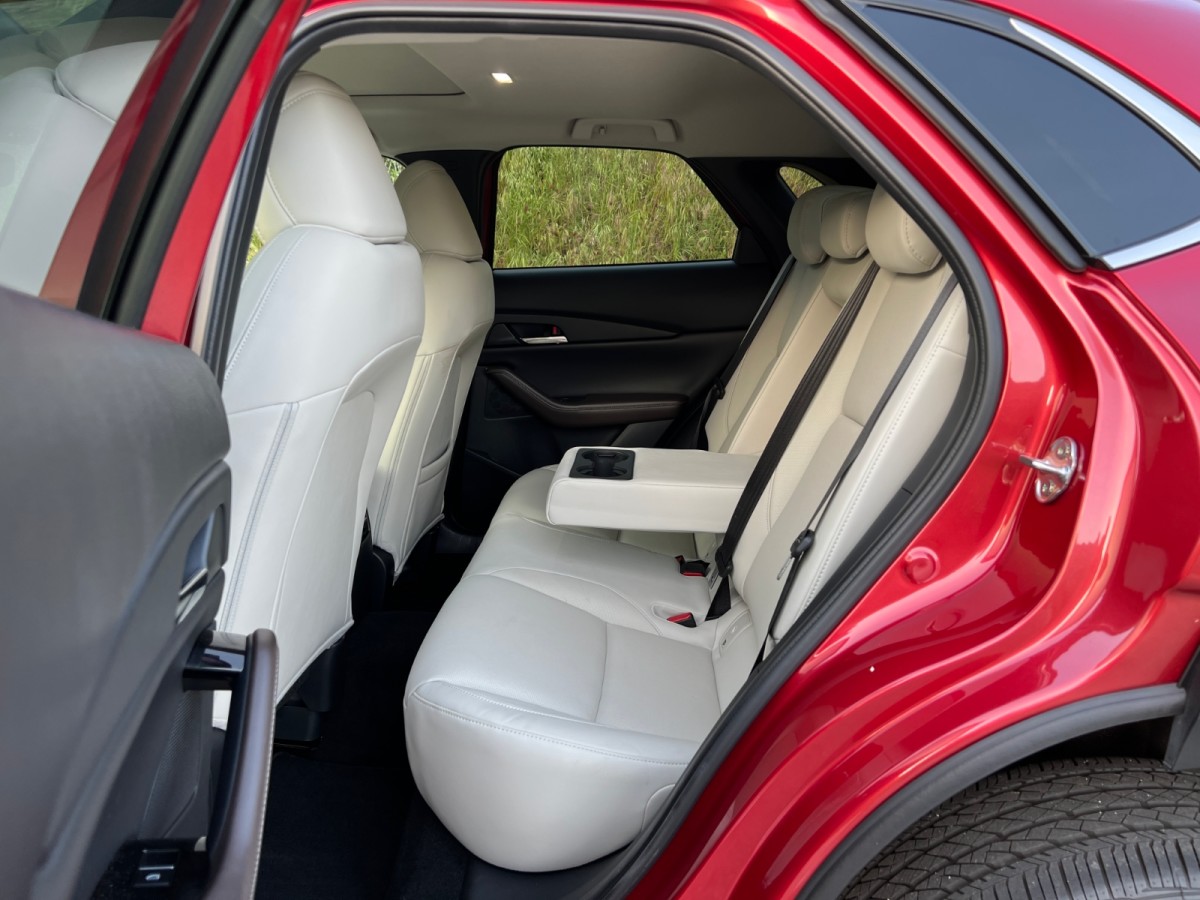
Cramped back seat
Not much cargo space
Flawed infotainment system
Expert review
The 2023 Mazda CX-30 is a small crossover with an emphasis on 'small.'
The rear-seat room is cramped and the cargo space is tight in this subcompact SUV, but the tradeoff is an appealing design, a classy and high-quality interior, and enjoyable driving dynamics, especially with the available turbocharged engine. Imagine what a Mazda 3 hatchback would be like with a raised suspension and thick lower body cladding, and you'll get the gist of the 2023 CX-30.
out of 10 expert review
Look & feel
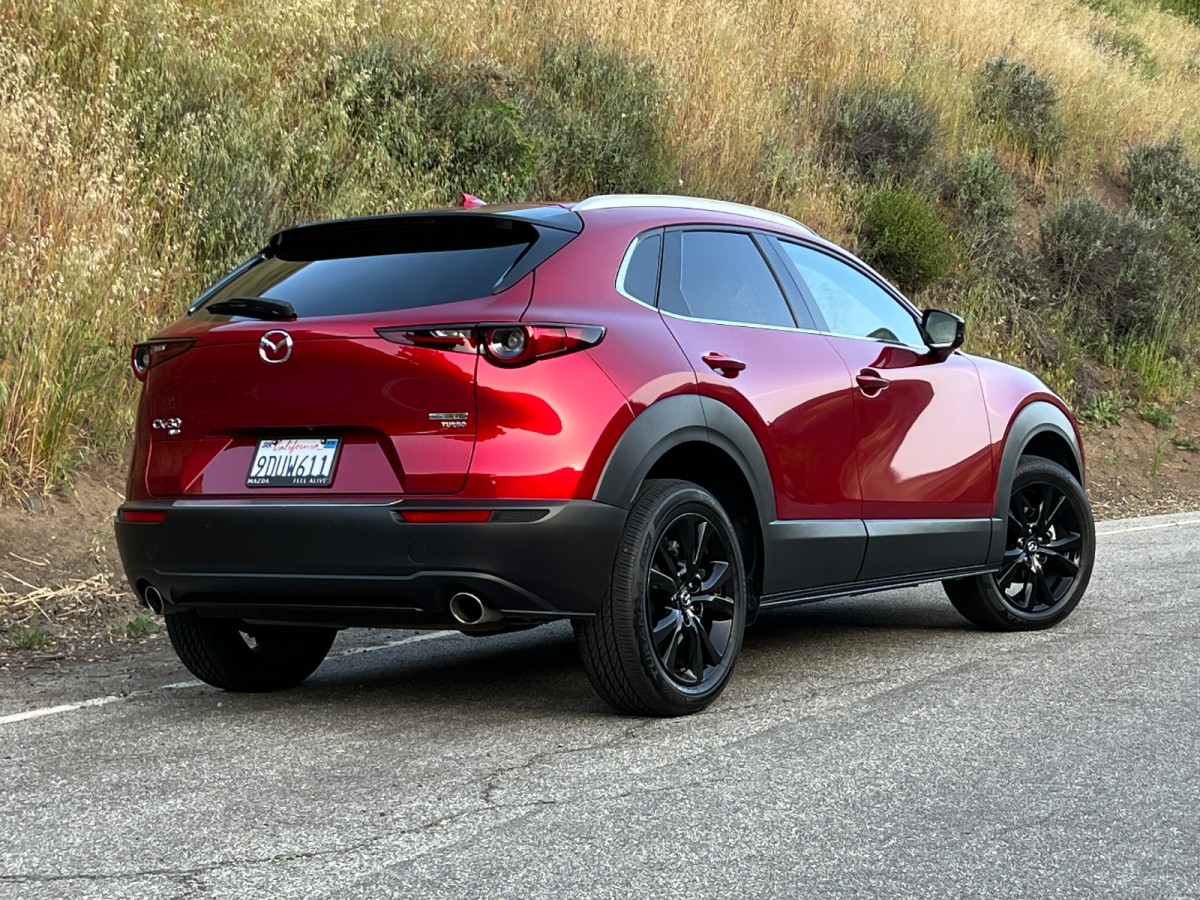
In Canada, you'll find the 2023 Mazda CX-30 available in four different trim levels (GX, GS, GT, and GT Turbo) spanning three powertrains. All CX-30 models have a six-speed automatic transmission and all-wheel drive (AWD). Prices range from $26,700 for the base GX trim to $38,600 for the top GT Turbo, not including a destination charge of $2,095. Our test vehicle was the U.S. equivalent of the top model, a GT Turbo with extra-cost Soul Red paint and an optional stainless steel rear bumper guard.
Due to its long hood, dramatically drawn flanks, and stubby rear end, the CX-30 looks nose-heavy. But it has an undeniably appealing and artful design ruined by cartoonishly excessive gray body cladding, as if to underscore the idea that it is an SUV, and not a car. Furthermore, the GT Turbo's black wheels get lost within the inky black holes punched into the universe of lower-body darkness, making them a nearly invisible presence.
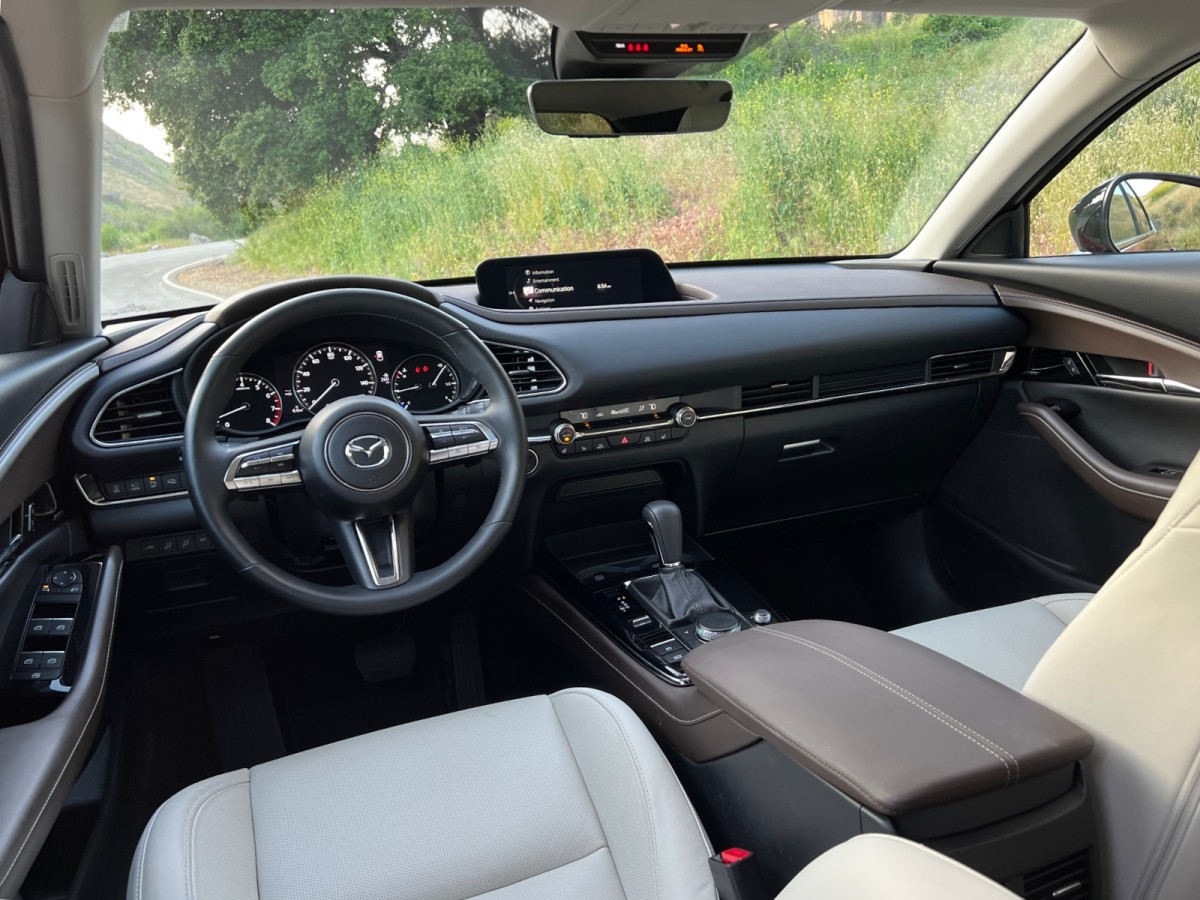
Open the driver's door, and the exterior's fake ruggedness evaporates in favour of an upscale, elegant cabin loaded with quality materials. The bottom two trim levels have cloth seats, while the rest get either artificial or genuine leather upholstery. (Leatherette can be optioned on the GS trim via a package.) Mazda further dresses the interior up with gloss black trim and polished metal accents.
Our GT Turbo test car had a tasteful combination of off-white leather, a chocolate brown centre console, and black for the dashboard, door panels, and carpeting. It looked like an entry-level luxury SUV inside, helping to justify the Mazda CX-30's premium pricing.
Performance
In Canada, the base GX trim keeps the entry-level Skyactiv-G 2.0-litre inline four-cylinder engine for the 2023 model year, producing 155 horsepower and 150 lb-ft of torque.
The GS and GT models gain five ponies over the 2022 versions for total power specs of 191 horsepower and 186 pound-feet of torque from the 2.5-litre four-cylinder engine. Of course, you're unlikely to feel the extra oomph, but you should notice this year's substantial improvement in Natural Resources Canada-rated fuel economy from 8.9 litres per 100 kilometres in combined driving to 8.2 L/100 km combined.
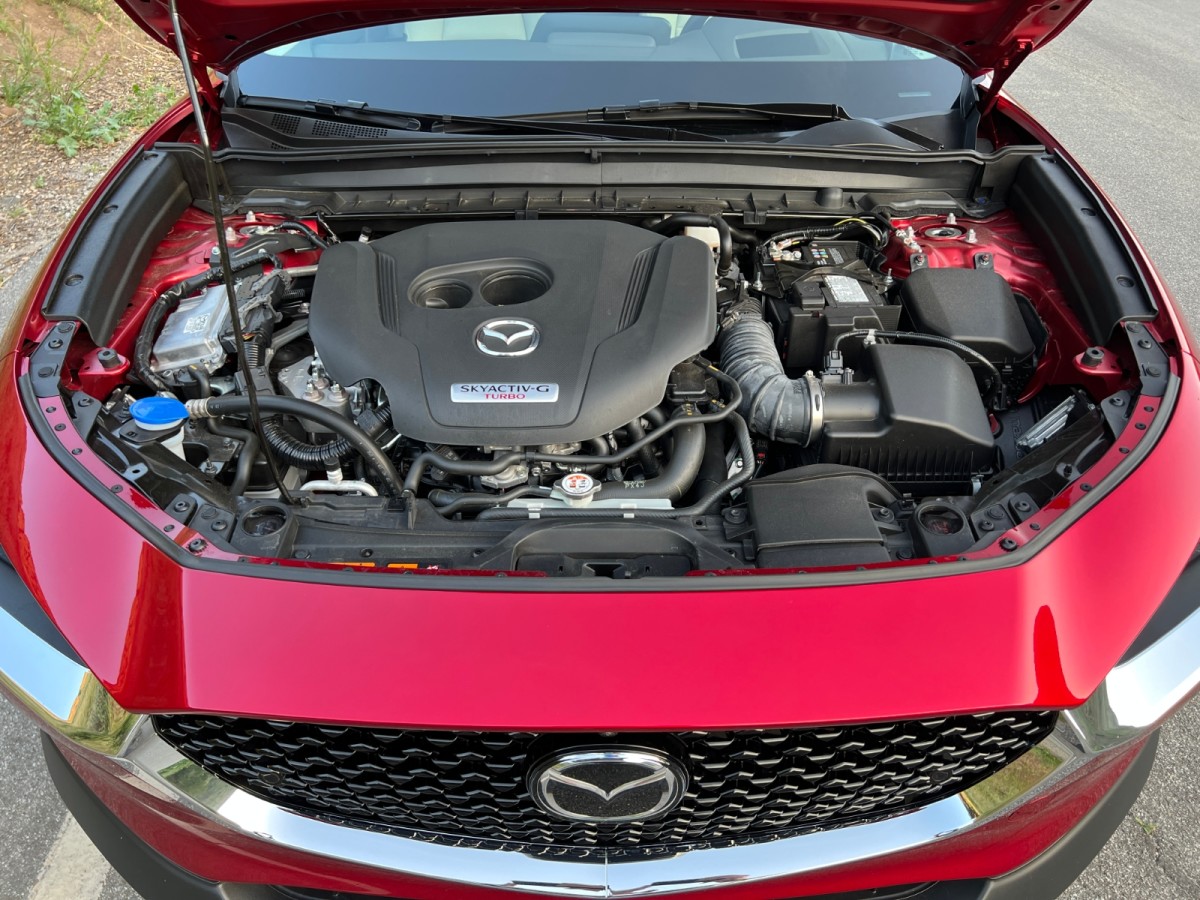
GT Turbos continue with a turbocharged 2.5-litre four-cylinder turbo engine that makes more horsepower and torque when you run it on premium gas. Pump the more expensive 93-octane fuel into the tank, and it generates 250 horsepower and 320 lb-ft of torque. Use regular 87-octane gas, and the engine makes 227 hp and 310 lb-ft. Since torque is what you feel when accelerating, we think you can use regular without much loss in real-world performance.
Both engines bolt to a six-speed automatic transmission with a Sport mode, and AWD is standard equipment. The CX-30 boasts a relatively generous 20 centimetres of ground clearance and has an Off-Road traction assist function. However, the front strut and rear torsion-beam suspension respond delicately to speed bumps and humps, so you'll want to keep to well-traveled paths if you head off the pavement.
Weighing in at 1,600 kilograms (3,525 pounds), the CX-30 GT Turbo provides robust acceleration and sounds terrific as engine revs rise. Unfortunately, when driving in heavy traffic, it is easy to catch the powertrain flat-footed when you're trying to squirt around slower vehicles. Switching from Normal into Sport mode resolves this, but then the transmission holds engine revs for too long.
Another disappointment is the CX-30's tiny 48-litre fuel tank. Our test vehicle averaged 10.0 litres per 100 kilometres on the evaluation drive, translating to less than 500 kilometres of range if you drain the tank dry. Since you're unlikely to do that, you'll need to plan refueling stops every 400 kilometres or so.
Mazda bolts 18-inch alloy wheels to most CX-30 models and adds its G-Vectoring Control Plus selective braking technology to make this little crossover SUV as rewarding as possible. The result is one of the most enjoyable vehicles in its class on a twisty mountain road. Only a turbocharged Hyundai Kona, especially in N specification, can rival it for putting a big smile on your face.
The suspension has plenty of compliance, so the CX-30 feels a little soft. But thanks to the engine's thick torque curve, the G-Vectoring Control Plus, the trustworthy brakes, and the excellent steering, you develop a rhythm while driving a winding road, riding the waves of torque and rolling with the body motions to keep up a quick pace.
Since few people drive their small crossovers like that, the CX-30's behaviour in daily-driving situations is more important. On the highway, the Mazda is exceptionally quiet and refined for this segment. And, with the turbocharged engine, getting up to speed and merging is effortless.
On city streets, we did not find the brake pedal intuitive. It isn't particularly communicative and requires more muscle than expected to generate the desired stopping power. However, bringing the CX-30 to a smooth, clean stop at intersections is easy.
Furthermore, the front suspension easily tops and bottoms out when traveling over speed humps and over speed bumps the impacts reverberate through the structure and shudder into the cabin. On this portion of the evaluation loop, the CX-30 was one of the worst performers we've experienced in quite some time. Unfortunately, our area doesn't have many potholes, so we cannot comment on the behaviour in that situation. But Mazda clearly has some work to do on this front.
Form & function
Most 2023 Mazda CX-30 models have standard dual-zone automatic climate control, an eight-way power-adjustable driver's seat, and a power moonroof. In Canada, heated front seats and rain-sensing wipers are standard, and a heated steering wheel comes in at the GS trim.
The CX-30 is comfortable for the driver and less so for the front passenger, since the right chair offers no better than four-way manual adjustment. However, during the testing week, temperatures were temperate, so the climate control system had no trouble keeping the cabin cool.
All but the base trim have standard rear air conditioning vents, perhaps to keep passengers' minds off the lack of legroom. The seat cushion and seatback are comfortable, and there is plenty of foot room under the front seats. But legroom is quite tight. Fortunately, the CX-30's front seatbacks are padded and upholstered instead of plastic paneled.
Storage space is reasonable up front. The storage bin under the centre armrest and the glove compartment has decent room and dividers to help keep things organized. There is a small tray forward of the cupholders, and the lower door panels have helpful bins. In the back, a centre armrest folds down to provide cupholders, and occupants can store items in the lower door panel bins or the single seatback storage pocket.
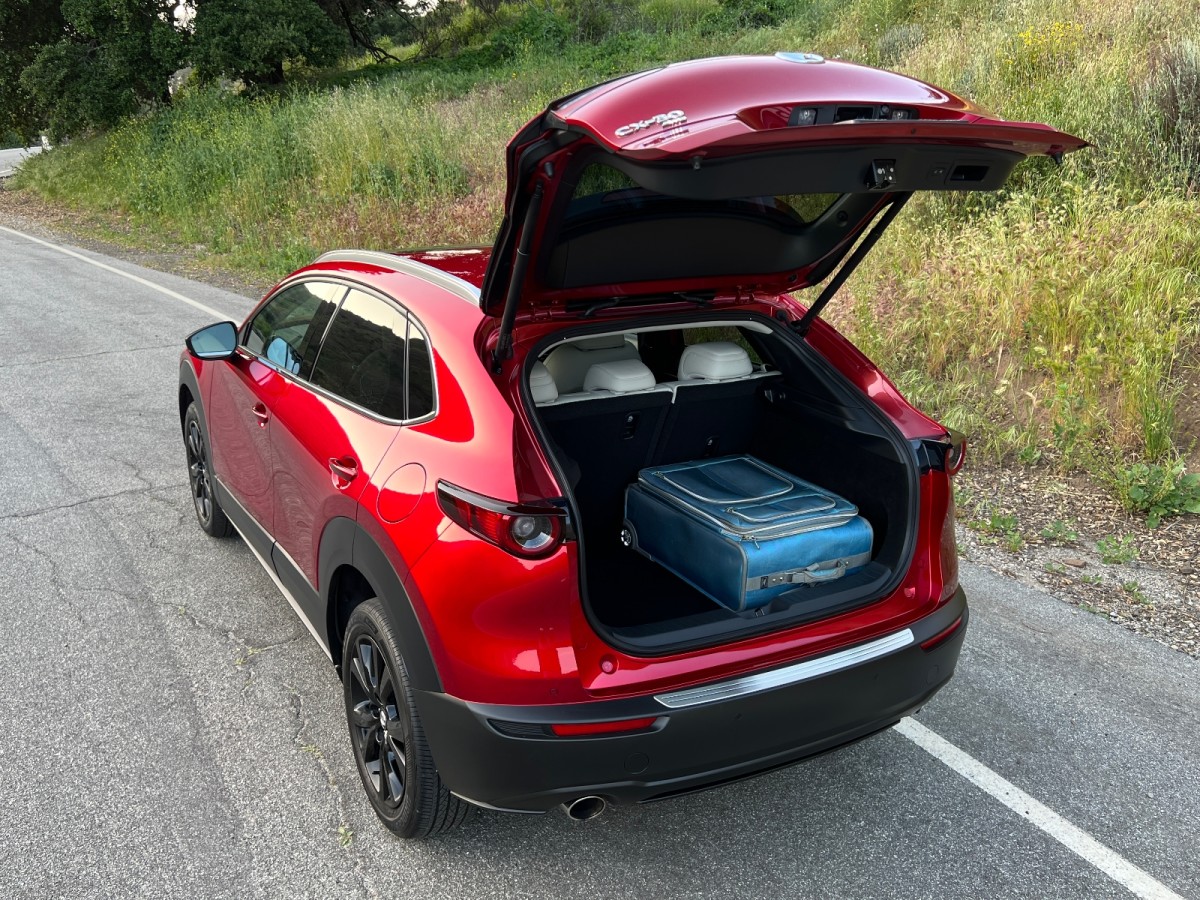
With the CX-30 GT and GT Turbo, the SUV has paddle shifters on the steering wheel and a power liftgate that it does not need. It rises to reveal 572 litres of cargo space, and you can fit two full-size suitcases nestled side-by-side on the cargo floor. Unfortunately, Mazda provides no nooks, nets, or underfloor storage space.
Fold the 60/40-split rear seats down, and the CX-30 supplies a maximum of 1,280 litres of cargo space. Neither of this SUV's cargo measurements is impressive, even for the small crossover segment.
Technology
There are three significant flaws with the CX-30's standard Mazda Connect infotainment system.
First, it doesn't have a touchscreen display. Mazda thinks touchscreens are distracting, but that's only true when there aren't simple, easy ways to access the most commonly used functions.
Ironically, the controls on the centre console require quick looks down to reference them until you memorize their locations, which takes your eyes completely off the road ahead. Also, the markings on the silver steering-wheel controls are hard to see and read at a glance, causing another source of driver distraction. And to use the voice-recognition system effectively, you must follow the instructions on the screen, introducing yet another source of distraction.
Second, Mazda Connect lacks conversational voice-recognition technology. Offering natural voice recognition to a level of quality found in modern BMW, General Motors, Lexus, Mercedes, Toyota, and Volvo models would resolve much of the irritation caused by the missing touchscreen display.
As it stands, even when we followed the recommended voice prompts shown on the display, our success rate at getting the directions or actions we sought was about 50 percent. Of course, you can bypass this problem by pairing your phone and using Apple CarPlay or Android Auto. But we still think Mazda needs to resolve this issue.
Third, there isn't a tuning knob. Mazda provides volume control on the centre console but not a matching tuning function. You can spin the centre knob to call up your saved favourites, but if you simply wish to dial up or down through the available radio stations to avoid the commercials, you're out of luck unless you've saved every station you're likely to want to listen to as a favourite.
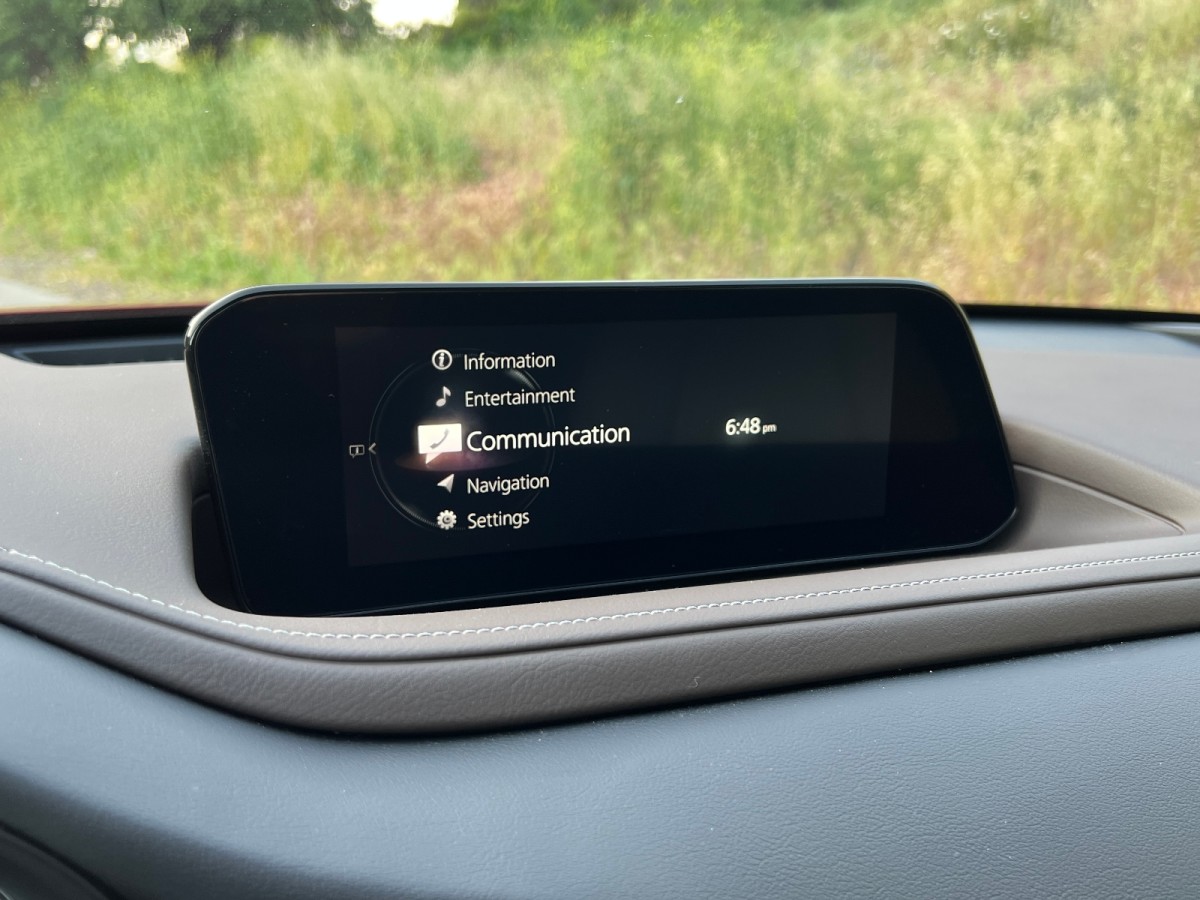
These shortcomings are unfortunate because Mazda beautifully integrates the 8.8-inch display into the dashboard's design, and it offers pleasing graphics and features a logical menu structure and user experience. In addition, the centre console controls operate with a sense of quality and fluidity, helping to underscore how refined the CX-30's interior is.
All CX-30s have Bluetooth, HD Radio, Apple CarPlay, Android Auto, two USB ports, and connected services. Turbos add SiriusXM satellite radio, a navigation system, and an adequate 14-speaker Bose premium sound system.
Safety
Safety is a 2023 Mazda CX-30 highlight. This year, Mazda improves the SUV's side-impact crash protection with standard rear side airbags, outboard rear seatbelt tensioners, and other updates.
As a result, the Insurance Institute for Highway Safety (IIHS) gives the Mazda CX-30 a "Top Safety Pick" rating. In this vehicle class, only the Honda HR-V offers that level of safety, earning a slightly higher "Top Safety Pick+" rating. But a Honda HR-V is nowhere near as appealing, upscale, or fun to drive as the Mazda CX-30.
There are plenty of safety features available for the 2023 CX-30, but not many are standard in Canada. On the GX grade, blind spot monitoring and rear cross-traffic alert are included. But you’ll need to step up to the GS trim to get adaptive cruise control, forward-collision warning with pedestrian detection, automatic emergency braking, lane-departure warning, lane-keeping assist, and automatic high-beam headlights.
The GT and GT Turbo trims upgrade with an adaptive front lighting system, a surround-view camera, front and rear parking sensors, automatic rear braking, traffic sign recognition, traffic jam assist, and a head-up display (HUD). At lower speeds, Traffic Jam Assist pairs adaptive cruise control with lane-centring assistance to make the commute more bearable.
We found the surround-view camera and parking sensors helpful during our test drive, and the head-up display is terrific. It conveys plenty of information, but the data point we find most useful is the blind-spot warnings that show on the HUD. Thanks to Mazda's approach, you don't need to look away from the road to see if it's safe to change lanes.
And yet, that's what we were doing when we experienced a full-on forward-collision warning and automatic emergency braking event on a highway. While traveling at about 40 km/h approaching an off-ramp, we checked the right mirror to see if it would be safe to change lanes. At this exact moment, a motorist ahead decided to tuck into a gap a few vehicles up, and the Jeep in front of us suddenly braked hard. The forward-collision system issued warnings, and the brakes automatically brought the CX-30 to an immediate halt.
Now, on the one hand, this is terrific. The tech worked precisely as intended. But, on the other hand, given the speed, the situation, and the distance between the Mazda and the Jeep ahead, the response also seemed excessive. Not only that, but it nearly gave everyone in the CX-30 a heart attack. But, so would an airbag deployment, so we'll take the technology over an actual collision, thank you.
Otherwise, the driving assistance systems worked well. We like that you can program the type of lane-departure warning the CX-30 issues, and the lane-keeping assist works transparently until you genuinely need it, at which point it acts decisively in a very European manner. The blind-spot monitoring system looks back a little further than you might expect, adding a measure of safety.
However, while driving the CX-30 enthusiastically in the mountains, a warning message popped up within the instrumentation. It said: "Safety and driver support systems partially disabled. Drive safely." It is unclear what triggered this, and it remained illuminated until we stopped, turned off the engine, and restarted the CX-30.
Cost-effectiveness
Rumour has it that you'll pay a premium to buy a Mazda CX-30, especially if you choose one of the turbocharged models. That's because Mazda positions the CX-30 as a premium offering in the same sliver of the small crossover segment where the Buick Encore GX, Jeep Compass, and Volkswagen Taos also reside.
However, considering the Mazda's standard AWD and robust mid-level powertrain, the CX-30 GS ($30,000; $32,200 with the Luxury Package) and GT ($36,200) suddenly look like a bargain. The rivals mentioned above cost the same or more, as do an equivalently equipped Chevrolet Trailblazer, Ford Bronco Sport, Honda HR-V, Subaru Crosstrek, Hyundai Kona, Kia Seltos, and Toyota Corolla Cross.
In addition, while the GT Turbo’s price of $38,600 is shockingly high for the segment, we think you can credibly compare it with any entry-level Audi Q3 or Mercedes-Benz GLA. Price-wise, the Audi and Mercedes start a few thousand dollars north of where the fully-loaded Mazda leaves off.
The problem, of course, is that North Americans don't ascribe any brand cachet to Mazda. Driving enthusiasts do and have for decades. But those types of customers seeking an affordable thrill ride with some added utility will get a Mazda 3 hatchback for its lighter weight, lower centre of gravity, and available manual transmission before they'll park a CX-30 in their driveway.
Nevertheless, we think the mid-trim CX-30s deliver compelling value. First, this crossover looks good, despite all the cladding. Second, the interior provides luxury-level design, detailing, and materials. Third, it has impressive power compared to most rivals, plus standard all-wheel drive and lots of ground clearance. Fourth, like all Mazdas, it is rewarding to drive. Lastly, the CX-30 is exceptionally safe.
If you won't mind the cramped back seat, the small cargo area, and the fussy infotainment system, the 2023 Mazda CX-30 GS or GT are good picks among small crossover SUVs. However, the tested CX-30 GT Turbo commands a premium for faster acceleration and advanced driving assistance tech that makes it harder to recommend unless you're choosing it over something like an entry-level Audi, Mercedes, or other small luxury-brand SUV.
Note: Images show a US model.

What owners say
Very comfortable and good handling vehicle.
February 10, 2024You get a LOT of features for the money, The red interior is super nice. I love the Carbon Edition model. Batman would be proud to drive this car!
July 20, 2023Trims & specs
Base MSRP $25,400 | Seating 5 |
Engine 2.5L 191 hp I4 | Cargo Capacity 20.2 cu ft |
Combined MPG 29 | Drivetrain AWD |
Base MSRP $33,800 | Seating 5 |
Engine 2.5L 250 hp I4 | Cargo Capacity 20.2 cu ft |
Combined MPG 26 | Drivetrain AWD |
Base MSRP $28,550 | Seating 5 |
Engine 2.5L 191 hp I4 | Cargo Capacity 20.2 cu ft |
Combined MPG 29 | Drivetrain AWD |
Base MSRP $35,400 | Seating 5 |
Engine 2.5L 250 hp I4 | Cargo Capacity 20.2 cu ft |
Combined MPG 26 | Drivetrain AWD |
Base MSRP $22,950 | Seating 5 |
Engine 2.5L 191 hp I4 | Cargo Capacity 20.2 cu ft |
Combined MPG 29 | Drivetrain AWD |
Base MSRP N/A | Seating N/A |
Engine N/A | Cargo Capacity N/A |
Combined MPG N/A | Drivetrain N/A |
Base MSRP N/A | Seating N/A |
Engine N/A | Cargo Capacity N/A |
Combined MPG N/A | Drivetrain N/A |
Base MSRP $29,290 | Seating 5 |
Engine 2.5L 191 hp I4 | Cargo Capacity 20.2 cu ft |
Combined MPG 29 | Drivetrain AWD |
Base MSRP $31,500 | Seating 5 |
Engine 2.5L 191 hp I4 | Cargo Capacity 20.2 cu ft |
Combined MPG 29 | Drivetrain AWD |
Base MSRP N/A | Seating N/A |
Engine N/A | Cargo Capacity N/A |
Combined MPG N/A | Drivetrain N/A |
Base MSRP N/A | Seating N/A |
Engine N/A | Cargo Capacity N/A |
Combined MPG N/A | Drivetrain N/A |


Pricing trends
MSRP range
$22,950 - $35,400
Current avg. market price
$27,569
Trending down by 1.4% this month
May 2026 - November 2026

