2021 Mazda CX-30 Reviews, Pricing & Specs




The CarGurus verdict
When it comes to the new 2021 Mazda CX-30 2.5 Turbo, the sum is greater than its handful of extra parts.
Blurring the lines between mainstream and luxury brands, the new 2021 Mazda CX-30 2.5 Turbo pairs effortless acceleration and engaging driving dynamics with a premium design and impressive technologies. Despite its substantial boost in power, this subcompact SUV isn’t about hardcore performance. Rather, it’s about delivering equal parts confidence, capability, style, and satisfaction, and at a price that stops where the traditional luxury brands are just getting started.
out of 10 expert review
Look & feel
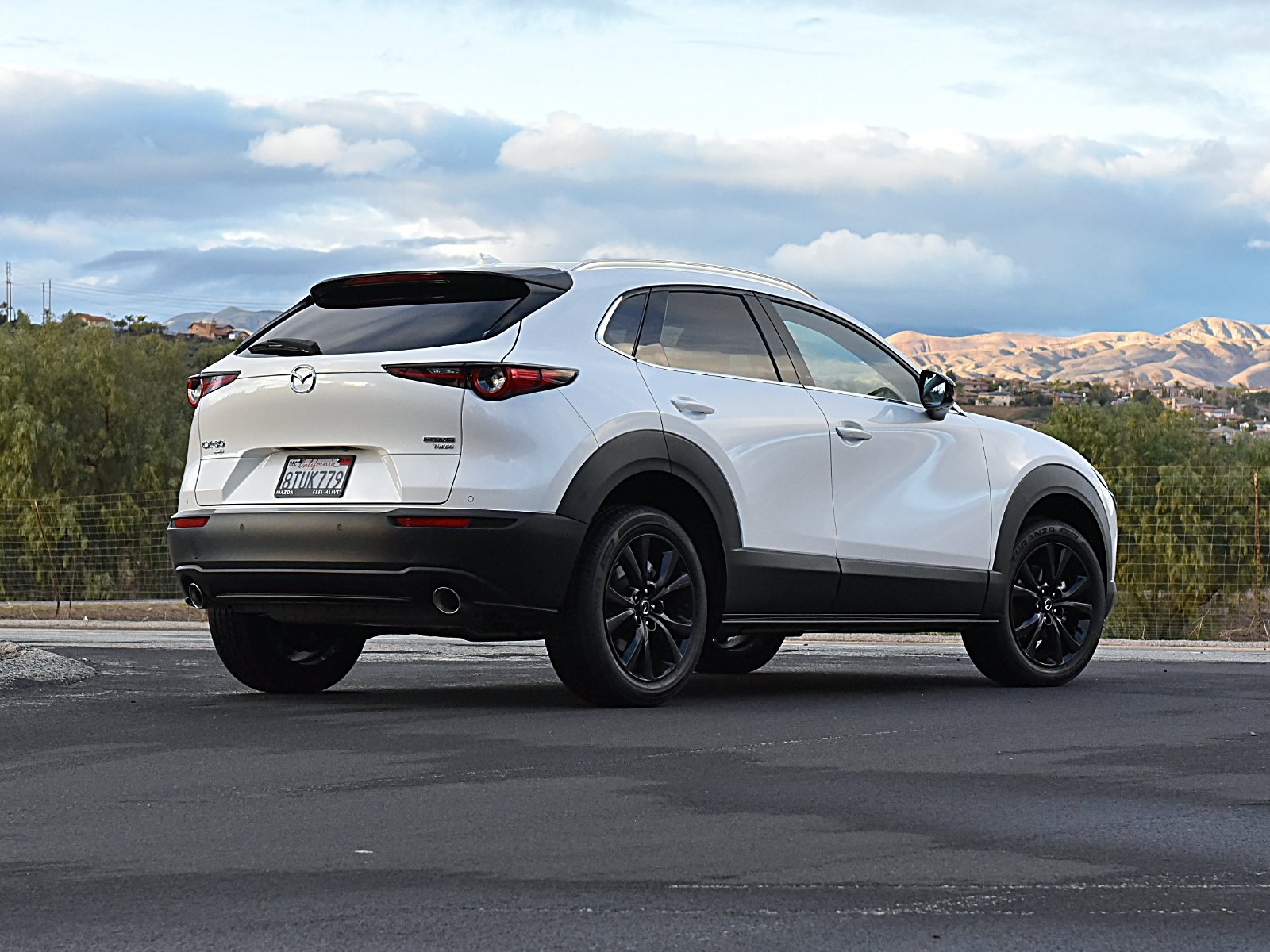
If you like black wheels and you cannot lie, well, then you’re going to like the new Mazda CX-30 2.5 Turbo introduced for the 2021 model year. Between the Turbo’s exclusive shiny black 18-inch rollers, shiny black grille, shiny black side mirror housings, and thick matte black body cladding, it appears as though a black Sharpie 44 Magnum was having its way with the CX-30 Turbo before calmer minds put a halt to the carnage.
When it comes to all of the lower body cladding, Mazda’s official explanation is that it gives the CX-30 Turbo a light and agile appearance, like the body is floating over the wheels. Yes, that is the effect, as though the CX-30 is cresting a sharp hill at speed and the suspension is fully extended. Except it looks like this all of the time.
Whether you like the effect or not, there’s no denying that Mazda’s approach makes the CX-30 look like something other than the Mazda Mazda3 hatchback on which it is based. Though the styling themes between the two models are similar, the CX-30 is higher off the ground both perceptually and in reality.
You realize this the moment you open the door to slide into—rather than drop down into—the CX-30. Once you’re situated in the driver’s seat, you’ll notice how the cabin looks just like the Mazda3’s. This is not a bad thing. Quality materials, complementary tones and textures, and stitched chocolate brown surfaces give every Mazda CX-30 Turbo an upscale vibe.
Changes to the cabin are limited to a chrome accent around the engine start button and a standard frameless rearview mirror. Black or white leather is standard with GT trim, the point in the line-up where the turbocharged engine becomes available.
Prices for the 2021 CX-30 range from an MSRP of $24,700 (not including a $1,950 destination charge) to $36,400 when the turbo engine is equipped. Our Snowflake White Pearl Mica test vehicle had the Black leather and a rear bumper guard, bringing the price to $38,827 including fees (Canadian, estimated).

Performance
Aside from adding its turbocharged Skyactiv 2.5-litre four-cylinder engine under the hood, Mazda makes a handful of changes to the CX-30 2.5 Turbo’s six-speed automatic transmission, standard i-Activ all-wheel-drive (AWD) system (though front-wheel drive (FWD) is standard on lower grades), front suspension tuning, and G-Vectoring Control Plus (GVC-Plus) technology.
The engine makes between 227 and 250 horsepower, depending on the octane rating of the fuel you feed it. Run it on regular, and you’ll be getting the 227 ponies. Not that there’s anything wrong with that, because torque measures 310 pound-feet at 2,000 rpm or 320 lb-ft at 2,500 rpm. In other words, acceleration is going to feel pretty much the same at lower engine speeds.
As far as fuel efficiency goes, the CX-30 Turbo’s official rating from Natural Resources Canada is 9.3 litres per 100 kilometres in combined driving. We averaged 9.6 L/100 km. Based on that average and the crossover’s 48-litre fuel tank, the maximum driving range is roughly 500 kilometres. Put another way, you’re going to be stopping for gas. A lot.
Talk with Mazda engineer Jay Chen, and it’s clear the company has spent a bunch of time studying acceleration g-force, which measures what people feel while they’re behind the wheel. Rather than calibrate the CX-30 Turbo to deliver the fastest acceleration time, Chen says Mazda tunes its powertrains to supply more power and response than most people will need most of the time. This approach, in turn, leads to greater driving satisfaction.
On the road, what you feel from the CX-30 Turbo is effortless acceleration regardless of the situation. There are hints of torque steer when you step hard on the accelerator from a stop or when exiting a corner or a curve, as you might expect with up to 320 lb-ft of torque flowing through the drivetrain. The revised GVC-Plus technology helps to manage this, and the i-Activ AWD monitors weight transfer, acceleration, and cornering g-force to actively distribute up to half of the engine’s power to the rear wheels, where a more robust rear differential mount can handle 300% more torque than a standard CX-30.
Mazda engineer Dave Coleman also admits that, depending on the situation, the software might limit torque delivery to the front wheels simply because there is so much of it. If that recalls the gone-but-not-forgotten Mazdaspeed 3, yes, the theory is similar. But compared to that sporty hot hatch, the Mazda CX-30 Turbo is less Zoom Zoom and more Feel Alive.
The distinction resides in how the vehicle drives. Modern Mazdas are not meant to deliver a raw and visceral dynamic. In keeping with the automaker’s move into premium territory, its cars and SUVs are all grown up and sophisticated. Yes, they still offer an enjoyable driving experience, but the source of that pleasure is less obvious, lending today’s Mazda lineup greater subtlety and sophistication.
Given the CX-30 Turbo’s close kinship with the Mazda3 Turbo, comparisons are difficult to avoid when you’ve driven both cars on the same roads – albeit not back-to-back.
To its detriment, the CX-30’s added height, weight, and tire sidewall section width make it less pleasurable to drive – and Mazda’s slight stiffening of the front suspension to account for some of the added bulk doesn’t solve this. Put simply, the CX-30 Turbo doesn’t handle as well as the Mazda3. To a driving enthusiast, this is an unacceptable trade-off, unless you have a regular hankering to head well off of the highway.
When driving in the dirt or snow is desirable, the CX-30’s 5 centimetres of extra ground clearance more than compensate for any reduction in on-pavement performance. Plus, the CX-30 Turbo comes with an Off-Road mode, which puts i-Activ on standby and ready to lock up the centre coupling to ensure maximum transfer of power to the rear wheels when necessary.
Feeling confident after hearing Mazda explain its Off-Road mode, and following days of rain, we headed down a muddy path and promptly encountered a maze of deep ruts and puddles. Knowing this trail well, and realizing just how deep and swampy the path ahead would be, we prudently pulled a three-point turn and headed back whence we came on the CX-30 Turbo’s all-season tires.
Later, we pulled onto the dirt shoulder of a country road. From a standstill, we mashed the accelerator pedal to the floor and the CX-30 Turbo’s i-Activ AWD instantly sent power to the rear wheels to give the little SUV remarkable traction and response as we aimed it back onto the pavement. With some front-drive-based AWD systems, you can feel a delay before the power heads to the rear axle. Here, in this situation, the delay proved imperceptible.
If you know what you’re looking for, you can tell that the CX-30 Turbo uses a simple torsion-beam rear suspension design. To Mazda’s credit, the majority of the time you can’t feel a difference, and that’s also true of the Mazda3. But, as we accelerated down an on-ramp onto a highway, the SUV passed over a dip on just the right side of the lane, but both sides of the CX-30’s rear end reacted to it, giving the SUV a more pronounced bounce than expected.
Nevertheless, the CX-30 is a clear cut above the small SUVs from mainstream brands and is nearly as rewarding to drive as the best luxury alternatives.

Form & function
In addition to being easy to get into and out of, the 2021 Mazda CX-30 Turbo is exceptionally comfortable for the driver. Thanks to eight-way manual adjustment, impressive long-distance support, and Mazda’s driver-focused interior layout and control positioning, the CX-30 Turbo feels like a perfectly natural fit.
Both front seats are also heated as standard, and a heated steering wheel is standard with the GS and GT trims. Ventilated seats are not available, though, a necessity if Mazda wants people to consider it a credible premium SUV alternative. It would help to have a wider range of adjustment for the front passenger’s seat, too. The seat itself is comfortable, just not easy to tailor to preferences as the one the driver enjoys.
Though Mazda arranges all of the controls around the driver for an intimate setting, the cabin’s organic shapes and overall minimalism contribute to a sense of spaciousness. This openness, combined with high-quality materials and switchgear, can make the CX-30 Turbo look and feel like a larger SUV from the driver’s seat.
But the CX-30 Turbo is actually a small SUV, and that’s evident when you load adults into the back seat. Cramped accommodations await, though it’s worth noting that the front seatbacks are just as soft and densely padded as the CX-30’s front centre and door panel armrests. So, grown-ups can tolerate it for a short while, in part because Mazda equips the CX-30 Turbo with rear-seat air conditioning vents.
Storage space is generous for a vehicle of this size, but Mazda locates the optional wireless smartphone charger at the bottom of the centre console storage bin beneath the centre armrest. This location forces a choice. Use the centre console for storage, or use it for wireless phone charging. It cannot serve both purposes.
Raise the rear liftgate and the CX-30 Turbo presents 572 litres of cargo space. That’s essentially identical to the Mazda3 hatchback, which supplies 569 litres of volume. Fold the seats down and the CX-30 offers 1,280 litres, which is less than the Mazda3 hatchback’s 1,334 litres.

Technology
Artfully poised atop the Mazda CX-30 Turbo’s dashboard, an 8.8-inch infotainment-system display offers two panels of data to the driver. It is not a touchscreen. Instead, the driver operates the system using physical controls on the centre console and steering wheel, or specific voice commands requiring prescribed pathways to success.
With enough time and acclimation, you get used to how the Mazda Connect infotainment system works. A natural voice recognition system would reduce distraction, and would make the Mazda CX-30 more competitive within the entry-luxury SUV club it aspires to join. But the voice control technology is helpful when walking the driver through the required prompts, though glancing back and forth between the road and the 8.8-inch display undercuts Mazda’s reasoning for not offering a touchscreen.
Furthermore, standard Apple CarPlay and Android Auto smartphone mirroring provide access to the digital assistants you already know and love. But there must be an easier way to cycle through your radio station favourites. Maybe we’re missing something obvious when setting Mazda Connect up, but the process of changing between favourite stations – pushing on the centre console knob to call up a menu, twisting it to select Favourites, pushing it again to choose Favourites, twisting it again to the desired station, and then pushing it again to choose a station – is seriously aggravating.
With the GT trim, the Mazda CX-30 includes SiriusXM satellite radio, a navigation system, and a 12-speaker Bose premium audio system. This is an impressive set of components, and it sounds great in part because Mazda says it was able to work with Bose early in this interior’s design phase to ensure proper speaker placement.
The GT trim also equips the CX-30 with an Active Driving Display (a head-up display). It shows the driver a range of useful data projected onto the windshield, including when another vehicle is in the SUV’s blind spots. This is brilliant because you don’t need to look away from the road ahead before signaling a lane change in order to know if the maneuver will be a safe one or not.

Safety
The Mazda CX-30 Turbo might be small, but it is mighty, and for an important reason other than its engine. This SUV earned a Top Safety Pick+ rating from the Insurance Institute for Highway Safety (IIHS). It gets the highest IIHS rating in every testing parameter.
In tests conducted by the National Highway Traffic Safety Administration (NHTSA), the same is true. It earns five-star ratings in every assessment except for rollover resistance, where it receives a four-star rating. Since we’ve made comparisons to the Mazda3 Turbo already, it's worth noting the car gets a superior 5-star rollover resistance rating.
Mazda equips every CX-30 Turbo with a full collection of safety features and advanced driving assistance systems (ADAS). They include the usual suspects and are effective in ways that please rather than irritate. There is no high-speed lane-centring assistance function, though, which is sometimes nice to have.
The GT trim adds an adaptive front lighting system that helps to illuminate around curves and corners by bending the headlight beams into them. It’s useful. This trim also installs front and rear parking sensors, and a rear automatic emergency braking system that operates at speeds under 10 km/h.

Cost-effectiveness
Mazda plugs the 2021 CX-30 Turbo into a sweet spot in the small SUV market. It costs more than competitors from mainstream brands, but it offers class-above design, materials, quality, and power.
At the same time, it costs less than competitors from luxury brands, delivering far more equipment and, in some cases, superior performance and more sophisticated styling at a lower price.
If you aspire to own a luxury SUV and you don’t care about the brand cachet that accompanies the purchase of an Audi, BMW, or Mercedes, the Mazda CX-30 GT Turbo demands consideration. But if you simply aspire to own a new SUV, you might want to consider the standard CX-30 and save yourself a few grand.
We spent a few days in a CX-30 GT before driving the turbocharged variant, finding it reasonably energetic thanks to its well-calibrated six-speed automatic transmission. And, in almost every respect, it offers the same levels of dynamism, quality, style, sophistication, and technology that you’ll find in a CX-30 Turbo.
Furthermore, the new CX-30 Turbo also faces stiff competition from within the Mazda family: the CX-5 Turbo. Granted, there’s a price premium of nearly $5,000, but this upgrades you into a larger, roomier, and no less enjoyable SUV.
Mazda says this familial pricing gap isn’t a concern, and that its customers will choose the SUV that is sized to and equipped for their lifestyle. More likely, this pricing similarity is a short-term problem because the next-generation CX-5 (CX-50?) will probably move it further upscale.
Such a move would give the new Mazda CX-30 Turbo some necessary breathing room, making it an even more cost-effective answer to the question of which small SUV to buy.
What owners say
"Overall, owners of the 2021 Mazda CX-30 are very satisfied with their vehicles, praising its sporty design, interior quality, and driving dynamics. Many highlighted the CX-30's fun-to-drive nature and luxury feel at an affordable price, making it an appealing option compared to competitors. However, some did mention that the back seat legroom could be improved and there’s a desire for additional USB ports."
This is a great small SUV. It feels roomy inside and the ride is very smooth. The premium package has all the bells and whistles I need. With regular maintenance this car will last a long time.
January 17, 2024As a loyal VW customer, I went to check out the new Taos suv when it arrived in showrooms. It was, to say the least, uninspiring and dull. Lots of cheap looking plastic everywhere. I had seen the CX-30 on tv, and a Mazda dealer was nearby. One look and I was blown away. Amazing minimalist design—both inside and out. And the quality of the interior materials was nothing like I’ve seen outside a true luxury car. And then I drove it—much more nimble and quicker than the VW. So sporty, so much luxury, so much style. Then looking at the price, the decision to buy the Mazda was quickly made. For a comparably equipped car, it was about $8000 less than the VW. No, I’m not making this up. It’s fun to drive and I’m laughing all the way to the bank. Thank you, Mazda.
July 2, 2021After reviewing various sources for performance and reliability I find this vehicle to be a good fit for using around town and also in inclement weather driving. I would not use this for offroad driving. It does have some features that should avail it to gravel roads and fire road travel. It offers ample cargo spaces. The amenities available are modern and well placed in the vehicle. I would compare this favorably to the Honda CR-V and other Suburban SUV type vehicles.
May 24, 2024What owners say
This is a great small SUV. It feels roomy inside and the ride is very smooth. The premium package has all the bells and whistles I need. With regular maintenance this car will last a long time.
January 17, 2024As a loyal VW customer, I went to check out the new Taos suv when it arrived in showrooms. It was, to say the least, uninspiring and dull. Lots of cheap looking plastic everywhere. I had seen the CX-30 on tv, and a Mazda dealer was nearby. One look and I was blown away. Amazing minimalist design—both inside and out. And the quality of the interior materials was nothing like I’ve seen outside a true luxury car. And then I drove it—much more nimble and quicker than the VW. So sporty, so much luxury, so much style. Then looking at the price, the decision to buy the Mazda was quickly made. For a comparably equipped car, it was about $8000 less than the VW. No, I’m not making this up. It’s fun to drive and I’m laughing all the way to the bank. Thank you, Mazda.
July 2, 2021After reviewing various sources for performance and reliability I find this vehicle to be a good fit for using around town and also in inclement weather driving. I would not use this for offroad driving. It does have some features that should avail it to gravel roads and fire road travel. It offers ample cargo spaces. The amenities available are modern and well placed in the vehicle. I would compare this favorably to the Honda CR-V and other Suburban SUV type vehicles.
May 24, 2024This is my seventh Mazda, so no surprises there. The car drives great and has all the bells and whistles. There is nothing in this segment that even comes close to the driving dynamics and premium interiors of this compact crossover.
February 27, 2024The cx30 has an incredible array of sophisticated features. Ive never had a vehicle like this. But it was very affordable compared to more expensive models like the BMW X2. It has the feeling of quiet luxery and yet zippy handling. I want to drive it everyday!
September 12, 2023I had a 2009 Mini Cooper with 112 K. When its A/C quit working earlier this year I got a couple estimates to have it repaired. With lowest being $2K, it was time to start looking for a new vehicle. It wasnt an easy decision- my Mini had been very reliable. Unfortunately after doing a good amount of research, I was disappointed to see that newer models of Mini didnt have high reliability ratings. Reliability is very important to me, so did more research & decided to look for a used Mazda CX3 & Hyundai Kona. I test drove a used 2020 Kona. It was a nice car, but it didnt have a couple options I was looking for (sunroof, heated seats). The salesperson told me Id be better ordering a new Kona, because finding a used one with those options would be difficult. We only have one Hyundai dealer where I live, so before doing this I decided to check out Mazda. I looked at several CPO Mazda CX-3 s. One dealership also had a 2021 CX30 (CPO), so decided to test drive both models. Both cars came equipped with similar options, pricing & mileage. Mazdas CPO warranty offers excellent coverage. Both cars, pre tax were under $30K which is hard to find nowadays. Ultimately, I ended up buying the CX30. It is slightly larger than CX-3, has a bit more leg room for back seat passengers. The Mazdas interior seemed less plastic vs. Hyundais Kona. The CX30 had a sunroof & heated leather power seats. It wasnt an easy decision but one Im pleased with. I have several friends & family members who own Mazdas and have been pleased with their reliability.
July 24, 2022Everything is great, has all the bells and whistles that the cx 5 has, for a small crossover SUV . The only thing I would say is it needs a little more leg room in the back. Larger tires, to fill the gap in the back wheel wells. Great !!!!
December 23, 2020Lots of features, good value, great quality, quiet, peppy and comfortable.
November 8, 2023Just bought it yesterday but absolutely adore it so far- great features, agility & a joy to drive
December 5, 2021Car is comfortable and cozy. Driver and passenger sit comfortable, any rear passengers might be a bit cramped on long rides.
April 16, 2024Trims & specs
Base MSRP $23,450 | Seating 5 |
Engine 2.5L 186 hp I4 | Cargo Capacity 20.2 cu ft |
Combined MPG 27 | Drivetrain AWD |
Base MSRP $28,700 | Seating 5 |
Engine 2.5L 186 hp I4 | Cargo Capacity 20.2 cu ft |
Combined MPG 29 | Drivetrain FWD |
Base MSRP N/A | Seating N/A |
Engine N/A | Cargo Capacity N/A |
Combined MPG N/A | Drivetrain N/A |
Base MSRP $30,100 | Seating 5 |
Engine 2.5L 186 hp I4 | Cargo Capacity 20.2 cu ft |
Combined MPG 27 | Drivetrain AWD |
Base MSRP N/A | Seating N/A |
Engine N/A | Cargo Capacity N/A |
Combined MPG N/A | Drivetrain N/A |
Base MSRP $24,050 | Seating 5 |
Engine 2.5L 186 hp I4 | Cargo Capacity 20.2 cu ft |
Combined MPG 29 | Drivetrain FWD |
Base MSRP N/A | Seating N/A |
Engine N/A | Cargo Capacity N/A |
Combined MPG N/A | Drivetrain N/A |
Base MSRP $25,450 | Seating 5 |
Engine 2.5L 186 hp I4 | Cargo Capacity 20.2 cu ft |
Combined MPG 27 | Drivetrain AWD |
Base MSRP $22,050 | Seating 5 |
Engine 2.5L 186 hp I4 | Cargo Capacity 20.2 cu ft |
Combined MPG 29 | Drivetrain FWD |
Base MSRP N/A | Seating N/A |
Engine N/A | Cargo Capacity N/A |
Combined MPG N/A | Drivetrain N/A |
Base MSRP $26,450 | Seating 5 |
Engine 2.5L 186 hp I4 | Cargo Capacity 20.2 cu ft |
Combined MPG 29 | Drivetrain FWD |
Base MSRP $27,850 | Seating 5 |
Engine 2.5L 186 hp I4 | Cargo Capacity 20.2 cu ft |
Combined MPG 27 | Drivetrain AWD |
Base MSRP $34,050 | Seating 5 |
Engine 2.5L 250 hp I4 | Cargo Capacity 20.2 cu ft |
Combined MPG 26 | Drivetrain AWD |
Base MSRP $32,450 | Seating 5 |
Engine 2.5L 250 hp I4 | Cargo Capacity 20.2 cu ft |
Combined MPG 26 | Drivetrain AWD |
Base MSRP $30,050 | Seating 5 |
Engine 2.5L 250 hp I4 | Cargo Capacity 20.2 cu ft |
Combined MPG 26 | Drivetrain AWD |
Base MSRP N/A | Seating N/A |
Engine N/A | Cargo Capacity N/A |
Combined MPG N/A | Drivetrain N/A |


Pricing trends
MSRP range
$22,050 - $34,050
Current avg. market price
$23,715
Trending down by 4.4% this month
May 2026 - November 2026

