2023 Chrysler 300 Reviews, Pricing & Specs


Pros & cons
What we like
Stylish design
Powerful engine
Good value for money
What to consider
Poor fuel economy
Outdated technology
Unimpressive safety ratings
The CarGurus verdict
Say goodbye to the 2023 Chrysler 300, which exits production after 19 years with the roar of a mighty V8.
That bellowing is courtesy of a 6.4-litre Hemi, returning to the Chrysler 300 for the first time since 2014. Available only in the limited-production 300C model, it puts enough power to the rear wheels to effortlessly repave the roads with rubber. Fortunately, Chrysler fortifies the 300C with wheel, tire, suspension, and braking upgrades to help drivers make the most of the muscle under the hood. Naturally, there is also an active exhaust system that makes plenty of noise.
Verdict: Even as it ages toward retirement, the Chrysler 300 remains a strikingly attractive large sedan. With an available 6.4-litre V8 engine, it packs the firepower to support its muscle-car looks. However, the aging platform leaves much to be desired in terms of tech, comfort, and safety.
out of 10 expert review
Look & feel
When Chrysler introduced the 300 sedan in 2005, critics and consumers likened it to a Bentley. You may have required beer goggles to see the resemblance, but the Chrysler’s round headlights, bold grille, blunt nose, and stately proportions recalled one of the most elegant luxury sedans of the time, the Bentley Arnage.
In addition, considering the Chrysler 300 replaced the 300M, an unpleasant relic of the automaker’s cab-forward styling experiments, the stark difference between the new 300 and the old 300M lent instant credibility to the Bentley comparison.
Chrysler substantially reworked the 300 in 2011, and over the years, the car received new or updated powertrains, fresh technologies, and other enhancements. But from the platform to the pillars, it draws direct lineage to the Bentley-adjacent sedan that debuted all those years ago.
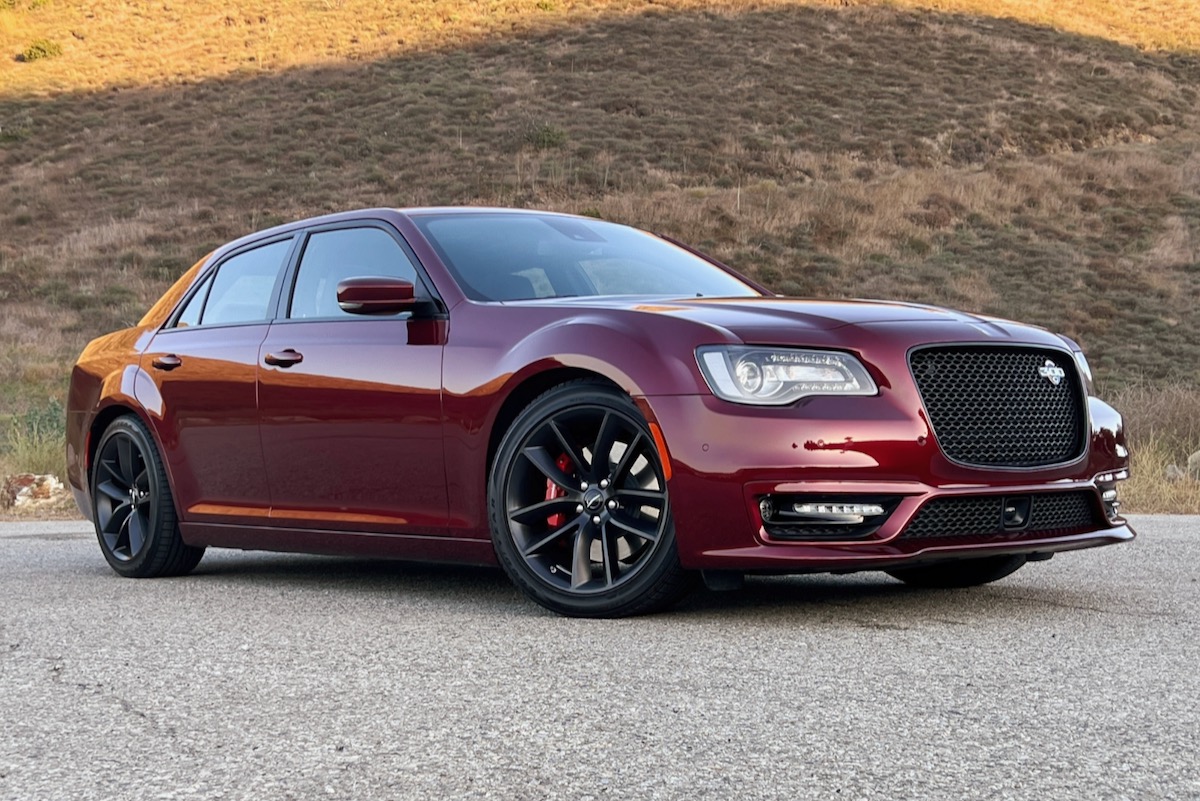
Nevertheless, the Chrysler 300 has aged exceptionally well from a styling standpoint. The car still looks good, and every trim level is available with or includes a blacked-out appearance with large 20-inch wheels wrapped in performance tires and gloss black accents.
For its final year in production, you can get a 2023 300 in Touring, Touring L, 300S, and 300C trim levels. The Touring and Touring L come only with a Pentastar V6 engine and your choice between rear-wheel drive (RWD) and all-wheel drive (AWD). The 300S is also available with that combination, or with a V8 engine and RWD. The 300C, limited to 2,000 examples, has a bigger and more powerful V8 and RWD.
Considering how the prices of new vehicles have risen, the 300 is relatively affordable, with new car pricing ranging from $48,945 to $72,995, not including the destination charge that varies across the country. The 300C special edition is the affordability exception, sitting at the top of that pricing spread. That’s what we evaluated for this review, and when you consider that it comes fully loaded with significant performance enhancements, that price also represents a bargain.
Don’t expect the interior quality to match the promise of luxury made by the exterior styling. The 300C gets carbon-fibre trim, premium Laguna leather upholstery, and cowhides covering the dashboard and other parts of the cabin. Otherwise, the interior looks and feels its price and age.

Performance
Aside from its exclusivity, the benefits of buying a 2023 Chrysler 300C are power and performance. Years ago, you could get a Chrysler 300 SRT, which equipped the full-size sedan with a 6.4-litre Hemi V8 and numerous hardware upgrades to match. The 300 SRT went out of production after the 2014 model year, but the 300C effectively revived it to commemorate 70 years since Chrysler first used the 300 name and to celebrate the final production run of the car.
In the 300C, the V8 makes power specs of 485 horsepower and 475 lb-ft of torque, put to the rear wheels through an eight-speed automatic transmission equipped with a Sport mode and paddle shifters. Chrysler says this powertrain produces roughly a 4.5-second run to 100 km/h when using launch control and attains a top speed of 257 km/h. And it isn’t shy about letting everyone within earshot know about it.
In addition to the big engine and active exhaust system, the 300C features an adaptive damping suspension, performance-oriented Brembo brakes, and performance tires wrapped around exclusive lightweight forged aluminum wheels. Driving modes adjust the drivetrain response, steering effort level, suspension firmness, and exhaust sound. You can configure your own preferences through the Custom setting or pick from Auto, Sport, and Track.
You must take care when stepping on the 300C’s accelerator pedal because the rear tires chirp easily after the traffic light turns green. A heavier foot can induce a squirrely sensation as the tires struggle to maintain their grip. And when you select Sport or Track mode, the traction and stability control systems allow more slip and slide.
We tried Sport mode on a mountain highway, and it unmistakably altered the 300C’s driving character. The car lunged with each press of the gas pedal, the steering took on a heavier feel, the suspension firmed up nicely, and the exhaust blasted the V8’s soundtrack loud and clear. But the accompanying stability control warning light convinced us that switching back to Auto mode was advisable.
Driving the Chrysler 300C is unconventionally fun. Constructed on a platform derived partly from mid-1990s Mercedes-Benz E-Class bits and pieces, there is a Germanic sensation in the ride and handling. Not a modern one, though. The 300C feels somewhat like a Nirvana-era AMG-tuned Benz, from the driving position to the driving dynamics.
There are two prices to pay for the 300C’s added performance. The first is cabin noise in the form of exhaust boom. The second is fuel economy, with an official Natural Resources Canada rating of 13.1 litres per 100 kilometres in combined driving. We averaged 13.4 L/100 km on the evaluation loop, which is full-size pickup truck territory.

Form & function
Technically, the Chrysler 300 is a full-size car, but it only feels that way if you’re sitting in one of the front seats. In the 300C, those seats offer an adequate range of power adjustments and feature premium Laguna leather, heating, and ventilation. Don't worry—the bolsters look stiff and uncomfortable, but they caress rather than assault you.
The rear seats are less hospitable, mainly due to the hard plastic front seatbacks, which make the already tight legroom even more dissatisfying. You won't like the back seat if you hate to slouch, either, as the 300’s rear backrest angle promotes that type of seating position. As a consolation, Chrysler supplies air conditioning vents, heated outboard cushions, and charging ports.
Storage space is generally lacking, and the 300 shows its age through its lack of a slot or tray designed to hold a modern smartphone or to charge one wirelessly. Chrysler dishes the covered area forward of the transmission shift dial to make it easier to fish coins out to pay for tolls (as if that’s still a thing). Ah, but there are heated and cooled front cupholders, which some people want. You can’t get a heated steering wheel, though.
In the back, the 300 offers unheated and uncooled cupholders in the fold-down centre armrest. Otherwise, storage is limited to the seatback map pockets, small armrest trays, and modest lower door panel bins.
Use the remote keyless entry fob to pop the trunk, which springs open without power assistance (unless it has snow or ice caked onto it). It reveals a large 461-litre cargo area with enclosed lid hinges so you won’t crush your belongings when slamming it shut using the convenient handle.

Technology
Chrysler equips the 300 with its previous-generation Uconnect infotainment system it shares with the Dodge, Jeep, Ram, and Fiat brands. While it offers the features you expect, it also increasingly shows its age.
Mounted in a squircle-shaped part of the dashboard, infuriatingly asymmetric to the air vents on either side, the 8.4-inch touchscreen is easy to use and navigate. Apple CarPlay and Android Auto connectivity require the use of a USB data port, and the 300C also comes with SiriusXM satellite radio and Guardian connected services. You can subscribe to a 4G LTE Wi-Fi hotspot, and the car has navigation, traffic reports, and voice recognition systems.
Though the graphics are dated and the touchscreen is small, the 300’s Uconnect system delivers on the basics. Even the voice-recognition system is acceptable if imperfect. The 300C also includes an SRT Dashboard to set driving modes, track vehicle performance, check system vitals, and more.
Chrysler provides stereo volume and radio tuning knobs below the screen, and the automaker’s trademark volume and tuning controls are present on the backs of the steering wheel spokes. They make surfing stations and adjusting the bass-heavy 19-speaker Harman Kardon premium audio system easy.
In addition, the primary dual-zone automatic climate controls for temperature, fan speed, and window defog/defrost are separate from the touchscreen display. However, to access the seat heating and ventilation, you must use one of the seven virtual menu buttons along the bottom of the infotainment screen.
We found one of the Chrysler 300C’s tech features particularly helpful. You can set a speed warning to let you know when you’ve exceeded a specific velocity, which is easy to do in this car. Unfortunately, if you’re flying down the highway, the alert is hard to hear over the wind, tire, and engine noise. That leaves you to notice a visual warning that is easy to miss in your peripheral vision.
One thing we wished the 300C had was a surround-view camera system. Or even a high-resolution reversing camera. This car’s outward visibility isn’t the best, though we’ll admit it’s easy to judge the front corners thanks to the long hood with well-defined corners. Front and rear parking sensors are standard with the 300C and optional on other versions of the car.

Safety
If you’re looking for advanced safety features, the Chrysler 300 will disappoint. If you’re not, this car will prove satisfying because, aside from an available lane-keeping assist system that is genuinely useful instead of irritating, the 300’s safety tech rarely tries to drive for you or second-guess your inputs.
Unfortunately, most of the available features are optional instead of standard in all but the fully loaded 300C. You must pay extra for the SafetyTec Plus Group to get them (and in Canada, that’s not even available on the base Touring trim). They include the usual suspects: forward-collision warning, automatic emergency braking, lane-departure warning, lane-keeping assist, blind-spot monitoring, rear cross-traffic alert, and adaptive cruise control. Rain-sensing wipers are about the only thing you can get for no extra charge.
You can adjust the sensitivity and responsiveness of some of these features, and with the lane-keeping assist system programmed in its medium setting, it isn’t intrusive. As a result, you’re more likely to leave it on to benefit from its corrective action. However, it would be nice if the lane-departure warning system offered a haptic vibration through the steering wheel, as we found the warning light hard to discern while driving.
The adaptive cruise control system isn’t terribly sophisticated. It can bring the 300 to a full stop but can’t resume speed when vehicles ahead start moving. In addition, when other cars cut into the gap ahead, the Chrysler brakes too much and for too long before slowly creeping back up to the set speed.
Another area where the Chrysler 300 shows its age is regarding crash-test ratings. It scores well enough in tests performed by the National Highway Traffic Safety Administration (NHTSA), the standards for which are just as old as the 300’s last redesign.
The Chrysler's performance is less impressive in the tougher Insurance Institute for Highway Safety (IIHS) tests. The IIHS hasn’t performed any of its updated and more demanding tests on this car, such as the small-overlap, frontal-impact test that measures protection if you impact something like a telephone pole on the driver’s-side corner of the front end. In the old moderate-overlap frontal-impact test that measures protection if you suffer a partial head-on collision with an approaching vehicle on a two-lane road, the Chrysler 300 gets a Marginal rating. In addition, the IIHS says the car’s headlight performance is Poor.

Cost-effectiveness
Given its upscale styling, unusual drivetrain configurations, and in 300C specification, muscular performance, Chrysler’s full-size car offers decent value for the money.
However, with safety features optional and safety ratings on the wrong side of sketchy, your chances of avoiding a collision or emerging from one unharmed aren’t as favourable as in other sedans. In addition, if you get the 300S with a V8 engine or the limited-production 300C, you’ll spend plenty of money at the gas pump.
Still, aside from the similar Dodge Charger and the Dodge Challenger coupe, which are also going out of production after the 2023 model year, there’s nothing quite like the Chrysler 300 available today. Unusual alternatives might include the Kia Stinger (also going out of production), Toyota Crown, and Volkswagen Arteon (no longer sold in Canada). As the Chrysler 300 departs, it leaves only minivans behind—the Chrysler Grand Caravan and Chrysler Pacifica—to represent the Chrysler brand.
None of these competitors can match the 300C’s class, sass, and ability for fast, though. And with V8-powered cars dropping out of the market faster than leaves on a breezy fall day, this might be one of your last chances to get your hands on this particular brand of American muscle right off the Brampton, Ontario, assembly line.
Note: Images show a US model.

What owners say
"Owners of the 2023 Chrysler 300 are largely satisfied with its smooth ride, spacious interior, and powerful performance. Many appreciate its comfort and style, noting that it's a great value for an American sedan. However, some drivers have pointed out that its rear-wheel drive isn't ideal for snowy conditions and that the sound system could use an update, especially since this is the last model year for the 300."
The roar of the 6.4L hemi is second to none. I wish the radio had been updated but seeing how this is the last model year, I understand. The ride is comfy and the seats hug you nicely. I get a lot of compliments on this car. You wont be disappointed.
December 13, 2023Smooth ride, roomy, comfortable, powerful and a beautiful pearl velvet color
July 15, 2023Chyster 300 is roomy, powerful, and very economical. Smooth transmission, but rear wheel drive not good in snow.
January 18, 2024What owners say
The roar of the 6.4L hemi is second to none. I wish the radio had been updated but seeing how this is the last model year, I understand. The ride is comfy and the seats hug you nicely. I get a lot of compliments on this car. You wont be disappointed.
December 13, 2023Smooth ride, roomy, comfortable, powerful and a beautiful pearl velvet color
July 15, 2023Chyster 300 is roomy, powerful, and very economical. Smooth transmission, but rear wheel drive not good in snow.
January 18, 2024The 300 is one of the smoothest accelerating cars I have ever driven and the ride feels like you are gliding down the road. The ZF 8-speed is smooth and reliable. Honestly Dodge and Chrysler is building the best cars they have built since the 60s and 70s. I rented one with over 60,000 miles on it and after that I had to buy one. After over 60,000 miles and being beat as a rental, the 300 didnt have a single rattle or noise in the interior and drove smooth as butter. That impressed me and I feel in love with the car. Get one while you still can.
April 22, 2024Last of the affordable American sedans. Good value. Sweet ride.
September 19, 2023Trims & specs
Base MSRP $55,000 | Seating 5 |
Engine 6.4L 485 hp V8 | Cargo Capacity 16.3 cu ft |
Combined MPG 19 | Drivetrain RWD |
Base MSRP $42,805 | Seating 5 |
Engine 3.6L 300 hp V6 | Cargo Capacity 16.3 cu ft |
Combined MPG 24 | Drivetrain RWD |
Base MSRP $34,295 | Seating 5 |
Engine 3.6L 292 hp V6 | Cargo Capacity 16.3 cu ft |
Combined MPG 24 | Drivetrain RWD |
Base MSRP $37,045 | Seating 5 |
Engine 3.6L 292 hp V6 | Cargo Capacity 16.3 cu ft |
Combined MPG 22 | Drivetrain AWD |
Base MSRP N/A | Seating N/A |
Engine N/A | Cargo Capacity N/A |
Combined MPG N/A | Drivetrain N/A |
Base MSRP $39,745 | Seating 5 |
Engine 3.6L 292 hp V6 | Cargo Capacity 16.3 cu ft |
Combined MPG 22 | Drivetrain AWD |
Base MSRP $46,350 | Seating 5 |
Engine 5.7L 363 hp V8 | Cargo Capacity 16.3 cu ft |
Combined MPG 20 | Drivetrain RWD |
Base MSRP $37,495 | Seating 5 |
Engine 3.6L 292 hp V6 | Cargo Capacity 16.3 cu ft |
Combined MPG 24 | Drivetrain RWD |