2022 Volkswagen Atlas Cross Sport Reviews, Pricing & Specs


Pros & cons
What we like
Stylish design
Comfortable
Impressive stereo
What to consider
Fairly pedestrian performance
Poor fuel economy
Interior materials feel cheap
The CarGurus verdict
If you don’t need a third-row seat, the 2022 Volkswagen Atlas Cross Sport is a stylish and practical alternative to the same old, same old.
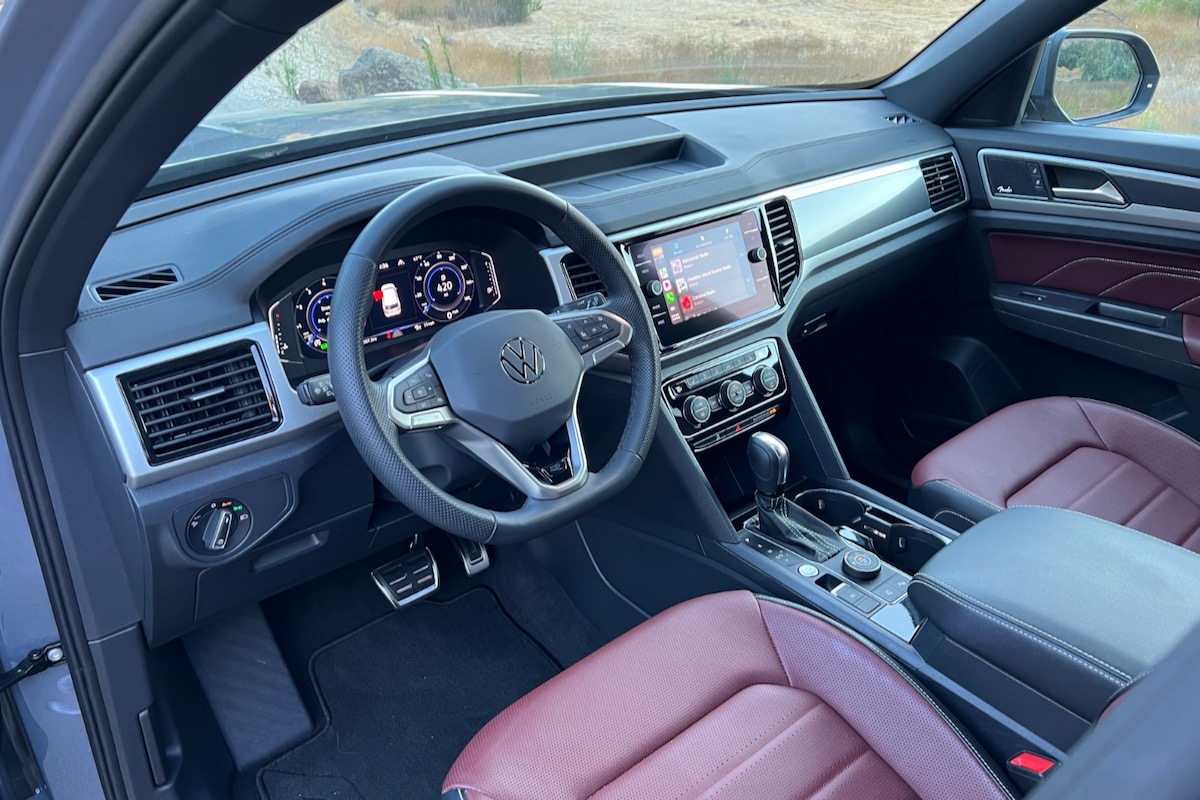
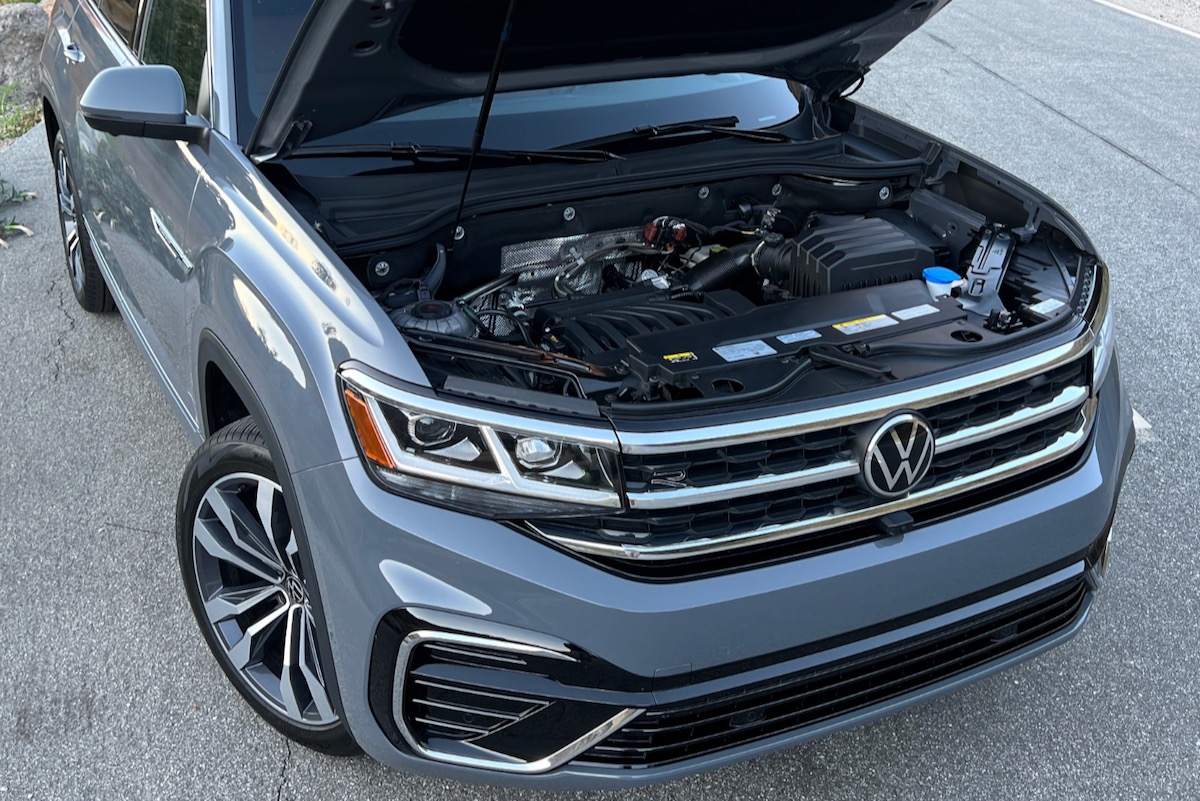
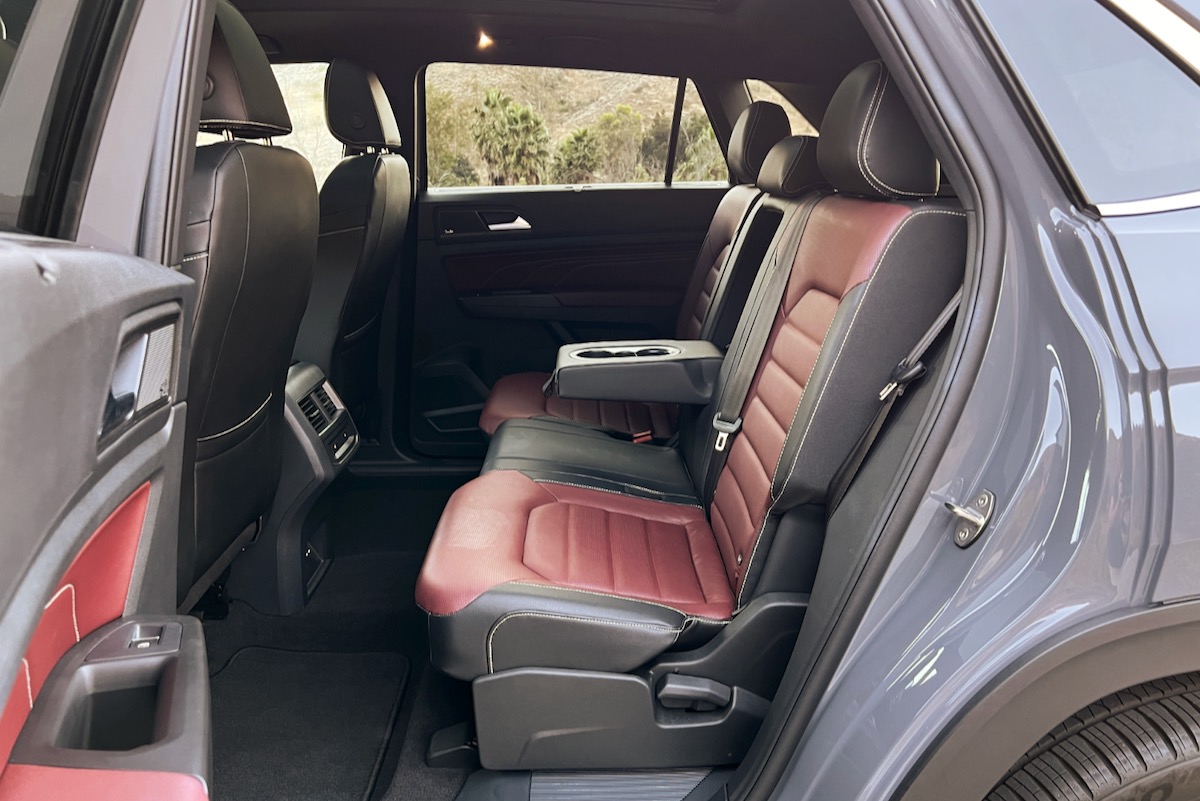
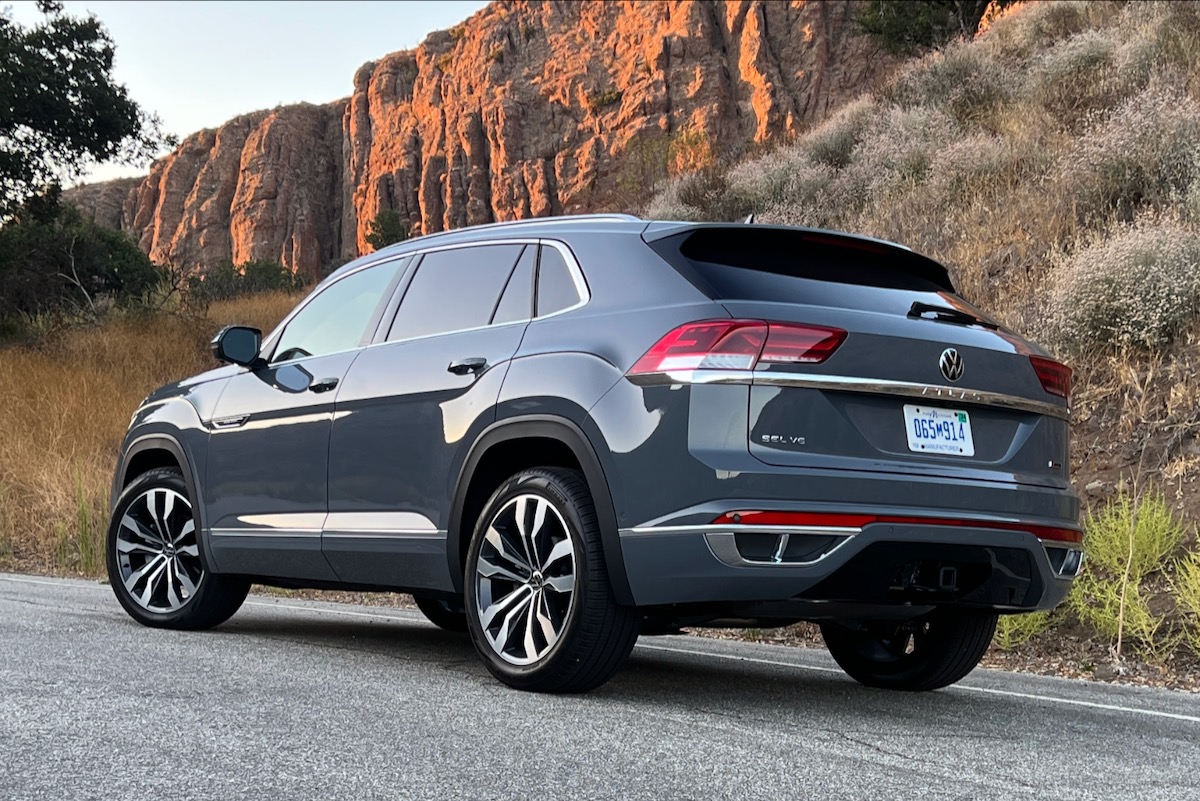
If it’s true that styling is what ultimately sells a person on a new vehicle, then the 2022 Volkswagen Atlas Cross Sport is poised for success. Volkswagen doesn’t fiddle with the Cross Sport formula for the 2022 model year, aside from adding standard digital instrumentation and bolting bigger 21-inch wheels to the top-of-the-line Execline, the US equivalent of which is shown in the accompanying photos. Those wheels, a Pure Grey paint job, and red leather seat inserts made our test vehicle look terrific.
out of 10 expert review
Look & feel
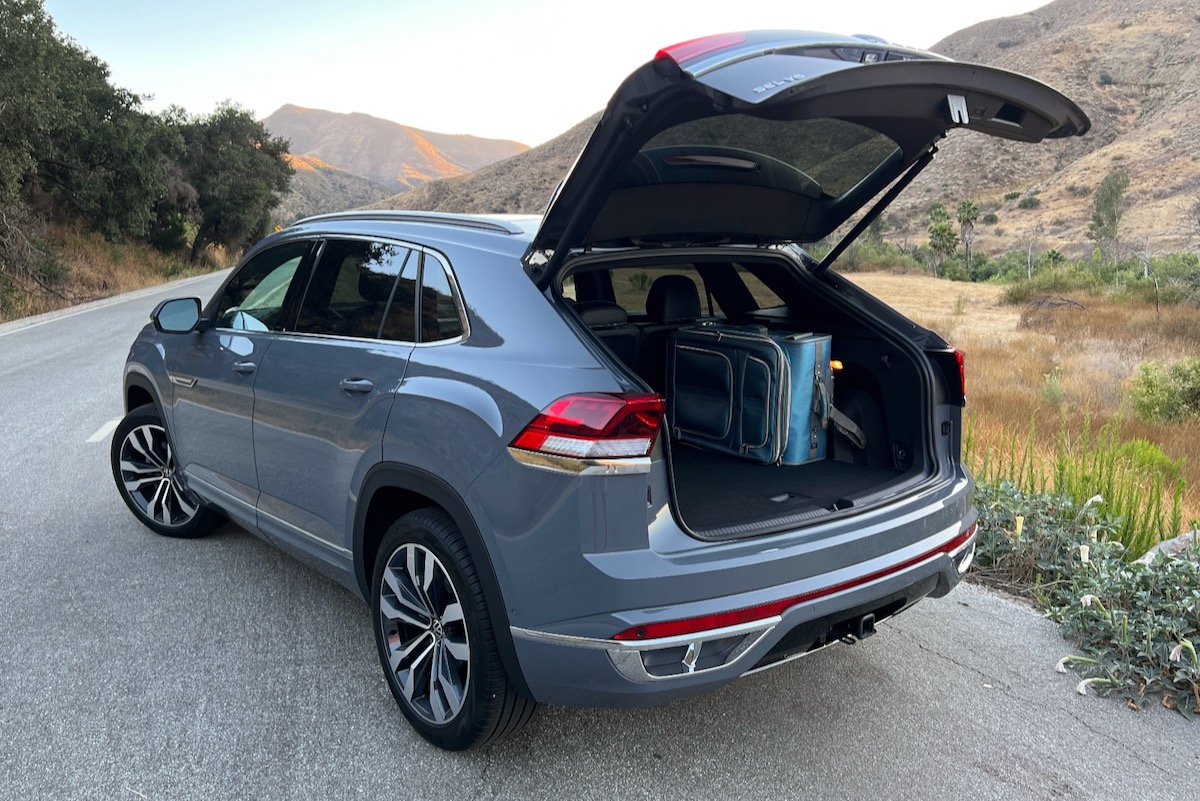
Volkswagen made the 2022 Atlas Cross Sport by removing the standard seven-passenger Atlas model’s third row, dropping the roofline by nearly 6 centimetres for a more rakish coupe-like appearance, and chopping the SUV’s length by 13.2 cm. The wheelbase remains the same, ensuring an exceptionally roomy interior for five people, but the Cross Sport’s stubby butt and angled rear window shrinks cargo space to 1,141 litres behind the second-row seat and a maximum of 2,203 litres.
These changes result in a bold, sporty, and upscale appearance, especially in Execline trim with the newly standard 21-inch machined-finish wheels. The chunky, five-split-spoke design emphasizes the Atlas Cross Sport’s broad-shouldered stance.
Unfortunately, the other Atlas Cross Sport wheel choices aren’t as appealing. The base Comfortline trim has 18-inch alloy wheels that look too small for the Cross Sport’s blistered fenders, but the Highline gets larger 20-inch wheels that look more appropriate.
Six paint colours are available, half of them requiring you to fork over some extra dough. The test vehicle was dipped in Pure Grey, and it looked fantastic in combination with the Dark Burgundy over Titan Black interior. The other interior colours include Cinnamon Brown and Titan Black. You really can’t go wrong with any of the Atlas Cross Sport Execline’s colour combinations—they all look great and convey an upscale appearance.
Unfortunately, the amount of hard, glossy plastic in the Atlas Cross Sport’s interior dulls the impression of quality, so don’t think you’re going to get a cut-rate Audi by choosing this VW. Also, the numerous storage areas that lack Volkswagen’s typical rubber or fabric-lined surfaces can produce lots of extra rattles and scraping noises while you drive. But if you can ignore these cheap fittings, you’ll feel like the Atlas Cross Sport is worth every penny.
An Atlas Cross Sport Execline carries a Manufacturer’s Suggested Retail Price (MSRP) in Canada of $56,595, not including a destination charge of $1,950 to ship it to your dealership from VW’s Chattanooga, Tennessee, factory. Compare that to a standard Atlas Execline, which would cost $57,695. By choosing the Atlas Cross Sport, you can save a little bit of money while getting extra style.
Performance
Volkswagen offers two engines in the Atlas Cross Sport. The standard engine is a turbocharged 2.0-litre four-cylinder supplying power specs of 235 horsepower and 258 pound-feet of torque, but only with premium fuel. And while the peak torque arrives at a reasonable 1,600 rpm, the Atlas Cross Sport weighs more than 2,000 kilograms—and that’s in base trim.
You may want to upgrade to the available 3.6-litre V6. It has a Natural Resources Canada fuel economy rating of 12.2 litres per 100 kilometres in combined driving, which is 1.6 L/100 km more than the turbo-four, but the V6 doesn’t require premium gas to make its more satisfying 276 hp and 266 lb-ft of torque. The V6 engine also tows more trailer weight, thanks to its 2,268-kilogram (5,000-pound) towing capacity. The turbo-four is only rated to tow 907 kilograms (2,000 pounds).
Both engines employ an eight-speed automatic transmission. In Canada, VW’s 4Motion all-wheel-drive (AWD) system is standard with either powertrain. You can choose from several driving modes with the 4Motion AWD system, including Onroad, Snow, Offroad, and Custom Offroad. Within the Onroad setting, additional choices include Comfort, Normal, Sport, and Individual.
The 2022 Volkswagen Atlas Cross Sport Execline that we test drove gets the V6 engine and 4Motion. Though an Atlas Cross Sport weighs only about 63 kilograms (140 pounds) less than the three-row Atlas, the V6 feels more energetic in the two-row version. That sounds suspect, we know, but we were happier with the powertrain in this Cross Sport than we were in the Atlas we evaluated a couple of months prior.
Still, this V6 is rapidly aging, the drivetrain occasionally lacks operational refinement, and we averaged 12.3 L/100 km on our testing loop. In the larger and heavier Atlas, the V6 4Motion powertrain returned 12.0 L/100 km. However, our Cross Sport testing day was a hot and muggy one, and the air conditioning was working overtime.
Furthermore, though the 21-inch wheels and 265/45 Pirelli Scorpion Zero all-season tires look great, they don’t help with urban and suburban ride quality. At lower city speeds, the Cross Sport’s suspension can transfer too much impact harshness, with too much clarity, on too frequent a basis. Except on perfect pavement, the ride can feel harsh and almost brittle depending on the type of road zits you encounter, and larger and sharper surface features like speed bumps and potholes shudder, reverberate, and almost echo up through the structure.
At higher speeds, the Cross Sport feels too soft and compliant when you’re driving on a winding road with various whoops and dips. Though they tend to squeal too much in curves and corners, the tires supply good grip. Additionally, the suspension keeps body roll in check, and both the light-effort steering and brakes exhibit hints of German engineering. However, the Cross Sport’s float and wallow are unwelcome. It’s like VW got the suspension tuning backward, making the Cross Sport too soft when you want it firmer and too firm when compliance is preferable. We think an adaptive damping suspension is necessary for the top Atlas Cross Sport trim.
Highway driving is where the Atlas Cross Sport shines brightest. Here, the ride quality is agreeable, and the V6 engine is at its most efficient. Road noise can be more intrusive than expected, though.
We did not head off-road in the Atlas Cross Sport. With just 19 centimetres of ground clearance and the large, low-profile tires mounted to nice wheels that would scratch easily, we didn’t want to risk it. However, the hardware and software intended to support light off-roading include hill start assist, hill descent control, and the previously mentioned Offroad and Offroad Custom driving modes.
Form & function
Because the Atlas Cross Sport shares its wheelbase, track width, and interior with the larger seven-passenger model (except for the third-row seat, of course), it is exceptionally roomy inside. You can carry five adults in this SUV, and families of four will find it especially accommodating thanks to the generous rear legroom.
Our test vehicle had 10-way power-adjustable front seats with heating and ventilation, heated rear seats in the outboard positions, a heated steering wheel, and a dual-zone automatic climate control system. A panoramic sunroof made the Atlas Cross Sport feel even bigger inside, and rear side-window sunshades help prevent sunlight from shining into kids’ faces.
Front and rear, comfort is king. Plus, there is no shortage of storage space thanks to roomy door panel bins, a large glove compartment, a sizable bin under the front armrest, and other nooks and crannies. However, as previously mentioned, VW doesn’t take its usual care in lining many of these locations with rubber or fabric, so whatever you put in them may rattle as you drive or scrape as they slide.
Volkswagen’s interior generosity extends to the Atlas Cross Sport’s cargo area, where you’ll find plenty of load-floor real estate with deep (unlined) wells to either side for carrying things that require some restraint. There is some storage underneath the load floor, too. Though the Cross Sport’s shorter length, lower roofline, and angled rear window reduce cargo space compared to the seven-passenger model, you can easily store full-size suitcases on their sides with plenty of room left over for backpacks or duffel bags.
Technology
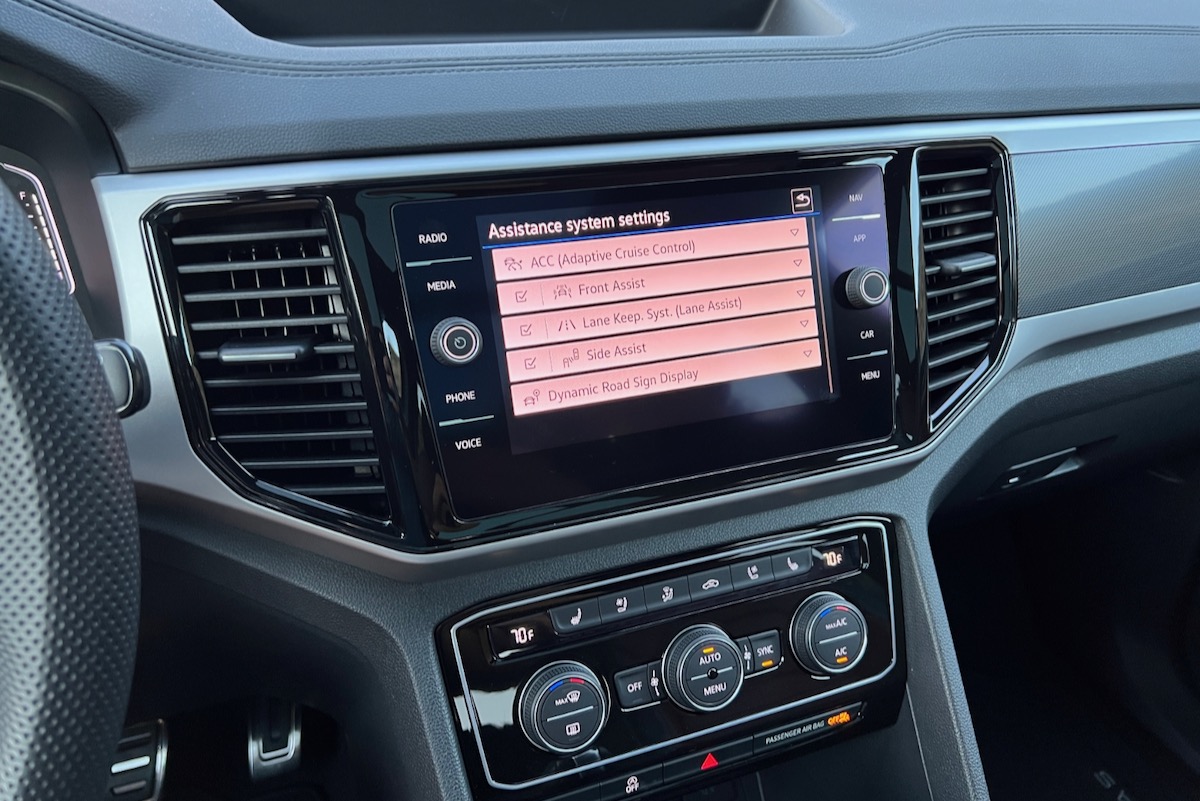
The base Atlas Cross Sport Comfortline comes standard with Volkswagen Digital Cockpit, a digital instrument cluster that has a 10.25-inch screen with different theme and data views, and pairs with an 8-inch touchscreen with a proximity-sensing display, Bluetooth pairing for two devices simultaneously, wireless Apple CarPlay and Android Auto, SiriusXM satellite radio, and wireless charging for smartphones. This infotainment system also provides access to three different Car-Net remote connectivity, which allows for remote access and vehicle performance reports.
Fundamentally, this technology checks all of the right boxes. However, the user experience is often a source of frustration, whether that relates to interaction with the touchscreen and the physical controls or attempting to use the voice recognition technology. Ultimately, we think your best bet is to simply pair your smartphone and run Apple CarPlay or Android Auto. You’ll likely save yourself some aggravation.
Our test vehicle in Execline badging had automatic high beams and a 12-speaker Fender premium audio system, and it was sensationally good for this price point. Volkswagen has moved away from Fender in some of its models, which, in our opinion, is a mistake.
Safety
As you move up the Atlas Cross Sport trim level ladder, you get more safety features. However, every version includes forward-collision warning, automatic emergency braking, blind-spot monitoring, and an automatic post-collision braking system that brings the vehicle to a stop immediately following a crash.
All Cross Sports in Canada also receive adaptive cruise control, front and rear parking sensors, a low-speed automatic braking system to prevent bumps when parking, lane-departure warning, lane-keeping assist, lane-centring assist, rear cross-traffic alert, and Travel Assist and Emergency Assist. Travel Assist pairs the adaptive cruise control with the lane-centring assist system, but you must keep your hands on the steering wheel. Remove them, and Emergency Assist assumes that you’ve fallen asleep or suffered a medical emergency, and it will bring the Atlas Cross Sport to a stop with the hazard lights flashing.
In addition to these features, adaptive LED headlights come in at the Highline trim, and our Execline test vehicle included a semi-autonomous Park Assist system and an Area View 360-degree surround-view camera system.
During the evaluation, we found Travel Assist occasionally too obvious about its steering inputs to maintain lane position and braking to maintain a safe travel distance to vehicles ahead. However, the overall assessment is that Travel Assist is accurate and sophisticated if lacking a bit of refinement.
Also, we much prefer the Atlas Cross Sport’s traditional matte-black steering wheel controls for Travel Assist compared to the gloss-black, haptic feedback, touch-sensing controls in the latest VW Tiguan and Golf GTI. Reflections and glare make the glossy, touch-sensing buttons hard to read, and it’s easy to accidentally activate their functions, whereas neither issue is a problem in the Atlas.
As was true of our experience with the standard Atlas, however, the Cross Sport’s Lane Assist technology inaccurately perceived road construction scars as lane markings, in turn attempting to make unnecessary course corrections. That is another source of driver aggravation.
One notable driver assistance tech improvement over the three-row Atlas is that with a family of four aboard, the automatic reverse braking system isn’t quite as sensitive when backing out of a driveway. In the standard Atlas, unless we creeped out of some driveways, the SUV would jerk to a halt. This did not happen in the shorter, stubbier Atlas Cross Sport.
If you’re unable to avoid a collision, the Atlas Cross Sport gets decent crash-test ratings. It does not earn the highest accolades from the Insurance Institute for Highway Safety (IIHS) or the National Highway Traffic Safety Administration (NHTSA), but the scores are nevertheless favourable.
Cost-effectiveness
Most of the Atlas Cross Sport’s rivals are smaller inside, and many lack a similar sense of style. However, some demonstrate specific areas of superiority over the Atlas Cross Sport.
For example, the Hyundai Santa Fe is a better value, offers more advanced technology, and offers hybrid and plug-in hybrid powertrain options in addition to the standard gas engines. The Jeep Grand Cherokee and Subaru Outback are better for off-roading. The Honda Passport has a more refined and sophisticated drivetrain. And the Ford Edge ST is genuinely enjoyable to drive on a twisty road.
Nevertheless, the Volkswagen’s blend of bold design, custom styling details, and an upscale look can go a long way toward putting the Atlas Cross Sport closer to the top of your crossover SUV shopping list.
Note: Images show a US model.
What owners say
"Overall, drivers seem to appreciate the 2022 Volkswagen Atlas Cross Sport for its spaciousness, smooth ride, and impressive features, especially in the higher trims. The roomy interior and unique features are highlighted positively. However, some drivers noted that the interior materials feel cheap compared to the price, and there were concerns about noise levels during the ride."
Great Car or SUV haven’t owned a VW for 40+ years … very impressive
May 4, 2025Great smooth ride,amazing technology, very roomy, a great price for what you get.I love my 2022 SEL R line premium.
September 28, 2023Features are wonderful! We ended up with the Premium R-line SEL Model. Best features are the sound system, seating, and moonroof. Other unique features included with this model are the cargo area covers and the cargo holders as well as the FULL SPARE TIRE! For the price, this vehicle had everything our family needed and wanted.
September 7, 2022What owners say
Great Car or SUV haven’t owned a VW for 40+ years … very impressive
May 4, 2025Great smooth ride,amazing technology, very roomy, a great price for what you get.I love my 2022 SEL R line premium.
September 28, 2023Features are wonderful! We ended up with the Premium R-line SEL Model. Best features are the sound system, seating, and moonroof. Other unique features included with this model are the cargo area covers and the cargo holders as well as the FULL SPARE TIRE! For the price, this vehicle had everything our family needed and wanted.
September 7, 2022It’s perfect for me. Yes the interior could be slightly more upgraded, bigger screen fancier knobs. I appreciate the simplicity of a touch screen, size and height of the vehicle is very roomy and spacious but not too big. The V6 is a smoother ride. Gas mileage is adequate.
May 5, 2022Trims & specs
Base MSRP N/A | Seating 5 |
Engine 3.6L 276 hp V6 | Cargo Capacity 1141 L |
Combined MPG 21 | Drivetrain AWD |
Base MSRP N/A | Seating 5 |
Engine 3.6L 276 hp V6 | Cargo Capacity 1141 L |
Combined MPG 21 | Drivetrain AWD |
Base MSRP N/A | Seating 5 |
Engine 2.0L 235 hp I4 | Cargo Capacity 1141 L |
Combined MPG 22 | Drivetrain AWD |
Base MSRP N/A | Seating N/A |
Engine N/A | Cargo Capacity N/A |
Combined MPG N/A | Drivetrain N/A |
Base MSRP N/A | Seating 5 |
Engine 3.6L 276 hp V6 | Cargo Capacity 1141 L |
Combined MPG 21 | Drivetrain AWD |
Base MSRP N/A | Seating N/A |
Engine N/A | Cargo Capacity N/A |
Combined MPG N/A | Drivetrain N/A |
Base MSRP N/A | Seating 5 |
Engine 3.6L 276 hp V6 | Cargo Capacity 1141 L |
Combined MPG 21 | Drivetrain FWD |
Base MSRP N/A | Seating N/A |
Engine N/A | Cargo Capacity N/A |
Combined MPG N/A | Drivetrain N/A |
Base MSRP N/A | Seating 5 |
Engine 2.0L 235 hp I4 | Cargo Capacity 1141 L |
Combined MPG 22 | Drivetrain AWD |
Base MSRP N/A | Seating N/A |
Engine N/A | Cargo Capacity N/A |
Combined MPG N/A | Drivetrain N/A |
Base MSRP N/A | Seating 5 |
Engine 2.0L 235 hp I4 | Cargo Capacity 1141 L |
Combined MPG 23 | Drivetrain FWD |
Base MSRP N/A | Seating N/A |
Engine N/A | Cargo Capacity N/A |
Combined MPG N/A | Drivetrain N/A |
Base MSRP N/A | Seating 5 |
Engine 2.0L 235 hp I4 | Cargo Capacity 1141 L |
Combined MPG 22 | Drivetrain AWD |
Base MSRP N/A | Seating 5 |
Engine 2.0L 235 hp I4 | Cargo Capacity 1141 L |
Combined MPG 23 | Drivetrain FWD |
Base MSRP N/A | Seating 5 |
Engine 3.6L 276 hp V6 | Cargo Capacity 1141 L |
Combined MPG 21 | Drivetrain AWD |
Base MSRP N/A | Seating 5 |
Engine 3.6L 276 hp V6 | Cargo Capacity 1141 L |
Combined MPG 21 | Drivetrain AWD |
Base MSRP N/A | Seating 5 |
Engine 2.0L 235 hp I4 | Cargo Capacity 1141 L |
Combined MPG 22 | Drivetrain AWD |
Base MSRP N/A | Seating 5 |
Engine 2.0L 235 hp I4 | Cargo Capacity 1141 L |
Combined MPG 22 | Drivetrain AWD |


Pricing trends
Current avg. market price
$30,695
Trending down by 0.6% this month
May 2026 - November 2026

