2022 Hyundai Tucson Reviews, Pricing & Specs





Expert review
The new 2022 Hyundai Tucson is longer and wider than before, with more cargo and passenger space.
The redesigned 2022 Hyundai Tucson has to offer a high-tech cabin, comfortable ride, competent engine lineup, and spacious cargo area to keep up with the Joneses in the hot-selling and competitive compact SUV class. It does that, and more, with Hyundai giving plenty of compelling reasons to take the 2022 Tucson for a test drive.
out of 10 expert review
Look & feel
The new Hyundai Tucson rides on a new platform. Elsewhere, it’s sold in short- and long-wheelbase versions, but in North America, Hyundai has elected to offer buyers the long-wheelbase model with two rows of seating and an expanded cargo area.
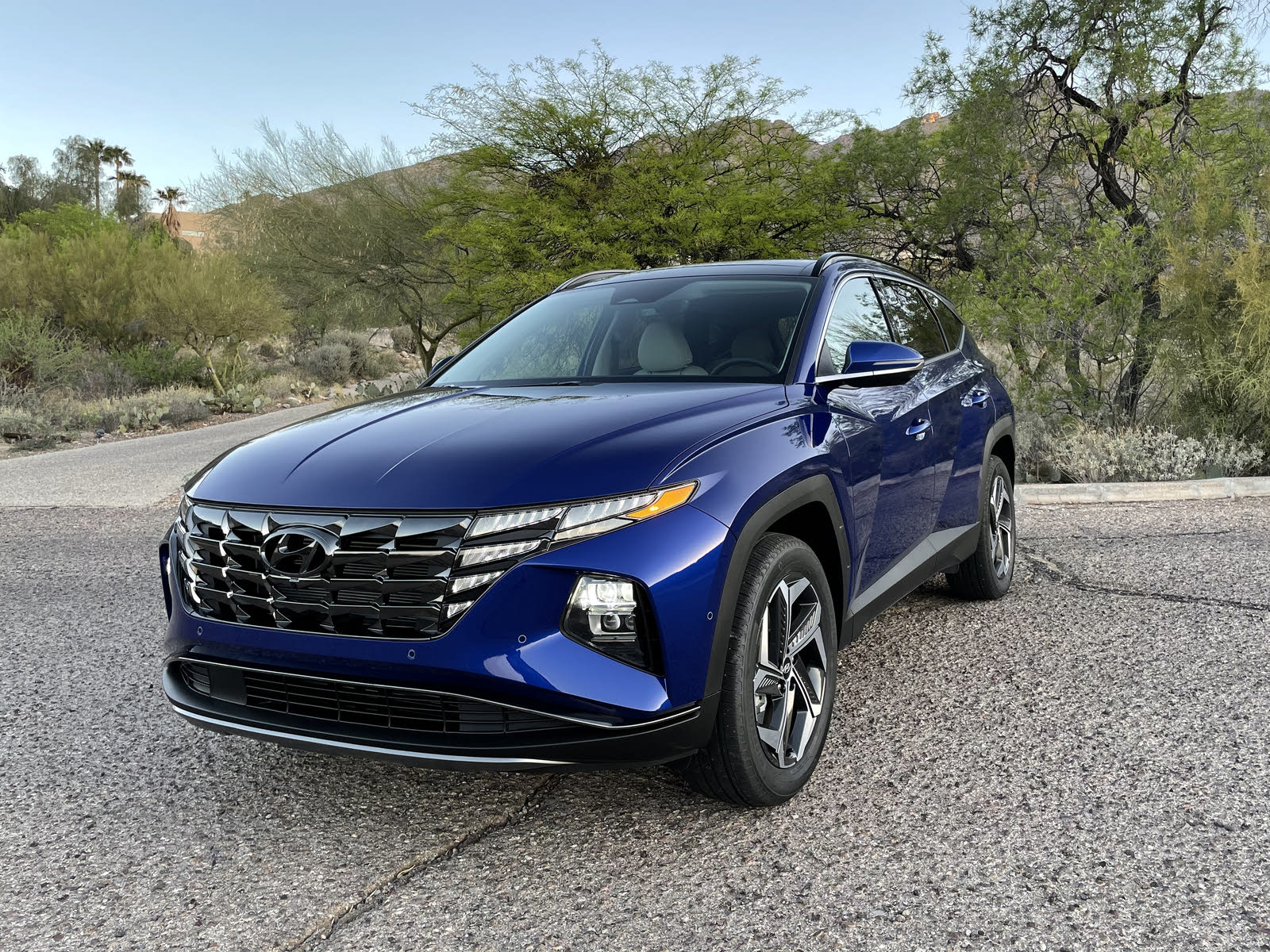
Up front, the Tucson wears the new face of Hyundai vehicles (the Santa Cruz truck gets one that’s similar). The parametric grille hides the standard LED daytime running lights, Bi-LED headlights, and LED front turn signals within its structure. When illuminated, the headlights and daytime running lights form a unique shape that looks not unlike the wings of the Aztec Spirit Bird.
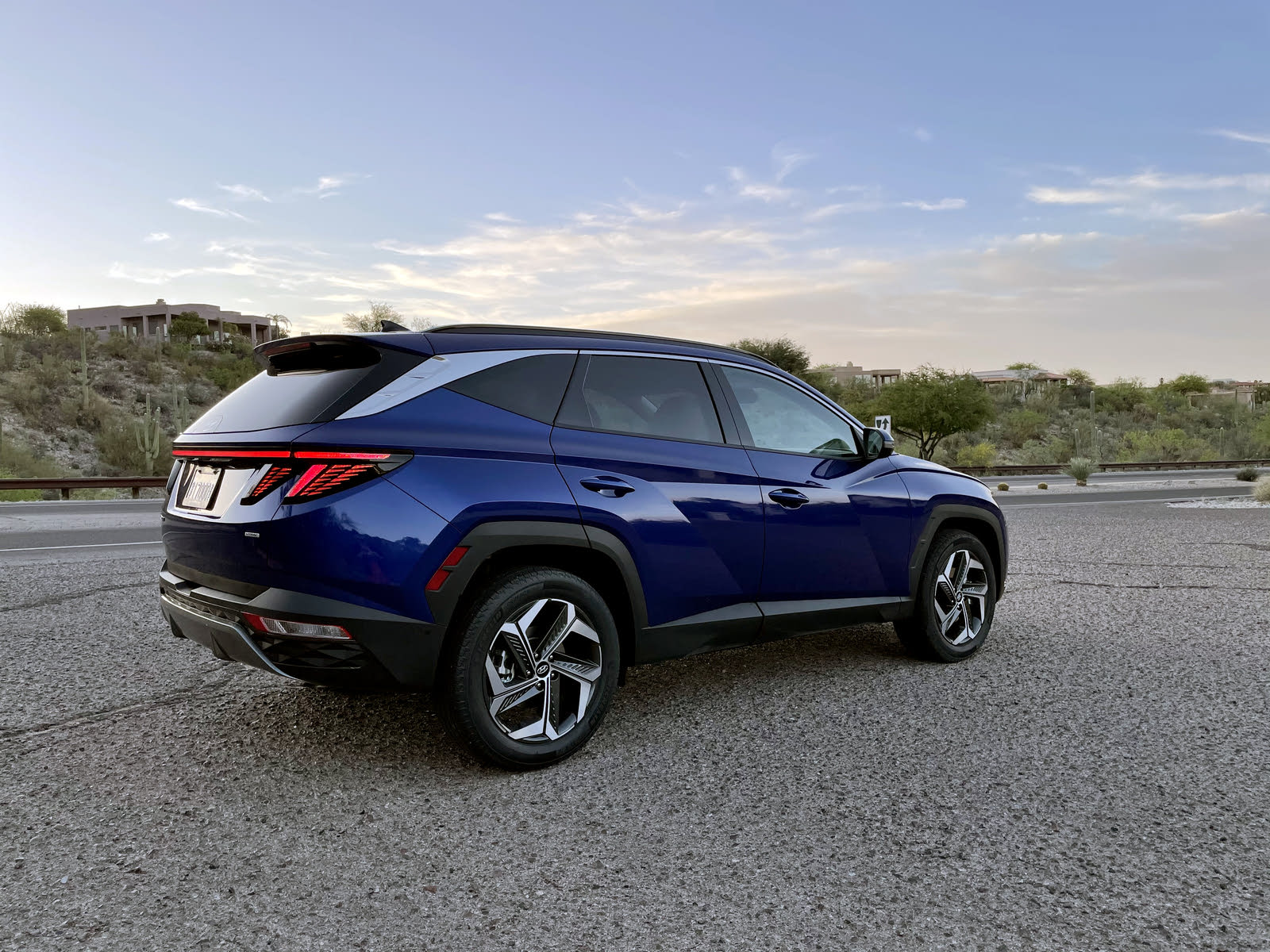
The side profile of the car employs the same design styling as the Hyundai Elantra, with a silver D-pillar that visually connects the window surrounds to the rear of the crossover, giving the Tucson a floating roof in a unique fashion.
Its back has toothy taillights that are illuminated by LEDs in most grades. The less-than-basic design helps the Tucson stand out among other compact SUVs.
The 2022 Tucson rides on either 17- or 19-inch alloy wheels, depending on trim level. Essential and Preferred grades, the latter available with a Trend Package and all powered by an internal combustion engine (ICE), get 17-inch alloys. The ICE-powered N Line grade and the hybrid-powertrain Luxury and Ultimate grades bump the wheel size to 19-inch alloys. There are four different wheel designs, including a darkened, complex variant on the Tucson N-Line trim.
High-end Tucsons get premium fascias, front and rear skid plates, gloss black pillars, and a panoramic sunroof. Standard features on the Tucson include roof rails (on all but the Essential trim), body-colour side-mirror housing, solar glass, and acoustic laminated glass. Heated outside mirrors are also standard with blind-spot monitoring and rear cross-traffic avoidance assist indicators and turn signals included from the Preferred grade. Front aero wipers and keyless entry are also included with Preferred, and adding the Trend Package equips a sunroof.
The cabin of the Tucson is well-appointed and on-par with what other, newer compact SUVs offer. Hyundai has given the five-seater standard stain- and odor-resistant cloth seats. Sport combination seats are included with N-Line, and leather-trimmed seats are offered from Preferred Trend up. Hard- and soft-touch surfaces are in the expected places and look relatively upscale compared to the Tucson’s price point.
Horizontal lines across the dashboard where the vents are kept and an uncluttered aesthetic give the Tucson’s interior a sense of spaciousness.

Performance
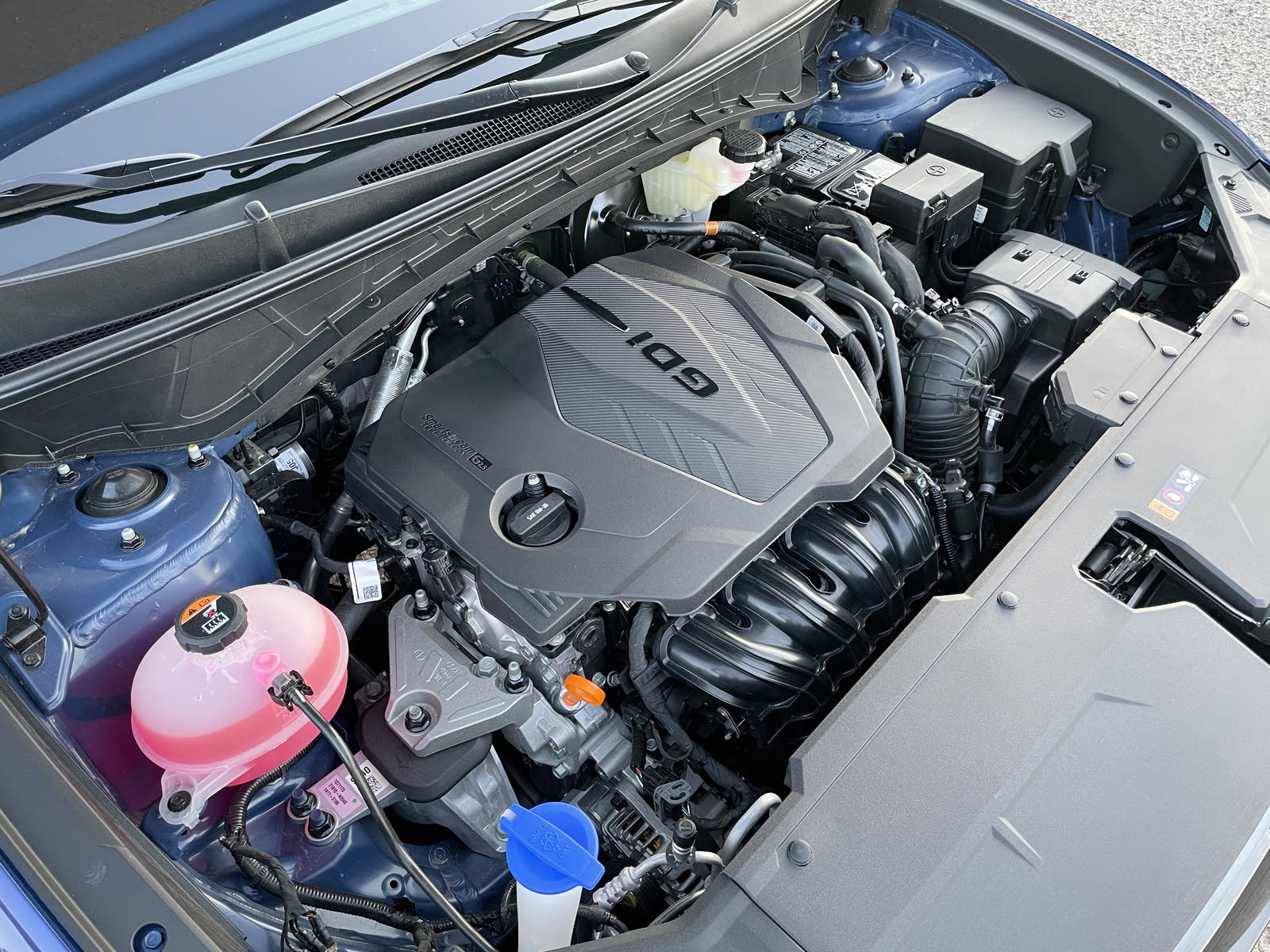
Presently, the 2022 Hyundai Tucson comes in two powertrain variants: a 2.5-litre direct-injected four-cylinder, and hybrid powertrain with a turbocharged 1.6-litre four-cylinder engine and an electric motor. A plug-in hybrid version of the Tucson will be introduced down the road. Hyundai pairs the ICE engine with an eight-speed automatic transmission, while the hybrid gets a six-speed.
The ICE engine delivers 187 horsepower and 178 pound-feet of torque. Those numbers aren’t anything special, and neither is the power plant. It’s the very definition of “fine:” capable, competent, but completely uninspiring. This new base engine has seen a power increase over the last-generation Tucson’s available 2.4-litre, adding six horsepower and three pound-feet of torque. Hyundai is targeting 8.2 litres per 100 kilometres combined for the 2022 four-cylinder with front-wheel drive (FWD) and 9.0 L/100 km with all-wheel drive (AWD), which would make it more efficient than the outgoing engine.
The real star of the Tucson show is the hybrid powertrain, which delivers more power at the ready for drivers. The hybrid offers 226 total system combined horsepower and 258 lb-ft of torque. Those numbers in no way make the Tucson a speedster, but they do make driving the car more fun. During testing, across a 7,000-foot elevation change, the turbo engine didn’t falter.
This power output makes the Tucson Hybrid substantially more powerful than the Ford Escape Hybrid and the Toyota RAV4 Hybrid.
Hyundai offers buyers the option to add AWD to their Tucson. It’s standard on the Tucson Hybrid and available on ICE models. In off-road testing, on loose gravel roads complete with switchbacks and whoops, at relatively high rates of speed, the AWD did not falter. It operated similarly to Subaru's generally perfectly reactive AWD system.
Front-wheel drive Tucsons are the most fuel-efficient. Those powered get a Natural Resources Canada-estimated fuel consumption rating of 9.1 L/100 km in city driving, 7.1 on the highway, and 8.2 combined. Adding AWD to the ICE-only vehicle brings its figures to 9.9 city, 8.0 hwy, and 9.0 combined.
The more powerful Tucson Hybrid drivetrain is far more fuel-efficient than the ICE models. The hybrid uses 6.3 L/100 km in the city, 6.6 on the highway, and 6.4 combined.
Hyundai has divulged the powertrain specifications for the Tucson plug-in, but it has yet to be road tested. The Tucson PHEV is powered by the same engine as the Tucson Hybrid, but it also gets a 13.8-kilowatt-hour lithium-ion battery powering an electric motor. That gives it an estimated total system output of 261 horsepower and 224 pound-feet of torque. Those numbers are both far higher than the Tucson Hybrid’s, making the plug-in the most powerful SUV in the Tucson lineup.
Range specifications for all-electric power aren’t available yet. Some simple math says that the Tucson PHEV should get around 40 kilometres of range on electricity alone. Hyundai says that it will take around two hours to charge the battery in the PHEV.
Powertrain and features information regarding the to-be-released Tucson N performance-focused SUV version of the model are forthcoming.
Form & function
The Hyundai Tucson is a budget-friendly compact SUV. That doesn’t mean that its interior is in any way cheap. It goes toe-to-toe with the big sellers in its competitive set, the Toyota RAV4, Honda CR-V, Nissan Rogue, Ford Escape, and is at least as nicely appointed as all of them (and better appointed than many).
A six-way power-adjustable driver’s seat is standard, but an eight-way version with lumbar support is on all but Essential and Preferred (adding the Trend Package to the latter equips the upgrade). Three-stage heated front seats are standard, and ventilated front seats, heated back seats, memory for the driver’s seat, and an eight-way power-adjustable passenger seat are available. It’s easy to find the right seating position and get the four-spoke steering wheel into place.
A tilt and telescoping steering wheel is standard. It’s leather-wrapped and heated on all trims but base.
The new Tucson platform has allowed Hyundai to make the SUV more spacious than ever before, meaning that there is now more room for passengers and cargo.
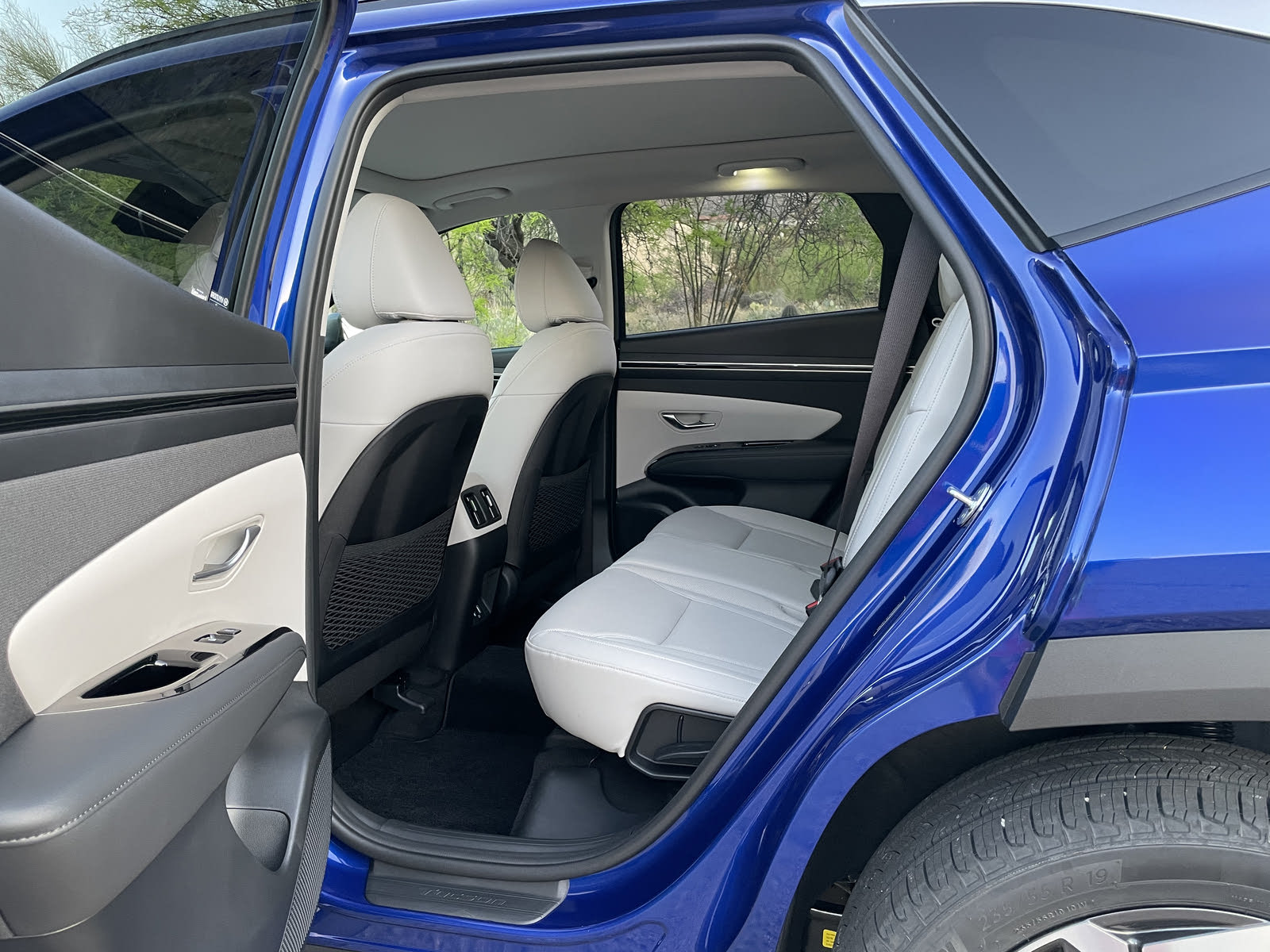
The Tucson has less legroom up front than the Forester, but the offering is comparable to most other compact SUVs on the market today. Its rear seats offer 90 millimetres more legroom than what is in the RAV4. Headroom figures are pretty standard for the segment.
The cabin has plenty of space for a family of four to fit comfortably for a road trip. There’s more passenger volume in the Tucson than there is the CR-V, RAV4, and Escape. Its 1,095-litre cargo space is comparable to that space in the rear of the Forester, RAV4, and CR-V. It bests the Escape by a long shot.
In the rear is a 60-40 split-folding bench seat that comfortably seats two adults. Behind that is a dual-level cargo floor.

Technology
Hyundai has given the Tucson a strong set of standard tech features. The roster includes an 8-inch infotainment touchscreen, a six-speaker audio system, Android Auto and Apple CarPlay connectivity, HD Radio, Bluetooth, and two USB ports. In front of the driver is a 4.2-inch multi-information display.
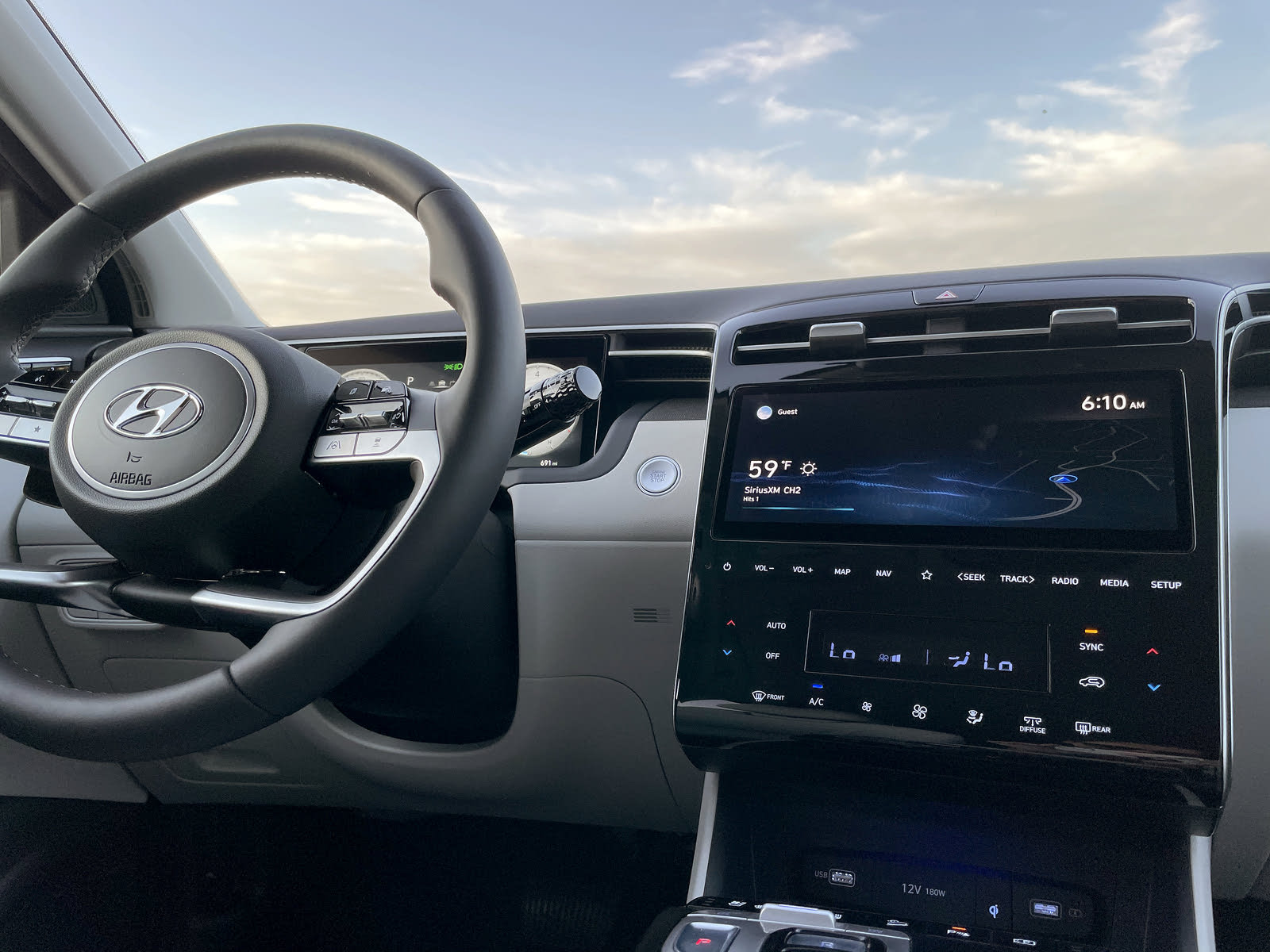
Moving up one trim level (Preferred) gets buyers satellite radio, Blue Link mobile app compatibility, two additional USB outlets in the rear of the centre console, rear air conditioning vents, and dual-zone automatic climate control. There’s also a fully digital instrument cluster and a 10.25-inch infotainment touchscreen with an on-board navigation system is available on higher trim levels.
When buyers opt for the larger screen, they get a screen that is embedded within a larger black plastic head unit that also includes all climate control and radio/media functionality. The surface is flat and there are only words denoting where to press on the plastic to get the functionality that is sought.
With no physical differences between these touchpoints, finding the right button to press on the centre console is difficult while keeping eyes on the road ahead. This causes a driver to rely more heavily on steering wheel controls and voice commands. The touchpoints are fairly responsive (far more so than early Cadillac versions of similar technology). A bigger gripe is the narrow steering wheel controls, which, though stylish, are not as easy to use as bulkier buttons.
Safety
The 2022 Hyundai Tucson has not been tested and rated by the Insurance Institute for Highway Safety (IIHS) nor the National Highway Traffic Administration (NHTSA).
The Hyundai SmartSense Safety Feature suite of driver-assist and safety technology includes standard and available features. The list of standard features includes forward collision-avoidance assist (cyclist and pedestrian detection is added at the Preferred grade), lane-keeping assist, automatic high beams, a driver attention monitor, and rear occupant alert.
Tucson shoppers can add blind-spot warning with collision avoidance assist, rear cross-traffic alert with collision avoidance assist, safe exit warning, adaptive cruise control with stop and go, a surround-view camera system, blind-spot monitoring, forward and reverse park distance warning, parking collision avoidance assist (rear), ultrasonic rear occupant alert, and remote parking assist. This list is extremely comprehensive and close to what you’d find in a luxury SUV of the Tucson’s size.
Hyundai backs every Tucson with a 5-year/100,000-kilometre limited warranty.
Cost-effectiveness
The 2022 Hyundai Tucson starts at $27,799 Canadian. (All pricing shown does not included the $1,825 destination charge.) Adding all-wheel drive costs an extra $2,000 on models where it is not standard equipment. Pricing for the gas-powered version of the Tucson tops out at $37,099 for the N-Line before taxes and delivery fees.
The 2022 Tucson Hybrid has a starting MSRP of $38,899 for the Luxury grade. Pricing for the model tops out at $41,599 for the Tucson Ultimate grade before associated taxes and fees.
Buyers can add a Trend Package on the Tucson Preferred that includes many of the features available on the upper models for $2,600.
Pricing for the Tucson Plug-In and Tucson N is not available at the time of publication.
The cost of the Tucson is in line with the pricing of the Honda CR-V and Mazda CX-5. However, the Tucson has more power and a more competitive list of safety features. The same is true for the Toyota RAV4 and RAV4 Hybrid.

What owners say
"Overall, Tucson owners love the smooth ride, excellent safety features, and stylish design of their SUV. Many appreciate the comfort and spacious interior, making it a popular pick for families. However, some drivers noted a lack of engine power and the need for more cargo space or larger cupholders. Despite these minor drawbacks, most are extremely satisfied with their decision to buy a Tucson."
Excellent vehicle! Everything I expected it to be, especially for a Hyundai product.
March 27, 2025Great features and a great value. This car is perfect size for a small family. It offers a lot of convenience and safety features.
July 6, 2025I love all the bells and whistles! The ability to set all your personal preferences-seat settings, heat/air,radio,phone,dash board view, and with your name! The blind spots are nice. It was a great deal with decent low mileage, limited AWD, I got more for my money. Fully covered with great warrantys
February 13, 2025What owners say
Excellent vehicle! Everything I expected it to be, especially for a Hyundai product.
March 27, 2025Great features and a great value. This car is perfect size for a small family. It offers a lot of convenience and safety features.
July 6, 2025I love all the bells and whistles! The ability to set all your personal preferences-seat settings, heat/air,radio,phone,dash board view, and with your name! The blind spots are nice. It was a great deal with decent low mileage, limited AWD, I got more for my money. Fully covered with great warrantys
February 13, 2025I LOVE this car! I researched and waited for the right one for months! I am so pleased with how smooth it drives and the fancy features! My know knock would be the lack of power. It doesn’t accelerate very quickly but I didn’t really expect it to. Overall I’m obsessed and can’t wait to drive it for many years to come
March 2, 2023Great value, the BEST warranty in the business. Lots of great options on the vehicle and glad they have the key fob so this vehicle is not one that can be stolen easily.
September 19, 2022Nothing short of amazing! Excellent safety features, design, and value for the money
June 19, 2024LOVE IT! Great SUV, not too big not too small. Wish it had handsfree trunk opening option but all else is great!
October 22, 2023Amazing features in the limited trim, more than our Honda CR-V Touring! Ride is a little bumpy, and gas mileage is a little under expected (24 rather than 26), and cubbies/cupholders could be a little bigger, but these are all pretty minor and I would buy it again. On the plus side, headlights are nice and bright, lots of customizable settings, and cargo space is a little bigger than the Honda for a few thousand less.
October 2, 2022The safety features, interior room, fit and finish of the interior, exterior sporty design and overall quality of the Tucson leaves the competition well behind. This is my first Hyundai but will undoubtedly not be my last.
March 22, 2022The Tucson is a great size for a medium size SUV. I really like the body design. There is good room in the back seat area. It drives nice and smooth, unlike an SUV. There are lots of good features, like touch display, driver assist, Android Auto. And the warranty is great. I believe it is a good value
December 27, 2023Trims & specs
Base MSRP N/A | Seating N/A |
Engine N/A | Cargo Capacity N/A |
Combined MPG N/A | Drivetrain N/A |
Base MSRP $32,400 | Seating 5 |
Engine 2.5L 187 hp I4 | Cargo Capacity 38.7 cu ft |
Combined MPG 26 | Drivetrain AWD |
Base MSRP $30,750 | Seating 5 |
Engine 2.5L 187 hp I4 | Cargo Capacity 38.7 cu ft |
Combined MPG 29 | Drivetrain FWD |
Base MSRP $27,100 | Seating 5 |
Engine 2.5L 187 hp I4 | Cargo Capacity 38.7 cu ft |
Combined MPG 29 | Drivetrain FWD |
Base MSRP $28,600 | Seating 5 |
Engine 2.5L 187 hp I4 | Cargo Capacity 38.7 cu ft |
Combined MPG 26 | Drivetrain AWD |
Base MSRP $25,800 | Seating 5 |
Engine 2.5L 187 hp I4 | Cargo Capacity 38.7 cu ft |
Combined MPG 29 | Drivetrain FWD |
Base MSRP N/A | Seating N/A |
Engine N/A | Cargo Capacity N/A |
Combined MPG N/A | Drivetrain N/A |
Base MSRP $27,300 | Seating 5 |
Engine 2.5L 187 hp I4 | Cargo Capacity 38.7 cu ft |
Combined MPG 26 | Drivetrain AWD |
Base MSRP N/A | Seating N/A |
Engine N/A | Cargo Capacity N/A |
Combined MPG N/A | Drivetrain N/A |
Base MSRP $35,300 | Seating 5 |
Engine 2.5L 187 hp I4 | Cargo Capacity 38.7 cu ft |
Combined MPG 29 | Drivetrain FWD |
Base MSRP $36,800 | Seating 5 |
Engine 2.5L 187 hp I4 | Cargo Capacity 38.7 cu ft |
Combined MPG 26 | Drivetrain AWD |
Base MSRP N/A | Seating N/A |
Engine N/A | Cargo Capacity N/A |
Combined MPG N/A | Drivetrain N/A |
Base MSRP $33,050 | Seating 5 |
Engine 2.5L 187 hp I4 | Cargo Capacity 38.7 cu ft |
Combined MPG 26 | Drivetrain AWD |
Base MSRP $31,550 | Seating 5 |
Engine 2.5L 187 hp I4 | Cargo Capacity 38.7 cu ft |
Combined MPG 29 | Drivetrain FWD |
Base MSRP N/A | Seating N/A |
Engine N/A | Cargo Capacity N/A |
Combined MPG N/A | Drivetrain N/A |


Pricing trends
MSRP range
$25,800 - $36,800
Current avg. market price
$22,564
Trending down by 0.8% this month
May 2026 - November 2026

