2021 Jeep Wrangler 4xe Reviews, Pricing & Specs



Expert review
The rugged Jeep Wrangler 4xe combines legendary off-road performace with an electrified powertrain for 2021 – for a price.
It’s 2021, which means automakers are electrifying everything under the sun, from family crossovers to pickup trucks and minivans. This list now includes one of the most legendary off-roaders of all time, the Jeep Wrangler, which sees the 4xe plug-in hybrid join the line-up for the 2021 model year. Long-time Wrangler owners may be encountering electrification for the first time, which could lead them to wondering if a plug-in hybrid Jeep is as capable as any other. In a word: yes.
out of 10 expert review
Look & feel
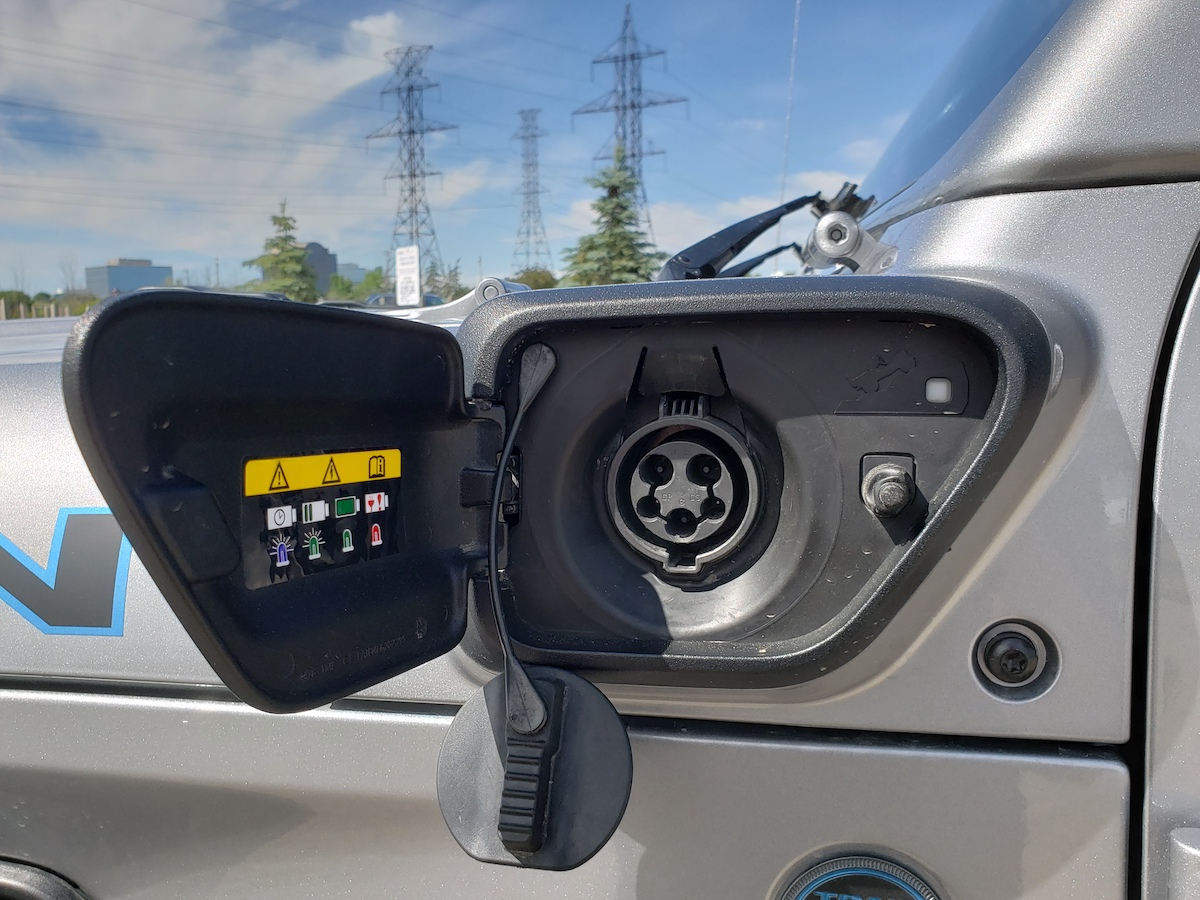
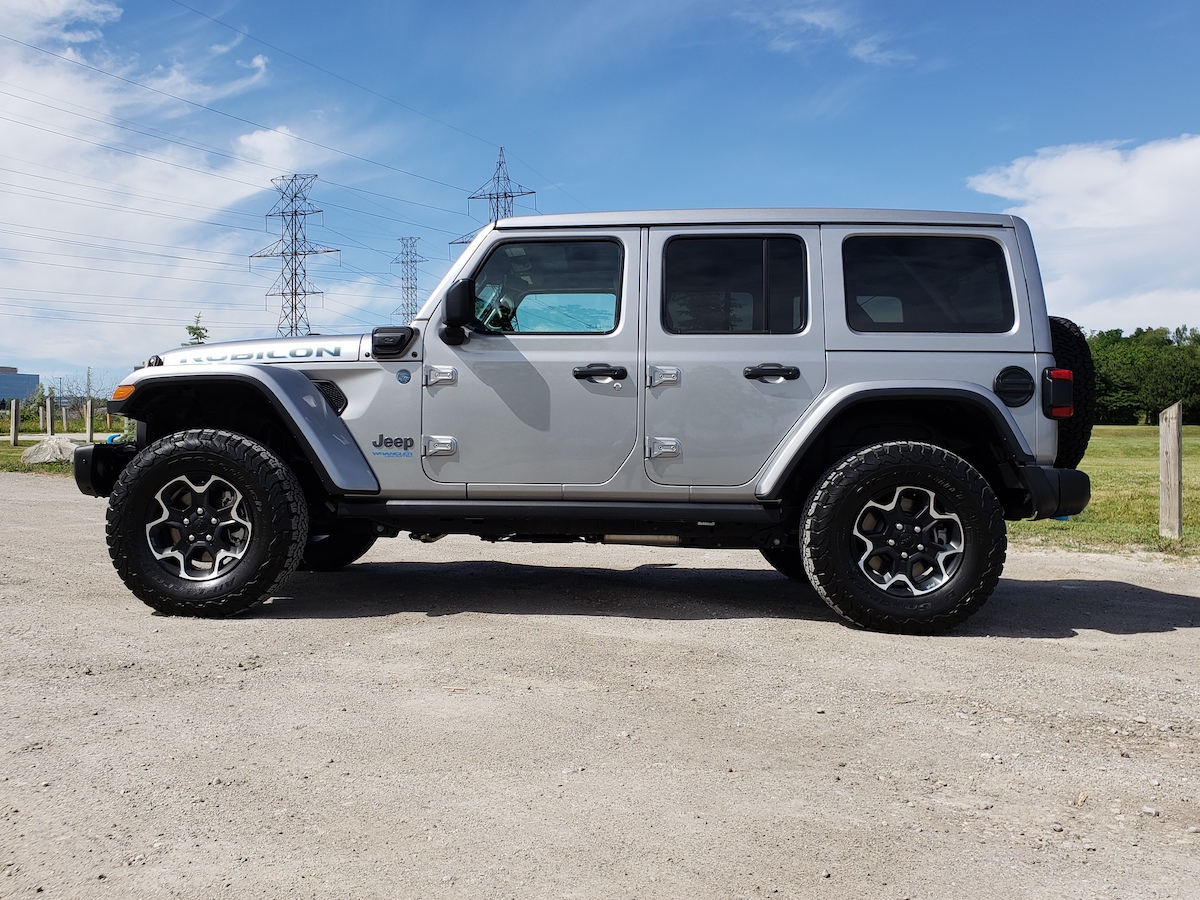
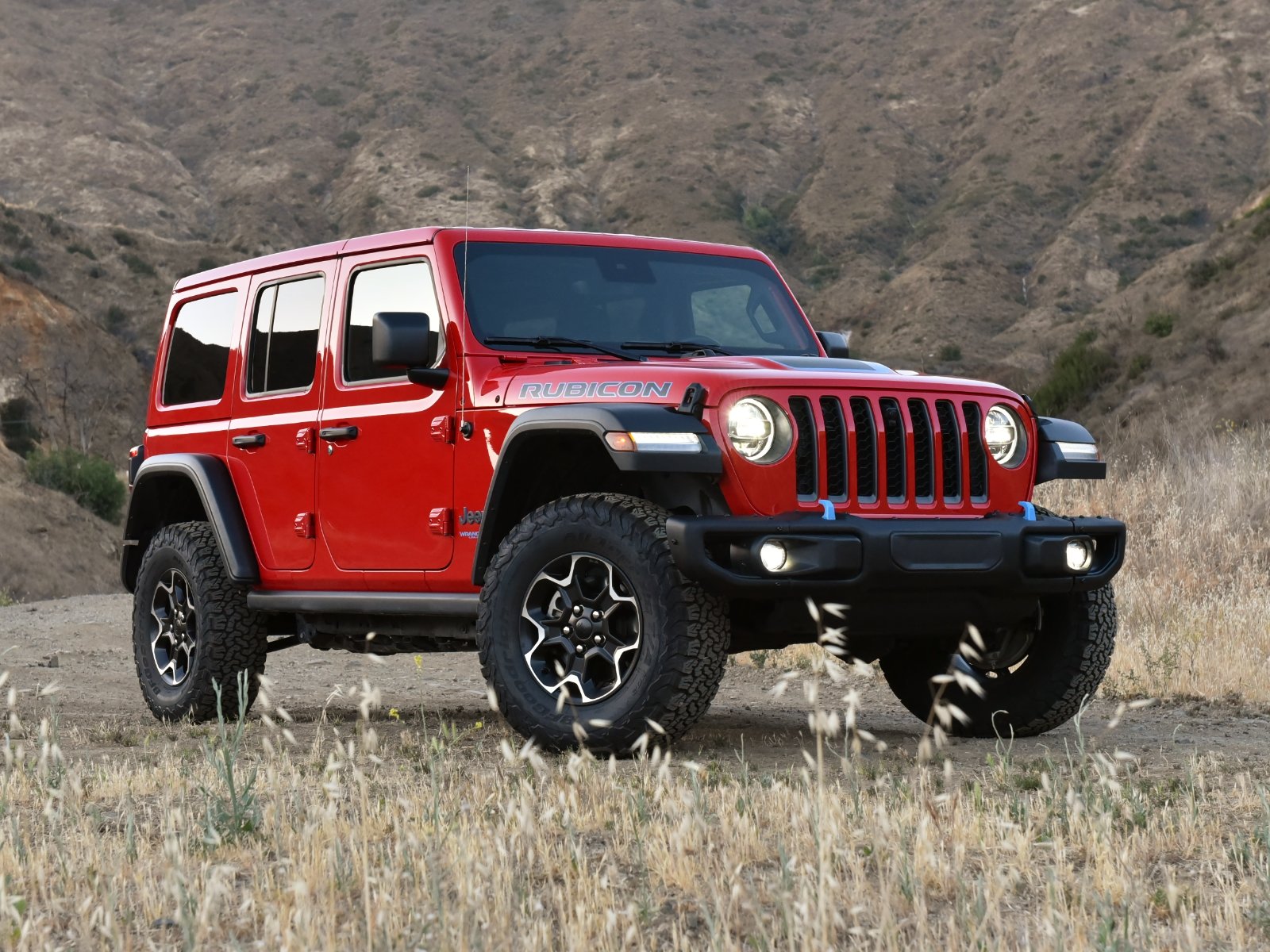
Fully battery electric vehicles can sometimes end up with styling that plays at being futuristic and downright weird, but plug-in hybrids are typically more derivative of their related gas-powered models. That’s the case here, where an observer could completely miss that this Rubicon test unit is a 4xe apart from the blue decals, the badging – and, of course, the charger port, which is located on the driver’s side front quarter panel. Otherwise, signature Wrangler elements remain, from the exterior-mounted spare tire to the removable doors, rounded headlights, and seven-slot grille.
Interior quality can remain relatively consistent across the line-up. Three grades are available: the 4xe Unlimited Sahara, with pricing starting at an MSRP of $54,995 Canadian before delivery fees, and the Unlimited Sahara High Altitude ($59,990) come with leather-faced seats with an 8-way power adjustable driver’s seat and, on the latter, heated front seats. The top-tier Unlimited Rubicon ($59,995) has unheated cloth seats as standard, but leather seats with the Rubicon logo can be added by your dealership for $1,095 and the Cold Weather Group equips heated front seats and a heated steering wheel for $995 more. This is more than a little shocking in Canada where heated seats are commonly standard in even the most budget-conscious of vehicles. On top of that, ventilated seats are not available.
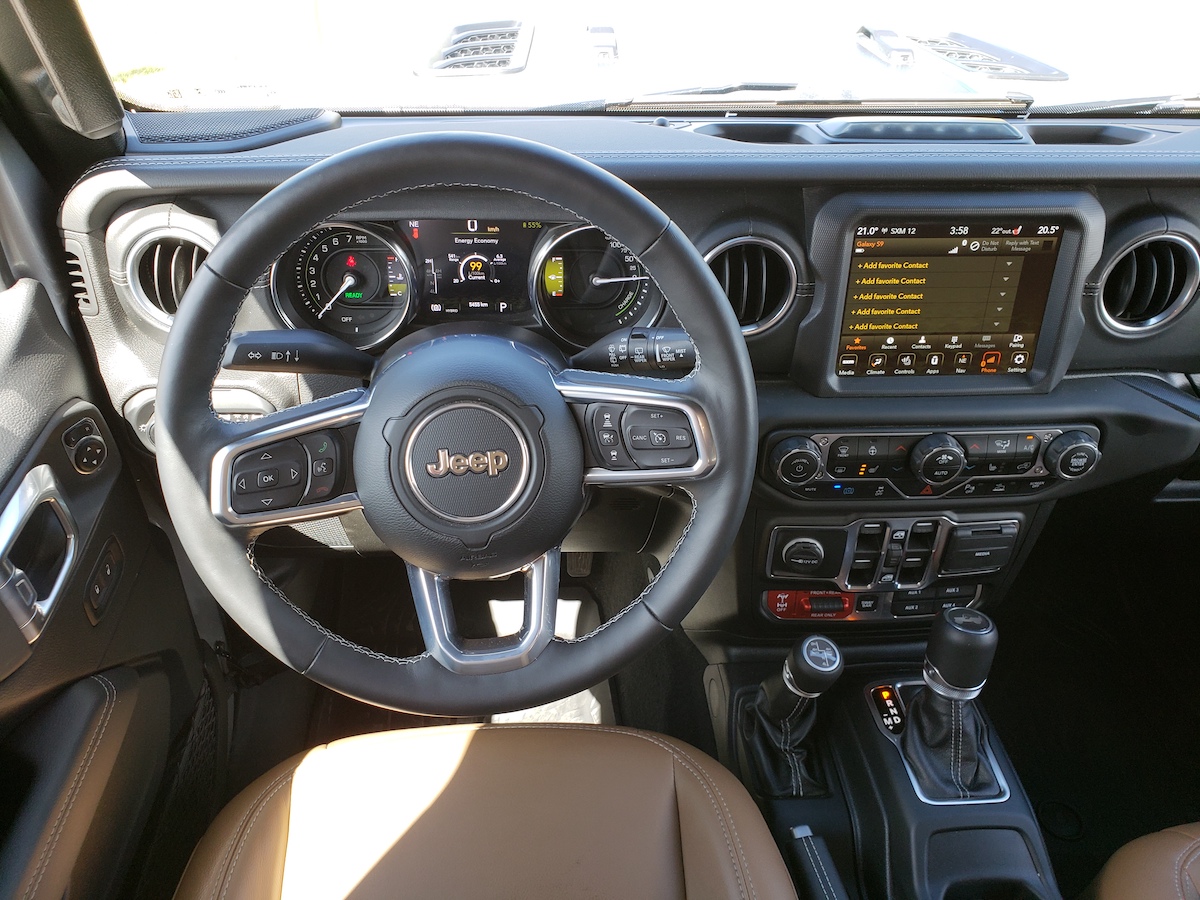
The interior of the Jeep Wrangler Unlimited Rubicon plug-in hybrid we tested included a combination of Dark Saddle brown leather seats, black leather inserts with contrast stitching, a dramatic front passenger grab handle with Wrangler emblazoned across the front, and otherwise a lot of black plastic. But this won’t surprise many people. After all, it’s still a Wrangler.
Performance
Every Wrangler 4xe combines a 2.0-litre turbocharged four-cylinder engine – good on its own for 270 horsepower and 295 pound-feet of torque peaking at 3,000 rpm – with a pair of electric motors, which combine for a total system output of 375 hp and 470 lb-ft of torque. This feeds through an eight-speed automatic transmission – no fuel-saving, droning CVTs here.
On the one hand, this is a trail-rated Wrangler, so it comes with all the associated parts. The two Sahara grades have a Selec-trac two-speed transfer case with a 2.72:1 low range ratio, while the Rubicon gets Jeep’s Rock-trac transfer case with a 4.0:1 ratio. Both offer 2WD High, four-wheel drive Auto, 4WD High, Neutral, and 4WD Low settings. Solid front and rear axles with available locking differentials on each, a fully articulating suspension, up to 27.4 cm (10.8 in) of ground clearance, and up to 76 cm (30 in) of water fording capability are already baked in. Yes, that’s true even though this is a plug-in hybrid: the 17 kWh battery pack is tucked inside the frame under the second-row seats, so it’s inside the cabin and not exposed to the elements.
On the other hand, the Wrangler’s plug-in hybrid drivetrain is top-notch. With a full charge, the Wrangler 4xe is rated by Natural Resources Canada as having an electric-only range of 35 kilometres. To the left of the steering wheel, a set of buttons gives the driver control over how to use the battery’s charge: hybrid mode runs both the turbo engine and electric motor for peak efficiency, while electric mode runs the motor only and e-save mode runs the engine on its own, saving the charge for later use while continuing to top it up with regenerative braking. The Max Regen button at the bottom left of the HVAC controls amplifies the effectiveness of the regenerative braking and brings the Wrangler very close to one-pedal driving.
On the road, the electric motors give the Wrangler 4xe a delightful and uncharacteristic burst of energy from a stop, and making the most of the motors and the one-pedal driving becomes intuitive very quickly. Although electric operation is as quiet as one would expect, no one could claim that the Wrangler 4xe is the quietest or best-handling vehicle on the market for everyday driving. But what’s to be expected? It’s still a Wrangler.
Form & function
Historically, plug-in hybrid systems that were shoehorned into cars that weren’t built for them meant some kind of sacrifice in space, either for the second-row occupants or in the cargo area. The current-generation Wrangler was designed to accommodate a battery pack under the rear seats, so there’s minimal loss in second-row space and it doesn't impede off-roading. Headroom for the Sahara grades, which both come with the three-piece hard-top roof, is the same as in standard Wrangler models at 1,023 mm. Leg room is only slightly compromised at 970 mm, 4 mm less than gas-only Wranglers. With the soft-top roof that’s equipped on the Jeep Wrangler Rubicon, rear passengers get more than 2 cm more headroom than in soft-top gas-only Wranglers for a total of 1,082 mm.
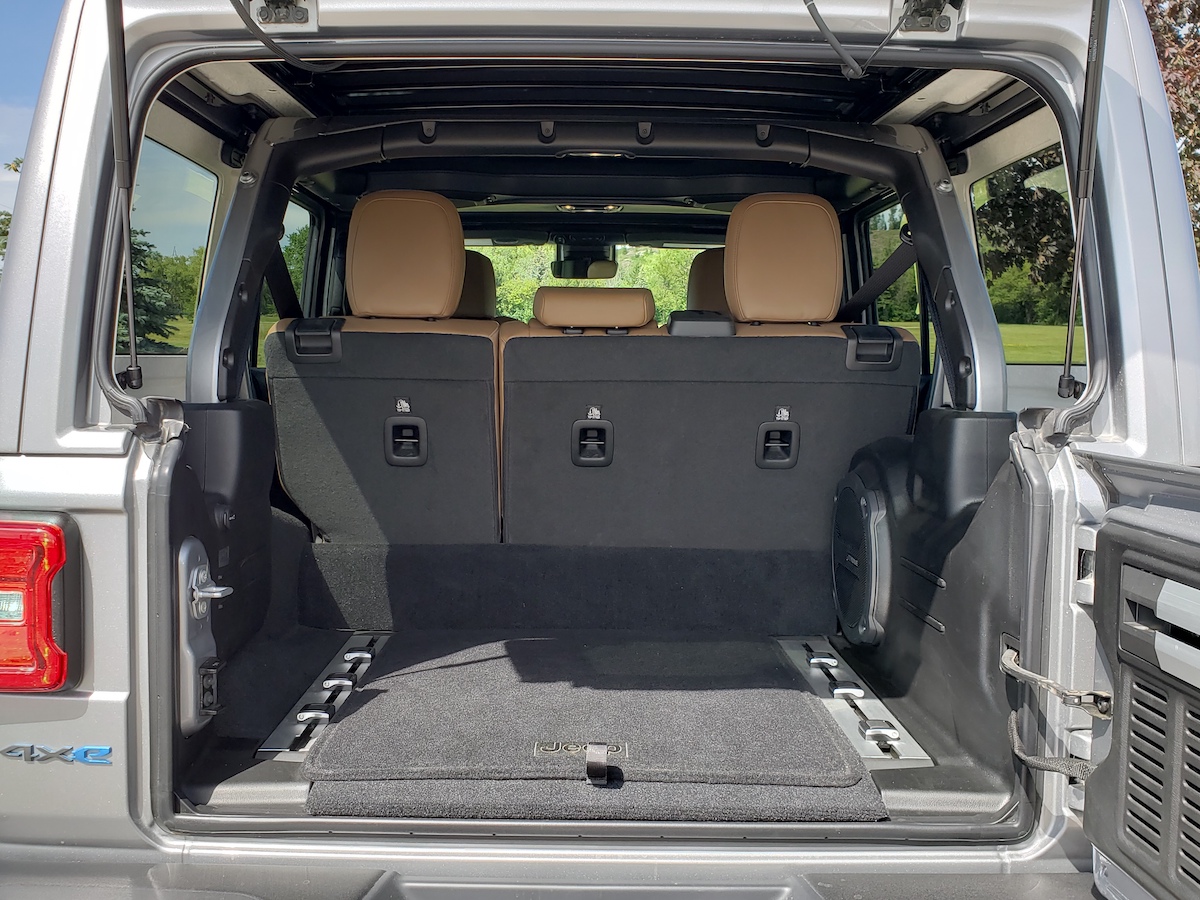
In cargo, there is a bit more of a sacrifice relative to other Wrangler models. All 4xe grades can hold up to 784 litres of cargo with the second-row seats upright and 1,908 litres with them folded. In any other Wrangler, those figures go up to 898 and 2,050 litres respectively. For some drivers, this could be enough to make a difference in the amount of gear that can be hauled around on outdoor adventures.
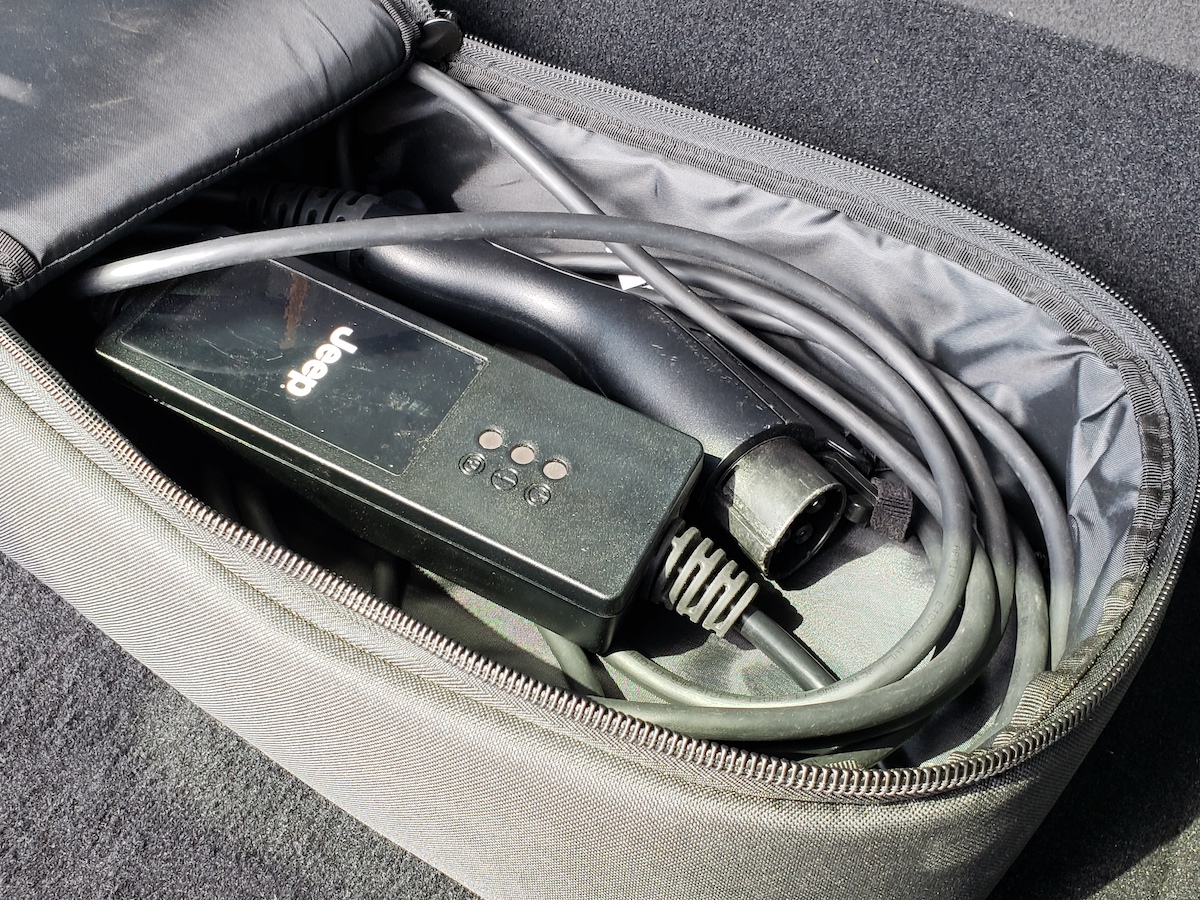
As plug-in hybrids go, the Wrangler 4xe is easy to manage. Some PHEV (plug-in hybrid electric vehicle) SUVs can be a tight squeeze in urban parking spots and driveways, but at a width of 1,875 mm, the Wrangler's body style is easier to manage than one might assume. A home charging cable is included and can be stored in the included zip-up storage bag that fits under the rear cargo load floor.
This Rubicon test unit has an optional power-retracting roof installed, a $3,995 option. Jeep enthusiasts will balk, but in this reviewer’s opinion, this feature is worth every single penny, every day of the week. When the decision to open the roof can be made on the fly at up to 96 kilometres per hour with no need to pull over and stow the roof panels – or, in the reverse, extract them from the cargo bag in the rain – drivers are far more likely to let the sunshine in, and that’s what a Jeep is for.
There are a few quirks, of course. Those who don’t drive Jeeps often will be continually confounded by having to go to the centre stack to open and close the power windows, for example. But this is a Jeep thing, and the 4xe is still a… well, you know.
Technology
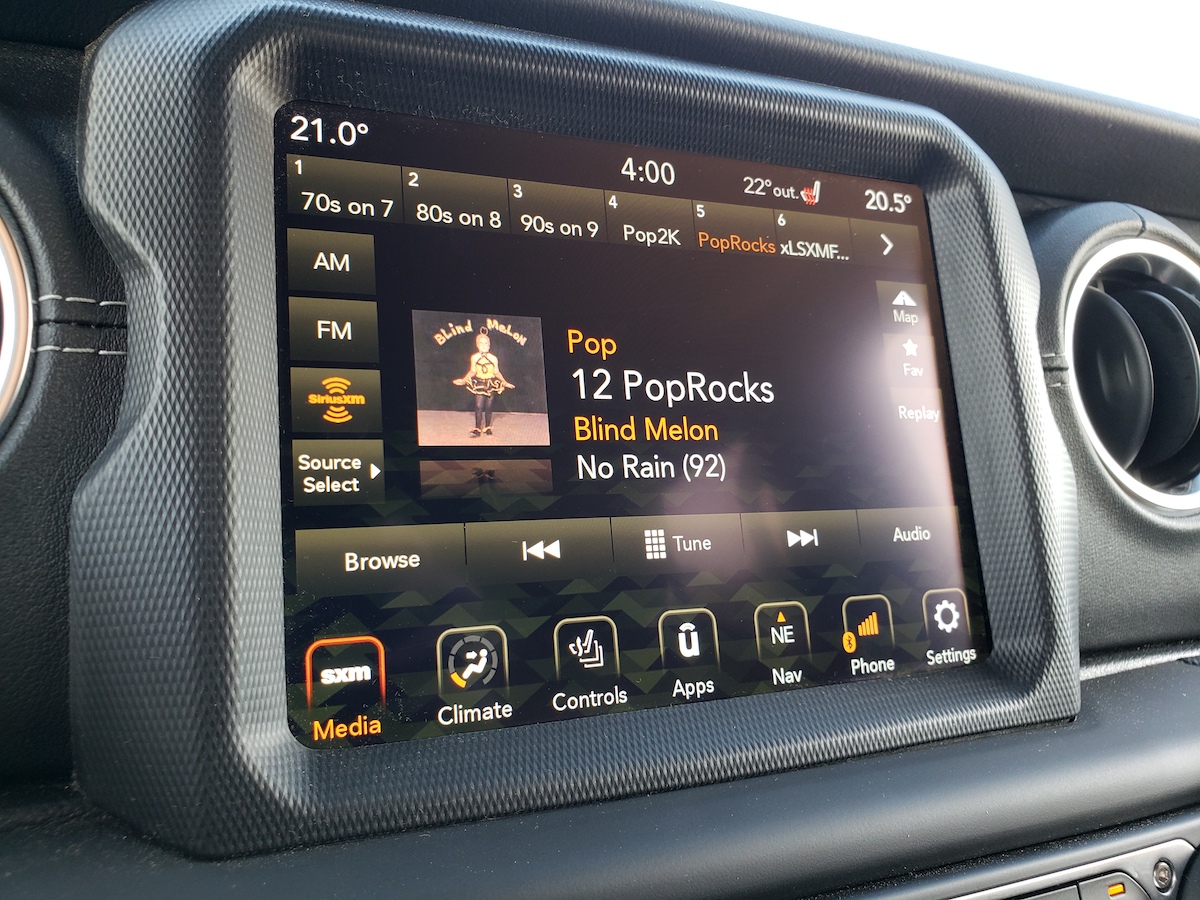
The Wrangler 4xe runs Uconnect 4C with navigation – Uconnect 5 hasn’t yet made it to the Wrangler line-up – on an 8.4-inch centre-mounted touchscreen. Android Auto and Apple CarPlay functionality are standard. This combination is a premium feature in the rest of the Wrangler line-up but is included with the plug-in hybrid. Uconnect is one of the most intuitive infotainment systems on the market, and it’s made even better here with the combination of its touch layout along with hard buttons and dials for critical HVAC and audio system functions. In lieu of the enormous 12-inch screen found on other Stellantis models such as the top grades of the Ram 1500, this feels like a fair compromise.
One of Uconnect’s best features is the volume and tuning toggles located on the back of the steering wheel, which can be adjusted with the driver’s index finger. Jeep’s off-road pages are also included that show information such as pitch and roll angle and geographic coordinates, and there are Hybrid Electric Pages for reviewing and adjusting settings related to vehicle efficiency.
What you won’t find is some of the other flashy tech goodies that are becoming common in the market. Rather than being fully digital, the instrument cluster has a traditional tachometer on the left and another gauge on the right that shows how much electric power is being used or stored. In the centre, there’s a 7-inch colour information display, which includes pages that show the total remaining range, fuel efficiency, and driver performance, among other information. There are four USB ports, but there’s no wireless phone charging pad. That comes as a surprise in a $50,000+ vehicle in 2021.
Safety
The Jeep Wrangler 4xe is structurally the same as any other Wrangler and is therefore covered by the IIHS’s 2021 Jeep Wrangler testing. In most crashworthiness tests it receives a Good rating, but drivers may wish to note that the driver’s side small overlap front test returned a result of Marginal, one step above poor, because it tipped over onto the passenger side after striking the barrier. Rear passenger head protection is also rated as Marginal with this note: “The dummy's head was hit by the window frame and C-pillar. This impact did not produce high head injury measures, but the head protection is insufficient.” Ratings for its LED headlights range from Marginal to Poor.
The NHTSA also hasn’t specifically rated the 4xe, though it does note one recall for a clutch pressure plate that may overheat. The 2021 Jeep Wrangler receives four stars overall for front crash tests, and three stars for rollover resistance. Side crash results are not provided.
Safety features aren’t exactly plentiful, either. Blind spot monitoring with rear cross-traffic detection and rear park assist are standard on the Unlimited Sahara High Altitude but not on other 4xe grades. On Unlimited Sahara and Unlimited Rubicon, these features are optional in the $945 Safety Group. All three grades also offer the $1,450 Advanced Safety Group, which includes automatic high beams, advanced braking assist, forward collision warning, and adaptive cruise control. Interestingly, controls for both standard and adaptive cruise control are mounted on the steering wheel.
Cost-effectiveness
Purely from a fuel efficiency standpoint, the Wrangler 4xe is a better bet than other Wrangler models. Gas-only Wranglers range in average combined fuel efficiency from a peak of 12.2 L/100 km for the 3.6-litre Pentastar V6 down to 9.5 L/100 km for the 3.0-litre six-cylinder EcoDiesel.
By using the Wrangler 4xe’s battery management systems liberally – including activating e-save mode on the highway, where it would be a waste to burn the battery – we were able to consistently come close to the 35-kilometre estimated average battery range despite running the air conditioning liberally. Our week-long fuel consumption rating was high at 9.2 litres per 100 kilometres, but roughly 400 kilometres of the 550 we drove were highway use, which is rarely where a hybrid shines. That said, this is still better than the estimated average for the diesel, which does best in highway use.
Natural Resources Canada says the 4xe should average 11.7 litres per 100 kilometres when using the engine alone, putting our figures in line with expectations. In typical combined use, NRCan says 4xe owners should expect to burn 4.8 litres-equivalent per 100 kilometres, which is high for a PHEV, but few of them combine efficiency with off-road capability as well as this one does.
The next question, however, is whether the amount a driver would save on fuel would make up for the difference in price. In the Wrangler’s case, NRCan estimates annual fuel costs on a 4xe would total $2,038, while a diesel Wrangler would cost $2,280 per year (or a little more for a Rubicon) and a V6 Wrangler would cost $3,050 per year. So, if a 2021 Wrangler Ultimate Rubicon buyer who was going to choose a V6 automatic, which rings up at $67,770 with equivalent options added and including destination fees, instead chooses the 4xe Rubicon shown here priced at $74,585 fees in, it would take about seven years to make up the difference on fuel alone. Whether that math works depends on the owner, but the better drive experience in the PHEV should play a role in the decision-making as well.
Where that math becomes less clear is in attempting to examine the competition. At the moment, there really isn’t any. Canadian pricing on the 2021 Ford Bronco ranges from $40,499 for the two-door base model to $59,994 for the top-trim four-door model, the Wildtrak. But even the Bronco can’t truly be considered competition to the Wrangler 4xe as of yet: a hybrid has been rumoured but not formally announced. For now, the 2021 Jeep Wrangler 4xe stands apart and alone, but serious competitors likely won’t be far behind.

What owners say
"Overall, owners of the 2021 Jeep Wrangler 4xe express strong enthusiasm for its blend of power and comfort, particularly enjoying the electric and turbo features which enhance performance. However, some drivers are disappointed with the fuel economy compared to the traditional gas model, especially given the higher price tag. The interior is praised for being family-friendly and well-equipped."
I love this car. It’s definitely pretty fairly priced. My only hesitation is the discontinuation of the the 4XE models or Wrangler and Geand Cherokee.
January 26, 2026Love this car, great speed,, quiet and comfortable with great gas mileage!
August 7, 2022Absolutely love everything about this vehicle except waiting on the recall parts to come in. Even with a month wait at this point, I’m still able to enjoy all the features and LOVE the electric component!
February 27, 2023What owners say
I love this car. It’s definitely pretty fairly priced. My only hesitation is the discontinuation of the the 4XE models or Wrangler and Geand Cherokee.
January 26, 2026Love this car, great speed,, quiet and comfortable with great gas mileage!
August 7, 2022Absolutely love everything about this vehicle except waiting on the recall parts to come in. Even with a month wait at this point, I’m still able to enjoy all the features and LOVE the electric component!
February 27, 2023I love this Jeep High Altitude 4xe… for my family purposes, it’s both refined- and rough-enough. Has seats for 5 that I need. Has great power with the electric plus turbo-4. The all electric mode is super quiet and fine for most of our daily driving, including 27 mile range (need to use hybrid if you want to hustle a bit more). Highly recommend the car…
August 13, 2021It helps save on gas. Very comfortable. Many details. Only issue is that mine did not come with the cold weather package. The heated seats, steering wheel and mirrors are in the cold weather package.
March 22, 2024Love the jeep! Had all the features I wanted.
October 4, 2021Jeep 4xe is great, but MPG is not there when this model is 20k more than the regular gas model. Gas mileage needs to go up or technology price needs to come down.
August 18, 2021Good value. Affordable. Sahara model was perfect for us. Snazzberry color is the snazz!
July 25, 2022Trims & specs
Base MSRP $67,795 | Seating 5 |
Engine 2.0L 375 hp I4 Hybrid | Cargo Capacity 27.7 cu ft |
Combined MPG 49 | Drivetrain 4X4 |
Base MSRP $61,395 | Seating 5 |
Engine 2.0L 375 hp I4 Hybrid | Cargo Capacity 27.7 cu ft |
Combined MPG 49 | Drivetrain 4X4 |
Base MSRP $57,695 | Seating 5 |
Engine 2.0L 375 hp I4 Hybrid | Cargo Capacity 27.7 cu ft |
Combined MPG 20 | Drivetrain 4X4 |


Pricing trends
MSRP range
$51,225 - $56,800
Current avg. market price
$34,297
Trending down by 1.5% this month
May 2026 - October 2026

