2021 INFINITI QX80 Reviews, Pricing & Specs


Expert review
The 2021 Infiniti QX80 is a flagship SUV that aims to combine luxury and ruggedness.
You might not expect Nissan’s luxury brand to make a hulking land yacht with globetrotting off-road capability, but that’s exactly what you get with the 2021 Infiniti QX80.
The QX80 is one of the last old-school SUVs, boasting body-on-frame construction and an available four-wheel drive (4WD) system with low range. It’s based on the Nissan Armada, which in turn is a rebadged version of the overseas-market Nissan Patrol—a legendary off-roader.
As a full-size luxury SUV based on a model from a mainstream brand, the QX80 follows the same formula as the Cadillac Escalade, Lexus LX 570, and Lincoln Navigator. In size, price, and prestige, it could also be considered a rival to the Land Rover Range Rover, BMW X7, and Mercedes-Benz GLS-Class, but these SUVs have more modern unibody construction.
The QX80 gets some small updates for the 2021 model year, including an improved version of Infiniti’s Smart Rearview Mirror. The Canadian trim line-up includes the base Luxe and the more highly equipped ProACTIVE grade, the latter available with seven or eight seats. Our test vehicle was the Canadian equivalent of the U.S. Sensory model, the ProACTIVE 7-passenger grade.
out of 10 expert review
Look & feel
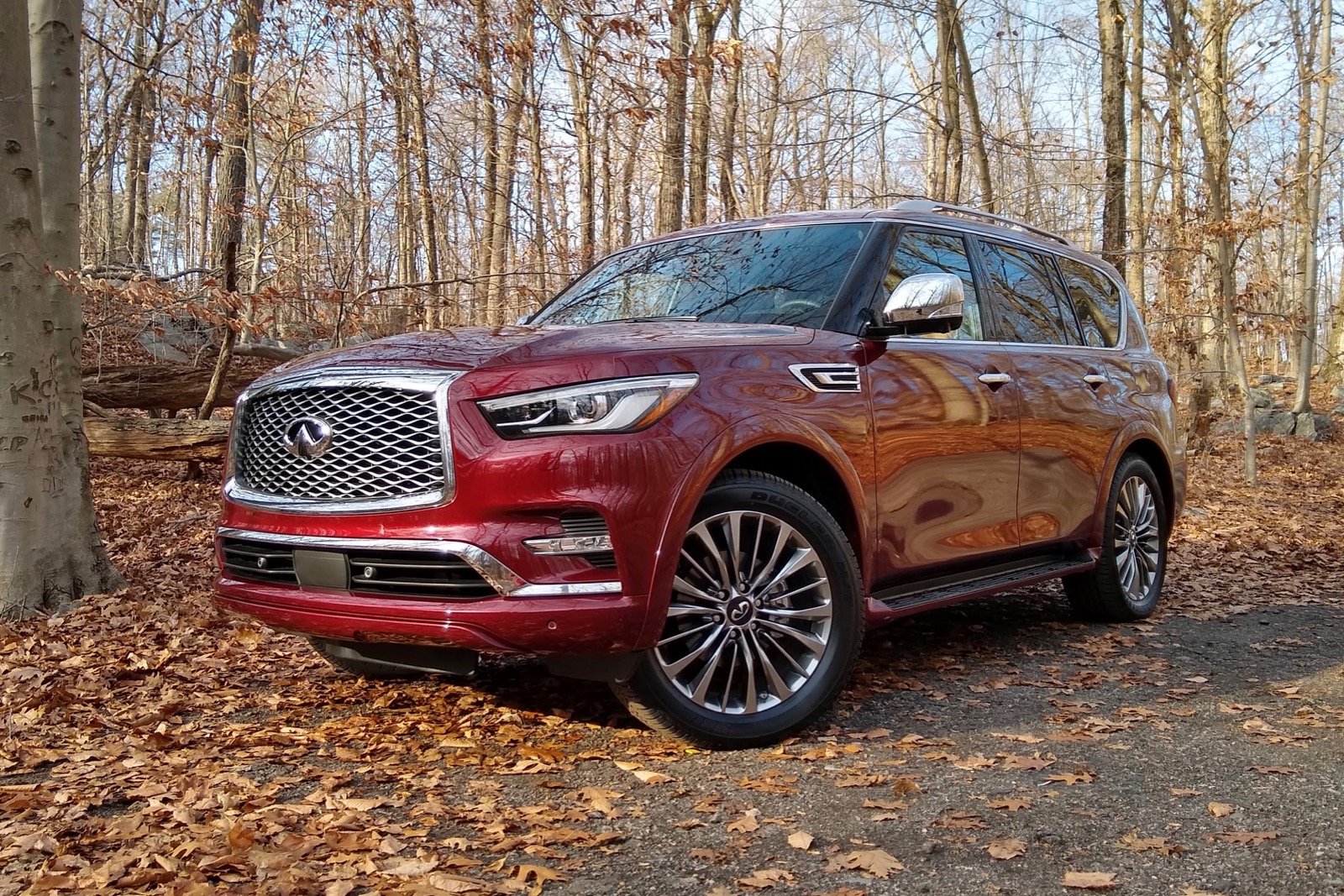
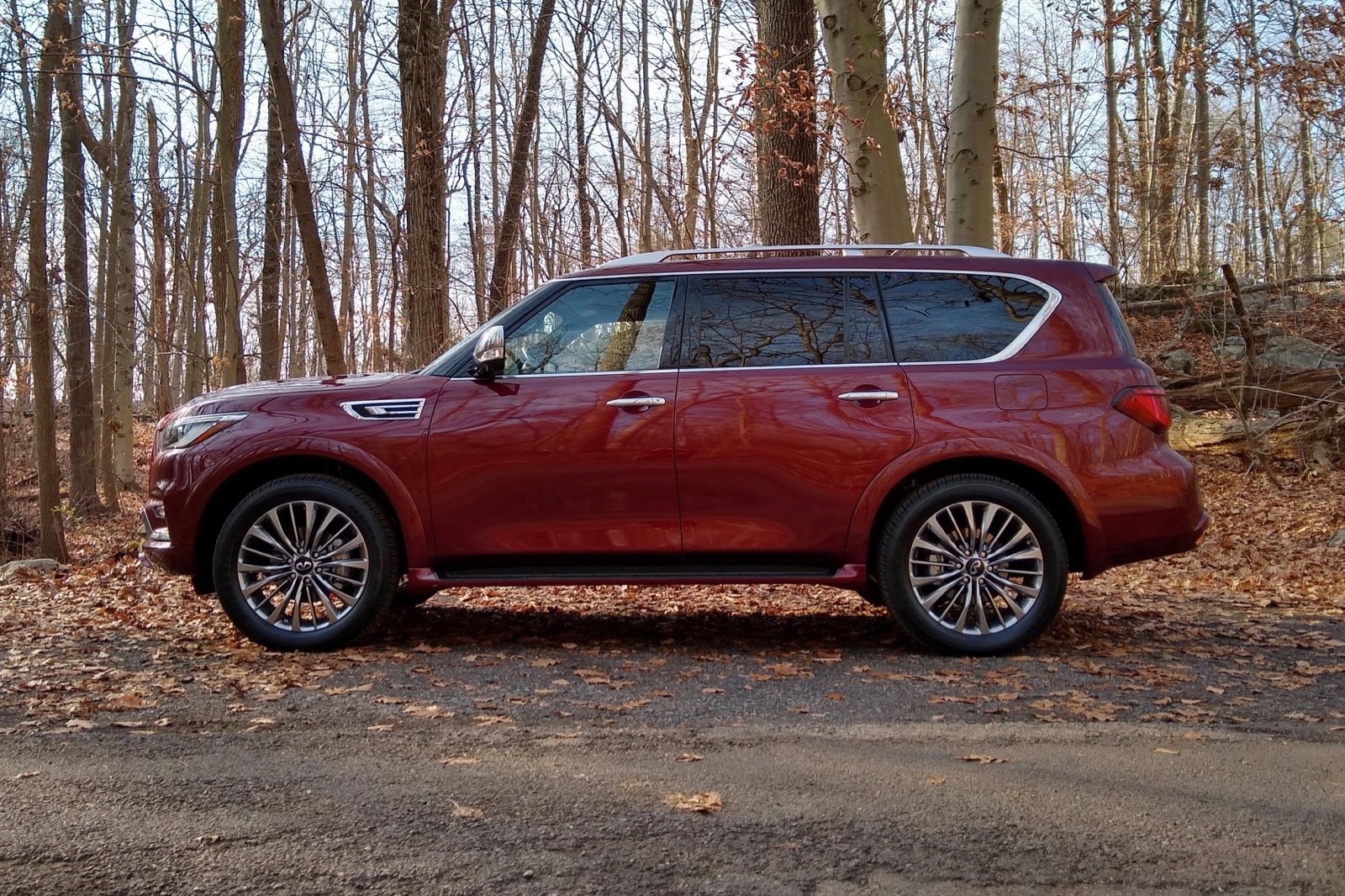
Reflecting its origins, the QX80 wears a mix of Nissan Armada and Infiniti styling elements. The basic body shell carries over from the Armada, which is evident in the profile of the roofline and the distinctive curve of the rear windows. Both SUVs also sport vents on their front fenders. While many other SUVs have switched to car-like unibody construction for its added rigidity, the QX80 and Armada stick with body-on-frame construction, with a separate body and chassis.
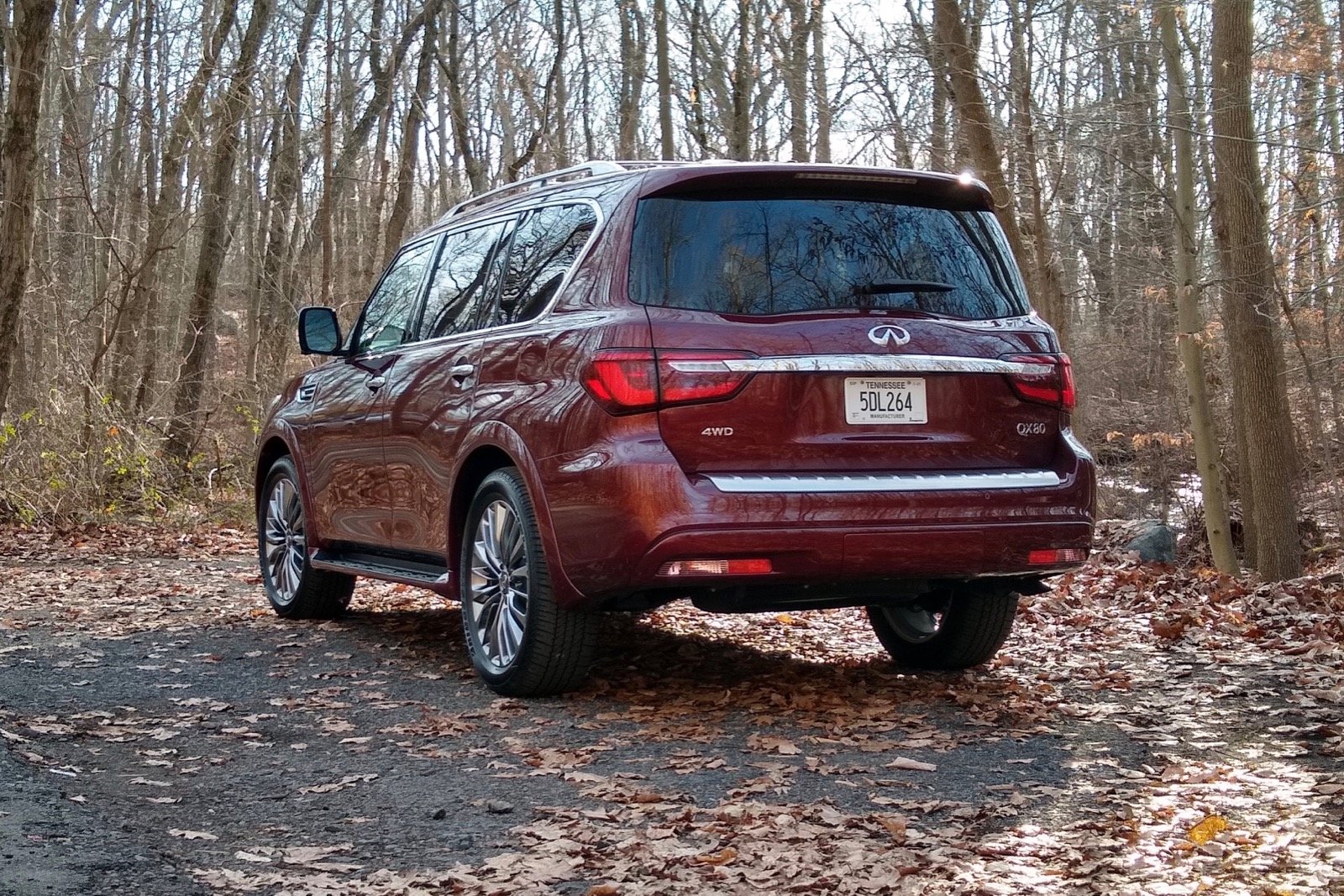
The QX80’s face is all Infiniti, however. Introduced for the 2018 model year, the current front-end styling includes the same grille and headlight design as other, smaller, Infiniti SUVs. This gives the QX80 an assertive look that’s not overly aggressive or overly flashy, compared to some other full-size luxury SUVs. It also nicely distinguishes the Infiniti from its Nissan sibling.
The QX80 gets standard LED headlights, taillights, and fog lights. The headlights get automatic high beams and windshield-wiper interlock, and an auto-leveling feature is included on the higher ProACTIVE grade. The base Infiniti QX80 Luxe trim level rides on 20-inch alloy wheels, but the QX80 ProACTIVE trim level gets 22-inch wheels.
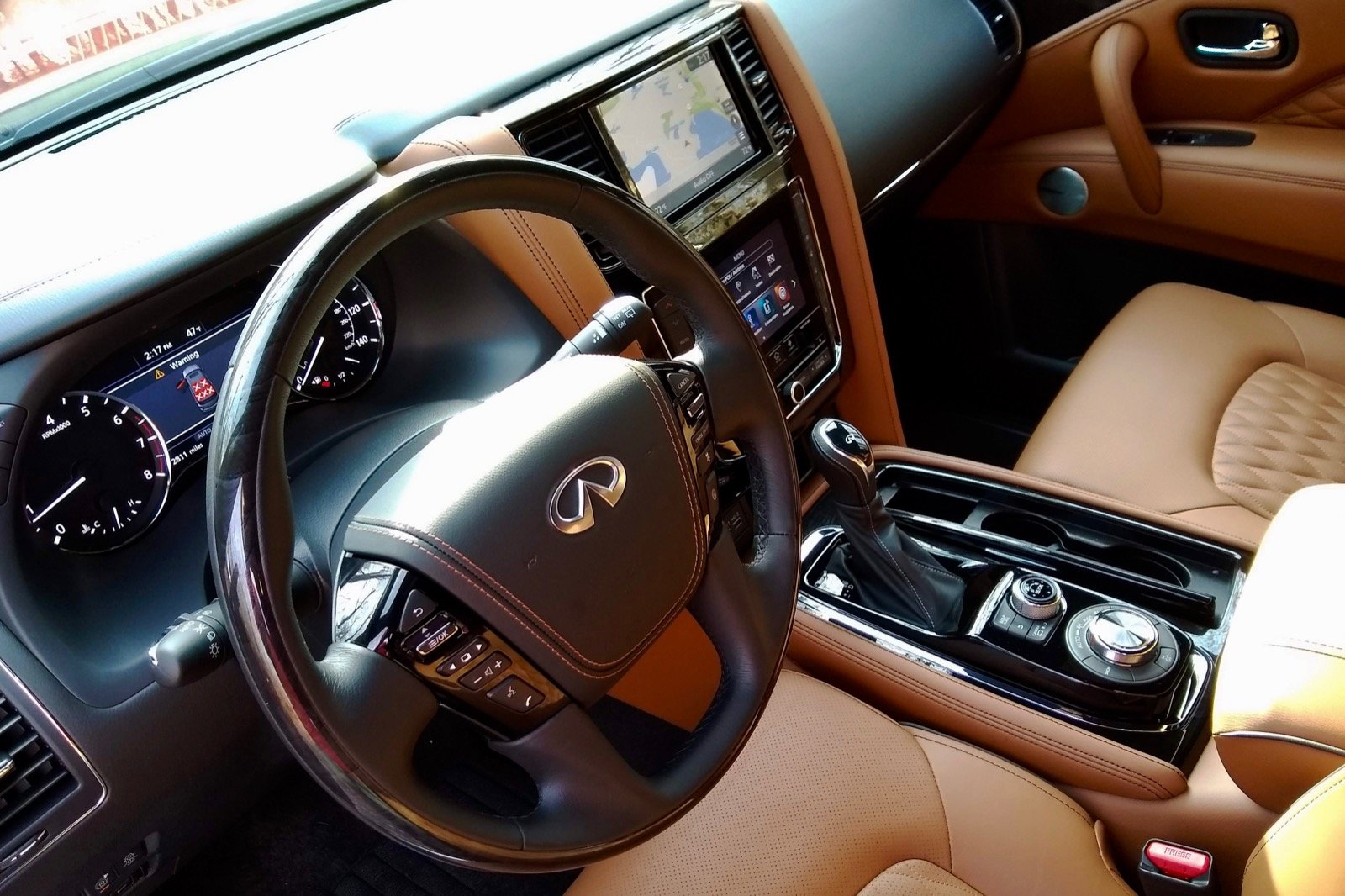
The interior design is much closer to the Armada. Infiniti dresses things up with wood trim, a smattering of contrast stitching, and standard perforated semi-aniline leather upholstery, but everything else is still recognizably Nissan. The dashboard has the same shape, with two scalloped sections defining the driver’s and front passenger’s sides. The 4WD selector and other switchgear also appear to carry over from the Armada. The QX80 even has a foot-operated parking brake—not exactly a high-end setup.
There’s nothing wrong with the interior, as it still feels properly luxurious. But buyers looking for exclusivity might feel disappointed.
Performance
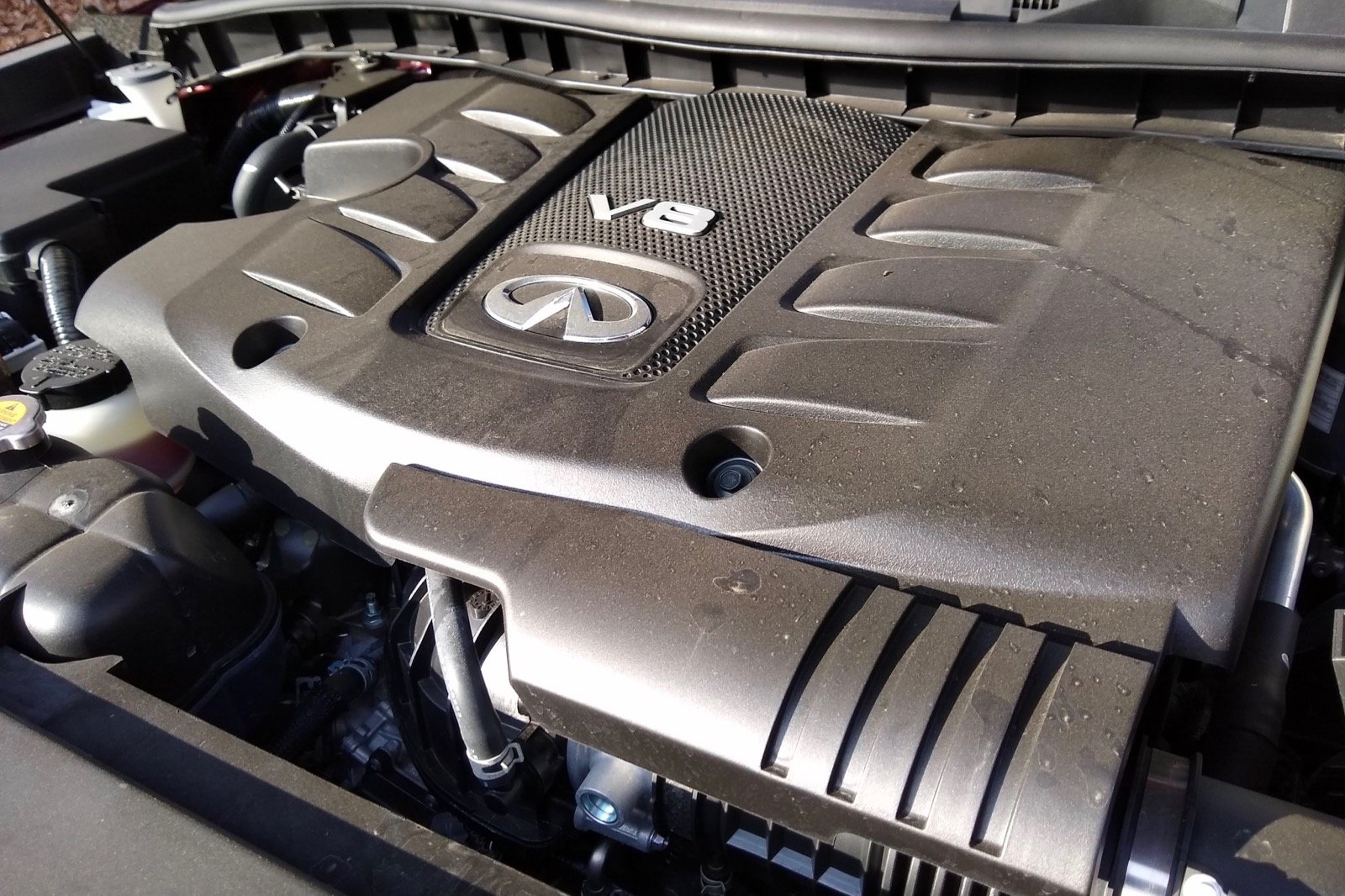
All QX80 models get a 5.6-litre V8 engine and seven-speed automatic transmission. Rear-wheel drive (RWD) is not offered in Canada; four-wheel drive (4WD) is standard.
The naturally aspirated V8 makes 400 horsepower and 413 lb-ft of torque, which is a bit less than a V8 Cadillac Escalade or the twin-turbo V6 Lincoln Navigator, but still plenty to get this big SUV moving. The engine felt very responsive in all situations, taking the stress out of highway overtaking. Transmission shifts could have been smoother, however. The gears in the 7-speed automatic felt more like they were being crumpled than shifted.
Body-on-frame construction often yields a truck-like ride, but Infiniti gave the QX80 front and rear independent suspension, with a rear auto-leveling feature that automatically adjusts for cargo or a trailer. QX80 ProACTIVE models also get Hydraulic Body Motion Control, which is designed to limit body roll during cornering.
Thanks to the independent suspension, the QX80 had a very comfortable ride—exactly what you’d hope to get in a luxury vehicle. Typically for a body-on-frame vehicle, some shudders were detectable over bumps, but nothing too bad, especially considering that our test car rode on 20-inch wheels (the upper trim is equipped with 22-inch wheels in Canada). The interior was very quiet as well.
Not surprisingly for a big SUV, the QX80 felt less composed in corners than it did on the highway. Even with Hydraulic Body Motion Control, the threshold for uncomfortable levels of body roll was fairly low. Vehicles like this aren’t designed for aggressive cornering, but even the slightest bit of exuberance made the QX80 list like a torpedoed ocean liner. However, our test car’s speed-sensitive power steering helped promote the relaxed driving style needed to avoid that. It was fairly slow, but with enough precision to confidently place the QX80 on the road.
The advantages of body-on-frame construction are towing and off-road capability. The QX80’s 4WD drivetrain features low range, and a forward skid plate is standard equipment, so this SUV should be better off-road than many of its competitors. However, its size might be a liability on tight trails, and the factory wheel-and-tire combinations are aimed more at style and on-road ride quality than off-road traction. The QX80 also lacks the off-road driver aids of the Lexus LX and Land Rover Range Rover.
The QX80 has a maximum towing capacity of 3,855 kilograms (8,500 pounds) when properly equipped. That’s more than a Cadillac Escalade and a Lincoln Navigator in peak Canadian spec.
Form & function
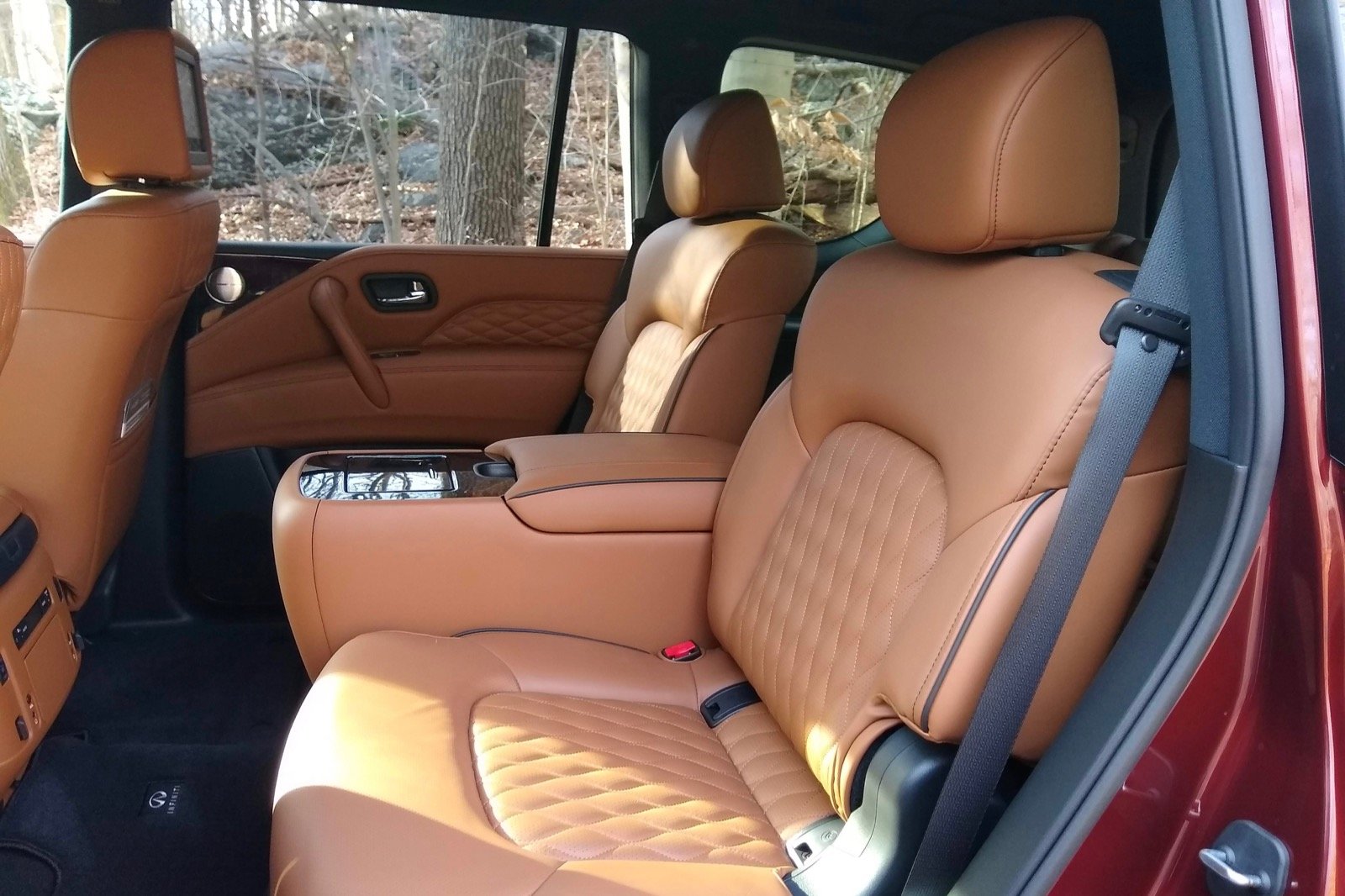
The three-row QX80 comes standard in a seven-seat configuration, with second-row captain’s chairs and a centre console. An eight-seat configuration is offered on the ProACTIVE grade, with a 60/40 split-folding second-row bench seat replacing the captain’s chairs.
Standard features include a 10-way-adjustable power driver’s seat and an eight-way front passenger’s seat, including two-way lumbar support for both (and heating and cooling as standard). However, the bottom cushions of both front seats lacked thigh support, which could prove uncomfortable over longer trips. A driver’s memory system for the seat, mirrors, and steering wheel is also standard. A pair of USB ports and a 12-volt outlet are located on the centre stack.
Passenger space in all three rows is competitive but not class-leading, and the Cadillac Escalade and Lincoln Navigator also offer long-wheelbase variants with even more space behind the first row. It’s unlikely that most people will feel cramped in a vehicle as big as the QX80, though, as even the third-row seats have enough space for adults. Models equipped with second-row captain’s chairs get a large console between the seats with plenty of storage space, plus climate controls and a pair of USB ports on the back of the front-row console. However, third-row passengers don’t get any charging ports.
At 470 litres with all three rows in place, 1,404 litres with the third row folded, and 2,694 litres with both the third row and the second-row captain’s chairs folded, cargo space trails the segment-leading Cadillac Escalade, as well as the Lincoln Navigator. As the numbers show, the third row eats into cargo space significantly, but that’s the case with all three-row SUVs (and even minivans). A power liftgate and power 60/40-split-folding third row are standard, which made switching between passenger and cargo hauling easier.
Up front, the centre console can open from both the front and the back, which is handy for second-row passengers, but the actual amount of storage space is fairly small. The front-door cupholders also aren’t shaped properly to hold drinks in place, and while Infiniti provides two potential spots on the centre console to hold your phone, neither can accommodate a phone while charging.
Technology
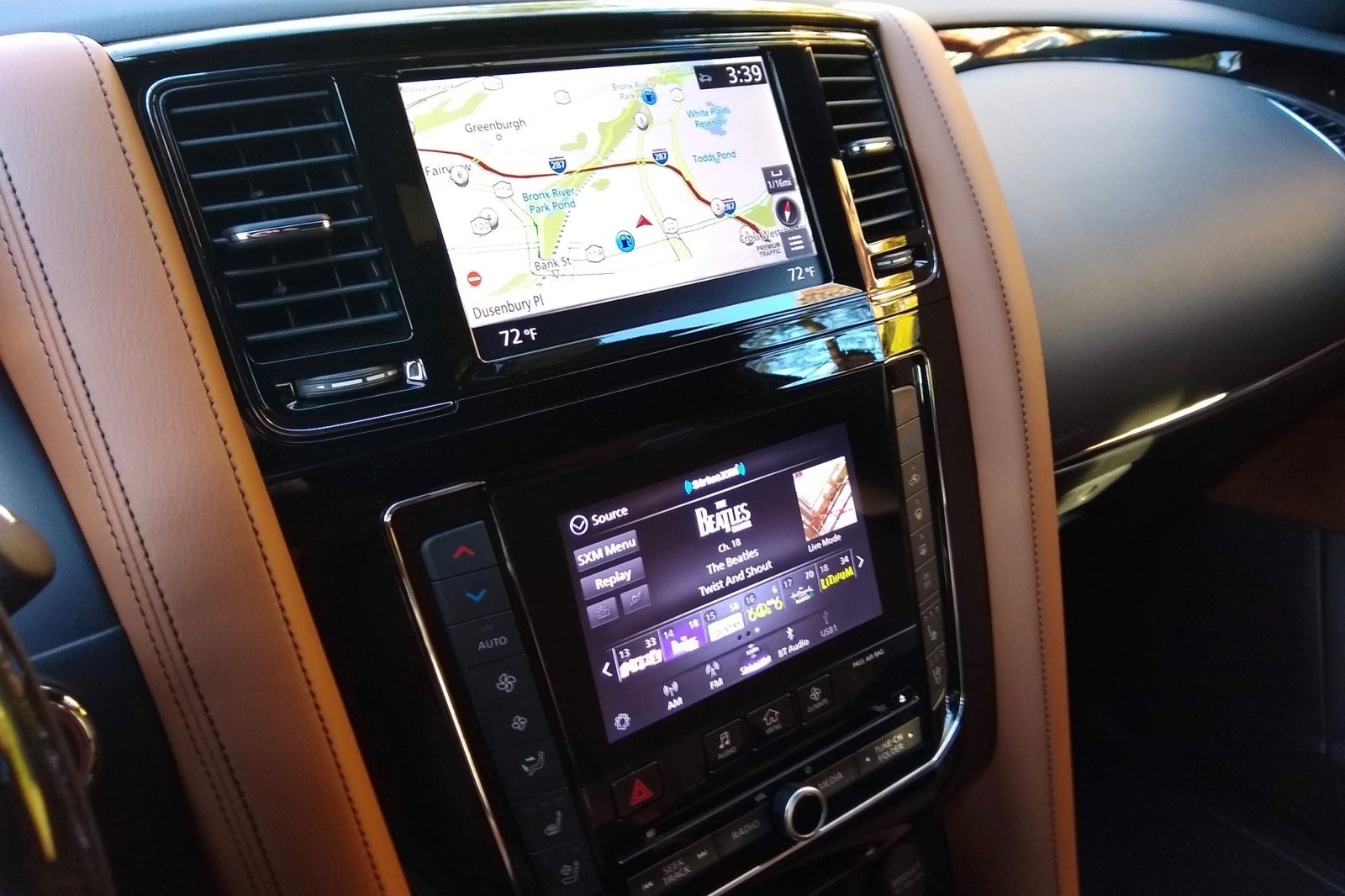
The standard Infiniti InTouch dual-screen infotainment system includes 8.0-inch upper and 7.0-inch lower touchscreens, Apple CarPlay and Android Auto compatibility, and standard on-board navigation. Bluetooth, SiriusXM satellite radio, and a 17-speaker Bose audio system are standard, along with a rear-seat entertainment system with dual 8-inch monitors, wireless headphones, auxiliary jacks, and 120-volt outlets for the second row.
The touchscreens are backed up by an array of analog controls, including a small dial on the centre console, buttons on the centre stack, and steering-wheel controls. However, none of these things actually help. It took significant trial and error to find out exactly how pressing a given button would affect what was on the screens, while the screens themselves are fairly small, and too far away from the driver for easy use.
It’s as if Infiniti keyed in on specific features without considering the overall user interface. For example, designers thought to include two ways to zoom in on maps—by pinching the screen or using the centre-console dial—but not a way to change SiriusXM stations that didn’t involve at least three touchscreen inputs.
At least Infiniti included some helpful tech that makes driving this big SUV easier. The available Smart Rearview Mirror can switch from a conventional mirror to a streaming-video display with the flick of a switch. That eliminates blind spots created by rear pillars or passengers’ heads. For the 2021 model year, the mirror is bigger (24 centimetres wide, from 22 cm before) and cancels out LED flicker from other cars’ headlights. The Around View Monitor 360-degree camera system is also standard. It can provide individual front and rear views, as well as an overhead view.
Safety
The National Highway Traffic Safety Administration (NHTSA) gave the 2021 Infiniti QX80 a four-star overall safety rating, with five stars for side crash tests, four stars for frontal crash tests, and a three-star rollover rating. The Insurance Institute for Highway Safety (IIHS) hasn’t tested the QX80, which isn’t unusual for expensive, low-volume vehicles like the Infiniti.
Standard safety features include cruise control (adaptive cruise control requires the upgrade), blind-spot monitoring, lane-departure warning, lane-keep assist, forward collision warning, and automatic emergency braking with pedestrian detection. Backup Collision Intervention and Blind Spot Intervention are included on the ProACTIVE grade. These are fairly common features available on mainstream SUVs but, unlike most other luxury brands, at least Infiniti makes many of them standard equipment.
Cost-effectiveness
Pricing for the 2021 Infiniti QX80 starts at $79,998 in Canada for the base Luxe trim level. Our range-topping Infiniti QX80 ProACTIVE 7-passenger test car had a starting MSRP of $87,998, but options like illuminated kick plates, welcome lighting, roof-rail crossbars, and Coulis Red paint, as well as a mandatory $3,225 charge for delivery fees and levies, brought the final price to $93,420 (Canadian, estimated).
For a loaded full-size luxury SUV, that’s a pretty competitive price. The QX80 lacks some of the standout features of the Cadillac Escalade and Lincoln Navigator, such as the Cadillac’s 38-inch display screen and Super Cruise driver-assist tech, or the Lincoln’s 450-hp twin-turbo V6 engine, but range-topping versions of those SUVs top the six-figure barrier.
However, the QX80 is also mechanically similar to the Nissan Armada. The Armada has the same powertrain, the same amount of interior space, and an infotainment system that’s actually a bit easier to use than Infiniti InTouch. But you can get the top Armada Platinum trim level for just under $80,000.
Infiniti's new-car warranty coverage includes a four-year, 100,000-kilometre, basic warranty, and a six-year, 110,000-kilometre, powertrain warranty.
Not surprisingly for a big V8-powered SUV, fuel efficiency is not the QX80’s strong suit. Natural Resources Canada fuel consumption ratings are 15.1 litres per 100 kilometres combined (17.6 city, 12.2 hwy).

What owners say
"Overall, owners find the 2021 INFINITI QX80 to be a luxurious and comfortable ride with a smooth driving experience. Many appreciate the refined interior and improved features, but some are disappointed with the lack of included entertainment options in lower trim levels and have noted cosmetic issues in certain vehicles. Comparisons with the Nissan Armada highlighted concerns about value for money as well."
Great car smooth ride very luxurious and definitely not over priced
April 21, 2024Comparing the three trim levels (luxe, premium select, and sensory), I have difficulty accepting that the rear entertainment system is not included (can be installed at an additional cost) in trims other than the sensory. Also, the dash has not been cosmetically upgraded (compare the infotainment display to the Armada). The 2021 QX80 is NOT the vehicle for me since I can get the new 2021 Armada Platinum for about $6-8 K less and have essentially the same vehicle. There is only one other vehicle to compare it with and that is the 2020 Nissan Armada SL (not the 2021 Armada Platinum).
June 27, 2021Best vehicle u could ever drive very comfortable very solid. And maintenance free I’ve owened Infiniti QX80 vehicles since 2004 had 04 had 2011 had 2017 and now 2019 next is the 2022 best maintenance free best comfortable truck ever
April 20, 2022What owners say
Great car smooth ride very luxurious and definitely not over priced
April 21, 2024Comparing the three trim levels (luxe, premium select, and sensory), I have difficulty accepting that the rear entertainment system is not included (can be installed at an additional cost) in trims other than the sensory. Also, the dash has not been cosmetically upgraded (compare the infotainment display to the Armada). The 2021 QX80 is NOT the vehicle for me since I can get the new 2021 Armada Platinum for about $6-8 K less and have essentially the same vehicle. There is only one other vehicle to compare it with and that is the 2020 Nissan Armada SL (not the 2021 Armada Platinum).
June 27, 2021Best vehicle u could ever drive very comfortable very solid. And maintenance free I’ve owened Infiniti QX80 vehicles since 2004 had 04 had 2011 had 2017 and now 2019 next is the 2022 best maintenance free best comfortable truck ever
April 20, 2022So far, the car seems refined and smooth. I like the new digital outlay in the SENSORY.Interior lighting has also been improved. It is definitely an improvement over the former Limited edition.
November 26, 2020The car was obviously wrecked on the front end and fixed very poorly. Paint running. Bad seals around the lights gaps don’t match up. And they said that it had been in zero wrecks.
July 31, 2024Trims & specs
Base MSRP $80,300 | Seating 8 |
Engine 5.6L 400 hp V8 | Cargo Capacity 16.6 cu ft |
Combined MPG 17 | Drivetrain RWD |
Base MSRP $83,400 | Seating 8 |
Engine 5.6L 400 hp V8 | Cargo Capacity 16.6 cu ft |
Combined MPG 16 | Drivetrain AWD |
Base MSRP $73,450 | Seating 8 |
Engine 5.6L 400 hp V8 | Cargo Capacity 16.6 cu ft |
Combined MPG 17 | Drivetrain RWD |
Base MSRP $69,150 | Seating 8 |
Engine 5.6L 400 hp V8 | Cargo Capacity 16.6 cu ft |
Combined MPG 17 | Drivetrain RWD |
Base MSRP $72,250 | Seating 8 |
Engine 5.6L 400 hp V8 | Cargo Capacity 16.6 cu ft |
Combined MPG 16 | Drivetrain AWD |
Base MSRP $76,550 | Seating 8 |
Engine 5.6L 400 hp V8 | Cargo Capacity 16.6 cu ft |
Combined MPG 16 | Drivetrain AWD |


Pricing trends
MSRP range
$69,150 - $83,400
Current avg. market price
$37,108
Trending down by 1.8% this month
May 2026 - October 2026

