2025 INFINITI QX80 Reviews, Pricing & Specs



Pros & cons
What we like
Plenty of cargo space
Spacious third row
Impressive stereo
What to consider
Fairly pedestrian performance
Poor fuel economy
Poor ride quality
Expert review
Infiniti’s full-size SUV, the QX80, receives a long overdue redesign.
The 2025 Infiniti QX80 is the Nissan luxury brand’s de facto flagship. It’s a full-size SUV that competes with the BMW X7, Cadillac Escalade, Land Rover Range Rover, Lexus LX, Lincoln Navigator, and Mercedes-Benz GLS. The QX80 benefits from a redesign for 2025 with new styling, a new powertrain, and updated tech features.
Verdict: The QX80 emphasizes interior space and tech gadgets over driving dynamics.
out of 10 expert review
Look & feel
In its first redesign since the 2017 model year, the QX80 grows about two and a half centimetres longer and about seven and a half centimetres wider, while height is basically unchanged. The QX80 retains its body-on-frame architecture, but with a new frame that improves torsional stiffness and lateral stiffness by 25% and 57%, respectively, according to Infiniti. Some rival SUVs like the Cadillac Escalade, Jeep Wagoneer, Lexus LX, and Lincoln Navigator are also body-on-frame, but this is very much an old school construction now limited to SUVs and pickup trucks.
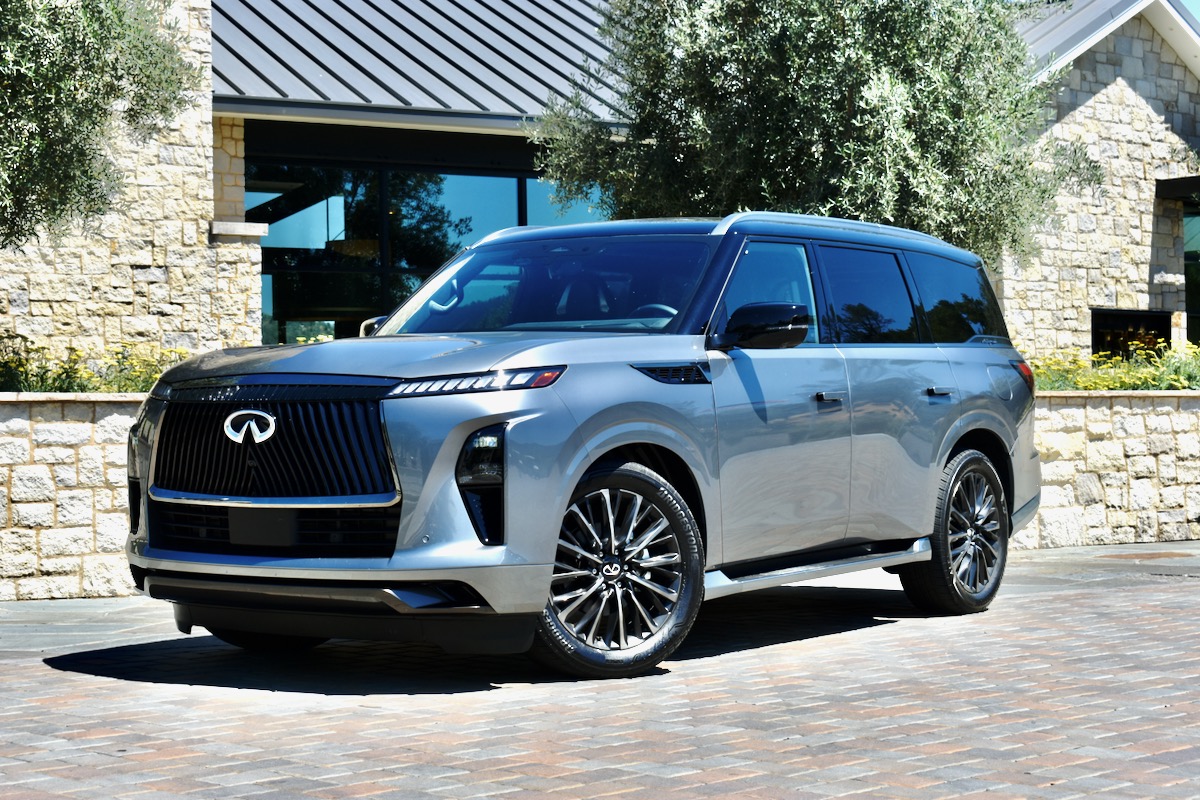
The 2025 QX80 gets more expressive styling, although the most interesting details are concentrated at the front. The grille is as big as ever, now even creeping up onto the hood courtesy of a new trim piece. The hood itself is creased to provide some visual interest (and likely added strength), but it’s something you only notice from the driver’s seat when the peaks in those creases block your view. The other major change is a stacked-headlight setup with large lower elements flanking the grille and narrow LED daytime running lights on the hood edges that gives the QX80 an imposing and distinctive look.
Other styling elements help update the old QX80 look. The vents on the front fenders return, and the squared-off rear end with low LED taillights retains the same general shape as the previous-generation design. However, the taillights are now full-width, comprised of over 300 LEDs. Blacked-out roof pillar trim and flush door handles also give the QX80 a cleaner appearance in profile view.
For 2025, the QX80 is offered in Canada in Luxe, Sensory, and Autobiography trim levels. 22-inch wheels are standard with a unique design for the top Autograph trim level. Roof rails are standard, but so is a panoramic moonroof that might make you think twice about using them.
The interior gets the same high-tech makeover as many other recent luxury-vehicle cabins, adding a large horizontal display up front as well as 64-colour ambient lighting. The screens are well-integrated, courtesy of trim pieces that flow into the dashboard and through the door panels. But even in Autograph models, shiny black plastic trim tends to crowd out the more premium-feeling metal and wood.
Luxe models get leather seats for the first row and second row, while Sensory models upgrade the first- and second-row appointments to semi-aniline leather. Autograph models get semi-aniline leather across all three rows.

Performance
The redesigned QX80 is powered by a twin-turbocharged 3.5-litre V6, which replaces last year’s naturally aspirated 5.6-litre V8. The twin-turbo V6 produces 450 horsepower and 516 pound-feet of torque, compared to 400 hp and 413 lb-ft of torque for the outgoing V8. A nine-speed automatic transmission also replaces the old seven-speed automatic, and four-wheel drive (4WD) remains standard in Canada.
The twin-turbo V6 engine’s additional power and the nine-speed automatic’s additional gears make themselves known when accelerating away from a stop. The new QX80 feels a lot more energetic than the old V8-powered version, even if you no longer get that nice V8 burble. The QX80 now features both active noise cancellation and active sound enhancement, but the latter tends to take over during acceleration, adding an unpleasantly artificial noise to the cabin.
An air suspension and adaptive damping are standard equipment on the 2025 QX80 in Canada. In addition to adjusting damper firmness in real time to provide the most compliant ride possible, the suspension system can raise or lower ride height. An off-road setting pumps up the suspension by 5.3 centimetres, giving the QX80 25.4 centimetres of ground clearance. While underway, the QX80 will also hunker down by 3 cm to improve aerodynamics. And it will lower 7 cm while stationary to make getting in and out easier.
The air suspension did its best to counteract our QX80 Autograph test car’s considerable weight, body-on-frame construction, and 22-inch wheels, but still couldn’t erase bumps. And even with its reinforced frame, the QX80 didn’t feel as solid as unibody vehicles. Given its immense size, we weren’t expecting much in terms of handling and the QX80 lived up to expectations. The same can also be said of other large body-on-frame SUVs, though, so it’s best to describe the QX80 as average rather than deficient.

Form & function
The redesign increased cargo space by 6%, 17%, and 28% behind the first, second, and third rows, respectively, according to Infiniti. That brings the totals to 623 litres with all three rows in place, 1,670 litres with the third row folded, and 2,860 litres with both the second and third rows folded. That gives the Infiniti a comfortable advantage over slightly smaller SUVs like the Lexus LX and Mercedes-Benz GLS. The Cadillac Escalade has even more cargo space, though, as does the Lincoln Navigator if the second and third rows are folded.
Infiniti makes reconfiguring the interior for passenger or cargo hauling easy with a power liftgate and power-folding second- and third-row seats. Controls in the cargo area, on the infotainment touchscreens, and on the seats themselves are handy, although we did find that second-row seats didn’t always have room to move if the driver’s seat was set up for taller occupants. Infiniti offers a 40/20/40 split-folding second-row bench seat or reclining captain’s chairs on the Autograph grade, with a reclining 60/40 split-folding third-row bench.
Passenger space in all three rows is in line with the similarly enormous Escalade and Navigator. Headroom doesn’t change much from the previous-generation QX80, but first-row and third-row legroom were increased by a few centimetres. That, along with generous side glass and well-placed cupholders and USB ports, makes the third row among the most tolerable of its kind. Heated, ventilated and massaging front seats and second-row seats are available, along with a heated third row.
Infiniti claims a maximum 3,855-kilogram (8,500-pound) towing capacity when properly equipped. That’s better than most other full-size luxury SUVs, although the Lincoln Navigator can tow up to 3,950 kilograms (8,700 pounds).

Technology
The redesigned cabin features dual 14.3-inch screens, one serving as the instrument cluster and the other serving as the infotainment touchscreen. A smaller 9-inch touchscreen on the centre console handles most controls not delegated to the main infotainment screen, such as climate control. A head-up display is also available, along with a total of eight USB-C ports, spread across all three rows. The QX80 is the first Infiniti model with Google built-in apps, meaning Google Maps serves as the native navigation system, Google Assistant handles voice recognition, and the Google Play Store allows owners to download other apps directly to the car. Wireless Apple CarPlay and Android Auto are still supported, however.
Google Maps provides a familiar interface for the navigation system, but everything else about the infotainment system has an unfortunately Nissan-like familiarity. The dual-screen cockpit setup may look impressive, but the graphics displayed on it seem too much like those in vehicles from Infiniti’s non-luxury parent brand. The lower touchscreen also requires fairly firm presses, intended to prevent users from hitting the wrong control inadvertently. But the deliberate action needed to, for example, turn on the ventilated seats, was a bit distracting compared to using physical buttons.
All 2025 QX80 models have Klipsch sound systems. Luxe models have a 14-speaker system, while Sensory and Autograph models have a 24-speaker version that also includes Individual Audio tech that can route sound through speakers mounted in the front headrests. This lets parents listen to music while children sleep in the second and third rows, or lets drivers take phone calls or get navigation directions without interrupting passengers’ music.
Like many other luxury cars, the QX80 is available with a 360-degree camera system that shows a composited view around the car. But Infiniti’s version lets you view eight different angles, and includes a 170-degree front wide view that can be displayed across the dual 14.3-inch screens. An Invisible Hood view shows what’s directly in front of the car at a low angle as well. A digital rearview camera, dash cam, and in-car camera are also available.

Safety
The 2025 Infiniti QX80 receives a Top Safety Pick+ rating from the Insurance Institute for Highway Safety (IIHS), which is that organization’s highest rating. National Highway Traffic Safety Administration (NHTSA) crash test results weren’t available at the time of publication. Standard safety features include: forward collision warning, automatic emergency braking, blind-spot monitoring, rear cross-traffic alert, lane-departure warning, and a trailer blind-spot warning system that works with trailers up to 33 feet in length.
The QX80 is also available with parent Nissan’s ProPilot Assist highway driving assistance system. The basic 1.1 version combines adaptive cruise control with automated lane centring, while the more advanced ProPilot Assist 2.1 version (available on Autograph models) allows for hands-free driving and automated lane changes.
We didn’t have a chance to try ProPilot Assist on the QX80 (our pre-production test car had an unspecified issue), but we’ve found that it performs reasonably well in other vehicles. It’s worth noting that lane changes must be initiated by the driver by flicking the turn-signal stalk, but that avoids the unpredictable behaviour of, for example, the General Motors Super Cruise system, which is just as impatient as us flawed humans.

Cost-effectiveness
Despite the smaller engine and the transmission’s two additional gear ratios, fuel economy is only slightly better than the outgoing model. Ratings land at 13.8 litres per 100 kilometres combined (15.1 city, 12.2 highway). The 2024 Infiniti QX80 was rated at 15.2 L/100 km combined (17.5 city, 12.4 highway).
Infiniti offers a four-year/100,000-kilometre basic warranty and six-year/110,000-kilometre powertrain warranty on new vehicles.
Pricing starts at $110,256 for a base QX80 Luxe (all prices include a mandatory $2,495 destination charge, additional fees, and the Canadian federal government’s luxury tax, which applies to all vehicles priced at $100,000 or more). The base price has increased nearly $20,000 versus the 2024 QX80, but it encompasses more standard equipment than before, Infiniti notes.
The QX80 Sensory starts in Canada at $121,056 including fees, while the Autograph trim is priced from $134,256. The 2025 Infiniti QX80 takes what was a nice but dated SUV and gives it expected updates like a downsized engine and more and bigger screens. The QX80 still won’t challenge a Range Rover, or even a Lexus LX, when it comes to off-road capability, and it can’t match the on-road driving dynamics of a BMW X7 or Mercedes GLS. But its functional interior and attention-grabbing design make the QX80 a noteworthy alternative to a Cadillac Escalade or Lincoln Navigator.
Note: Images and video show a US model.


What owners say
This vehicle is unbelievable! Twin turbo is awesome…fit and finish as nice as I’ve seen.
October 20, 2024Trims & specs
Base MSRP $85,550 | Seating 8 |
Engine 3.5L 450 hp V6 | Cargo Capacity 22.0 cu ft |
Combined MPG 17 | Drivetrain AWD |
Base MSRP $92,650 | Seating 8 |
Engine 3.5L 450 hp V6 | Cargo Capacity 22.0 cu ft |
Combined MPG 17 | Drivetrain AWD |
Base MSRP $99,950 | Seating 8 |
Engine 3.5L 450 hp V6 | Cargo Capacity 22.0 cu ft |
Combined MPG 17 | Drivetrain AWD |
Base MSRP $89,550 | Seating 8 |
Engine 3.5L 450 hp V6 | Cargo Capacity 22.0 cu ft |
Combined MPG 18 | Drivetrain RWD |
Base MSRP $82,450 | Seating 8 |
Engine 3.5L 450 hp V6 | Cargo Capacity 22.0 cu ft |
Combined MPG 18 | Drivetrain RWD |
Base MSRP $109,900 | Seating 7 |
Engine 3.5L 450 hp V6 | Cargo Capacity 22.0 cu ft |
Combined MPG 17 | Drivetrain AWD |


Pricing trends
MSRP range
$82,450 - $109,900
Current avg. market price
$85,094
Trending down by 2.3% this month
May 2026 - October 2026

