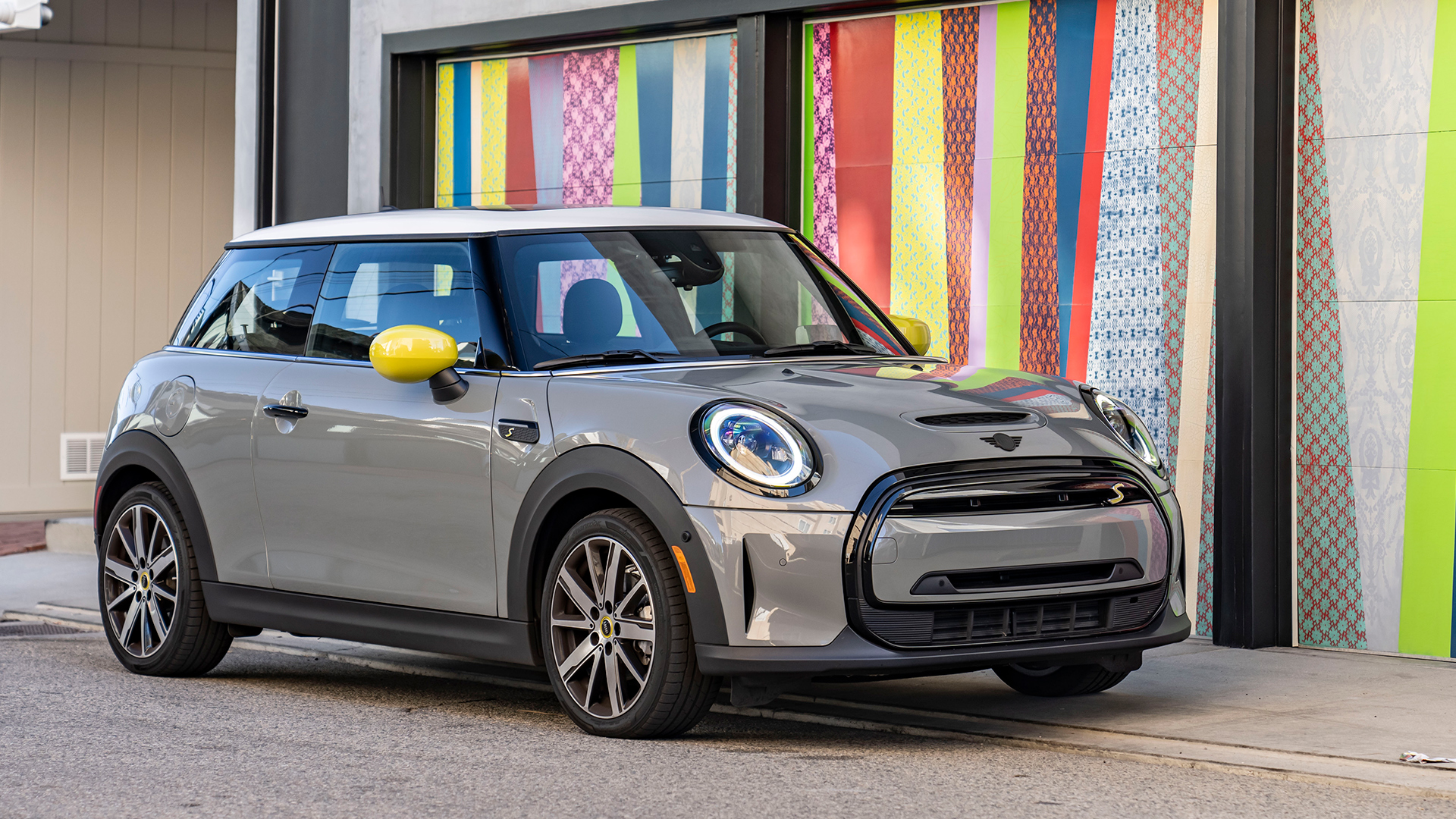
2020 MINI Cooper Reviews, Pricing & Specs


Pros & cons
What we like
Stylish design
Multiple powertrain options
Multiple body styles
What to consider
Advanced safety features are not standard
Cramped back seat
Not much cargo space
Expert review
The MINI Cooper is an historic icon, and in 2020 it takes a step toward the electric future.
The MINI Cooper showcases timeless design and encourages even the timidest driver to live out their inner Mario Kart fantasies. With a short wheelbase, low curb weight, and torquey engines, the MINI Cooper delivers more smiles per square foot than most competitors. And with a new electric powertrain option, it can do so with a green footprint, too.
out of 10 expert review
Look & feel
The 2020 Cooper looks like nothing else on the road—or at least nothing else not wearing a MINI badge. The wide-eyed headlights up front flaunt LED rings. The front grille grins. The colour options are vibrant. The Union Jack taillights are a real crowd-pleaser. Based just on its styling, the Cooper is a certified enthusiast machine. Yet, it would never be called wasteful or gaudy. It drips charm and invites praise.
While it originally came as only a two-door hardtop, the MINI Cooper has evolved. First, there was a convertible variant. A four-door body style came later. Now, MINI has introduced an all-electric Cooper: the SE trim. MINI markets this one as offering similar levels of performance and refinement as the sweet-spot S trim, but with a battery and electric motor in place (thus, the “E” addition to the “S”).
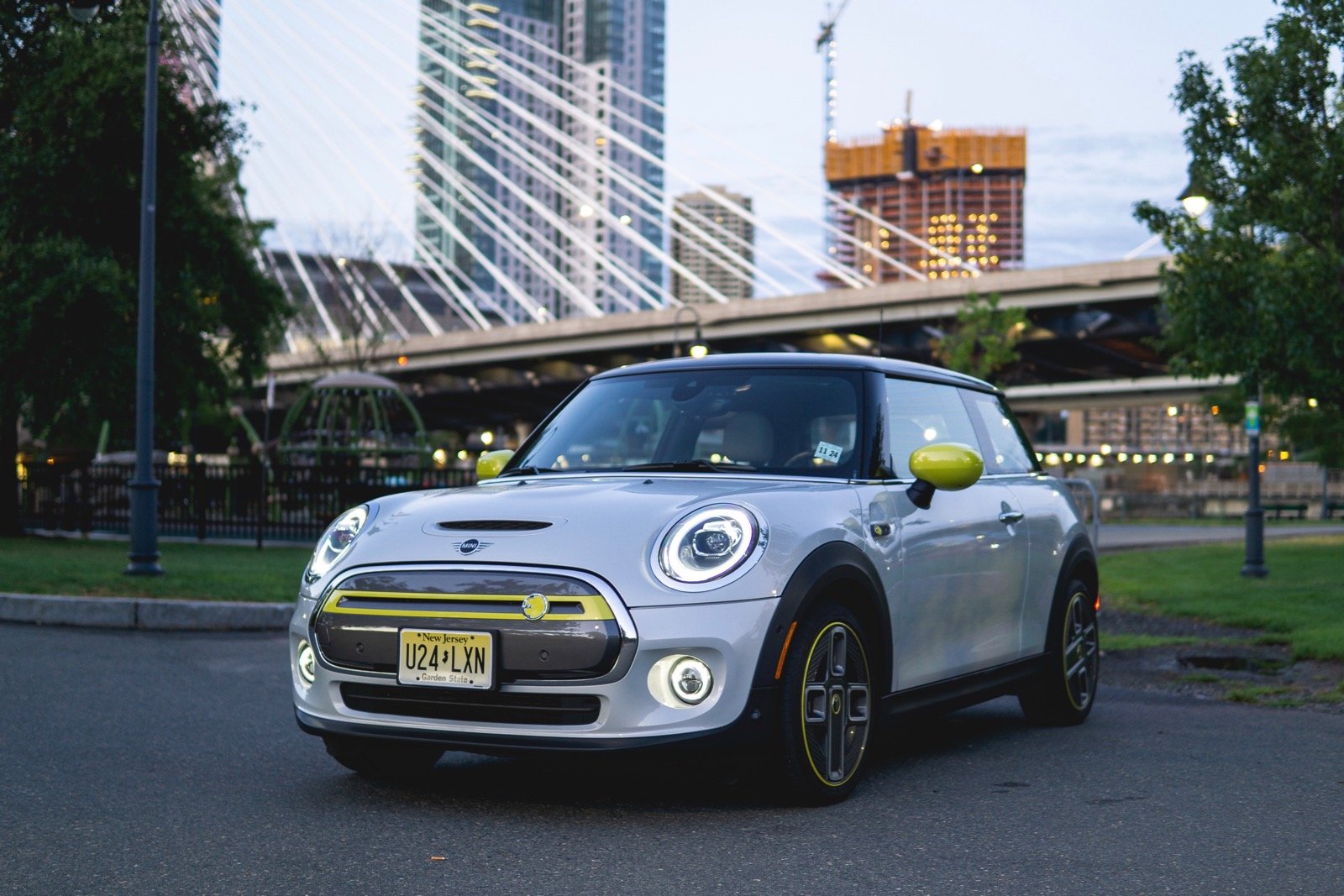
For this review, we tested the SE—we’ve spent significant time behind the wheel of previous-year, gas-powered Coopers. Design-wise, the SE mimics much of what you’ll find on a “regular” Cooper S. The key difference is that the SE sits slightly higher off the road to accommodate the battery cells positioned under its floor. And of course, you can buy an SE with a unique paint scheme and interesting EV-exclusive wheels, designed to evoke a European-style electrical outlet. Otherwise, it’s tough to tell the difference between the electron-fueled MINI and its gas-powered brethren.
Inside, the Mini Cooper’s design remains dominated by circles. The speakers, air vents, and door handles are all circular. And, between the front seats, a massive circular housing surrounds the touchscreen infotainment system (also controllable via a circular rotary dial between the seat cushions). Overall, the Cooper delivers a premium feel. In fact, it’s safe to say this level of refinement is unmatched in cars of its size.
Performance
Ever since giving V8 racecars stiff competition on the European Touring Car Championship circuit during the 1960s, MINIs have had a special reputation for performance. Outright speed isn’t the game, these cars are about nimble quickness, carving corners, and navigating traffic with ease. Today, the front-wheel-drive (FWD) Mini Cooper S continues to uphold this reputation, and the MINI John Cooper Works (or JCW) trim dances circles around most cars that, on paper, would appear significantly more impressive.
Performance is also where the MINI Cooper SE excels. The electric motor weighs in at 181 horsepower and 199 pound-feet of torque, fed by a 32.6-kilowatt-hour battery pack. Those figures sit just below the Cooper S’s 2.0-litre turbocharged inline four-cylinder engine, which generates 189 hp and 207 lb-ft. However, because of the immediacy of the electric motor's torque delivery, the SE feels just as quick accelerating from a stop (and it very nearly is). Additionally, the SE sprints ahead of the base Cooper, which employs a drivetrain with a 1.5-litre turbo three-cylinder making 134 hp and 162 lb-ft.
The SE also uses regenerative braking to help keep its battery charged. The default system is aggressive and will bring the car to a relatively quick stop without you ever needing to touch the brake pedal. While some drivers will enjoy this golf-cart-style one-pedal driving, others are likely to switch to the less-aggressive setting every time they turn on the car. Even then, the brakes still regenerate energy every time the driver removes their foot from the accelerator.
There is a bit of a weight penalty to the SE trim. Batteries are heavy, so even after replacing the gasoline engine with an electric motor, the SE weighs roughly 135 kilograms (300 pounds) more than a Cooper S. However, thanks to the SE’s battery back being mounted in a “T” shape beneath the Cooper’s floor, the centre of gravity remains low. That helps this little car feel planted in the corners. Add direct steering, limited body roll, and wide-open sight lines, and the SE remains true to the classic MINI driving experience.
Gas-powered Coopers employ either a seven-speed dual-clutch automatic transmission (DCT) or an eight-speed automatic, the latter of which is found in only the John Cooper Works trim. The SE uses a single-speed gearbox. For the 2020 model year, no manual transmission is offered. That’s pretty shocking for MINI, but thankfully a six-speed manual transmission is set to return in 2021.
Form & function
As you’d likely expect, the MINI Cooper hatchback is not the car of choice for carpoolers, soccer moms (or dads), road trips, home-improvement projects, or ski vacations. Front-seat space is good and the big greenhouse means you never feel trapped inside a shoebox—even if it may look like you are from the vantage point of passing cars. Still, the backseat is predictably tiny, and best suited for children. Even then, any kid going through a growth spurt is likely to complain.
Behind the rear seat in a two-door Cooper, you’ll find a scant 246 litres of cargo space, which remains unchanged in the SE trim. Pick a four-door hatchback, and cargo space grows to a more competitive 371 litres. The MINI Convertible cuts things very short, delivering only 161 litres. Dropping the rear seats in our SE tester provided a maximum of 730 litres. For context, that’s still less than half of what you can expect from a Volkswagen Golf with its seats folded. It’s impressive that MINI was able to engineer the SE without cutting any interior space, but it was also pretty necessary. There’s just not that much space available to cut.
Passenger and cargo space aside, the MINI Cooper is a thoughtfully designed car. Two-zone automatic air conditioning is a surprising luxury in a car this size, and the heating system runs off a particularly efficient heat pump to help minimize the draw on the SE’s battery during winter.
The chrome toggle switches on the dashboard are fun to flick, the steering wheel is beautifully ergonomic, and the car’s materials feel top-notch. BMW has invested plenty in the MINI brand, and the impact is noticeable.
Technology
The 2020 MINI Cooper SE features a unique “eDrive” driver-information display connected to the steering wheel. If your viewing angle isn’t quite right, be sure to solve it via the seat-adjustment controls because the information display moves up and down with the steering-wheel adjustments. That small detail is an annoyance, but a manageable one.
The eDrive screen can display all sorts of info, including vehicle speed, time, average energy consumption, remaining charge, and drive mode (Sport, Mid, or Green). But the one most critical to the driver is likely the vehicle’s remaining range. With a 32.6-kilowatt-hour battery, the Cooper SE can travel only 177 kilometres according to Natural Resources Canada. That’s not competitive against cars like the Hyundai Kona Electric or Chevrolet Bolt, but it’s also worth noting that the MINI Cooper was already particularly appealing to urban drivers who may not view 200-kilometre driving ranges as critically necessary.
The 6.5-inch touchscreen infotainment display lives within a circular housing in the centre of the dash. It will catch your eye, but it's not the most efficient use of space. It includes Bluetooth connectivity, navigation, and Apple CarPlay (but not Android Auto). MINI offers the Cooper SE in three levels in Canada—Classic, Premier, and Premier+—and many shoppers will prefer the 8.8-inch screen that comes standard on the SE Premier+. Also standard on that top-tier SE (which is what we spent our week testing) are a wireless charging pad and a head-up display.
Safety
Some might find it hard to imagine a car the size of the MINI Cooper could ever be considered safe, and our test car's lack of advanced safety features didn't help that feeling. Front and rear parking sensors were included with the Premier+ package, and the car's rear-view camera system looked sharp, but overall, the MINI Cooper SE lacked a lot of advanced safety tech present in other similarly-priced cars. Forward-collision warning is standard, but automatic emergency braking is unavailable.
The U.S. National Highway Traffic Safety Administration (NHTSA) has not rated the MINI Cooper. Thankfully, the Insurance Institute for Highway Safety (IIHS) has. From the IIHS, the 2020 MINI Cooper received top marks, earning "Good" scores in all crash tests.
Cost-effectiveness
You'd expect a car as small as the MINI Cooper three-door to return enviable fuel consumption figures. Surprisingly, you'd be wrong. The most efficient model is the base Cooper hardtop with a 1.5-litre three-cylinder engine. That powertrain returns 8.4 litres per 100 kilometres in the city, 6.5 on the highway, and 7.5 combined. Amp up the engine to the Cooper S's 2.0-litre four-cylinder, and pay a minor penalty; NRCan estimates 8.9/6.6/7.9 for that one. With its 177 km range, the MINI Cooper SE earns a 2.2 litres-equivalent per 100 km rating for combined driving.
Although it's easy to run up the price on a gas-powered MINI Cooper (especially the JCW), the Cooper SE looks like a relative bargain. Our Premier+ model had as-tested pricing of $51,956 including destination fees (Canadian, estimated), but $8,000 of that price was due to the Premier+ package. Go for a base-level SE, and the MSRP plus destination starts at $43,956. For a new car, let alone a new electric car, that's a compelling price point. Tack on the Canadian federal iZEV incentive of up to $5,000 plus any available provincial rebates, and suddenly you can drive away in a Cooper SE for less than the cost of a Honda Accord.
Plus, there's the appeal of eliminating trips to the gas station, although you'll still need to pay for electricity.
Note: Images show a US model.

What owners say
Trims & specs
Base MSRP $23,400 | Seating 4 |
Engine 1.5L 134 hp I3 | Cargo Capacity 8.7 cu ft |
Combined MPG 32 | Drivetrain FWD |
Base MSRP N/A | Seating N/A |
Engine N/A | Cargo Capacity N/A |
Combined MPG N/A | Drivetrain N/A |
Base MSRP N/A | Seating N/A |
Engine N/A | Cargo Capacity N/A |
Combined MPG N/A | Drivetrain N/A |
Base MSRP $24,400 | Seating 5 |
Engine 1.5L 134 hp I3 | Cargo Capacity 13.1 cu ft |
Combined MPG 32 | Drivetrain FWD |
Base MSRP $33,400 | Seating 4 |
Engine 2.0L 228 hp I4 | Cargo Capacity 8.7 cu ft |
Combined MPG 30 | Drivetrain FWD |
Base MSRP $23,400 | Seating 4 |
Engine 1.5L 134 hp I3 | Cargo Capacity 8.7 cu ft |
Combined MPG 32 | Drivetrain FWD |
Base MSRP $32,400 | Seating 4 |
Engine 2.0L 189 hp I4 | Cargo Capacity 5.7 cu ft |
Combined MPG 30 | Drivetrain FWD |
Base MSRP $27,400 | Seating 4 |
Engine 2.0L 189 hp I4 | Cargo Capacity 8.7 cu ft |
Combined MPG 30 | Drivetrain FWD |
Base MSRP $28,400 | Seating 4 |
Engine 1.5L 134 hp I3 | Cargo Capacity 5.7 cu ft |
Combined MPG 32 | Drivetrain FWD |
Base MSRP $29,900 | Seating 4 |
Engine 181 hp Electric | Cargo Capacity 7.5 cu ft |
Combined MPG 108 | Drivetrain FWD |
Base MSRP $38,400 | Seating 4 |
Engine 2.0L 228 hp I4 | Cargo Capacity 5.7 cu ft |
Combined MPG 29 | Drivetrain FWD |
Base MSRP $24,400 | Seating 5 |
Engine 1.5L 134 hp I3 | Cargo Capacity 13.1 cu ft |
Combined MPG 32 | Drivetrain FWD |
Base MSRP $28,400 | Seating 5 |
Engine 2.0L 189 hp I4 | Cargo Capacity 13.1 cu ft |
Combined MPG 30 | Drivetrain FWD |


Pricing trends
MSRP range
$23,400 - $38,400
Current avg. market price
$19,932
Trending down by 4.5% this month
May 2026 - October 2026