2020 Ford Expedition Reviews, Pricing & Specs



Pros & cons
What we like
Spacious
Plenty of cargo space
Powerful engine
What to consider
Outdated technology
Interior materials feel cheap
Expert review
There are all-around used family vehicles than the 2020 Ford Expedition. Just make sure to get the extended-length Expedition MAX version if you want to carry a full house of passengers and cargo at the same time.
Equipped with three rows of legitimately comfortable seating for as many as eight passengers, able to hold as much as 2,962 litres of cargo, capable of towing up more than 4,000 kilograms (9,000 pounds) of trailer, and supplying a minimum of 24.6 centimetres of ground clearance, I can’t think of a better all-around SUV than the 2020 Ford Expedition. But all of this capability doesn’t come cheap. Prices start at $62,500 for an Expedition XLT, and an Expedition King Ranch like our test vehicle tallies up to $80,750, not including a $1,950 destination charge.
out of 10 expert review
Look & feel
Last redesigned for the 2018 model year, the Ford Expedition is a cleanly styled full-size SUV. Some might even call the styling boring. But clean, boring designs tend to age well over time, and if you’re spending this kind of money on an SUV, chances are you plan to keep it around for many years.
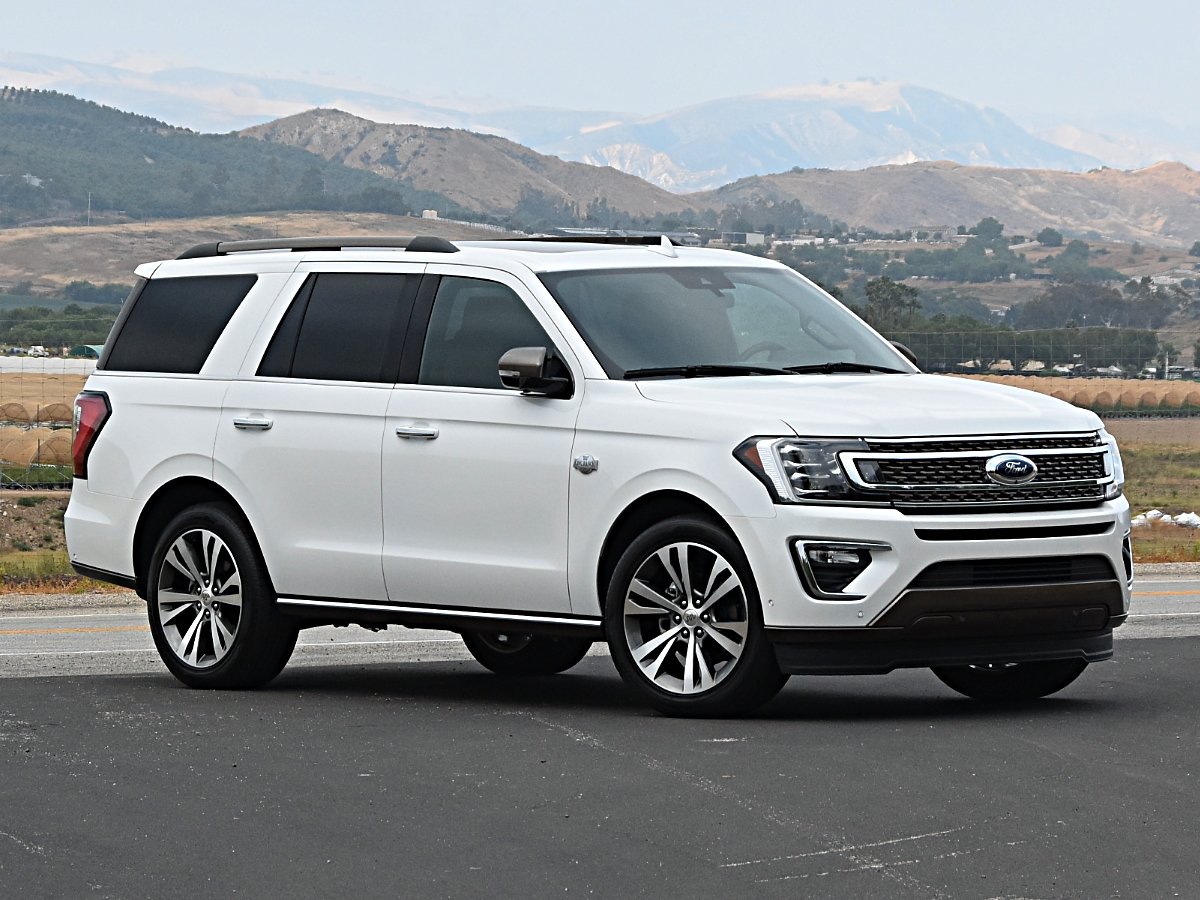
Named after the largest ranch in the U.S., the Ford Expedition King Ranch wears a handsome set of 22-inch aluminum wheels, a mesh grille insert, LED headlights, and exclusive gray-painted lower exterior trim. Special front fender emblems indicate the model’s special status within the Expedition lineup.
Dipped in Star White metallic paint, our test SUV looked terrific. It’s hard to fault this design, but I don’t like the shape of the taillights, and I think the roof C-pillar (the one behind the rear doors) should be painted black to give the roof more of a floating effect. But Lincoln uses that approach with the Navigator, which is based on the Expedition, so keeping that section body colour helps to differentiate the two models.
Inside, the Expedition King Ranch has special Del Rio leather in Mesa (brown) over Ebony, along with numerous King Ranch cattle-brand logos throughout. When my kids asked what the symbol was, my wife and I explained. And, well, they were horrified. But hey, they love hamburgers, so they’ll get over it.
As nice as the King Ranch’s cabin is, there is quite a bit of hard plastic in the Expedition, particularly in the lower-level Expedition XLT trim. Even at the SUV’s base price, this is hard to accept. When you’re spending upwards of $80,000, as you will on a King Ranch or the more conventionally luxurious Expedition Platinum trim level, it’s borderline offensive. Buying a Lincoln Navigator solves this problem to a large degree.
Performance
Every 2020 Expedition has a twin-turbocharged 3.5-litre EcoBoost V6 engine. While it lacks the rumble of a traditional V8, you cannot argue with the twin-turbo engine's power specs of 375 horsepower at 5,000 rpm and 470 pound-feet of torque at 2,250 rpm. And from the driver’s seat, when you accelerate, the 3.5-litre twin-turbo V6 offers a low chuffing exhaust note that is different and rather pleasant.
A 10-speed automatic transmission delivers the engine’s power to all four wheels in Canada via the Expedition’s standard four-wheel-drive (4WD) powertrain (the rear-wheel drive (RWD) configuration is not sold in our market). All Expeditions offer 24.9 centimetres of ground clearance except the MAX, which supplies 24.6 centimetres. All MAX versions have a towing capacity of 4,082 kilograms (9,000 pounds). The standard Expedition yanks 4,173 kilograms (9,200 pounds).
Driving the Ford Expedition is mostly pleasing. The twin-turbocharged engine supplies plenty of power, and this big 2,551-kilogram (5,624-pound) Ford accelerates with enthusiasm, the 10-speed automatic almost always finding the right gear at the right time.
With a surprisingly tight turning radius and easily modulated brakes, the Expedition feels unexpectedly agreeable to drive in urban environments. The steering is, however, slow, and it requires plenty of wheel work when parking or navigating tight quarters.
An adaptive damping suspension is standard on the King Ranch, and it does a fantastic job of quelling excessive ride motions. But it can struggle to filter impact harshness, which I attribute to the oversized 22-inch wheels and 285/45 tires. The ride is sometimes busy, especially on imperfect pavement.
Something that sets the Expedition apart from most other full-size SUVs is its independent rear suspension design. This helps to improve the ride and handling and also conserves interior space to provide more room for passengers and cargo. However, this Ford’s primary competitors from General Motors, the 2021 Chevrolet Tahoe and Suburban, and the 2021 GMC Yukon, are finally adopting this design, making it a much more competitive ballgame.
As far as fuel consumption is concerned, Natural Resources Canada says to expect an Expedition to burn 14.1 litres per 100 kilometres in city driving, 10.6 on the highway, and 12.5 combined. For the MAX, those figures climb to 14.7 L/100 km city, 11.2 hwy, and 13.1 combined.
Form & function
Ford Expeditions are made to tow, to carry cargo, and to haul people. At these things, it excels.
Pull an exterior door handle, and the King Ranch’s power running boards deploy, making it easy to step up and into the SUV. Once you’re aboard, every seat in the house is comfortable and accommodating. But this is especially true of the front seats, which are heated and ventilated in the Expedition King Ranch. The steering wheel is heated, too. Plus, from the dual glove compartment design to the huge bin under the centre armrest, the Expedition supplies tons of interior storage.
Equipped with heated second-row captain’s chairs, the King Ranch offers first-class accommodations for passengers. You can use the wide pass-through between them, or tilt and slide the seats in order to access the third-row bench.
Unlike most vehicles equipped with a third-row seat, including other full-size SUVs, the one in the Expedition is genuinely comfortable for adults. And they can ride back there for more than just a short trip, thanks to the impressive legroom. We’re talking all-day levels of room and support, underscoring just how significant Ford’s decision to use an independent rear suspension is and why Chevy and GMC are finally copying this approach with their redesigned 2021 full-size SUVs.
In the standard-length Expedition, this SUV offers 546 litres of cargo space behind the third-row seat, which isn’t much given the size of the vehicle. The long-wheelbase Ford Expedition MAX offers more, at 971 litres. But even that number merely matches what a Honda Odyssey offers behind its third-row seat. But then, a minivan can’t tow a Sea Ray SLX 280, can it?
Most of the time, you’ll keep the third-row seat folded down. That leaves you with 1,672 litres behind the second-row seats (2,075 with the MAX). Or, if you need as much room as the Expedition offers, fold the second row to create 2,962 litres (3,440 litres with the MAX).
Technology
In an SUV this big and expensive, a recessed 8-inch touchscreen infotainment system screen just isn’t cutting it. The Expedition needs the same 12-inch Sync 4 setup Ford just debuted for the redesigned 2021 F-150 pickup truck. However, since offering Sync 4 isn’t a simple plug-and-play proposition, the wait could be a while.
In any case, Sync 3 is easy to use, as long as you’re patient about waiting for it load and, on occasion, respond to input. The voice-recognition technology isn’t fully natural, but Ford makes it easier to use by recommending prompts. Besides, it comes with Bluetooth, Apple CarPlay, and Android Auto, letting you sidestep some of Sync 3’s shortcomings.
Other highlights include FordPass Connect with a 4G LTE WiFi hotspot, a navigation system, an available premium sound system from Bang & Olufsen, a rear-seat entertainment system with dual screens embedded into the front head restraints, and Pro Trailer Backup Assist.
The trailer technology is especially helpful if you plan to frequently tow. It provides a knob on the Expedition’s dashboard, which you turn in the direction you want the trailer to go. At the same time, the knob commands the SUV’s steering, which autonomously turns in the correct direction to reverse the trailer in the right direction.
Safety
Vehicle weight is a major contributor to crash safety. The bigger and heavier your vehicle is, the more likely it will protect you in a collision with smaller vehicles. And when it comes to the Expedition, almost everything else on the road is smaller.
But, with the decision to drive a heavy full-size SUV comes a responsibility to your fellow motorists. As an Expedition driver, you must take extra care to ensure that you’re not the cause of an accident.
To that end, the Expedition receives Ford Co-Pilot360, a collection of safety features and advanced driving assistance systems (ADAS), as standard features. They include forward collision warning, automatic emergency braking, blind-spot warning, rear cross-traffic warning, lane-departure warning, and lane-keeping assistance. Adaptive cruise control with stop-and-go capability is optional.
During my testing, I found the ADAS to work well. Smooth, accurate, and subtle, the technology rarely aggravates a driver enough to turn it off. It was, however, sometimes hard to tell the difference between the lane departure warning vibration through the steering wheel and vibration from the road surface.
In crash tests conducted by the National Highway Traffic Safety Administration (NHTSA), the Expedition earns 5-star ratings in every test plus a 4-star rollover resistance rating. The Insurance Institute for Highway Safety (IIHS) had not tested the Expedition as this review was published.
Cost-effectiveness
With upper-level MSRPs, full-size SUVs are expensive to buy, and thanks to poor fuel efficiency, they’re expensive to own. If you don’t tow something heavy on a regular basis, they are not cost-effective choices in transportation.
You may hate hearing this, but if towing is off of the table, a minivan is the better bet than a large SUV. Minivans offer tens of thousands of dollars worth of savings in terms of the purchase price, and they’re simply not as expensive to keep on the road in terms of operation and maintenance costs. The saving grace of a full-size SUV is that the underlying engineering is typically more robust than that of a minivan, and these kinds of SUVs often remain on the road for decades.
Among its direct large three-row SUV competitors, the Ford Expedition is not the most affordable vehicle you can buy. But, for now, it is the best. And the best of anything usually comes at a premium.
Note: Images show a US model.

What owners say
"Overall, owners are very happy with the 2020 Ford Expedition, appreciating its spaciousness and luxurious feel, making it ideal for families. Many love the powerful engine and advanced features. However, some drivers noted that the vehicle can be a bit pricey and expected slightly better gas mileage."
Great space for a large family. Great options and ride.
January 19, 2026I had a 2016 Expedition and loved it this one has more of a round shape to it but still has everything I was looking for an big enough for my big family
April 27, 2025Value is good. Transmission doesn’t invoke a great deal of confidence.
September 9, 2025What owners say
Great space for a large family. Great options and ride.
January 19, 2026I had a 2016 Expedition and loved it this one has more of a round shape to it but still has everything I was looking for an big enough for my big family
April 27, 2025Value is good. Transmission doesn’t invoke a great deal of confidence.
September 9, 2025I love everything about it! The way it drives and technology are fantastic!
October 23, 2021Love my expedition! Luxurious, spacious and drives like a dream.
April 29, 2021Great truck for a larger family and smooth comfortable ride. It would be difficult to find another 8 passenger vehicle that has all the features and comfort for this many passengers. Even the third row seat reclines!
June 26, 2022Great family ride !!! Tows like crazy ! Looooottttttsss of room. Smoother and quieter than expected. Only negative is I Was hoping for a little better avg mileage per gal.
May 11, 2022Amazing car!!! So much room, we upgraded from a Ford Explorer which is another great vehicle, but our 10 yr son is growing and our nephews (15 & 14 are 6ft o-line & DT football players) and they didnt have any leg room. The features on this vehicle are amazing. We fit and have plenty of room! We travel so nice and comfortable. The gas mileage is great for being such a huge vehicle. The turn radius is awesome, we fit anywhere.
December 30, 2022This car is excellent from top to bottom I would compare it to GMC Yukon
December 1, 2021Missing front camera and side camera and some future
February 5, 2023Trims & specs
Base MSRP $55,820 | Seating 8 |
Engine 3.5L 375 hp V6 | Cargo Capacity 20.9 cu ft |
Combined MPG 19 | Drivetrain 4X4 |
Base MSRP $51,990 | Seating 8 |
Engine 3.5L 375 hp V6 | Cargo Capacity 20.9 cu ft |
Combined MPG 19 | Drivetrain 4X4 |
Base MSRP $73,935 | Seating 8 |
Engine 3.5L 400 hp V6 | Cargo Capacity 20.9 cu ft |
Combined MPG 20 | Drivetrain 4X2 |
Base MSRP $78,715 | Seating 7 |
Engine 3.5L 375 hp V6 | Cargo Capacity 36.0 cu ft |
Combined MPG 18 | Drivetrain 4X4 |
Base MSRP $53,025 | Seating 8 |
Engine 3.5L 375 hp V6 | Cargo Capacity 36.0 cu ft |
Combined MPG 20 | Drivetrain 4X2 |
Base MSRP $56,035 | Seating 8 |
Engine 3.5L 375 hp V6 | Cargo Capacity 36.0 cu ft |
Combined MPG 18 | Drivetrain 4X4 |
Base MSRP $48,990 | Seating 8 |
Engine 3.5L 375 hp V6 | Cargo Capacity 20.9 cu ft |
Combined MPG 20 | Drivetrain 4X2 |
Base MSRP $52,810 | Seating 8 |
Engine 3.5L 375 hp V6 | Cargo Capacity 20.9 cu ft |
Combined MPG 20 | Drivetrain 4X2 |
Base MSRP $75,590 | Seating 7 |
Engine 3.5L 375 hp V6 | Cargo Capacity 36.0 cu ft |
Combined MPG 20 | Drivetrain 4X2 |
Base MSRP $66,375 | Seating 8 |
Engine 3.5L 375 hp V6 | Cargo Capacity 36.0 cu ft |
Combined MPG 20 | Drivetrain 4X2 |
Base MSRP $69,495 | Seating 8 |
Engine 3.5L 375 hp V6 | Cargo Capacity 36.0 cu ft |
Combined MPG 18 | Drivetrain 4X4 |
Base MSRP $76,965 | Seating 8 |
Engine 3.5L 400 hp V6 | Cargo Capacity 36.0 cu ft |
Combined MPG 20 | Drivetrain 4X2 |
Base MSRP $80,110 | Seating 8 |
Engine 3.5L 400 hp V6 | Cargo Capacity 36.0 cu ft |
Combined MPG 18 | Drivetrain 4X4 |
Base MSRP $66,470 | Seating 8 |
Engine 3.5L 375 hp V6 | Cargo Capacity 20.9 cu ft |
Combined MPG 19 | Drivetrain 4X4 |
Base MSRP $55,835 | Seating 8 |
Engine 3.5L 375 hp V6 | Cargo Capacity 36.0 cu ft |
Combined MPG 20 | Drivetrain 4X2 |
Base MSRP $58,845 | Seating 8 |
Engine 3.5L 375 hp V6 | Cargo Capacity 36.0 cu ft |
Combined MPG 18 | Drivetrain 4X4 |
Base MSRP $77,085 | Seating 8 |
Engine 3.5L 400 hp V6 | Cargo Capacity 20.9 cu ft |
Combined MPG 19 | Drivetrain 4X4 |
Base MSRP $72,895 | Seating 7 |
Engine 3.5L 375 hp V6 | Cargo Capacity 20.9 cu ft |
Combined MPG 20 | Drivetrain 4X2 |
Base MSRP $63,345 | Seating 8 |
Engine 3.5L 375 hp V6 | Cargo Capacity 20.9 cu ft |
Combined MPG 20 | Drivetrain 4X2 |
Base MSRP $76,025 | Seating 7 |
Engine 3.5L 375 hp V6 | Cargo Capacity 20.9 cu ft |
Combined MPG 19 | Drivetrain 4X4 |


Pricing trends
MSRP range
$48,990 - $80,110
Current avg. market price
$38,939
Trending down by 1.5% this month
May 2026 - October 2026

