2025 Ford Expedition Reviews, Pricing & Specs


Pros & cons
What we like
Powerful engines
Impressive technology
What to consider
Thirsty engines
Tech requires additional subscription
The CarGurus verdict
Now in its fifth generation, the 2025 Ford Expedition upgrades its tech and adds an off-road-focused Tremor trim level.
The Ford Expedition isn’t for everyone, but for shoppers who need a combination of interior space and powerful towing capability, it’s one of only a few quality options on the current market. All-new for the 2025 model year, the Expedition retains subdued styling on the outside, but its tech-forward interior looks impressively futuristic. The addition of the new-for-2025 Ford Expedition Tremor means the Expedition is now prepared to travel further off-road than any before.
Verdict: The Tremor is undeniably cool, and for such a large vehicle, the Expedition is surprisingly easy to drive in everyday circumstances. With a starting price just over $82,000 before fees in Canada (or $85K for a Ford Expedition MAX), there’s no disputing that Ford’s selling an expensive vehicle. However, both the Expedition and Expedition MAX offer a ton of standard equipment, and given their capability, both are priced in line with the Chevrolet Tahoe and Chevrolet Suburban.
out of 10 expert review
Look & feel
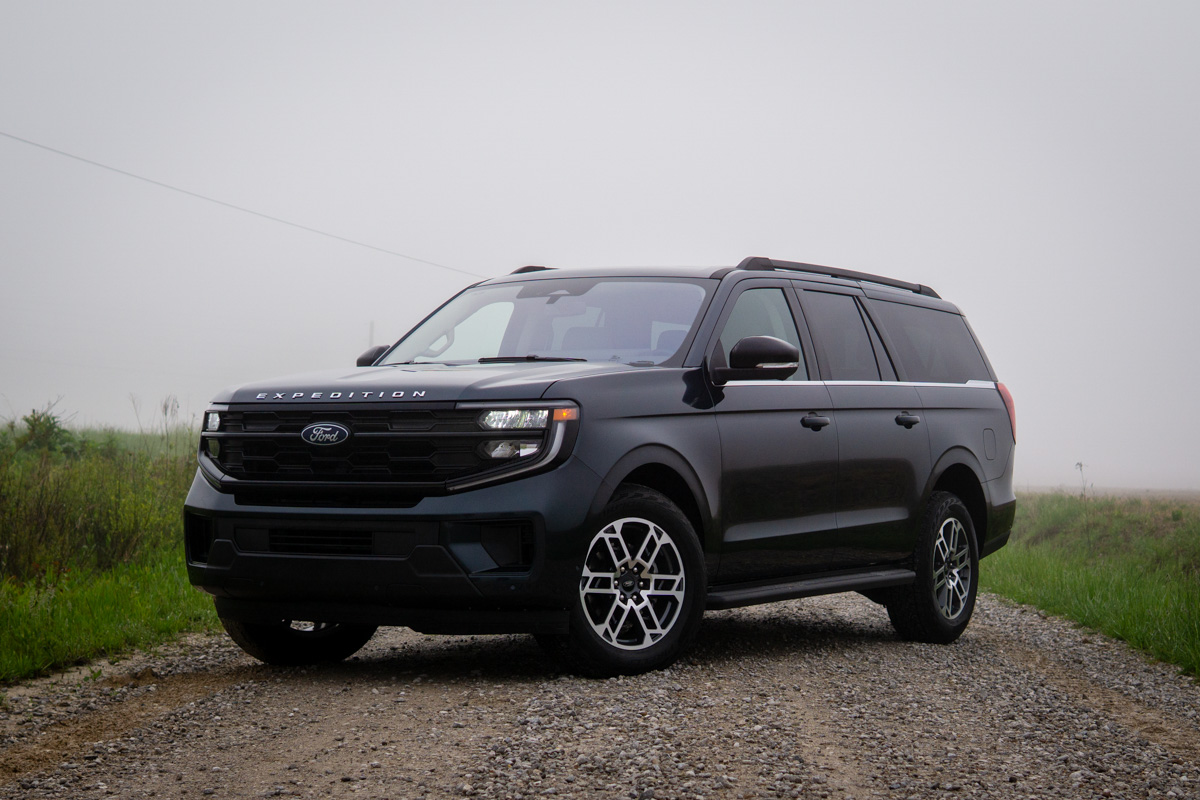
Take a look at a modern school bus. With a long, rectangular body trailing a squared-off nose, it's a design that tackles function first, form second. The goal: transport many people and their belongings. Now, take a look at the 2025 Ford Expedition. Although undeniably more attractive than a big yellow school bus, the form-over-function ethos is on display here, too. With slab sides and a big, rectilinear silhouette, the Expedition doesn’t compromise on headroom, legroom, shoulder room, or any other -room in its transportative mission. One look and it’s clear this is a vehicle designed for taking people places.
That isn’t to say Ford’s designers threw styling out the window, however. Horseshoe-shaped daytime running lights (DRLs) frame the Expedition’s bold grille, which itself appears to span the entire width of the fascia. Integrated headlights and, on Tremor trim levels, integrated off-roading lamps further add to this full-width appearance.
Blacked-out B-, C-, and D-pillars add a wraparound look to the Expedition’s glass, but otherwise the profile view is relatively simple. A distinct character line sits just above the door handles and runs from the edge of the headlights to nearly the taillights. Shoppers can choose between a range of wheel designs and sizes from 18 to 24 inches depending on the trim level selected. At the rear, thanks to a black tailgate, the Expedition sports a two-tone paint job on all but Agate Black Metallic versions.
The tailgate itself is one major change for 2025. As part of the generational redesign, Ford has swapped in a split-gate in place of the outgoing Expedition’s traditional liftgate. The new design has a few benefits. For one, it means luggage won’t come spilling out if you open only the top portion. For another, it makes for a great place to sit and rest when parked.
Ford sells the 2025 Expedition in four trim levels: Active, Platinum, Tremor, and King Ranch. There are also two lengths available. The standard Expedition stretches 5,331 millimetres on a 3,112 mm wheelbase, while the Expedition MAX is 5,631 mm long and has a 3,340 mm wheelbase. Legroom is the same in both the second row and the third row, but the MAX offers significantly more cargo space.
We tested the top-level King Ranch trim and the entry-level Active trim for this review, and we sampled the new Tremor on an off-road course. While the King Ranch did boast significantly nicer materials and impressive Del Rio leather seating, the Active trim nonetheless impressed us with its ActiveX synthetic leather upholstery. Further, the Active trim comes standard with niceties we’d typically expect on mid-level or higher trims: tri-zone automatic climate control, power-folding rear seats, and most notably, the 24-inch panoramic driver information display.
We’ll get into the big info display and the (slightly) smaller infotainment touchscreen later in this review, but it’s worth noting these interior centrepieces give every Expedition a futuristic and button-light design. For a vehicle this big, the interior feels astoundingly minimalist.

Performance
Shoppers who demand a V8 engine in their full-size SUV should drive an Expedition and reconsider. Every 2025 Ford Expedition comes with a twin-turbocharged “EcoBoost” 3.5-litre V6 engine. The standard engine churns out 400 horsepower and 480 lb-ft of torque, but the new Tremor trim comes standard with a high-output version of this engine, boosting it to 440 horsepower and 510 lb-ft of torque.
We evaluated the standard engine in two Expedition MAX models during our on-road driving. Despite the vehicle’s 2,628-kilogram (5,794-pound) curb weight, the powertrain had no problem bringing us up to highway speed. In fact, the Expedition feels particularly well-suited for long highway drives. It’s comfortable and quiet enough that those in the front seats can converse with third-row passengers. It’s also easy to set the cruise control and burn through highway klicks in this vehicle. We spent roughly three hours on the highway and neither hill nor dale could slow down the Expedition’s progress.
It’s easy to look at the Expedition or Expedition MAX and assume it’s going to be a nightmare to drive in the city, yet the big SUV is astoundingly easy to maneuver on narrow roads, too. Ford’s ten-speed automatic transmission handles shifts quietly and accurately, and the multi-link rear suspension never felt unsettled when traversing rough or broken pavement. The brakes also instill confidence, although the laws of physics are not to be trifled with. Bringing that much weight to a complete stop will take some distance, no matter how stout the brake pedal feels.
The Tremor replaces the outgoing Expedition’s Timberline trim. It boosts ground clearance from 22 centimetres to 26.9 cm and improves the approach, departure, and breakover angles to 28.2, 24.3, and 22.4 degrees, respectively. In Canada, four-wheel drive (4WD) is standard on all 2025 Expedition trims.
In addition to the increased ground clearance, standard 4WD, and high-output engine, the Tremor gets a few other performance modifications. 33-inch all-terrain tires wrap 18-inch aluminum wheels, skid plates protect the front end, transmission, and fuel tank, and an electronic locking rear axle also comes standard. We tested the Tremor on an off-road course that, under normal conditions, likely wouldn’t have challenged most rugged SUVs. However, after heavy rain, the course was extremely slick with multiple deep-water sections. In these conditions, the Tremor’s drivetrain and tires combined for excellent traction, and the added ground clearance helped us navigate large rocks and blind water crossings. Ultimately, the Expedition Tremor isn’t an ideal vehicle for hardcore off-roading purely due to its size. However, shoppers who need a full-size SUV that can get their big family (and maybe their big boat) to a remote campsite will be well served by this latest Ford.
There is one undeniable downside to the Expedition’s mass and power. Fuel economy is terrible, with the Natural Resources Canada rating it at 15.4 litres per 100 kilometres in the city, 10.7 on the highway, and 13.3 in combined driving. In our test, which included a long stretch of highway driving, we saw 17.0 L/100 km from a King Ranch model.
In a vacuum, these figures are understandable, if not quite defensible. However, the Expedition doesn’t live in a vacuum. Its stiffest competition, the Chevrolet Tahoe and Chevrolet Suburban, both are available with a diesel engine that returns 11.5 L/100 km city, 9.7 highway, and 10.7 in combined driving. When we tested the Tahoe, we found that diesel engine to be a torquey delight, too, and one of the chief reasons to test drive a Chevy alongside the 2025 Expedition.

Form & function
Of course, if maximum trailering is your objective, the Tahoe can’t hold a candle to the redesigned Expedition. Although Chevy’s 3,810-kilogram (8,400-pound) maximum towing capacity is commendable, the new Expedition tops out at 4,350 kilograms (9,600 pounds). Even when not equipped with a weight-distributing hitch, it can still tow an impressive 3,175 kilograms (7,000 pounds). Better yet, all Expeditions sold in Canada include an integrated trailer brake controller, upsized radiator, and a two-speed automatic 4WD transfer case.
Inside, the Expedition will likely swallow all the luggage you have to give it. 611 litres behind the third row in the standard Expedition expands to 1,022 litres in the Expedition Max. Fold the third row down, and the max numbers increase to 1,979 and 2,392 litres, respectively. And, with all rear seats down, the Expedition offers 3,072 litres, and the Expedition MAX provides 3,485 litres. While this is a capacious SUV, the Expedition still isn’t quite as spacious on the inside as the Chevrolet Tahoe, nor is the Expedition MAX as spacious as the Chevrolet Suburban.
In terms of layout and common touchpoints, some shoppers will love Ford’s minimalist interior design. Others, likely, will not love it. In place of physical buttons on the steering wheel, the Expedition uses two touch-sensitive trackpads that map to a portion of the driver information display. It won’t take long to get comfortable using it, but it’s admittedly a bit more high-tech than we were expecting from this hulking SUV. Likewise, the climate controls are housed in the touchscreen, and even the headlights require a few finger taps on the display. Luckily, the headlights default to their “auto” setting and functions like auto stop/start and vehicle hold will stay engaged if selected, even after the car has been turned off and restarted.

Technology
The 24-inch driver information display is the most groundbreaking feature in the 2025 Ford Expedition. It displays all the standard fare such as speed, odometer, and the like, but it also features enough automotive real estate to include a Google Maps projection to the right-hand side, and a selectable widget in the middle (we went with a simple trip computer). To keep the driver information display visible above the steering wheel, Ford did have to eschew the traditional steering wheel shape (you know, a circle) for something, well, odd. Instead of being round, the wheel has a flattened profile. Ford calls it a squircle — a combination of square and circle — but we call it awkward.
Not to be outdone, the 13.2-inch touchscreen display centred on the dash is also an impressive bit of tech. Using a Google-based operating system, it features built-in Google Maps, Google Assistant, and the Google Play store. Dubbed the Ford Digital Experience, the tech works brilliantly, although operating it properly also requires an active cellular data plan. The data plan element is called the Ford Connectivity Package and buyers receive one year of complimentary access, followed by either an annual subscription costing $199.95 in Canada, or a one-time purchase cost of $995 (prices are as of this writing). Without the Ford Connectivity Package, this brilliant tech is severely hampered, so either budget for the subscription or plan on sticking with wireless Android Auto or Apple CarPlay projection.

Safety
The National Highway Traffic Safety Administration (NHTSA) has not yet rated the 2025 Ford Expedition. While the Insurance Institute for Highway Safety (IIHS) has applied their rating to the 2025 model, the actual crash testing was performed on a previous-generation 2023 model. The 2023 Expedition received only Moderate scores in the small overlap front and updated moderate overlap front tests (Good scores in all other evaluations), but these may not be indicative of the updated Expedition’s crashworthiness.
Although up-to-date crash tests are not available, the Expedition does come with an impressive suite of standard safety features. Automatic emergency braking, lane-keeping assist, and adaptive cruise control are to be expected on a modern SUV, but we’re also happy to see features like a 360-degree camera, blind-spot monitoring, and rear cross-traffic alerts standard, as those are particularly helpful when maneuvering a big vehicle. Additionally, Ford includes its Pro-Trailer Hitch Assist and Pro-Trailer Backup Assist on every Expedition.
BlueCruise 1.4 (the latest iteration) is also available on all trim levels. A 90-day trial is also included, although after that period, BlueCruise will require a $64.99 monthly subscription, a $650 annual subscription, or a $3,295 one-time cost at the time of purchase of the vehicle. (Canadian pricing is current as of this writing but subject to change.) Whether the hands-free driving tech is worth that price is up for debate, but the technology’s capabilities are well vetted at this point. In our testing, BlueCruise handled more than 150 kilometres of continuous highway driving with nary a fault.

Cost-effectiveness
The 2025 Ford Expedition (and MAX) arrives in Canada with a higher starting price than the 2025 Chevrolet Tahoe (and Suburban) at $84,815, including a $2,595 destination charge and other fees. However, the Chevy Tahoe’s base LS trim level ($79,933) is not nearly as well equipped as the Expedition Active, nor does it come with standard 4WD. An LT trim ($87,433) is more in-line with Ford’s least-expensive offering. That parity is consistent up the trim ladder.
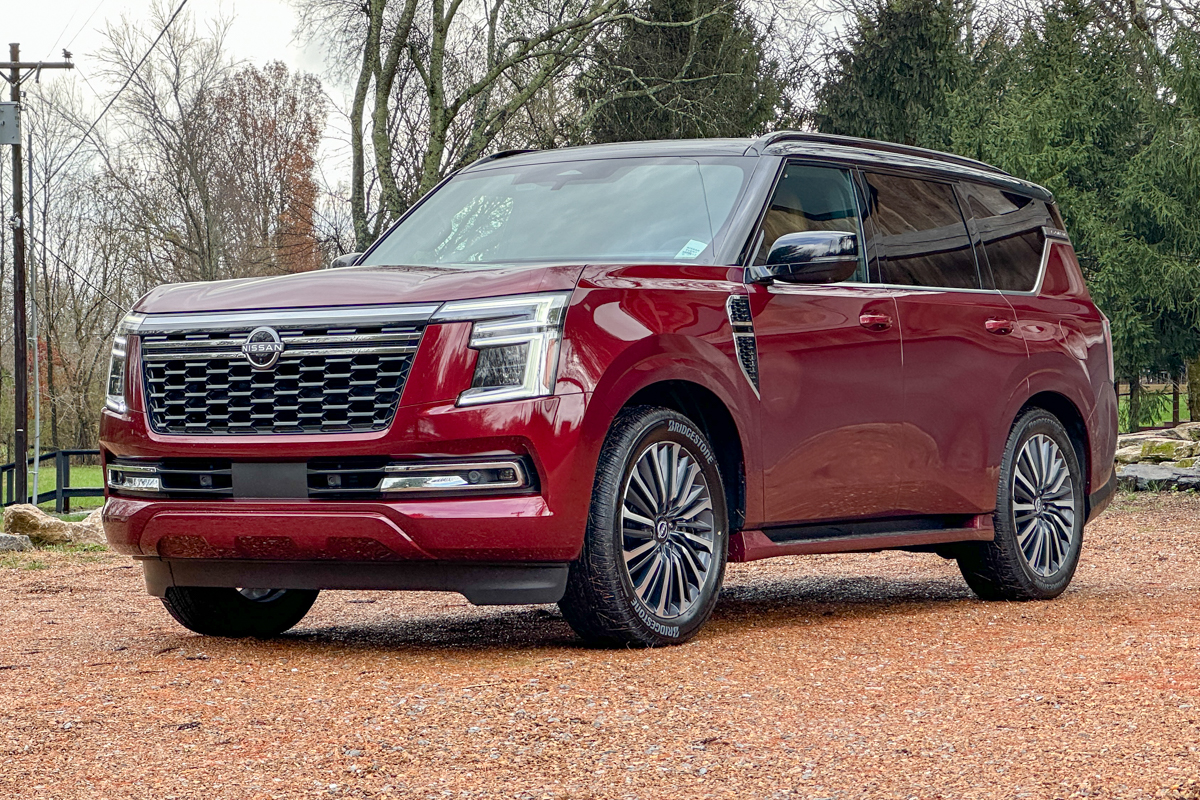
Also in the same ballpark are the Nissan Armada ($87,850), the Toyota Sequoia ($87,174), the Jeep Wagoneer ($83,026) and the GMC Yukon ($95,433).
Truthfully, a starting price tag north of $80,000 will make many eyes water, and a fully loaded price just shy of $110,000 (arguably homing in on the $128,695 Lincoln Navigator) may escalate those teary eyes to full-on weeping. Yet when considering the Expedition’s stout capability and undeniable practicality, the price is very much in line with the rest of the market.
Note: Images show a US model.


What owners say
Great vehicle! Perfect family vehicle and great to travel long distances with plenty of space
January 1, 2026I compared this to the Tahoe, Navigator and Sequoia. I chose the Expedition for the rugged ability to tow, 4x4, and yet luxury of great suspension and decent gas mileage for size. The new 2025 dash is amazing. The 2026 packages are changing so I needed to purchase in 2025 to get all the stealth options , retractable running boards and avoid the increase in pricing.
November 7, 2025Unbelievable amount of tech for the price and lots of room too.
April 19, 2026Trims & specs
Base MSRP $84,000 | Seating 7 |
Engine 3.5L 400 hp V6 | Cargo Capacity 21.6 cu ft |
Combined MPG 18 | Drivetrain 4X4 |
Base MSRP $62,400 | Seating 8 |
Engine 3.5L 400 hp V6 | Cargo Capacity 21.6 cu ft |
Combined MPG 20 | Drivetrain 4X2 |
Base MSRP $65,400 | Seating 8 |
Engine 3.5L 400 hp V6 | Cargo Capacity 21.6 cu ft |
Combined MPG 18 | Drivetrain 4X4 |
Base MSRP $68,400 | Seating 8 |
Engine N/A | Cargo Capacity 36.1 cu ft |
Combined MPG N/A | Drivetrain N/A |
Base MSRP $65,400 | Seating 8 |
Engine 3.5L 400 hp V6 | Cargo Capacity 36.1 cu ft |
Combined MPG 20 | Drivetrain 4X2 |
Base MSRP $74,850 | Seating 8 |
Engine 3.5L 400 hp V6 | Cargo Capacity 21.6 cu ft |
Combined MPG 18 | Drivetrain 4X4 |
Base MSRP $81,350 | Seating 8 |
Engine 3.5L 440 hp V6 | Cargo Capacity 21.6 cu ft |
Combined MPG 18 | Drivetrain 4X4 |
Base MSRP $87,000 | Seating 7 |
Engine N/A | Cargo Capacity 36.1 cu ft |
Combined MPG N/A | Drivetrain N/A |
Base MSRP $61,525 | Seating 8 |
Engine N/A | Cargo Capacity 36.1 cu ft |
Combined MPG N/A | Drivetrain N/A |
Base MSRP $57,400 | Seating 5 |
Engine 3.5L 400 hp V6 | Cargo Capacity 21.6 cu ft |
Combined MPG 18 | Drivetrain 4X4 |
Base MSRP $77,850 | Seating 8 |
Engine N/A | Cargo Capacity 36.1 cu ft |
Combined MPG N/A | Drivetrain N/A |


Pricing trends
MSRP range
$57,400 - $87,000
Current avg. market price
$88,514
Trending down by 0.2% this month
May 2026 - November 2026