2026 Toyota bZ vs 2026 Honda HR-V
Overview | |
Listings98 | Listings47 |
Ratings & Reviews | |
User Reviews | User Reviews |
Expert reviews5.3 out of 10 | Expert reviews6.5 out of 10 |
Pros
Cons
| Pros
Cons
|
2026 Honda HR-V Reviews SummaryAvailable in three trim levels equipped with an underpowered engine and optional all-wheel drive (AWD), the HR-V is an unremarkable subcompact SUV. A refresh for the 2026 model year adds an improved standard infotainment system and minor styling and interior modifications, but nothing that addresses this model’s primary shortcomings. The changes include a larger touchscreen with faster response times, wireless Apple CarPlay and Android Auto, and wireless smartphone charging. Verdict: Simply put, the 2026 Honda HR-V is not one of the best subcompact SUVs. It is dreadfully slow and disappointingly inefficient, and it barely meets the minimum technological expectations of the young people who might want to buy it. Plus, it demonstrates none of the innovation seen in the original HR-V and in some competitors in the small SUV segment. | |
2026 Toyota bZ Reviews SummaryReaders are looking at the electric vehicle formerly known as the bZ4X. It wears a shorter name for 2026, but that’s not the big news. More power, up to 468 kilometres of range, a standard NACS charging port (with a CCS adapter), and Plug & Charge capability are all major improvements. Toyota has also tidied up the styling inside and out and added a larger infotainment screen. Verdict: With the refreshed 2026 bZ, Toyota has fixed the bZ4X’s most significant flaws, making this a genuinely competitive model at a comparatively affordable price. | |
No video found | No video found |
Popular Features & Specs | |
Engine2.0L 158 hp I4 | Engine168 hp Electric |
DrivetrainFWD | DrivetrainFWD |
Seating Capacity5 | Seating Capacity5 |
Horsepower158 hp @ 6500 rpm | Horsepower |
EV Battery Capacity | EV Battery Capacity57.7 kWh |
Fuel Economy (City)9.0 L(e)/100 km | Fuel Economy (City)1.6 L(e)/100 km |
Fuel Economy (Highway)7.4 L(e)/100 km | Fuel Economy (Highway)2.0 L(e)/100 km |
Battery Charge Time (240V) | Battery Charge Time (240V)6 hours |
Engine | |
Engine Name2.0L 158 hp I4 | Engine Name168 hp Electric |
Torque138 lb-ft @ 4200 rpm | Torque |
Horsepower158 hp @ 6500 rpm | Horsepower |
Battery Charge Time (240V) | Battery Charge Time (240V)6 hours |
DrivetrainFWD | DrivetrainFWD |
Fuel Economy | |
EV Battery Capacity | EV Battery Capacity57.7 kWh |
Fuel Economy (City)9.0 L(e)/100 km | Fuel Economy (City)1.6 L(e)/100 km |
Fuel Economy (Highway)7.4 L(e)/100 km | Fuel Economy (Highway)2.0 L(e)/100 km |
Interior | |
Seating Capacity5 | Seating Capacity5 |
Key Features | |
Navigation System | Navigation SystemOptional |
Safety | |
Front Crash Overall5 | Front Crash Overall4 |
Side Crash Overall5 | Side Crash Overall5 |
Dimensions & Capacity | |
Cargo Space691 L | Cargo Space784 L |
Curb Weight1433 kg | Curb Weight1840 kg |
Height1610 mm | Height1651 mm |
Length4567 mm | Length4689 mm |
Width1839 mm | Width1859 mm |
Wheelbase2654 mm | Wheelbase2850 mm |
Maximum Payload477 kg | Maximum Payload474 kg |
Number of doors4 | Number of doors4 |
Overview | ||
Listings | ||
Ratings & Reviews | ||
User reviews | ||
Expert reviews | 5.3 out of 10Read full review | 6.5 out of 10Read full review |
Pros & cons | Pros
Cons
| Pros
Cons
|
Summary | Available in three trim levels equipped with an underpowered engine and optional all-wheel drive (AWD), the HR-V is an unremarkable subcompact SUV. A refresh for the 2026 model year adds an improved standard infotainment system and minor styling and interior modifications, but nothing that addresses this model’s primary shortcomings. The changes include a larger touchscreen with faster response times, wireless Apple CarPlay and Android Auto, and wireless smartphone charging. Verdict: Simply put, the 2026 Honda HR-V is not one of the best subcompact SUVs. It is dreadfully slow and disappointingly inefficient, and it barely meets the minimum technological expectations of the young people who might want to buy it. Plus, it demonstrates none of the innovation seen in the original HR-V and in some competitors in the small SUV segment. | Readers are looking at the electric vehicle formerly known as the bZ4X. It wears a shorter name for 2026, but that’s not the big news. More power, up to 468 kilometres of range, a standard NACS charging port (with a CCS adapter), and Plug & Charge capability are all major improvements. Toyota has also tidied up the styling inside and out and added a larger infotainment screen. Verdict: With the refreshed 2026 bZ, Toyota has fixed the bZ4X’s most significant flaws, making this a genuinely competitive model at a comparatively affordable price. |
Video | No video found | No video found |
Popular Features & Specs | ||
Engine | 2.0L 158 hp I4 | 168 hp Electric |
Drivetrain | FWD | FWD |
Seating Capacity | 5 | 5 |
Horsepower | 158 hp @ 6500 rpm | |
EV Battery Capacity | 57.7 kWh | |
Fuel Economy (City) | 9.0 L(e)/100 km | 1.6 L(e)/100 km |
Fuel Economy (Highway) | 7.4 L(e)/100 km | 2.0 L(e)/100 km |
Battery Charge Time (240V) | 6 hours | |
Engine | ||
Engine Name | 2.0L 158 hp I4 | 168 hp Electric |
Torque | 138 lb-ft @ 4200 rpm | |
Horsepower | 158 hp @ 6500 rpm | |
Battery Charge Time (240V) | 6 hours | |
Drivetrain | FWD | FWD |
Fuel Economy | ||
EV Battery Capacity | 57.7 kWh | |
Fuel Economy (City) | 9.0 L(e)/100 km | 1.6 L(e)/100 km |
Fuel Economy (Highway) | 7.4 L(e)/100 km | 2.0 L(e)/100 km |
Interior | ||
Seating Capacity | 5 | 5 |
Key Features | ||
Navigation System | Optional | |
Safety | ||
Front Crash Overall | 5 | 4 |
Side Crash Overall | 5 | 5 |
Dimensions & Capacity | ||
Cargo Space | 691 L | 784 L |
Curb Weight | 1433 kg | 1840 kg |
Height | 1610 mm | 1651 mm |
Length | 4567 mm | 4689 mm |
Width | 1839 mm | 1859 mm |
Wheelbase | 2654 mm | 2850 mm |
Maximum Payload | 477 kg | 474 kg |
Number of doors | 4 | 4 |
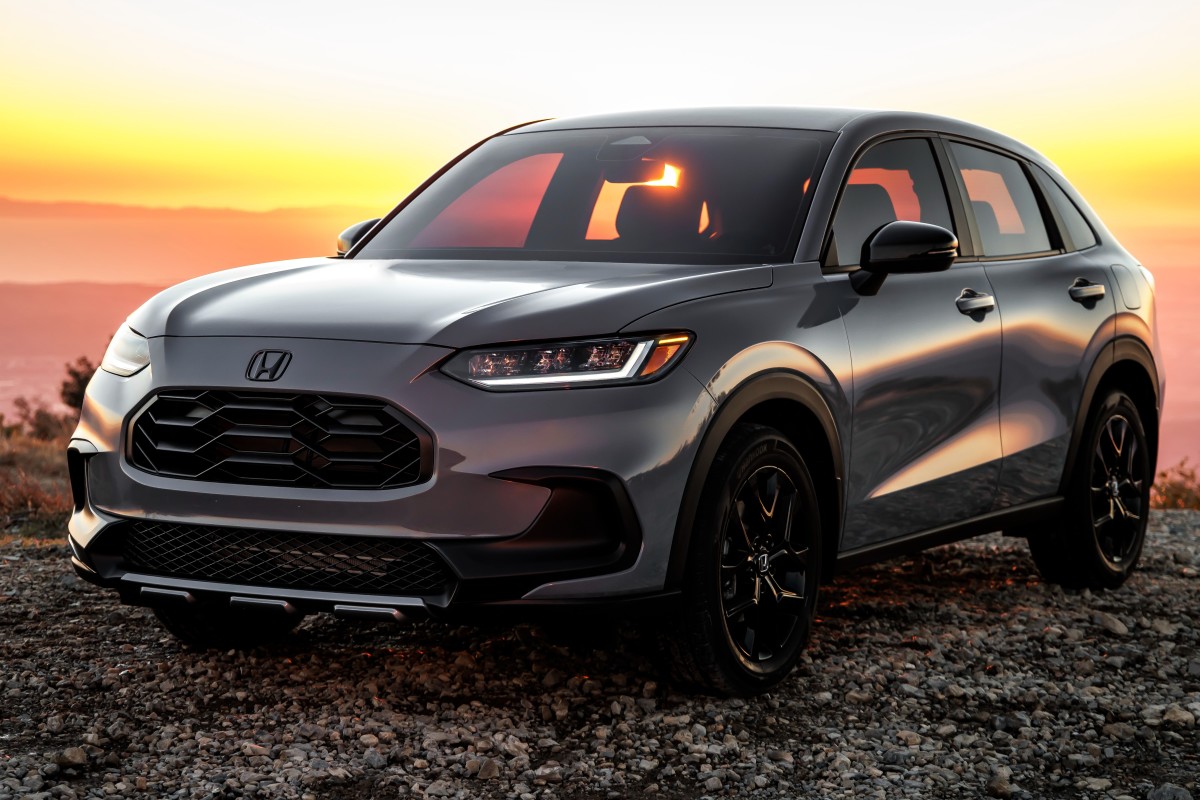
The 2026 Honda HR-V was available in three trim levels: LX, Sport, and EX-L, with Canadian pricing ranging from $33,446 to $41,846, including a $2,000 destination charge. The EX-L trim, which we tested, featured a striking Nordic Forest Pearl paint and 18-inch alloy wheels, giving it a more refined appearance despite its unconventional design. The HR-V's styling updates included new wheel designs across all trims and additional paint colours, enhancing its overall aesthetic appeal. Inside, the HR-V's cabin was upgraded with grey upholstery and trim in the EX-L, offering a more upscale feel. The interior featured genuine leather seats with perforated surfaces and Z-pattern stitching, along with improved cabin lighting and detailing.
In contrast, the 2026 Toyota bZ was offered in XLE and Limited trims, with options for single-motor FWD or dual-motor AWD and two battery sizes. Canadian prices ranged from $47,920 to $63,620, with the XLE trims qualifying for a $5,000 EV rebate. The bZ's exterior design was improved with body-colour trim, giving it a more appealing look. Inside, the dashboard and centre console were redesigned for a cleaner appearance, and the XLE's fabric seats featured an upscale pattern. The bZ's interior boasted a larger 14-inch touchscreen integrated with climate controls, although the digital instrument cluster's placement and readability were less than ideal.
The 2026 Honda HR-V was powered by a 2.0-litre four-cylinder engine producing 158 horsepower and 138 pound-feet of torque. Despite its modest power, the HR-V's continuously variable transmission (CVT) managed urban driving well but struggled with acceleration on highways and steep grades. The HR-V's fuel economy was rated at 8.3 L/100 km for FWD and 8.7 L/100 km for AWD, but real-world testing showed an average of 9.5 L/100 km. The HR-V's dynamic tuning was commendable, with a multi-link rear suspension and Agile Handling Assist providing a lively driving experience. However, the lack of turbocharging limited its performance potential.
The 2026 Toyota bZ offered a choice between a single electric motor with a 57.7-kWh battery or dual motors with a 74.7-kWh battery. The FWD model delivered 168 horsepower and 198 pound-feet of torque, with a range of 380 kilometres and an efficiency rating of 16.1 kWh/100 km. The AWD version produced 338 horsepower and offered a range of up to 468 kilometres. The bZ's charging capabilities included compatibility with Tesla Superchargers and a CCS adapter for versatile charging options. Efficiency tests showed the FWD bZ achieving 13.7 kWh/100 km in Eco mode and 15.9 kWh/100 km in Normal mode. The bZ's instant torque provided quick acceleration, but its handling was less suited for spirited driving due to its all-season tires and lifeless steering.
The 2026 Honda HR-V's interior lacked the innovation of its predecessor, with a standard rear seat that folded flat but no longer offered the versatile "Magic Seat" configuration. The HR-V's cargo space was practical, with 691 litres behind the rear seats and 1,559 litres with them folded. However, it lacked features like a fold-flat front passenger seat, panoramic sunroof, and rear climate control vents. The front seats were comfortable, with the EX-L offering eight-way power adjustment, but the rear seats were less accommodating, lacking support and amenities.
The 2026 Toyota bZ, built on a skateboard-style EV platform, offered easy access with its elevated ground clearance. The front seats featured standard height adjustment, with eight-way power adjustment available in both trims. The bZ's interior included heated front seats, a heated steering wheel, and ample storage options, though it lacked a traditional glove compartment. Rear passengers enjoyed generous legroom and standard air conditioning vents and USB ports. The bZ's cargo space measured 784 litres, expandable to 1,611 litres with the rear seats folded, though the sloped rear window limited maximum capacity.
The 2026 Honda HR-V featured a 9-inch touchscreen with a faster processor, wireless Apple CarPlay and Android Auto, and a wireless smartphone charger. However, it lacked built-in navigation and SiriusXM satellite radio. The EX-L trim offered an eight-speaker audio system, while the LX and Sport had fewer speakers. The HR-V's tech was straightforward and user-friendly, with a 7-inch digital instrumentation panel and a walk-away automatic vehicle lock.
The 2026 Toyota bZ came with a 7-inch digital instrument cluster and a new 14-inch touchscreen infotainment display. The infotainment system supported wireless Apple CarPlay and Android Auto, SiriusXM satellite radio, and various connected service plans. The system's usability was generally good, though it lacked a home screen for simultaneous data display and had readability issues in daytime mode. The Drive Connect feature powered the native navigation system and Intelligent Assistant, which performed well in testing.
The 2026 Honda HR-V was equipped with Honda Sensing, which included a suite of driver assist features such as forward-collision warning, automatic emergency braking, and adaptive cruise control. However, the adaptive cruise control occasionally failed to respond appropriately, requiring driver intervention. The HR-V received favourable safety ratings from the NHTSA and a Top Safety Pick+ rating from the IIHS for the 2025 model year.
The 2026 Toyota bZ featured Toyota Safety Sense 3.0, which included high beam assist, forward collision warning, and adaptive cruise control. Proactive Driving Assist provided additional safety, and the Limited trim offered advanced features like Traffic Jam Assist and Advanced Park. The bZ's adaptive cruise control had inconsistent responses, and the driver monitoring system was overly sensitive. The IIHS rated the bZ's front crash avoidance tech highly but gave its headlights a Poor rating.
CarGurus highlights
According to CarGurus experts, the overall rating for the 2026 Honda HR-V is 5.3 out of 10, while the 2026 Toyota bZ scores 6.5 out of 10. Based on these ratings, the Toyota bZ is the recommended choice, offering better performance, technology, and safety features, making it a more compelling option for consumers seeking a modern and efficient vehicle.
Choose the 2026 Toyota bZ if:
- You want an electric vehicle with impressive range and charging options.
- You prioritize advanced safety features and driver assistance technology.
- You seek a spacious and comfortable interior with modern amenities.


Choose the 2026 Honda HR-V if:
- You prefer a more affordable entry price and lower overall cost.
- You value a lively driving experience with good handling dynamics.
- You appreciate straightforward technology and user-friendly features.


CarGurus highlights
According to CarGurus experts, the overall rating for the 2026 Honda HR-V is 5.3 out of 10, while the 2026 Toyota bZ scores 6.5 out of 10. Based on these ratings, the Toyota bZ is the recommended choice, offering better performance, technology, and safety features, making it a more compelling option for consumers seeking a modern and efficient vehicle.
Choose the 2026 Toyota bZ if:
Shop Now- You want an electric vehicle with impressive range and charging options.
- You prioritize advanced safety features and driver assistance technology.
- You seek a spacious and comfortable interior with modern amenities.
Choose the 2026 Honda HR-V if:
Shop Now- You prefer a more affordable entry price and lower overall cost.
- You value a lively driving experience with good handling dynamics.
- You appreciate straightforward technology and user-friendly features.

By: CarGurus + AI
At CarGurus, our team of experienced automotive writers remain at the heart of our content operation, conducting hands-on car tests and writing insightful guides that are backed by years of industry experience. To complement this, we are harnessing AI to make our content offering more diverse and more helpful to shoppers than ever. To achieve this, our AI systems are based exclusively on CarGurus content, ratings and data, so that what we produce is both unique to CarGurus, and uniquely helpful to car shoppers.
