2021 Toyota RAV4 Hybrid vs 2020 Toyota Highlander

Overview | |
MSRP$34,600 | MSRP$28,900 |
Listings257 | Listings157 |
Ratings & Reviews | |
User Reviews | User Reviews |
Expert reviews7.7 out of 10 | Expert reviews8.5 out of 10 |
Pros
Cons
| Pros
Cons
|
2020 Toyota Highlander Reviews SummaryMidsize three-row SUVs are all spacious and powerful, but only the Toyota Highlander reaches the premium threshold for passenger comfort. Redesigned for 2020, the Highlander's revised styling and technology are secondary to its silent operation, soft ride, and cosseting interior. The upper trims feel and drive just like a Lexus, without the upcharge. There is nothing exciting about a Highlander, and yet, there is no other SUV in the $35,000 to $50,000 range that feels so effortless and tranquil. | |
2021 Toyota RAV4 Hybrid Reviews SummaryA 2021 Toyota RAV4 Hybrid pays for itself in a little more than three years. We’ll show you the math later in this review, but based on national averages, it goes from being more expensive to buy to saving you money after about 40 months of ownership. Toyota sells the 2021 RAV4 Hybrid in LE, XLE, XLE Premium, XSE, and Limited trim levels. Pricing runs from $28,650 to $37,180, plus a $1,175 destination charge that can vary depending on your region. The XLE Premium trim is new for the 2021 model year and adds a super chrome wheel finish, a power sunroof, SofTex leatherette upholstery, dual-zone automatic climate control, and more. | |
No video found | |
Popular Features & Specs | |
Engine3.5L 295 hp V6 | Engine2.5L 219 hp I4 Hybrid |
Drive TrainFWD | Drive TrainAWD |
Seating Capacity8 | Seating Capacity5 |
Horsepower295 hp @ 6600 rpm | Horsepower |
EV Battery Capacity | EV Battery Capacity1.6 kWh |
MPG City20 | MPG City41 |
MPG Highway28 | MPG Highway38 |
Engine | |
Engine Name3.5L 295 hp V6 | Engine Name2.5L 219 hp I4 Hybrid |
Torque263 lb-ft @ 4700 rpm | Torque |
Horsepower295 hp @ 6600 rpm | Horsepower |
DrivetrainFWD | DrivetrainAWD |
Fuel Economy | |
EV Battery Capacity | EV Battery Capacity1.6 kWh |
MPG City20 | MPG City41 |
MPG Highway28 | MPG Highway38 |
Interior | |
Seating Capacity8 | Seating Capacity5 |
Safety | |
Front Crash Overall4 | Front Crash Overall4 |
Side Crash Overall5 | Side Crash Overall5 |
Dimensions & Capacity | |
Cargo Space16.0 cu ft | Cargo Space37.5 cu ft |
Curb Weight4145 lbs | Curb Weight3690 lbs |
Height68.1 in | Height67.0 in |
Length194.9 in | Length180.9 in |
Width76.0 in | Width73.0 in |
Wheelbase112.2 in | Wheelbase105.9 in |
Maximum Payload1685 lbs | Maximum Payload1230 lbs |
Number of doors4 | Number of doors4 |
Maximum Towing Capacity5000 lbs | Maximum Towing Capacity1750 lbs |
Overview | ||
MSRP | $34,600 | $28,900 |
Listings | ||
Ratings & Reviews | ||
User reviews | ||
Expert reviews | 7.7 out of 10Read full review | 8.5 out of 10Read full review |
Pros & cons | Pros
Cons
| Pros
Cons
|
Summary | Midsize three-row SUVs are all spacious and powerful, but only the Toyota Highlander reaches the premium threshold for passenger comfort. Redesigned for 2020, the Highlander's revised styling and technology are secondary to its silent operation, soft ride, and cosseting interior. The upper trims feel and drive just like a Lexus, without the upcharge. There is nothing exciting about a Highlander, and yet, there is no other SUV in the $35,000 to $50,000 range that feels so effortless and tranquil. | A 2021 Toyota RAV4 Hybrid pays for itself in a little more than three years. We’ll show you the math later in this review, but based on national averages, it goes from being more expensive to buy to saving you money after about 40 months of ownership. Toyota sells the 2021 RAV4 Hybrid in LE, XLE, XLE Premium, XSE, and Limited trim levels. Pricing runs from $28,650 to $37,180, plus a $1,175 destination charge that can vary depending on your region. The XLE Premium trim is new for the 2021 model year and adds a super chrome wheel finish, a power sunroof, SofTex leatherette upholstery, dual-zone automatic climate control, and more. |
Video | No video found | |
Popular Features & Specs | ||
Engine | 3.5L 295 hp V6 | 2.5L 219 hp I4 Hybrid |
Drive Train | FWD | AWD |
Seating Capacity | 8 | 5 |
Horsepower | 295 hp @ 6600 rpm | |
EV Battery Capacity | 1.6 kWh | |
MPG City | 20 | 41 |
MPG Highway | 28 | 38 |
Engine | ||
Engine Name | 3.5L 295 hp V6 | 2.5L 219 hp I4 Hybrid |
Torque | 263 lb-ft @ 4700 rpm | |
Horsepower | 295 hp @ 6600 rpm | |
Drivetrain | FWD | AWD |
Fuel Economy | ||
EV Battery Capacity | 1.6 kWh | |
MPG City | 20 | 41 |
MPG Highway | 28 | 38 |
Interior | ||
Seating Capacity | 8 | 5 |
Safety | ||
Front Crash Overall | 4 | 4 |
Side Crash Overall | 5 | 5 |
Dimensions & Capacity | ||
Cargo Space | 16.0 cu ft | 37.5 cu ft |
Curb Weight | 4145 lbs | 3690 lbs |
Height | 68.1 in | 67.0 in |
Length | 194.9 in | 180.9 in |
Width | 76.0 in | 73.0 in |
Wheelbase | 112.2 in | 105.9 in |
Maximum Payload | 1685 lbs | 1230 lbs |
Number of doors | 4 | 4 |
Maximum Towing Capacity | 5000 lbs | 1750 lbs |
In 2020, the Toyota Highlander received a styling update that left it close to its predecessor yet significantly more refined. The tailgate glass was slanted a few more degrees, and the body panels featured exaggerated creases that delineated wide arcs around the fenders. The signature Toyota theme carried a trapezoidal shape characterizing various aspects, from the tailgate's license plate cutout to the slimmer headlights and the grille. Every trim except the base L came with projector-beam LED headlights and fog lights, with the upper trims Limited and Platinum flaunting prettier LED running lamps. Notably, the 20-inch wheels on these top trims added grandeur. New paint options, like the Blueprint on the Limited trim, were highlighted as the most attractive part of the vehicle. However, some found the overall design to lack excitement despite not being off-putting.
The Highlander’s interior mirrored Toyota’s dedication to quality and finish. Silver-painted accents adorned the armrests, steering wheel, and gear selector. The dashboard featured an 8-inch touchscreen and climate controls framed in polished black plastic, creating a floating effect. This cohesive design extended to every trim level, with the Limited showcasing a sophisticated three-tone interior of brown, beige, and black. Padded surfaces and rich textures were prevalent except for the middle door panels. Compared to competitors like the Ford Explorer and Honda Pilot, the Highlander’s interior stood out, rivaled only by the Kia Telluride for its meticulous detail and quality. The Platinum trim upped the luxury with diamond-quilted seat backrests.
In contrast, the 2021 Toyota RAV4 Hybrid Limited, while nearly fully loaded, did not immediately communicate its higher-end positioning. The exterior called for larger wheels akin to its non-hybrid counterparts, and the absence of an Adventure trim for the hybrid version was noted due to the limitations of its AWD system. The RAV4 Hybrid managed a tough appearance for a compact crossover but could benefit from bolder wheels.
Inside, the RAV4 Hybrid was a blend of stylish and practical elements. The quality varied, with some glossy hard plastics commonplace in compact SUVs. A noticeable rattle was traced to the license plate vibration on the tailgate, impacting perceived quality. Nevertheless, it provided a functional and user-friendly experience, graced with useful materials despite some shortcomings.


The 2020 Toyota Highlander showcased a robust 3.5-liter V6 engine available in FWD and AWD configurations. It produced an impressive 295 horsepower and 263 pound-feet of torque, ensuring brisk acceleration and smooth performance derived from its Lexus RX counterpart. The eight-speed automatic transmission effectively utilized the engine's output, although it required a significant throttle push for downshifts. Despite these strengths, the Highlander had a loose steering setup and a soft suspension that contributed to buoyancy at speed, likened to an older Buick. The driving experience emphasized comfort through muted inputs and outputs, promoting relaxed long-distance journeys. Torque vectoring on AWD models and selectable driving modes provided finer control, though the default driving experience felt more refined than dynamic. Fuel efficiency was commendable, achieving 21 mpg city, 29 mpg highway, and 24 mpg combined for FWD, slightly lower for AWD.
On the other hand, the 2021 Toyota RAV4 Hybrid brought a hybrid powertrain combining a 2.5-liter four-cylinder engine with front and rear electric motors, delivering a combined 219 horsepower. This setup made the RAV4 Hybrid feel lively, albeit with a less pleasant engine sound under stress. The hybrid achieved an impressive EPA rating of 40 mpg combined, closely matched by real-world tests averaging 39.7 mpg. The continuously variable automatic transmission (CVT) operated seamlessly, and regenerative braking was well-executed. Steering was well-weighted, and despite the lackluster grip of the all-season tires, the RAV4 Hybrid handled agreeably with its MacPherson strut front and multi-link rear suspension. While the RAV4's driving dynamics favored stability and comfort, its performance in tighter traffic revealed some inconsistencies, particularly with adaptive cruise control and lane-keeping systems.
The 2020 Toyota Highlander excelled in accommodating occupants and cargo with its versatile seating configurations. It could seat eight or seven with the second-row captain's chairs, offered as standard on Limited and Platinum trims and an option on the XLE. The Platinum trim exclusively featured captain's chairs, whereas the L and LE trims had a bench-only configuration. The second row's ample legroom and adjustability for fore/aft and reclining positions added versatility, accessing the third row easily for individuals under six feet. The wide-opening rear doors facilitated ingress and egress, particularly beneficial for anyone with mobility issues. The Highlander boasted 16 cubic feet of cargo space behind the third row, expanding to 48 cubic feet with the rear seats folded, and further to 84 cubic feet when both the second and third rows were down. Added amenities in upper trims included a 120-volt outlet, side window shades, and heated second-row seats.
Conversely, the 2021 Toyota RAV4 Hybrid focused on comfort and practicality within its compact crossover confines. The driver's seat had an eight-way power adjustment, and front seats featured heating and ventilation. The rear seats offered decent space for adults, with leg support and air conditioning vents improving overall comfort, alongside heated rear cushions. The dashboard layout was intuitive, and the oversized climate and stereo knobs were functional. Storage was cleverly designed, with useful shelves and adequate space for small items. Cargo capacity was competitive, offering 37.5 cubic feet behind the rear seats and 69.8 cubic feet with the seats folded. Despite offering ample storage and user-friendly features, the RAV4 Hybrid’s cargo area was somewhat impeded by the bulky all-weather mat and subwoofer placement.
While the 2020 Toyota Highlander flaunted a new design, its infotainment system lagged behind expectations. The maps fell short in detail, and the absence of onboard apps necessitating a connected phone added to the inconvenience. The 12.3-inch touchscreen, optional on Limited and standard on Platinum trims, shared display space with climate controls and other information, reducing usable screen area. Standard features included Apple CarPlay, Android Auto, and Amazon Alexa integration, yet the overall system lacked user-friendly structure compared to rivals like GM and Hyundai. Saving graces included the 10-inch head-up display and a 7-inch instrument cluster display, both offering crisp visuals. The semi-automated driving features and adaptive cruise control were well-executed, and the optional JBL audio system, though decent, was not exceptional.
The 2021 Toyota RAV4 Hybrid offered multiple infotainment systems, with 7-inch or 8-inch touchscreen displays. All versions supported Apple CarPlay, Android Auto, and Amazon Alexa, with a three-month SiriusXM trial. The top-tier infotainment in the test vehicle included an 11-speaker JBL audio system, dynamic navigation, and voice recognition, though it struggled with certain commands like climate control adjustments. Camera-based technology upgrades were impressive, featuring a 360-degree surround-view system and rearview camera mirror. Compared to the Highlander, the RAV4 Hybrid's technology suite was more user-friendly and responsive, solidifying its appeal for tech-savvy consumers.
The 2020 Toyota Highlander came equipped with Toyota Safety Sense 2.0 as standard, featuring automatic emergency braking with pedestrian and cyclist detection, lane-keeping assist, adaptive cruise control, and automatic high beams. Additional features like blind-spot monitoring and rear emergency braking were optional. Notably, a driver's knee airbag and passenger cushion airbag were standard. The Highlander received a 2020Top Safety Pick award from the IIHS, securing top ratings in all crash tests and for its emergency braking systems.
Similarly, the 2021 Toyota RAV4 Hybrid included Toyota Safety Sense 2.0 across all trims, comprising adaptive cruise control, forward-collision warning, automatic emergency braking, lane-departure warning, and lane-keep and centering assists. It also featured automatic high beams and road-sign recognition. Higher trims added blind-spot monitoring and rear cross-traffic warning, with rear automatic braking available exclusively on the Hybrid Limited. TSS 2.0 generally performed well, despite some quirks with lane-centering assistance and adaptive cruise control in dense traffic. The RAV4 Hybrid earned a five-star safety rating from NHTSA and top marks from IIHS, barring the headlight evaluation.
CarGurus highlights
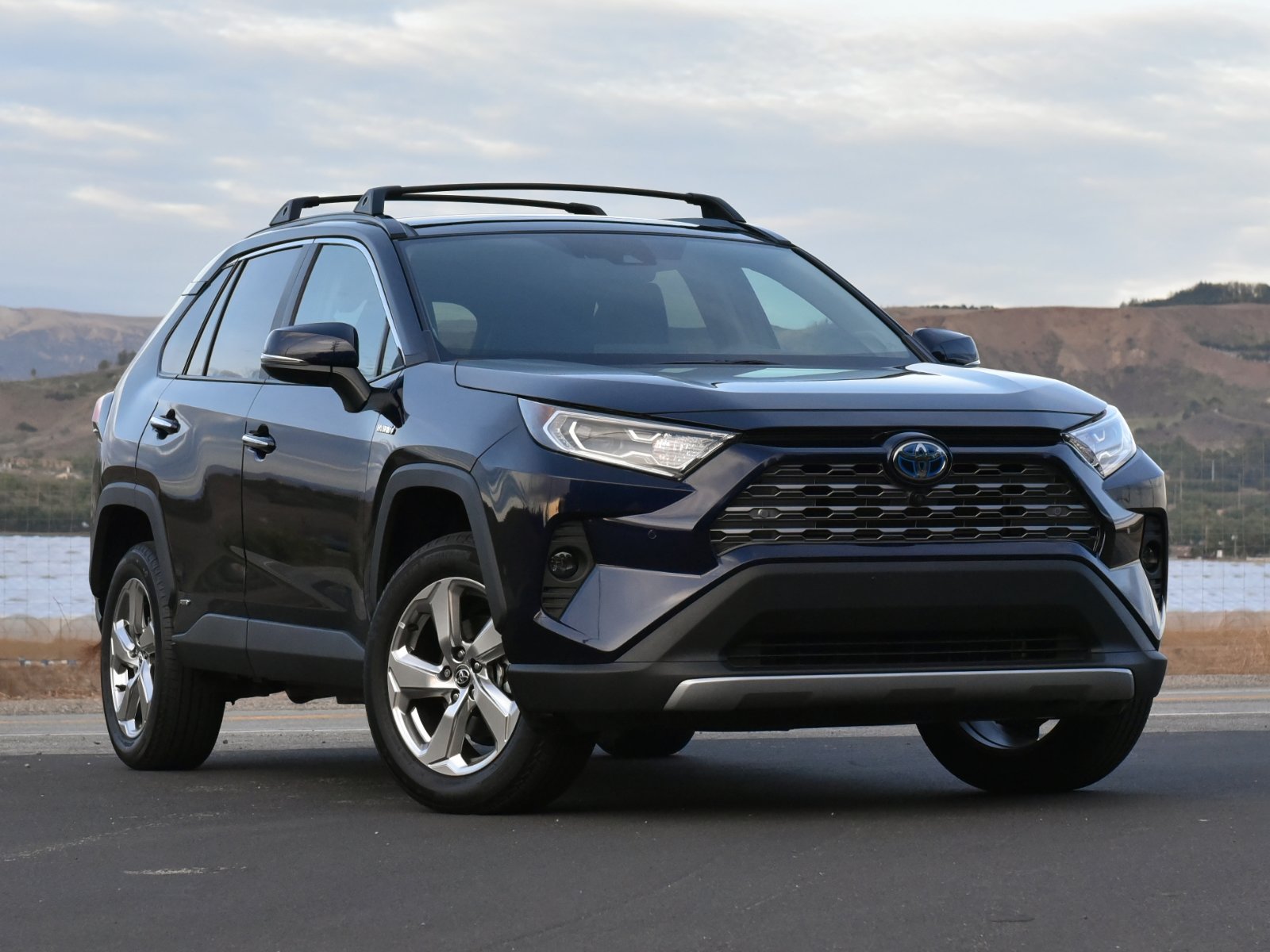
According to CarGurus experts, the overall rating for the 2020 Toyota Highlander is 7.7 out of 10, while the 2021 Toyota RAV4 Hybrid scores 8.5 out of 10. Based on these ratings, the 2021 Toyota RAV4 Hybrid garners a stronger recommendation for offering superior fuel economy, advanced technology, and commendable safety in a compact, more accessible package. While the Highlander offers spaciousness and comfort, the RAV4 Hybrid’s blend of efficiency and functionality provides better value for a wider range of consumers.
Choose the 2021 Toyota RAV4 Hybrid if:
- You value excellent fuel economy without compromising on lively acceleration.
- You prefer a compact SUV with user-friendly technology and responsive infotainment systems.
- You want a vehicle with comprehensive standard safety features and top crash-test performance.


Choose the 2020 Toyota Highlander if:
- You desire a spacious and versatile interior with superior second-row adjustments and cargo capacity.
- You prioritize a smooth and quiet ride suitable for long-distance travels.
- You seek a family-friendly SUV with advanced safety features and high-quality interior finish.


CarGurus highlights
According to CarGurus experts, the overall rating for the 2020 Toyota Highlander is 7.7 out of 10, while the 2021 Toyota RAV4 Hybrid scores 8.5 out of 10. Based on these ratings, the 2021 Toyota RAV4 Hybrid garners a stronger recommendation for offering superior fuel economy, advanced technology, and commendable safety in a compact, more accessible package. While the Highlander offers spaciousness and comfort, the RAV4 Hybrid’s blend of efficiency and functionality provides better value for a wider range of consumers.
Choose the 2021 Toyota RAV4 Hybrid if:
Shop Now- You value excellent fuel economy without compromising on lively acceleration.
- You prefer a compact SUV with user-friendly technology and responsive infotainment systems.
- You want a vehicle with comprehensive standard safety features and top crash-test performance.
Choose the 2020 Toyota Highlander if:
Shop Now- You desire a spacious and versatile interior with superior second-row adjustments and cargo capacity.
- You prioritize a smooth and quiet ride suitable for long-distance travels.
- You seek a family-friendly SUV with advanced safety features and high-quality interior finish.

By: CarGurus + AI
At CarGurus, our team of experienced automotive writers remain at the heart of our content operation, conducting hands-on car tests and writing insightful guides that are backed by years of industry experience. To complement this, we are harnessing AI to make our content offering more diverse and more helpful to shoppers than ever. To achieve this, our AI systems are based exclusively on CarGurus content, ratings and data, so that what we produce is both unique to CarGurus, and uniquely helpful to car shoppers.

