2020 Ford Escape vs 2020 Honda Pilot

Overview | |
MSRP$24,885 | MSRP$31,650 |
Listings204 | Listings55 |
Ratings & Reviews | |
User Reviews | User Reviews |
Expert reviews8.0 out of 10 | Expert reviews8.0 out of 10 |
Pros
Cons
| Pros
Cons
|
2020 Ford Escape Reviews SummaryIn case you didn’t hear, Ford came out with an electric crossover, calling it the Mustang Mach-E. Ford could have called it something else, but the marketing department decided to leverage the famous Mustang name to capture headlines and, hopefully, shoppers. What should not be overlooked is the fact Ford chose to make its first-ever standalone electric vehicle a crossover. This choice is a testament to how far the sport utility vehicle has come. Paired with Ford's decision to phase out sedans and hatchbacks, it's clear the company is putting all of its eggs into its trucks, SUVs, and crossovers. Suffice it to say, there is just a bit of pressure on the redesigned 2020 Ford Escape. While the Escape has been around since 2000, it came into its own in 2013 when the “One Ford” philosophy was adopted, meaning that vehicles would be sold in multiple markets around the globe. As a result, the U.S. got Europe’s Ford Kuga, rebranded as the Escape—a high-tech, handsome, and surprisingly athletic small SUV. So, with all this mind, the new Escape needs to not only be an improvement over the previous generation to compete against the rest of the compact crossover segment, it also needs to win over would-be sedan and hatchback customers. Can the 2020 Escape rise to the occasion? | |
2020 Honda Pilot Reviews SummaryThe Honda Pilot was once the leader of the midsize 3-row crossover pack. But several rivals from Hyundai, Kia, and Mazda have caught up to (and in some cases, surpassed) the Pilot. Still, the Pilot offers tons of cargo space, an adult-friendly third row, and an impressive list of standard safety features. But Honda’s choices on driver controls and in-car tech are its biggest shortcomings. Read on to learn how the Pilot stacks up against the competition, and to learn the CarGurus recommended trim. | |
No video found | No video found |
Popular Features & Specs | |
Engine1.5L 181 hp I3 | Engine3.5L 280 hp V6 |
Drive TrainFWD | Drive TrainFWD |
Seating Capacity5 | Seating Capacity8 |
Horsepower | Horsepower280 hp @ 6000 rpm |
MPG City27 | MPG City19 |
MPG Highway33 | MPG Highway27 |
Engine | |
Engine Name1.5L 181 hp I3 | Engine Name3.5L 280 hp V6 |
Torque | Torque262 lb-ft @ 4700 rpm |
Horsepower | Horsepower280 hp @ 6000 rpm |
DrivetrainFWD | DrivetrainFWD |
Fuel Economy | |
MPG City27 | MPG City19 |
MPG Highway33 | MPG Highway27 |
Interior | |
Seating Capacity5 | Seating Capacity8 |
Safety | |
Front Crash Overall5 | Front Crash Overall4 |
Side Crash Overall5 | Side Crash Overall5 |
Dimensions & Capacity | |
Cargo Space37.5 cu ft | Cargo Space16.5 cu ft |
Curb Weight3299 lbs | Curb Weight4036 lbs |
Height66.1 in | Height70.6 in |
Length180.5 in | Length196.5 in |
Width85.6 in | Width78.6 in |
Wheelbase106.7 in | Wheelbase111.0 in |
Maximum Payload | Maximum Payload1509 lbs |
Number of doors4 | Number of doors4 |
Maximum Towing Capacity | Maximum Towing Capacity3500 lbs |
Overview | ||
MSRP | $24,885 | $31,650 |
Listings | ||
Ratings & Reviews | ||
User reviews | ||
Expert reviews | 8.0 out of 10Read full review | 8.0 out of 10Read full review |
Pros & cons | Pros
Cons
| Pros
Cons
|
Summary | In case you didn’t hear, Ford came out with an electric crossover, calling it the Mustang Mach-E. Ford could have called it something else, but the marketing department decided to leverage the famous Mustang name to capture headlines and, hopefully, shoppers. What should not be overlooked is the fact Ford chose to make its first-ever standalone electric vehicle a crossover. This choice is a testament to how far the sport utility vehicle has come. Paired with Ford's decision to phase out sedans and hatchbacks, it's clear the company is putting all of its eggs into its trucks, SUVs, and crossovers. Suffice it to say, there is just a bit of pressure on the redesigned 2020 Ford Escape. While the Escape has been around since 2000, it came into its own in 2013 when the “One Ford” philosophy was adopted, meaning that vehicles would be sold in multiple markets around the globe. As a result, the U.S. got Europe’s Ford Kuga, rebranded as the Escape—a high-tech, handsome, and surprisingly athletic small SUV. So, with all this mind, the new Escape needs to not only be an improvement over the previous generation to compete against the rest of the compact crossover segment, it also needs to win over would-be sedan and hatchback customers. Can the 2020 Escape rise to the occasion? | The Honda Pilot was once the leader of the midsize 3-row crossover pack. But several rivals from Hyundai, Kia, and Mazda have caught up to (and in some cases, surpassed) the Pilot. Still, the Pilot offers tons of cargo space, an adult-friendly third row, and an impressive list of standard safety features. But Honda’s choices on driver controls and in-car tech are its biggest shortcomings. Read on to learn how the Pilot stacks up against the competition, and to learn the CarGurus recommended trim. |
Video | No video found | No video found |
Popular Features & Specs | ||
Engine | 1.5L 181 hp I3 | 3.5L 280 hp V6 |
Drive Train | FWD | FWD |
Seating Capacity | 5 | 8 |
Horsepower | 280 hp @ 6000 rpm | |
MPG City | 27 | 19 |
MPG Highway | 33 | 27 |
Engine | ||
Engine Name | 1.5L 181 hp I3 | 3.5L 280 hp V6 |
Torque | 262 lb-ft @ 4700 rpm | |
Horsepower | 280 hp @ 6000 rpm | |
Drivetrain | FWD | FWD |
Fuel Economy | ||
MPG City | 27 | 19 |
MPG Highway | 33 | 27 |
Interior | ||
Seating Capacity | 5 | 8 |
Safety | ||
Front Crash Overall | 5 | 4 |
Side Crash Overall | 5 | 5 |
Dimensions & Capacity | ||
Cargo Space | 37.5 cu ft | 16.5 cu ft |
Curb Weight | 3299 lbs | 4036 lbs |
Height | 66.1 in | 70.6 in |
Length | 180.5 in | 196.5 in |
Width | 85.6 in | 78.6 in |
Wheelbase | 106.7 in | 111.0 in |
Maximum Payload | 1509 lbs | |
Number of doors | 4 | 4 |
Maximum Towing Capacity | 3500 lbs | |
The 2020 Ford Escape was a striking compact crossover, borrowing design elements from the Ford GT supercar, with a large grille reminiscent of the Fiesta and Focus hatchbacks. Its curvaceous design, while aesthetically pleasing, resulted in a reduction of cargo space compared to its predecessor. Inside, the Escape boasted a modern cabin with a digital instrument panel and a floating infotainment screen, maintaining a balance between futuristic design and practical control placement. The Escape was available in four trims: S, SE, SEL, and Titanium, each offering a range of features from basic driver-assistance systems to premium audio and leather interiors.
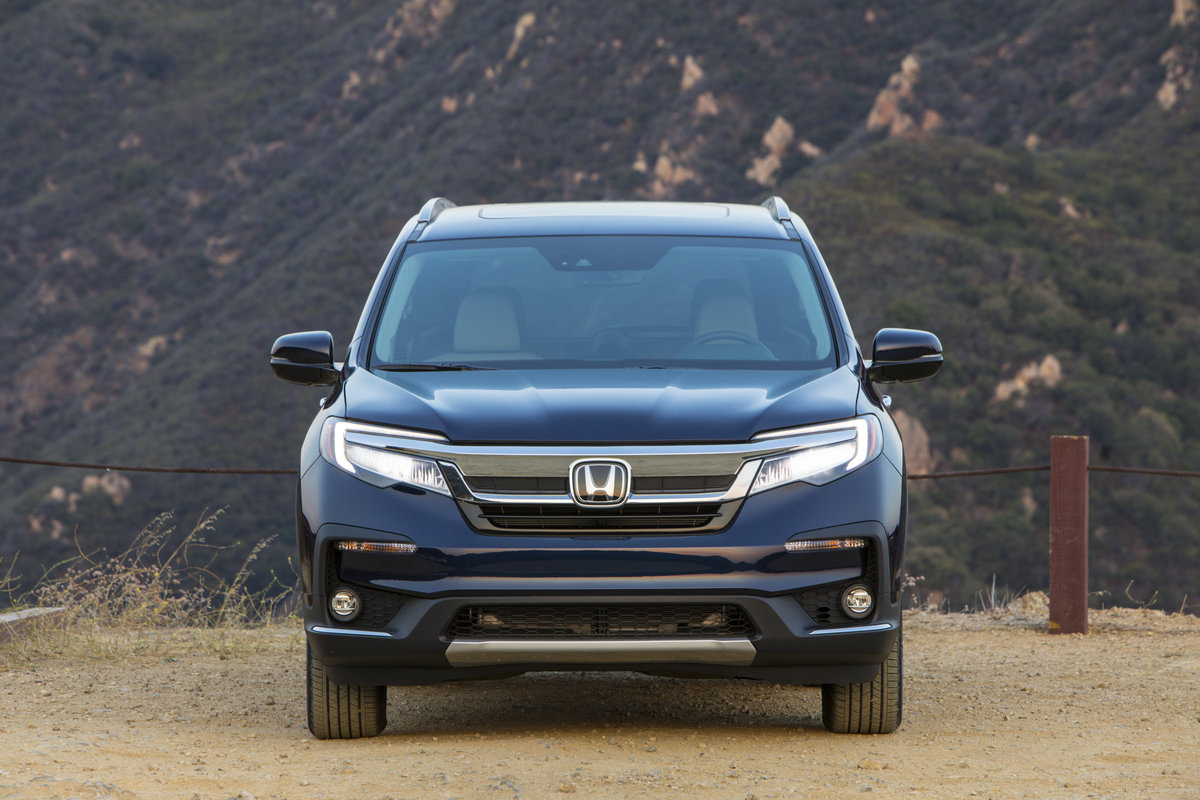
In contrast, the 2020 Honda Pilot shared the dynamic styling of the Honda lineup, featuring thin LED headlights and a multi-tiered grille. Its design cleverly masked its size, giving it a sleeker appearance. The Pilot's cabin was spacious and comfortable, with a semi-digital instrument panel and a focus on practicality, though it used hard plastics in some areas. The Pilot offered five trims: LX, EX, EX-L, Touring, and Black Edition, each adding features like leather upholstery, a power moonroof, and advanced tech options. The Pilot's interior was designed for family use, with ample space and thoughtful storage solutions.


The 2020 Ford Escape offered a diverse range of powertrains, including a new three-cylinder engine producing 180 horsepower and 177 pound-feet of torque, standard on the S, SE, and SEL trims. The 2.0-litre turbocharged four-cylinder engine, available on the SEL and standard on the Titanium, delivered 250 horsepower and 275 pound-feet of torque, providing brisk acceleration. The Escape also offered hybrid and plug-in hybrid options, with the hybrid producing 198 horsepower. The Escape's handling was sporty, with direct steering and strong brakes, making it enjoyable to drive. Fuel efficiency varied, with the hybrid achieving as low as 5.4 litres per 100 kilometres in the city.
The 2020 Honda Pilot was powered by a 3.5-litre V6 engine across all trims, producing 280 horsepower and 262 pound-feet of torque. It came with standard all-wheel drive in Canada, with a 6-speed automatic transmission on lower trims and a 9-speed automatic on the Touring and Black Edition. The V6 provided strong acceleration, though it wasn't the segment leader. The Pilot's ride was tuned for comfort, ideal for commutes and road trips, though it lacked athleticism. The Intelligent Traction Management System offered drive modes for various conditions, enhancing its capability in different terrains.
The 2020 Ford Escape's sleek design resulted in reduced cargo space, offering 974 litres behind the second row and up to 1,852 litres with seats folded, less than its predecessor and some rivals. However, it prioritized passenger space, providing ample headroom and legroom, with a commanding seating position for the driver and front passenger. The Escape featured numerous storage solutions, including deep water-bottle holders and multiple compartments, emphasizing real-world usability.
The 2020 Honda Pilot offered a spacious 8-passenger cabin, with optional second-row captain’s chairs reducing capacity to seven. Its third row was adult-friendly, with ample head and legroom. The Pilot provided 1,583 litres of cargo space with the second and third rows folded, competitive with rivals like the Toyota Highlander and Kia Telluride. Higher trims featured a power liftgate and hands-free power tailgate. The Pilot was designed for family use, with numerous storage spaces and features like a conversation mirror and CabinTalk for easy communication with rear passengers.
The 2020 Ford Escape's base trim featured a small 4.2-inch audio control screen, while the SE trim upgraded to an 8-inch Sync touchscreen with Android Auto and Apple CarPlay. The Sync system allowed multitasking, enhancing usability. The Titanium trim included a head-up display, though its flip-up screen design limited its effectiveness for taller drivers.
The 2020 Honda Pilot featured an 8-inch Display Audio touchscreen with Apple CarPlay and Android Auto across all trims. The system included a 215-watt, 7-speaker stereo with a subwoofer. However, the infotainment system's layout was confusing, lacking a tuning knob and relying heavily on touchscreen interaction. Higher trims added navigation, a rear entertainment system, and a 590-watt, 11-speaker premium audio system with a wireless charging pad.
The 2020 Ford Escape came standard with Ford Co-Pilot360, offering features like forward-collision warning, automatic emergency braking, and lane-keeping assist. It also included blind-spot monitoring and rear cross-traffic alert. The Escape earned a Good rating from the IIHS in all phases of testing.
The 2020 Honda Pilot featured the HondaSensing suite, including forward-collision warning, automatic emergency braking, and adaptive cruise control. It also offered optional safety features like blind-spot monitoring. The Pilot received a five-star overall crash test rating from the NHTSA and a Good rating from the IIHS, with a Superior score in crash prevention technology.
CarGurus highlights
According to CarGurus experts, the overall rating for the 2020 Ford Escape is 8.0 out of 10, while the 2020 Honda Pilot scores 8.0 out of 10. Both vehicles offer strong attributes, but the choice depends on your specific needs. If you prioritize a sporty drive and modern design, the Ford Escape is a great option. However, for those needing more space and family-oriented features, the Honda Pilot is the better choice.
Choose the 2020 Ford Escape if:
- You prefer a sporty driving experience with multiple engine options, including hybrid variants.
- You value modern interior design with practical storage solutions.
- You seek a compact SUV with advanced safety features as standard.


Choose the 2020 Honda Pilot if:
- You need a spacious 3-row SUV with adult-friendly seating in all rows.
- You prioritize family-friendly features and ample cargo space.
- You want a vehicle with a comprehensive suite of safety technologies and a strong safety rating.


CarGurus highlights
According to CarGurus experts, the overall rating for the 2020 Ford Escape is 8.0 out of 10, while the 2020 Honda Pilot scores 8.0 out of 10. Both vehicles offer strong attributes, but the choice depends on your specific needs. If you prioritize a sporty drive and modern design, the Ford Escape is a great option. However, for those needing more space and family-oriented features, the Honda Pilot is the better choice.
Choose the 2020 Ford Escape if:
Shop Now- You prefer a sporty driving experience with multiple engine options, including hybrid variants.
- You value modern interior design with practical storage solutions.
- You seek a compact SUV with advanced safety features as standard.
Choose the 2020 Honda Pilot if:
Shop Now- You need a spacious 3-row SUV with adult-friendly seating in all rows.
- You prioritize family-friendly features and ample cargo space.
- You want a vehicle with a comprehensive suite of safety technologies and a strong safety rating.

By: CarGurus + AI
At CarGurus, our team of experienced automotive writers remain at the heart of our content operation, conducting hands-on car tests and writing insightful guides that are backed by years of industry experience. To complement this, we are harnessing AI to make our content offering more diverse and more helpful to shoppers than ever. To achieve this, our AI systems are based exclusively on CarGurus content, ratings and data, so that what we produce is both unique to CarGurus, and uniquely helpful to car shoppers.

