Key Findings:
- Affordability over technology: 80% of Canadians agree manufacturers should prioritize making vehicles more affordable over adding new technology features.
- Practical improvements for the future: Better fuel economy (43%), more affordable vehicle options (40%) and more durable or reliable vehicles (39%) top Canadians’ list of changes that would improve their experience of owning or driving a vehicle over the next five to 10 years.
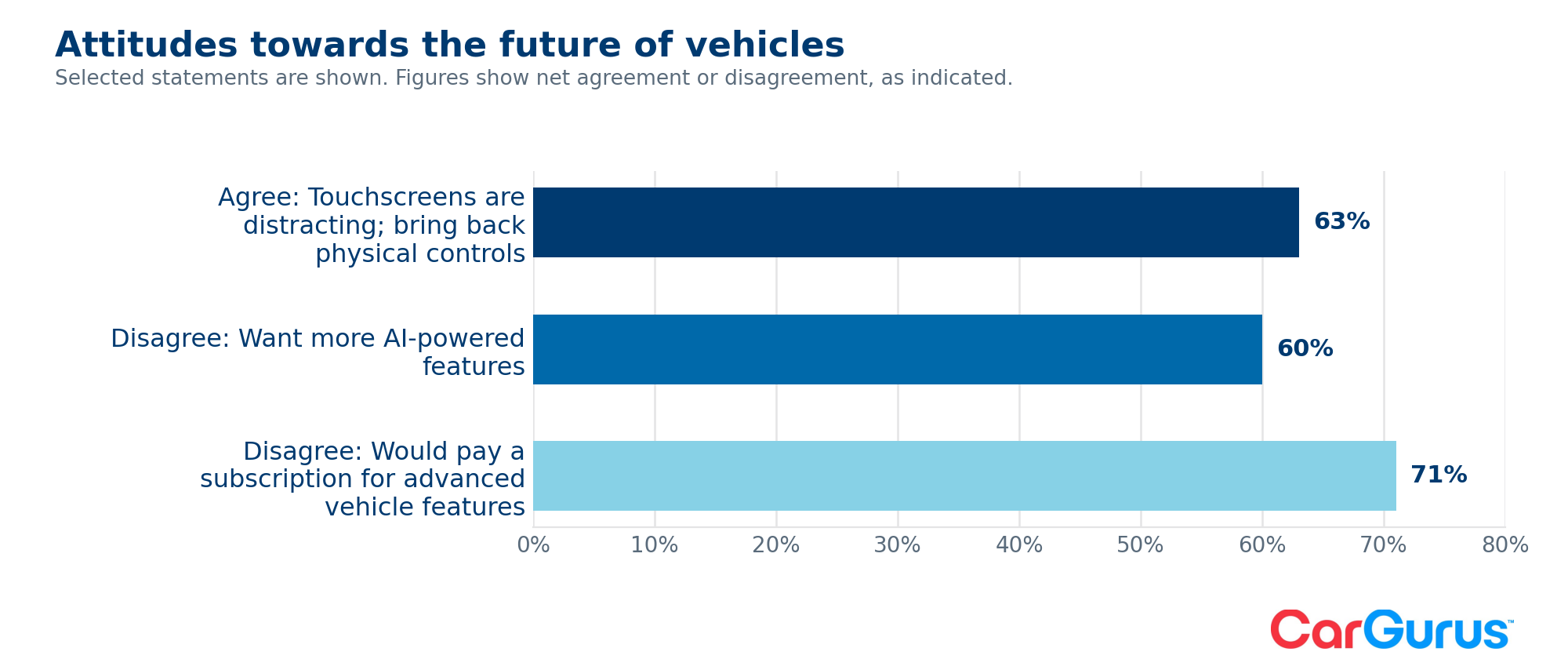
- Canadians are selective about technology: 63% agree touchscreens have become too distracting and manufacturers should bring back physical controls. Meanwhile, 60% do not want more AI-powered vehicle features, and 71% would not pay a subscription for advanced vehicle features.
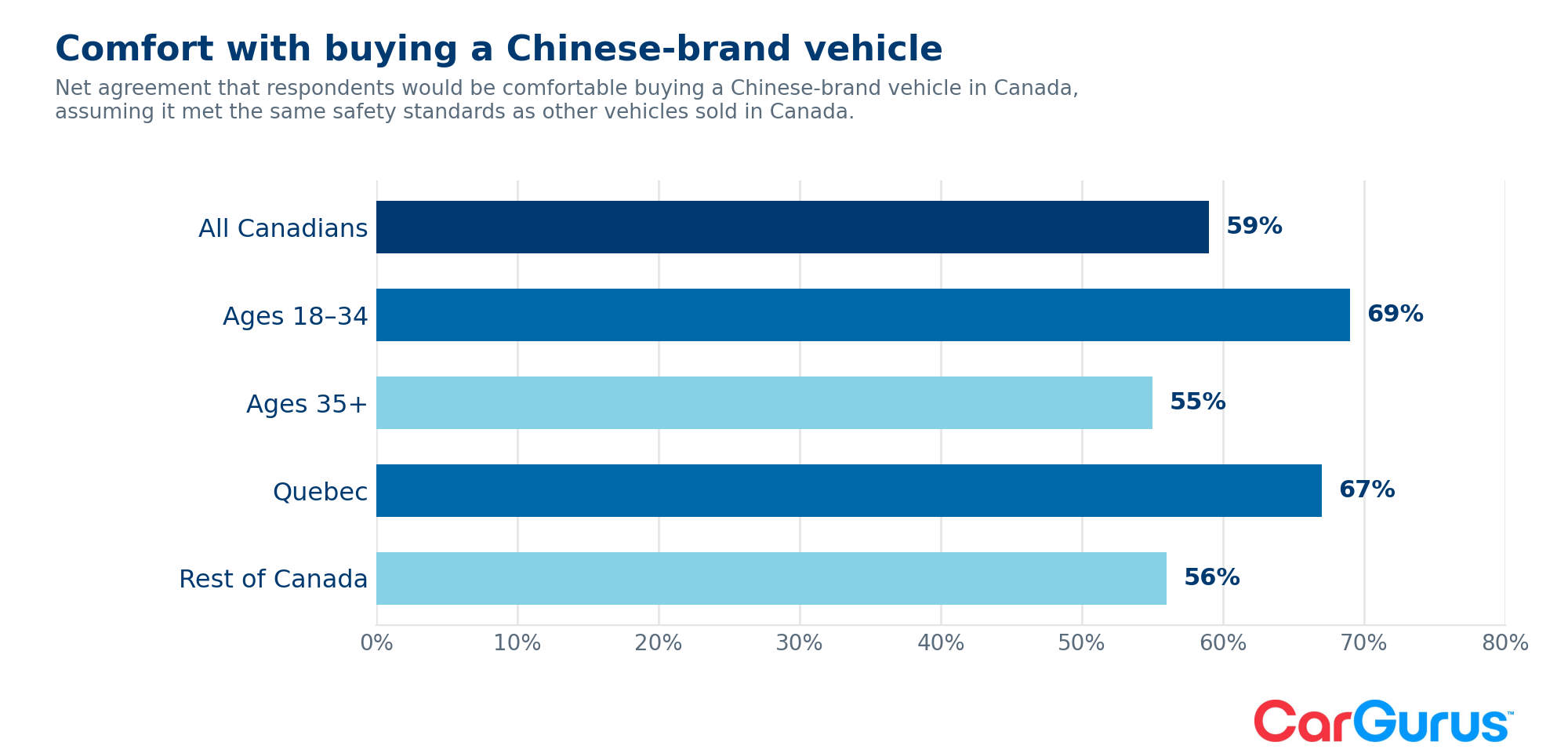
- A majority are open to Chinese-brand vehicles: When asked about Chinese-brand vehicles generally, 59% agree they would be comfortable buying one in Canada if it met the same safety standards as other vehicles sold here. The figure rises to 69% among adults aged 18 to 34 and 67% in Quebec.
Introduction
CarGurus marked 10 years in the market by commissioning a Leger survey to understand what Canadians value most in a vehicle and how their preferences may evolve over the next five to 10 years. The insights come at a time when higher fuel prices are adding to the cost of driving, and Canada is allowing more Chinese-made EVs into the market, reshaping the choices available to consumers.
Amid these changes, the survey examined Canadians’ vehicle preferences by asking what trade-offs respondents would be willing to make when choosing their next vehicle, what improvements they want over the next five to 10 years, and how they feel about newer features and Chinese-brand vehicles.
The results show a clear preference for practical value. Canadians favour vehicles that are affordable to buy, economical to run and reliable over time, with better fuel economy topping their list of desired improvements.
The results also show that Canadians are selective about new technology, particularly touchscreens and paid subscriptions, while a majority say they would be comfortable buying a Chinese-brand vehicle if it met the same safety standards as other vehicles sold here.
Together, the findings show what Canadians value in their vehicles today and what they hope will improve in the years ahead.
Affordability and practical value lead future vehicle priorities
When asked directly about the trade-off between affordability and technology, 80% of Canadians agree vehicle manufacturers should prioritize making vehicles more affordable over adding new technology features.
That preference for practical value carries through when Canadians were asked to select up to five changes that would most improve their experience of owning or driving a vehicle over the next five to 10 years. Better fuel economy was the most commonly selected improvement at 43%, followed by more affordable vehicle options at 40% and more durable/reliable vehicles at 39%. The next most commonly selected change, longer EV driving range, stands at 18%.
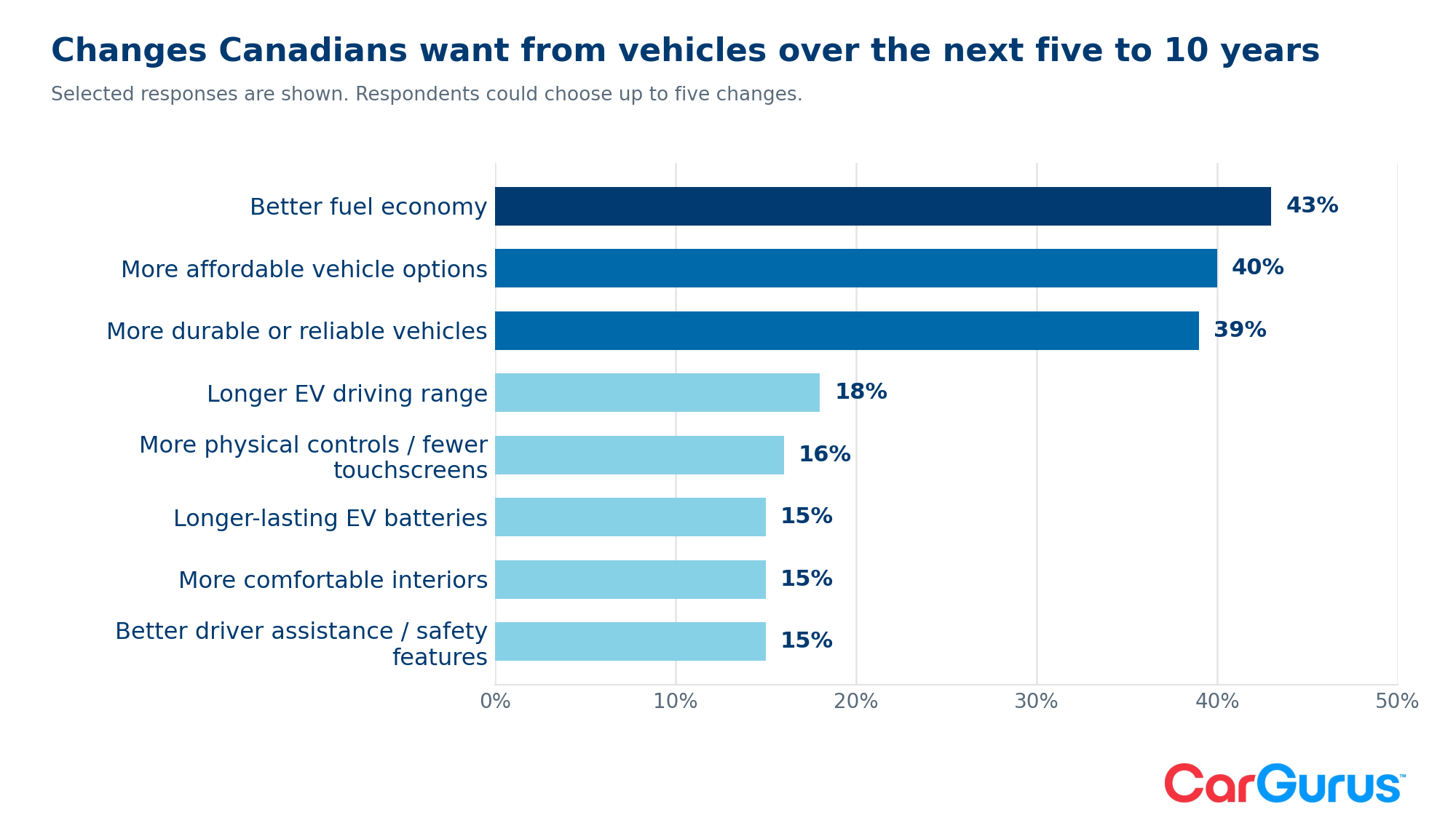
These priorities come amid continued pressure on household budgets and high fuel costs. In August 2026, gasoline prices rose 22.8% year over year, while passenger vehicle maintenance and repair services increased 3.7%.1 Together, these increases add to the ongoing expenses Canadians weigh alongside a vehicle’s purchase price and provide context for their focus on fuel economy, affordability and reliability.
“Automakers have moved away from many budget-focused models over the past decade in favour of larger, more premium vehicles,” says David Undercoffler, Head of Consumer Insights at CarGurus. “That leaves an opening for more affordable, value-oriented options. Chinese automakers bringing EVs to Canada could compete for those shoppers if they deliver on price, reliability, and safety.”
Canadians are selective about the technology they want in their vehicles
While vehicle technology continues to advance, the survey findings suggest Canadians do not necessarily see more technology as better.
Nearly two-thirds of Canadians, 63%, agree that touchscreen technology has become too distracting and manufacturers should bring back more physical buttons and manual controls.
Similarly, 60% don’t want more AI-powered features in their vehicles, while 71% aren’t willing to pay a monthly or annual subscription for advanced vehicle features.
At the same time, 25% say they would like more AI-powered vehicle features, such as smarter voice assistants or personalized in-car assistance, while 15% would be willing to pay a monthly or annual subscription for advanced vehicle features.
Over the past 10 to 15 years, vehicle manufacturers have increasingly relied on touchscreen systems for their in-car features, so much so that some tech-focused brands such as Tesla and Polestar rely almost entirely on touchscreens in their ranges, and many other popular models, such as the Volvo EX30 or the BMW iX3 are similarly reliant on screens.
More car manufacturers are clearly listening to customer concerns. Mercedes, Hyundai, Subaru, and Volkswagen have reverted to physical controls in their latest models rather than purely relying on touchscreens.
The shift to subscription services is more persistent, however, with brands such as Kia, Genesis, Mazda, Toyota, General Motors, and BMW (among others) all offering subscriptions for connected features and software. Although BMW in particular made headlines elsewhere around the world for remotely trialling locking certain features such as heated seats behind a paywall, this did not extend to the Canadian market.
Younger Canadians show greater interest in emerging technology
Interest in newer vehicle technology is higher among younger Canadians. Among those aged 18–34, 35% want more AI-powered features, compared with 21% of those aged 35 and older. Subscription willingness is also higher among younger Canadians, at 27% compared with 10%.
However, affordability still comes first across age groups: 77% of Canadians aged 18–34 say manufacturers should prioritize affordability over new technology, compared with 82% of those aged 35 and older.
Nearly six in 10 Canadians are open to Chinese-brand vehicles
More Chinese automakers are looking to sell vehicles in Canada, and the survey suggests many Canadians are open to buying from them. Overall, 59% of respondents say they would be comfortable buying a Chinese-brand vehicle if it met the same safety standards as other vehicles sold here. Openness is higher among Canadians aged 18 to 34 (69%), and Quebec also stands out, with 67% comfortable buying one, compared with 56% in the rest of Canada.
Until now, Canadians have mostly encountered Chinese-made vehicles under familiar names such as Tesla, Volvo and Polestar. Chinese automakers are also working to sell vehicles here under their own brands: Chery has been road testing vehicles in Canada for its Jaecoo and Omoda brands, while BYD has begun compliance procedures to import two cars. Chery claims it will begin sales in late 2026.
David says value will be important in determining whether unfamiliar brands win over Canadians. “Younger adults are more open to brands that are new or unfamiliar than older adults, but overall our survey suggests that unfamiliar brands can still appeal to a broad group of Canadians if they offer strong value for money, especially in the current climate.”
For more background, see the CarGurus guide to Chinese automotive brands that could enter Canada.
Reliability leads the trade-offs Canadians are willing to make
When considering their next vehicle, respondents could select up to two trade-offs they would be willing to make. The most commonly selected trade-off was paying more for a vehicle expected to be more reliable and need fewer repairs (23%), followed closely by choosing a lower-priced vehicle with fewer technology or comfort features (21%).
Together, those responses emphasize two ways Canadians are prioritizing value: Paying more to avoid future repair costs, and giving up features to lower the purchase price.
Only 15% of respondents say they would pay more for a hybrid or all-electric vehicle, while 12% would choose a smaller vehicle with less passenger or cargo space in exchange for a lower price. Another 10% would pay more for a vehicle made or assembled in Canada, compared with 8% who would pay more for advanced technology features.
Younger Canadians were more willing to make some of the higher-cost trade-offs. Among those aged 18 to 34, 22% were willing to pay more for a hybrid or all-electric vehicle, compared with 13% of those aged 35 and older. They were also more likely to select paying more for advanced technology features (14% versus 5%).
Vehicle priorities vary across Canada
The survey also points to regional differences in what Canadians want from their vehicles over the next five to 10 years.
The focus on affordability is especially clear in Atlantic Canada. More affordable vehicle options were selected by 53% of respondents in the region, compared with 40% nationally. Better fuel economy was also selected by 53% of respondents in Atlantic Canada, compared with 43% nationally, suggesting that both the purchase price and ongoing cost of driving are important considerations.
While the survey did not ask what influenced these responses, recent economic indicators offer some useful context. According to Statistics Canada’s latest Canadian Income Survey, median after-tax incomes for families and unattached individuals were lower across four Atlantic provinces than in any other province in 2024. The region has also experienced particularly sharp increases in fuel costs, with gasoline prices rising between 24.6% and 28% year over year in August 2026.2 Together, these figures provide context for the region’s stronger focus on both the upfront cost of a vehicle and how much it costs to operate.
In Quebec, 46% preferred more durable or reliable vehicles, compared with 37% outside the province. Respondents also showed greater interest in improvements that could make EVs easier to own and use. Longer EV driving range was selected by 29%, compared with 15% outside Quebec. Interest was also higher in longer-lasting EV batteries (21% versus 13%), faster charging (20% versus 12%) and better access to public charging (16% versus 10%).
Quebec’s established EV market provides context for those findings. In the second quarter of 2026, ZEVs represented 17.8% of new vehicle registrations in Quebec, compared with 10.7% nationally, and new ZEV registrations in the province increased 12.5% year over year.
Quebec’s established EV market may also help make ownership more appealing. In CBC coverage of Dongfeng’s planned entry into Quebec, lower electricity costs, greater familiarity with EVs and stronger consumer acceptance were identified as factors that could make the province an attractive starting point for the automaker’s Canadian expansion.
That familiarity may also be relevant to the survey findings, with greater exposure to EVs potentially making practical considerations such as range, battery life and charging more important to consumers in the province. The survey did not ask respondents what influenced their choices, so this should be viewed as context rather than an explanation.
In a separate question, 20% of Quebec respondents selected paying more for a hybrid or all-electric vehicle, compared with 14% elsewhere in Canada.
What the findings say about Canadians’ vehicle priorities
Taken together, the findings suggest Canadians are looking for practical improvements from their vehicles first. Affordability, fuel economy and reliability are the top priorities, while interest in newer technologies such as AI and subscription-based features is more limited overall.
At the same time, younger Canadians show greater openness to AI-powered features, subscriptions and Chinese-brand vehicles, pointing to some generational differences in how vehicle preferences could evolve.
Overall, it’s clear that although Canadians are open to new technology, it has to be seen in the context of affordability, reliability, or usability. In times of economic uncertainty, buyers clearly want to know they’re getting long-term value for their money.
So while younger buyers’ openness to AI, subscriptions, and Chinese-brand vehicles may significantly impact the shape of the Canadian auto market over time, it’s a more value-led approach that matters most right now.
“There isn’t one version of the vehicle of the future that will appeal to every Canadian,” says David. “Preferences differ by age and region, but the common thread is that new options have to make sense in everyday life. For automakers entering the market or updating future models, the challenge is showing Canadians a benefit they can use and a vehicle they can trust at a price they can justify.”
Methodology: Leger is the largest Canadian-owned full-service market research firm. Leger conducted an online survey of 1,538 Canadians aged 18+ between September 4-7, 2026, using their online panel, LEO. Leger's online panel has approximately 500,000 members nationally and has a retention rate of 90 per cent. A probability sample of the same size would yield a margin of error of +/- 2.5 per cent, 19 times out of 20.
1 Statistics Canada. Table 18-10-0004-07: Consumer Price Index, monthly, percentage change, not seasonally adjusted, Canada, provinces, Whitehorse and Yellowknife—Transportation. https://doi.org/10.25318/1810000401-eng.
2 Statistics Canada. Table 18-10-0004-13: Consumer Price Index by product group, monthly, percentage change, not seasonally adjusted, Canada, provinces, Whitehorse, Yellowknife and Iqaluit. DOI: 10.25318/1810000401-eng. Figures shown for gasoline in Newfoundland and Labrador, Prince Edward Island, Nova Scotia and New Brunswick, August 2025 to August 2026.


