2026 Chevrolet Colorado Reviews, Pricing & Specs


Pros & cons
What we like
Stylish design
Fun to drive
Easy-to-use technology
What to consider
Poor fuel economy
Interior materials feel cheap
Poor ergonomic design
Expert review
The 2026 Chevrolet Colorado makes a strong case for itself in the midsize pickup truck segment.
Available only in a crew-cab, short-bed body style, the Colorado offers one powertrain, rear-wheel drive (RWD) or four-wheel drive (4WD), and five trim levels. Talk about simplicity! Last redesigned for the 2023 model year, the Colorado is mostly unchanged for 2026. White Sands paint replaces Harvest Bronze on the Trail Boss and ZR2, and a new Bronze Accent Package is available. Additionally, Chevy has discontinued the snorkel and the rubber bed mat options.
Verdict: In most ways, the 2026 Colorado is an impressive midsize truck. However, it plays runner-up to the Toyota Tacoma, which is not only more versatile and available with a wider range of dealer accessories but also trades on its legendary reputation for long-term reliability.
out of 10 expert review
Look & feel
The affordable WT (work truck) forms the foundation for the Trail Boss in the 2026 Chevy Colorado hierarchy, while the mid-grade LT trim serves as the basis of the Z71, with higher trim levels adding off-road capability. At the top of the lineup, the Colorado ZR2 includes even more features and extra off-roading hardware. Prices range from $42,943 to $64,243, including a $2,600 destination charges and other fees. (That’s more than $600 higher than Toyota's equivalent charge to transport the Tacoma to a dealership.)
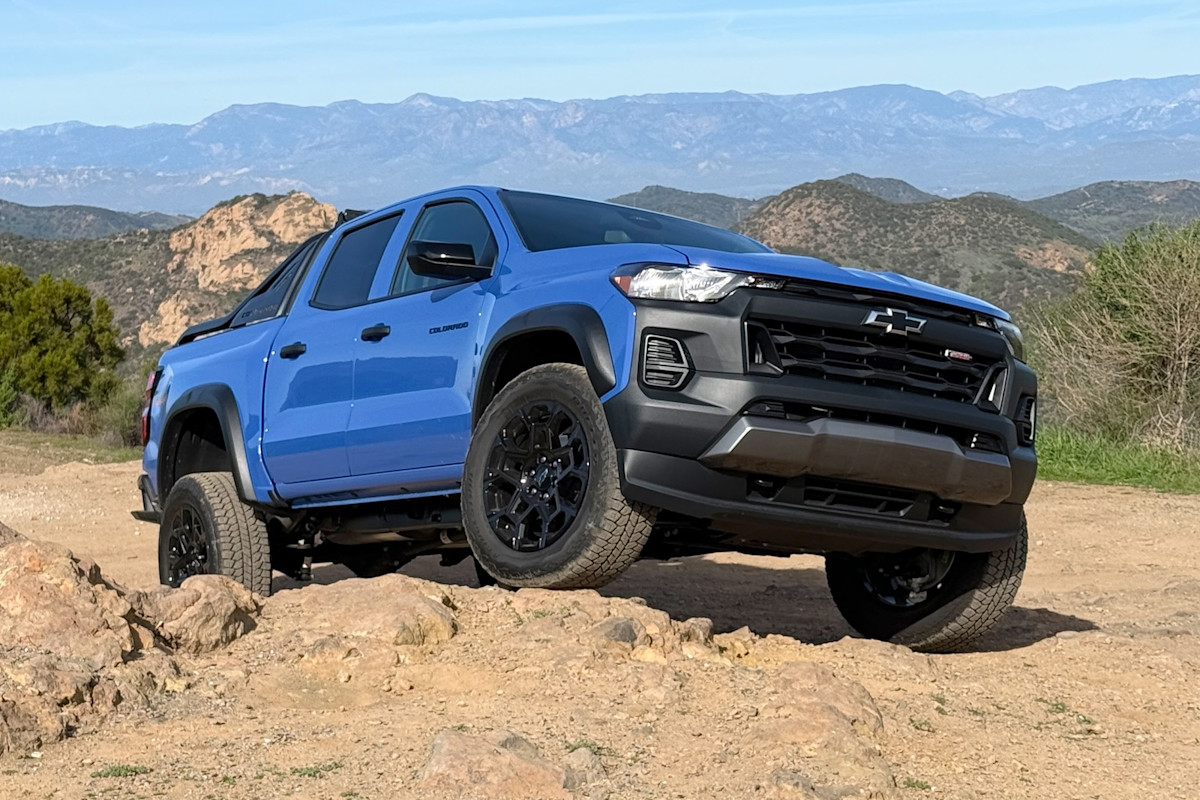
Our test truck arrived in Trail Boss spec with Reef Blue paint, the Midnight Edition Package ($7,270), and the Convenience Package II ($2,895). Because the Midnight Edition Package equips the Trail Boss with a 40-inch off-road light bar, the test vehicle also needed accessory power distribution and switch kits that are added at no extra charge. With the addition of a spray-on bedliner ($625), the test truck’s Canadian manufacturer’s suggested retail price (MSRP) tops out at $63,528 with fees.
The Reef Blue paint looked great, the Midnight Edition’s 20-inch wheels filled the truck’s blistered fenders, and the cargo bed sport bar gave it even more style and presence.
Then we opened the driver’s door. Flimsy carpeted floor mats, acres of plastic, and the black-everything monotony of the cabin wiped the smile off our face. Sure, there were some metallic accents here and there, and some gloss-black trim to go with the 11-inch digital driver display and the 11.3-inch touchscreen infotainment system, but the Trail Boss’s interior was downright depressing. During testing, our area got whacked with intense storms that made a mess of everything, and the test truck’s carpeted mats were trashed in no time. All-weather floor liners are available.
While the execution might leave something to be desired, the design is appealing. Those dual screens give the Colorado a modern appearance, and for the most part the controls are easy to find and use. Inexplicably, Chevy doesn’t provide a headlight control knob. And the windshield wipers, mounted on the left stalk, are more difficult to use with precision than they should be.
Performance
All 2026 Chevrolet Colorado trims come with a turbocharged 2.7-litre four-cylinder engine (Chevy calls it the TurboMax) and an eight-speed automatic transmission. The engine generates 310 horsepower and 430 pound-feet of torque, returns as little as 11.1 litres per 100 kilometres in combined city and highway driving (RWD models), and boasts a towing capacity of up to 3,500 kilograms (7,700 pounds, or 2,720 kilograms (6,000 pounds) for the Colorado ZR2). The maximum payload rating is 837 kilograms (1,846 pounds) for RWD models.
The turbo four is lively enough in the 2,052-kilogram (4,524-pound) Colorado Trail Boss, though it doesn’t sound very good under acceleration and fuel economy is poor. The bigger the tires and the higher the suspension lift, the more money you’ll spend on fueling this truck. Our test vehicle’s window sticker said it should have gotten 13.1 L/100 km in combined city and highway driving, but we averaged 13.4 L/100 km during the test drive.
There is a caveat regarding that observed fuel economy. We ran the two-speed Autotrac transfer case in Automatic 4WD mode instead of 2-Hi because of damp roads in the region. The Auto mode makes a difference in the wet, especially when accelerating around corners at intersections. We found the Colorado resistant to throttle inputs when calling for increased highway speeds to pass slower traffic or climb mountain grades. You need to push hard on the accelerator to get the transmission to kick down, perhaps because regular use of the turbo directly translates into bank-account-busting fuel consumption.
Trail Bosses have an off-road-tuned suspension with a five-centimetre factory lift and a wider stance. All-terrain tires are standard, along with Off-Road and Terrain driving modes and a hill descent control system. The Chevrolet Colorado ZR2 offers even more off-road upgrades — including 33-inch mud-terrain tires and Multimatic DSSV dampers — but we were very impressed with the Trail Boss. It powered up a steep grade with no trouble at all, navigated deep ruts with ease, and parked a front wheel on a jutting boulder to show off its impressive wheel articulation. The only thing missing was a forward-facing camera, and when you’re off-roading without a spotter, a camera adds confidence.
The roads leading to the trail were anything but straight, and the best we can say about the Trail Boss’s handling is that it’s secure within relatively low limits thanks to reasonable grip, easily modulated brakes, and decent steering. If you know a road well, you can hustle it quicker than you might guess. Otherwise, keep your speed in check.
For example, on a repaired section of a nearby highway, the surface isn’t smooth. Most vehicles we test on this stretch of road manage the bumps and dips without much effort, but the Trail Boss’s stability control system turned this relatively innocuous road repair into a drama-filled moment during an otherwise uneventful drive.
This version of the Colorado has an exceptionally stiff suspension, which is likely why the stability control triggered. In city driving, every nuance of the road surface translates into a vibration, a shudder, or a skitter, giving the Trail Boss an endearingly authentic and vintage-truck-like ride quality. Equally, you’re not worried about speed humps or bumps, drainage dips or driveway aprons, or potholes and parking blocks, because it seems impervious to them all. The Trail Boss did not suffer from road noise from its all-terrain tires on the highway because wind noise and the racket from the engine (especially when accelerating or climbing a grade) drowned out any whir from the rubber.
Sickly, feeble halogen headlights are standard on the Trail Boss. Their illumination was so poor that on our first night in the Colorado, we thought we were driving only with the daytime running lights on. Is it ridiculous that you can accessorize a Trail Boss with off-road lighting but not the LED headlights that Chevy offers on other versions of the Colorado? Yes, it is.
Form & function
Chevrolet offers the Colorado Trail Boss with cloth or Evotex upholstery, the latter a soft artificial leather that feels durable but also looks as though it would trap sweat in a hot, muggy climate. Unfortunately, if you want to upgrade from a manually adjustable driver’s seat to eight-way power adjustment, you’ll need the optional Convenience Package II, and that includes Evotex. No cloth seats for you.
So equipped, our Colorado Trail Boss proved quite comfortable with temperatures in the high teens. That option package also includes heated front seats and a heated steering wheel (and to that point, it’s worth noting these features are not standard, even in Canada). Furthermore, though the door panels and sides of the centre console are covered in the same hard, unyielding plastic as the rest of the truck’s interior, they don’t impede legroom, so those surfaces are not uncomfortable.
The front passenger is not as lucky in the comfort department. That seat offers four-way manual adjustment and is mounted closer to the floor, but it provides enough leg support to be comfortable. Since our test truck didn’t have assist steps, shorter people found it hard to enter and exit.
As is true with most midsize pickups, the Colorado’s back seat is cramped. Not only that, but the seat cushion is too soft and low, and the Trail Boss doesn’t have a centre armrest. This prompted a teenager who frequently rides in test vehicles to announce her dissatisfaction. Fortunately, Chevy provides rear air conditioning vents in every Colorado, and the front seatbacks are soft and padded, which makes them kind to the knees and shins.
The rear 60/40-split cushion folds up to reveal storage space under the seat. Up front, the bin under the centre armrest is remarkably roomy, the glove compartment is an equally good size, and Chevy carves as much storage space as possible into each door panel.
Around back, Chevy’s CornerStep bumper design makes it easy to climb into the cargo bed. Most Colorados have an EZ Lift-and-Lower tailgate, which can hold 225 kilograms (500 pounds) in its middle position. Drop it completely to access the StowFlex compartment built into the inner wall of the tailgate. Chevrolet offers numerous accessory upgrades to improve the Colorado’s cargo bed utility.
Technology
The Chevy Colorado is firing on all cylinders with its in-cab technology. From display size and functionality to the welcome sequence and graphics, it’s very well done.
The show starts with an 11-inch digital driver display offering several genuinely useful data panels in one of three visual themes. The steering wheel controls for this screen are fairly intuitive, but resetting the trip computer is unnecessarily aggravating.
To the right of the driver display is an 11.3-inch touchscreen infotainment system running on Google built-in technology. That means it includes Google Maps, Google Assistant, and access to apps via the Google Play Store. Additionally, the infotainment system offers wireless Apple CarPlay, wireless Android Auto, Bluetooth, SiriusXM satellite radio, access to OnStar connected services, and access to a subscription-based Wi-Fi hotspot. Wireless smartphone charging is available, and certain trim levels also have two front and two rear USB ports.
Unexpectedly, Google Assistant improperly interpreted and responded to two of our standard testing prompts. Typically, “find the nearest Starbucks” and “find the closest Chipotle” are easy layups for modern voice recognition systems. However, the Colorado played dumb unless we said “give me directions to a Starbucks” or “navigate to a Chipotle.” Otherwise, the infotainment system was a pleasure to use.
Some might complain about the absence of a tuning knob, but you can tune using rocker switches on the front or back of the steering wheel spokes. However, the standard six-speaker stereo is no good beyond mid-volume, and you must get a Colorado Z71 or ZR2 to enjoy a Bose premium audio system.
Safety
The Colorado’s Chevy Safety Assist suite and Safety Package include forward-collision warning, automatic emergency braking, pedestrian and cyclist detection, lane departure warning, lane keep assist, automatic high-beam headlights, and a safe following distance indicator. Blind spot monitoring, rear cross-traffic alert, and rear parking sensors are also standard in Canada.
In addition to those safety features, the Colorado has a rear-seat reminder system, a high-definition reversing camera, a tire fill alert system, Teen Driver monitoring technology, and a Buckle to Drive system that requires everyone aboard to have their seatbelts on before shifting the truck into gear (although you can deactivate it via a menu in the infotainment system).
A Technology Package is available that adds adaptive cruise control, a rear pedestrian alert system, and a high-definition surround-view camera system. If you’re seeking a lane-centring assist system or Chevy’s Super Cruise hands-free driving technology, you’ll need to upgrade to the full-size Silverado.
The Trail Boss’s technology worked as expected during our evaluation. We found the forward collision warning system to be far less sensitive than it was the first time we drove a current-generation Colorado, which was a blessing. It’s not clear if testing in low winter light instead of high summer light caused this or if Chevrolet resolved the previous maddening tendency to issue excessive collision alerts. Additionally, while the lane keeping assist system did make itself known on a few occasions, it wasn't intrusive or bothersome.
Both the U.S. National Highway Traffic Safety Administration (NHTSA) and the Insurance Institute for Highway Safety (IIHS) have performed crash tests on the Colorado, and the results were disappointing. In NHTSA testing, the driver and front passenger seating positions received three-star protection in a side-impact collision (out of five stars), and the truck has three-star rollover resistance with RWD and 4WD.
The IIHS gave the Colorado’s Chevy Safety Assist systems a “Poor” front crash prevention rating. The Colorado did earn the highest “Good” rating in two of the organization’s crash tests, but a rating for the latest moderate overlap front-impact test wasn’t available at the time of writing.
Cost-effectiveness
Scan the standard equipment list for a Colorado WT and you’ll discover a well-equipped truck that you can upgrade with 4WD, smarter wheels, more interior amenities, and a spray-on bedliner. That's all for just over $50,000, though, which is not far off a 4WD Tacoma crew cab. The GMC Canyon, Honda Ridgeline, and Jeep Gladiator are also more expensive when comparably equipped. A Ford Ranger XL comes in a little lower than the Chevy, and upgrading to the XLT adds a greater choice of powertrains and colours and more equipment than you can get with the Colorado. The Ford is more fuel-efficient, too.
If you’re concerned about the turbo fours in the Chevy and the Ford, then the Nissan Frontier SV offers V6 power for a comparable starting price. That engine is also about as fuel-efficient as the one in the Colorado and, unlike the Chevy, LED headlights are standard across the board.
Ultimately, we think the Colorado offers good potential value, but the truck’s unimpressive fuel economy, poor safety ratings, and OnStar connected service offerings undercut the competitive prices. Nevertheless, we like the Colorado’s authentic truckiness, its off-roading capability, the styling, and its in-cab technology. With improvements in key areas, Chevrolet could elevate the Colorado from good to great.

What owners say
The Zr2 is the truck to get, fun, capable, reliable, great looks and the best value.
October 14, 2026Trims & specs
Base MSRP $35,700 | Seating 5 |
Engine 2.7L 310 hp I4 | Cargo Capacity N/A |
Combined MPG 19 | Drivetrain 4X4 |
Base MSRP $50,700 | Seating 5 |
Engine 2.7L 310 hp I4 | Cargo Capacity N/A |
Combined MPG 17 | Drivetrain 4X4 |
Base MSRP $44,600 | Seating 5 |
Engine 2.7L 310 hp I4 | Cargo Capacity N/A |
Combined MPG 18 | Drivetrain 4X4 |
Base MSRP $32,400 | Seating 5 |
Engine 2.7L 310 hp I4 | Cargo Capacity N/A |
Combined MPG 21 | Drivetrain 4X2 |
Base MSRP $36,000 | Seating 5 |
Engine 2.7L 310 hp I4 | Cargo Capacity N/A |
Combined MPG 21 | Drivetrain 4X2 |
Base MSRP $39,300 | Seating 5 |
Engine 2.7L 310 hp I4 | Cargo Capacity N/A |
Combined MPG 19 | Drivetrain 4X4 |
Base MSRP $40,500 | Seating 5 |
Engine 2.7L 310 hp I4 | Cargo Capacity N/A |
Combined MPG 18 | Drivetrain 4X4 |


Pricing trends
MSRP range
$32,400 - $50,700
Current avg. market price
$56,413
Trending down by 4.1% this month
April 2026 - October 2026