2026 Toyota Tacoma Reviews, Pricing & Specs


Pros & cons
What we like
Multiple configurations
Reputation for reliability
Impressive resale value
What to consider
Poor fuel economy (TRD Pro)
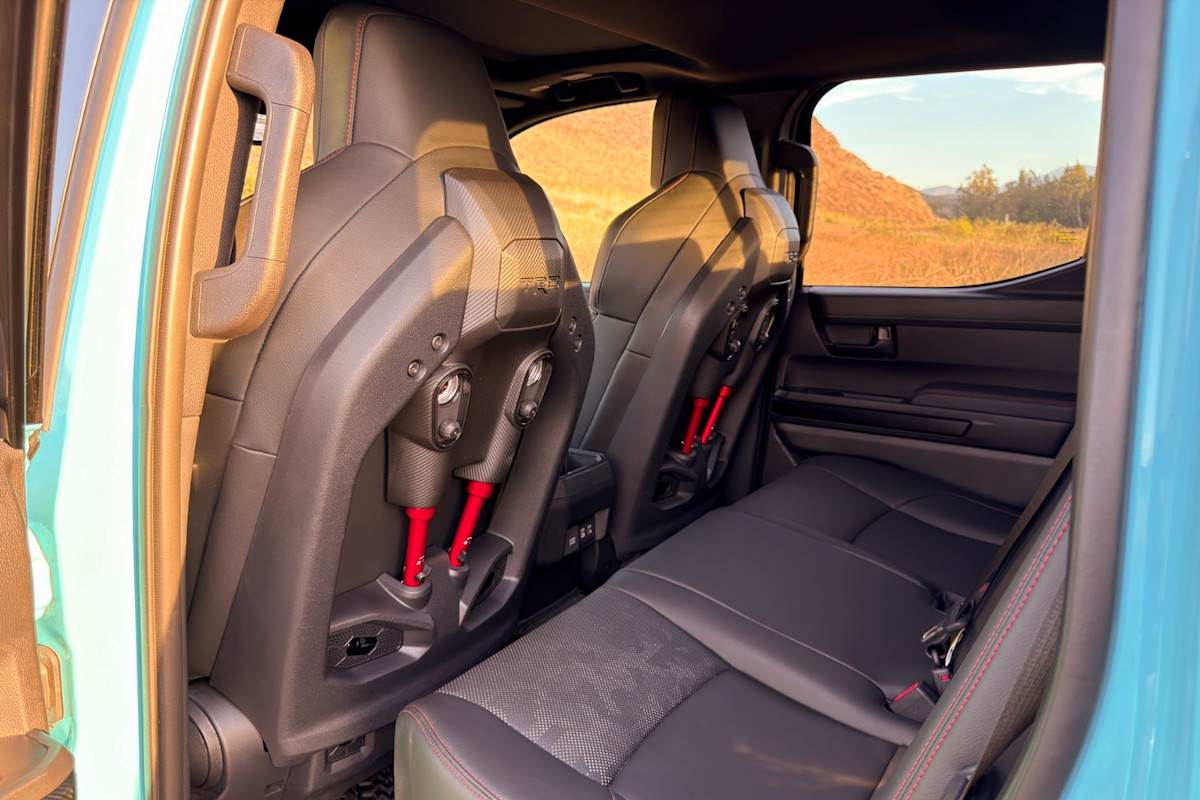
Cramped back seat (TRD Pro)
Interior materials feel cheap
The CarGurus verdict
Toyota sells many versions of the 2026 Tacoma, but we can’t see why the TRD Pro needs to be one of them.
We’d bet good money that most people who buy a Tacoma TRD Pro — one of the most off-road-capable Tacoma models — won’t use it to blast across the desert with wild abandon. Buyers will probably want to consider a different version of Toyota’s midsize pickup truck, which is available in Canada as a Double Cab with two bed lengths, several powertrain combinations, and multiple packages.
Verdict: The 2026 Tacoma TRD Pro sells a fantasy, not a reality. Given some of the compromises it requires, we think people who want an expensive off-road-ready Tacoma would be happier with the Trailhunter model.
out of 10 expert review
Look & feel
There is a 2026 Toyota Tacoma for almost anyone. While the Double Cab (crew cab) and four-wheel drive (4WD) are standard in Canada, shoppers can choose from a short or standard-length cargo bed, a turbocharged gasoline engine or a turbocharged hybrid powertrain, and a manual or an automatic transmission. A total of eleven packages are available across the three core configurations. Compare that diversity to what Chevy, Ford, Jeep, and Nissan offer, and it's easy to see why many people prefer Tacos.
Those packages include the SR5, SR5+, TRD Sport, TRD Off-road, TRD Sport+, TRD Off-road+, TRD Sport Premium, TRD Off-road Premium, Limited, TRD Pro, and Trailhunter. The first eight are non-hybrid only. The Limited, TRD Pro, and Trailhunter are hybrid only.
Canadian prices range from $50,825 to $87,257, including the $1,930 destination charge. Our TRD Pro test truck arrived with Wave Maker blue paint, a cargo bed mat, and a few other accessories. The Canadian manufacturer’s suggested retail price (MSRP) is $82,446, including destination. (Note our test vehicle is in U.S. specification, and some accessories shown may not be available in Canada.)
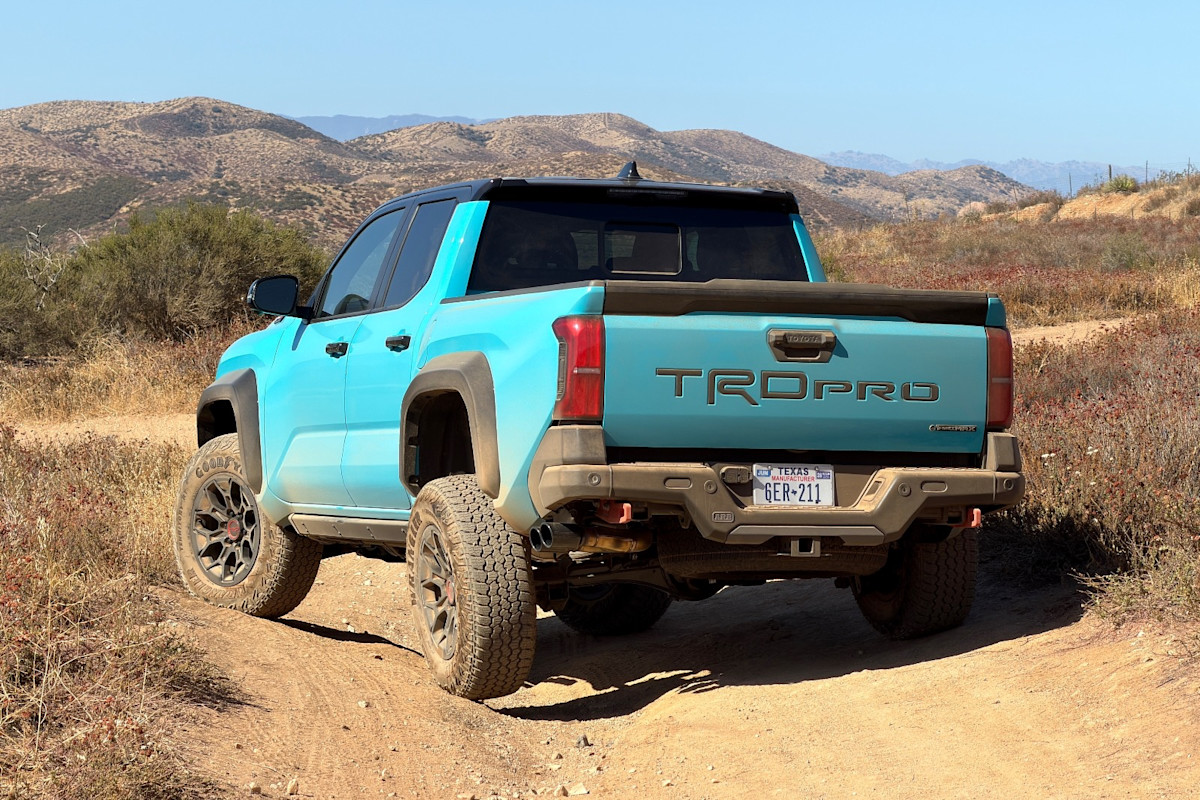
We mostly liked the styling, but the gloss black overfenders and mirror caps seem susceptible to scratches when off-roading. Also, the grooves in the decorative black plastic glued to the hood quickly fill with dust, grit, and dirt, and they aren’t easy to clean. Fortunately, the TRD Pro does not include the large lower front spoiler found on most other versions of the Tacoma, which requires removal before attempting to tackle serious terrain.
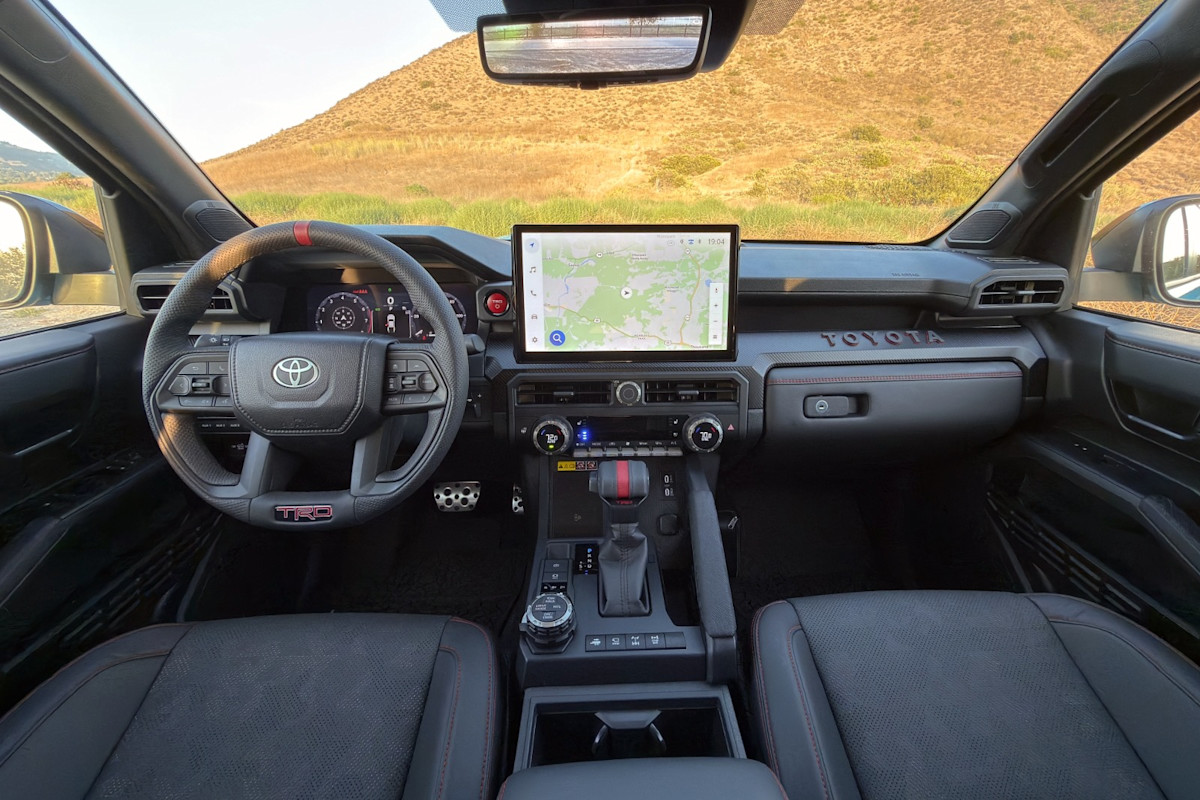
Nothing about this truck’s interior — aside from its fancy IsoDynamic performance seats — suggests it should cost anywhere close to $80,000. It is industrial in look and feel, equipped with oversized climate control knobs and a chunky volume knob.
Performance
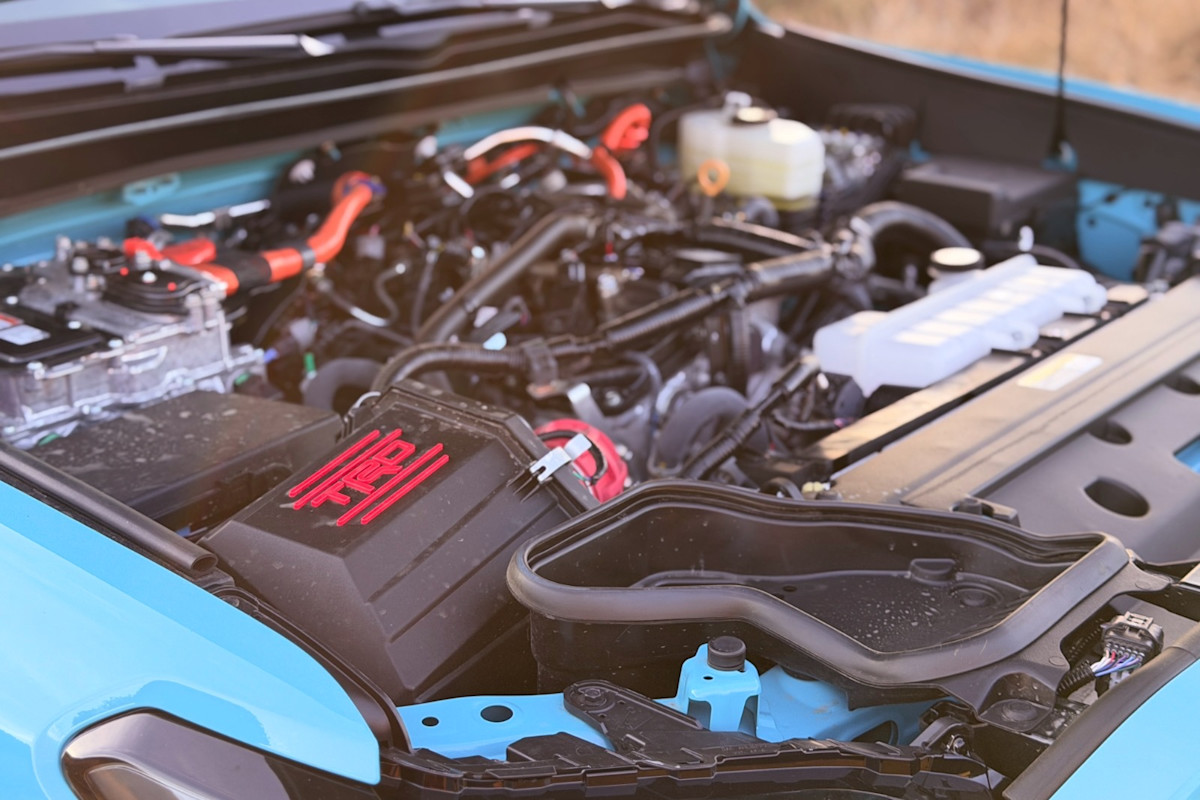
A 2.4-litre turbocharged four-cylinder engine is standard and comes with an eight-speed automatic transmission or, in two configurations, a six-speed manual. In all Canadian models with the automatic, it provides 278 hp and 317 lb-ft of torque. Manual versions see a slight drop to 270 hp and 310 lb-ft. The i-Force Max hybrid bumps power and torque to 326 hp and 465 lb-ft and theoretically has better fuel economy.
According to Natural Resources Canada and the test truck’s window sticker, the TRD Pro should have consumed 10.3 litres per 100 kilometres in combined driving. Based on our real-world experience, that is laughable and totally unrealistic. The TRD Pro’s 2.5-centimetre front suspension lift, knobby 33-inch tires, and lack of the giant chin spoiler that adorns most other Tacomas all have a big impact on real-world fuel economy.
Driving only in Eco mode, we observed 13.4 L/100 km on our fuel economy testing loop. During a drive to the far reaches of our city to an off-highway vehicle park, the Tacoma again averaged 13.4 L/100 km in a mix of city, highway, and off-road driving. For a truck meant to reach the middle of nowhere, the TRD Pro’s indicated 394 kilometres of range after filling its 69-litre tank is also inadequate.
As an off-road model, the Tacoma TRD Pro has standard 4WD, a cold-air performance intake, a locking rear differential, and three driving modes including Eco, Normal, and Sport. Multi-Terrain Select is also standard, and in 4WD mode this feature offers Deep Snow, Mud, Sand, Dirt, and Auto settings. Downhill Assist Control (hill descent control) and Crawl Control are also standard. Crawl Control is a low-speed off-road cruise control system that maintains a steady rate of speed.
The TRD Pro has a large front aluminum skid plate and rides on a sophisticated suspension equipped with a stabilizer bar disconnect feature. There’s a double-wishbone arrangement up front and a coil-spring multi-link setup at the back. Fox Quick Switch 3 adjustable internal-bypass shocks equipped with piggyback reservoirs are bolted in at each corner. As noted above, the TRD Pro features a 2.5 cm front and 1.25 cm rear suspension lift.
We like how this Tacoma sounds when it accelerates because it makes a low chuffing sound that reminds us of a tuned Subaru boxer engine. And acceleration from the i-Force Max powertrain is robust. On a bumpy multi-lane highway, the Tacoma TRD Pro soaked up the usual irregularities as though they didn’t exist. We find this behaviour common in trucks tuned for high-speed desert running performance. At lower speeds, though, the TRD Pro communicated every nuance of a rippled section of road.
As we drove along a winding mountain road, the TRD Pro exhibited unexpectedly flat cornering, but the 265/70R18 Goodyear Wrangler Territory rugged-terrain tires are designed for off-road traction, not on-pavement grip. Those tires excelled at the off-highway vehicle park. Whether pounding down a trail at speeds up to 80 km/h or crawling along on sections that seemed impassable, the TRD Pro was nothing short of an off-roading rock star. However, opportunities for higher-speed off-road driving are fairly limited even at established off-road parks and trails, so many buyers won’t be able to really test this truck.
Fortunately, the TRD Pro treatment doesn’t negatively impact towing and hauling capabilities, so this truck remains practical irrespective of trim level. Our test vehicle was rated to tow 2,722 kilograms (6,000 pounds) and carry 730 kilograms (1,610 pounds) of payload, while the TRD Off-Road model is rated at 2,903 kg (6,400 lb) and 640 kg (1,411 lb) respectively.
Form & function
The Tacoma TRD Pro is not easy to climb into or get out of, especially for those with short legs. This model’s IsoDynamic front seats don’t help, either, especially anyone trying to wedge themselves into the back seat. They incorporate an adjustable internal air-over-oil shock absorber system that Toyota claims can keep the driver and front passenger more comfortable and stable while off-roading. Those who know what they're doing can adjust them using a small air pump stored in the glove compartment. That hardware eats up rear-seat legroom and foot room, though, and the hard front seatbacks appear likely to cause knee and shin injuries.
While they take up a lot of space, the IsoDynamic seats work as advertised. We experienced a lot less head toss and body bounce while running around within the off-highway vehicle park than we have in other off-road-oriented trucks and SUVs. As a result, the experience didn’t beat us up as much. The IsoDynamic seats are also heated, ventilated, and wrapped in SofTex artificial leather, and the Tacoma’s dual-zone automatic climate control system had no trouble shrugging off the intensifying heat of testing day.
Front seat storage space includes tiered door panel trays designed to allow to moisture to drain out. There’s also a shelf embedded into the dashboard, a big glove compartment, and decent storage in the centre console. A one-litre water bottle does not fit in the centre cupholders, an obvious miss on Toyota’s part.
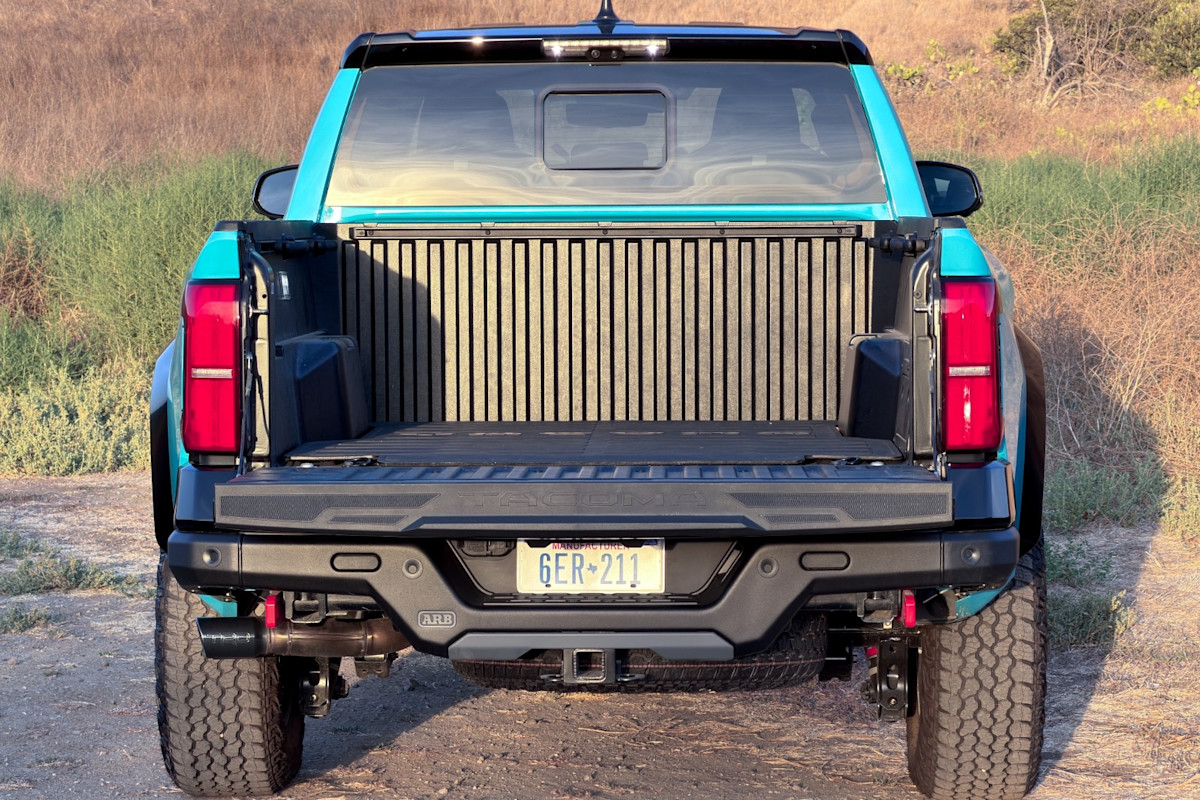
Above the TRD Pro’s standard ARB-sourced steel bumper — equipped with robust recovery hooks — a power tailgate drops to provide access to a 5-foot cargo bed made of sheet-moulded compound reinforced by aluminum. Our test truck had a small storage compartment with a 12-volt power outlet and a USB port, a 2,400-watt household-style AC inverter outlet (standard with the hybrid powertrain), cargo bed lighting, and adjustable tie-down cleats. Toyota offers a long list of cargo bed accessories for the Tacoma.
One thing that came in handy for us was a camera view of the cargo bed, which we used to monitor our luggage on the way home from the airport. It was Jenga’d together right at the cab wall, but without a way to secure it further, we needed to monitor it closely.
Technology
Our TRD Pro tester had the larger 12.3-inch digital instrument cluster and 14-inch touchscreen. Wireless Apple CarPlay and Android Auto are standard. Four connected services plans are also standard with free trial subscriptions on most models. Navigation and the Intelligent Assistant are part of the Drive Connect plan, which is free for three years with higher packages and requires a subscription from day one on lower versions. Safety Connect is complimentary for five years on all models and provides an overhead SOS button.
We found this Toyota Audio Multimedia infotainment system easy to use. It would be great if Toyota offered a standard home screen allowing the driver to simultaneously see the navigation map, music information, and paired phone data, but it's possible to program the digital instrumentation panel to achieve that.
One unusual thing we experienced was a loss of street-level navigation map detail on several occasions. That’s not uncommon for a cloud-based system when the signal drops out, but this happened in areas where service should have been good. The system kept navigating; we just couldn’t see any roads on the map. While Toyota’s voice recognition system usually works well, in the Tacoma it couldn’t direct us to the nearest hospital when prompted.
Our test truck had a JBL premium audio system that sounded OK. It includes a removable Bluetooth-enabled dashboard speaker so that drivers can share their favorite tunes with everyone on the trail, lake, or beach. We’re sure they won’t mind.
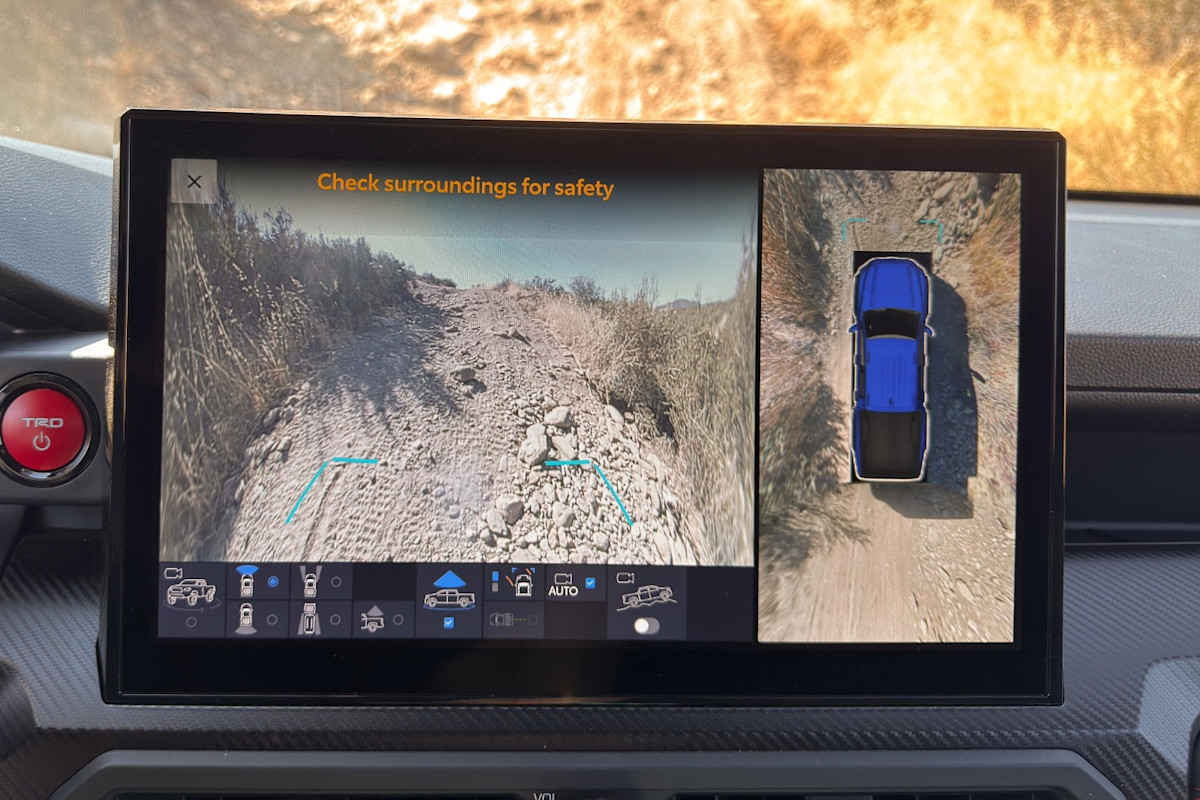
We put the TRD Pro’s Multi-Terrain Monitor camera system to good use. It offers front, side, and rear views and can come in handy when off-roading. However, drivers should still get out and check things for themselves. We didn’t trust the image in one off-roading situation, and it’s a good thing because we may have otherwise gotten ourselves into a bad situation.
Anyone planning to tow will likely appreciate the Trailer Backup Guide with Straight Path Assist system, integrated brake controller, and blind spot monitoring that also covers a trailer. These features are all standard on Tacoma Hybrids and are available on some non-hybrid versions.
Safety
Every 2026 Tacoma has Toyota Safety Sense 3.0 (TSS 3.0), which includes adaptive cruise control, forward collision warning with pedestrian detection, automatic emergency braking, lane departure warning, lane keep assist, lane centring assist, road sign assist, and high beam assist. Blind spot monitoring and rear cross-traffic alert are not part of TSS 3.0 but are also standard in Canada.
Proactive Driving Assist (PDA) is standard on models with the automatic transmission. This Toyota technology can automatically add subtle braking and steering inputs during driving to provide an extra layer of safety. It is effective but can also be aggravating when it unnecessarily brakes or steers.
Drive the Tacoma with the adaptive cruise control and lane centring assist active and there’s very little need for control inputs. However, the steering wheel is not touch-sensitive, so drivers need to periodically add steering inputs. In the Tacoma, the frequency necessary to avoid warnings was too short, making the tech tiring to use on long and straight sections of highway.
In traffic, the driver aids proved adept at smoothly moderating speed when other motorists cut into the gap ahead. When traffic cleared, the truck accelerated back up to the set speed without delay.
Crash test scores could be better. According to the U.S. National Highway Traffic Safety Administration (NHTSA), the Tacoma crew cabs earn a four-star overall rating due mainly to a three-star driver protection score in the frontal impact test. Otherwise, the Tacoma crew cab receives four-star and five-star ratings.
The Insurance Institute for Highway Safety (IIHS) gave the 2026 Tacoma a Marginal rating in its updated moderate overlap frontal impact assessment. Otherwise, the Tacoma earns Good or Acceptable ratings.
Cost-effectiveness
Across its lineup, the 2026 Toyota Tacoma is a cost-effective midsize pickup truck.
It’s available in more configurations than its rivals, and the prices are competitive. Toyota includes generous complimentary trial subscriptions to connected services, particularly the Safety Connect plan. Toyotas are also well known for their long-term reliability, and Tacomas hold their value better than their competitors.
We’re less convinced of the cost effectiveness of the TRD Pro model we tested for this review. It’s expensive, falls well short of fuel economy expectations, and the standard IsoDynamic seats compromise interior room. Unless buyers are genuinely going to use the TRD Pro for its intended purpose, they're better served by a different version of the 2026 Tacoma.
What owners say
Trims & specs
Base MSRP $36,635 | Seating 2 |
Engine 2.4L 278 hp I4 | Cargo Capacity N/A |
Combined MPG 23 | Drivetrain 4X2 |
Base MSRP $42,815 | Seating 5 |
Engine 2.4L 278 hp I4 | Cargo Capacity N/A |
Combined MPG 21 | Drivetrain 4X4 |
Base MSRP $40,905 | Seating 5 |
Engine 2.4L 278 hp I4 | Cargo Capacity N/A |
Combined MPG 21 | Drivetrain 4X4 |
Base MSRP $44,415 | Seating 5 |
Engine 2.4L 278 hp I4 | Cargo Capacity N/A |
Combined MPG 21 | Drivetrain 4X4 |
Base MSRP $40,915 | Seating 5 |
Engine 2.4L 278 hp I4 | Cargo Capacity N/A |
Combined MPG 23 | Drivetrain 4X2 |
Base MSRP $35,745 | Seating 2 |
Engine 2.4L 228 hp I4 | Cargo Capacity N/A |
Combined MPG 21 | Drivetrain 4X4 |
Base MSRP $42,815 | Seating 5 |
Engine 2.4L 278 hp I4 | Cargo Capacity N/A |
Combined MPG 21 | Drivetrain 4X4 |
Base MSRP $37,405 | Seating 5 |
Engine 2.4L 228 hp I4 | Cargo Capacity N/A |
Combined MPG 21 | Drivetrain 4X4 |
Base MSRP $44,115 | Seating 5 |
Engine 2.4L 278 hp I4 | Cargo Capacity N/A |
Combined MPG 21 | Drivetrain 4X4 |
Base MSRP $34,205 | Seating 5 |
Engine 2.4L 228 hp I4 | Cargo Capacity N/A |
Combined MPG 23 | Drivetrain 4X2 |
Base MSRP N/A | Seating N/A |
Engine N/A | Cargo Capacity N/A |
Combined MPG N/A | Drivetrain N/A |
Base MSRP $37,705 | Seating 5 |
Engine 2.4L 278 hp I4 | Cargo Capacity N/A |
Combined MPG 23 | Drivetrain 4X2 |
Base MSRP N/A | Seating N/A |
Engine N/A | Cargo Capacity N/A |
Combined MPG N/A | Drivetrain N/A |
Base MSRP $38,205 | Seating 5 |
Engine 2.4L 278 hp I4 | Cargo Capacity N/A |
Combined MPG 23 | Drivetrain 4X2 |
Base MSRP $39,835 | Seating 2 |
Engine 2.4L 278 hp I4 | Cargo Capacity N/A |
Combined MPG 21 | Drivetrain 4X4 |
Base MSRP $41,405 | Seating 5 |
Engine 2.4L 278 hp I4 | Cargo Capacity N/A |
Combined MPG 21 | Drivetrain 4X4 |
Base MSRP $53,570 | Seating 5 |
Engine 2.4L 278 hp I4 | Cargo Capacity N/A |
Combined MPG 21 | Drivetrain 4X4 |
Base MSRP $39,135 | Seating 2 |
Engine 2.4L 278 hp I4 | Cargo Capacity N/A |
Combined MPG 23 | Drivetrain 4X2 |
Base MSRP N/A | Seating N/A |
Engine N/A | Cargo Capacity N/A |
Combined MPG N/A | Drivetrain N/A |
Base MSRP $32,545 | Seating 2 |
Engine 2.4L 228 hp I4 | Cargo Capacity N/A |
Combined MPG 23 | Drivetrain 4X2 |
Base MSRP $40,415 | Seating 5 |
Engine 2.4L 278 hp I4 | Cargo Capacity N/A |
Combined MPG 23 | Drivetrain 4X2 |
Base MSRP N/A | Seating N/A |
Engine N/A | Cargo Capacity N/A |
Combined MPG N/A | Drivetrain N/A |
Base MSRP N/A | Seating N/A |
Engine N/A | Cargo Capacity N/A |
Combined MPG N/A | Drivetrain N/A |


