2026 BMW M5 Reviews, Pricing & Specs
Pros & cons
What we like
Multiple body styles
Versatile plug-in hybrid powertrain
Excellent blend of performance and everyday comfort
What to consider
Potentially polarizing design
Awkward dashboard layout
Gaudy interior
Expert review
With rivals from Audi and Mercedes-Benz on hiatus, the BMW M5’s combination of performance and practicality stands out even more.
One of the most hallowed names in BMW lore, the M5 is a high-performance version of the midsize 5 Series with extensive powertrain upgrades to suit the racetrack and autobahn alike. The M5 underwent what is arguably its most extensive redesign ever for the 2025 model year, switching to the current-generation 5 Series body (known as the G60) and gaining a first-ever plug-in hybrid powertrain. As such, changes for 2026 are limited to a more powerful onboard charger and more paint options.
Verdict: Today’s M5 is unrecognizable from previous generations, but it’s still a compelling performance car.
out of 10 expert review
Look & feel
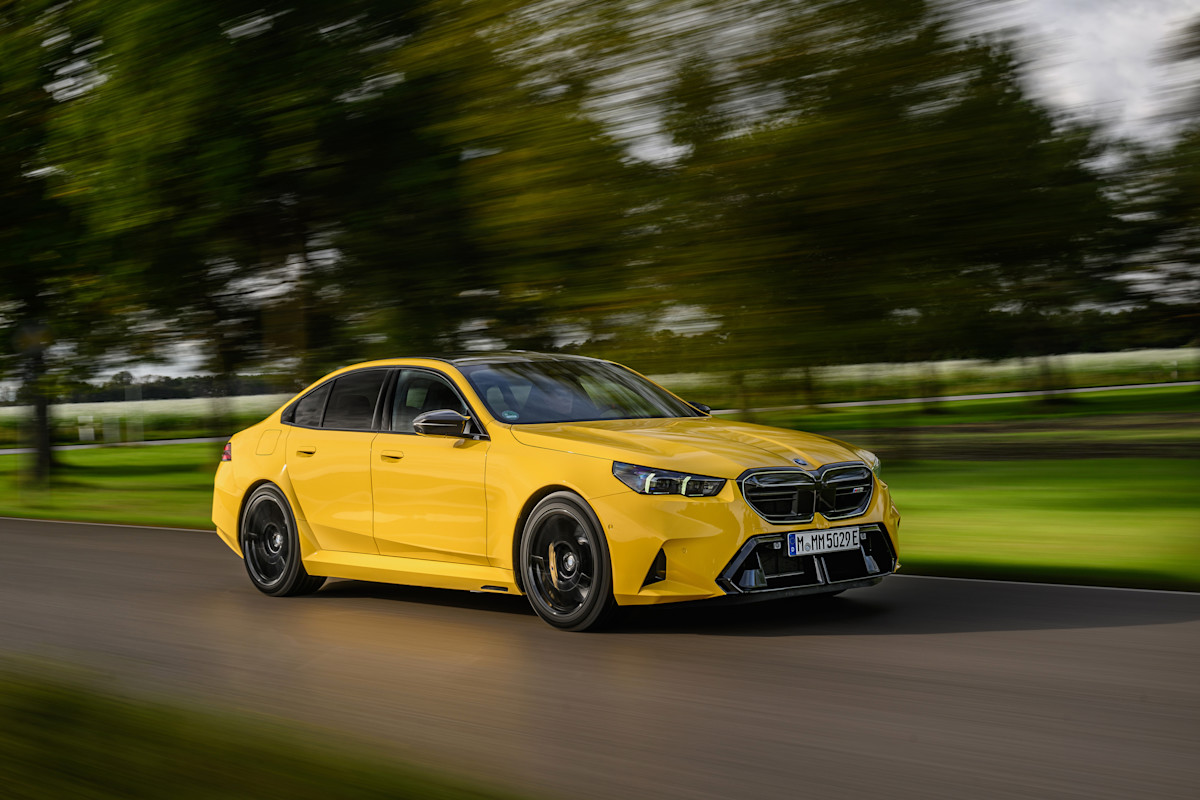
For most of its history the M5 has leaned toward subtlety, but subtlety isn’t in the vocabulary of BMW’s current design language. The 2026 BMW M5 takes the already-awkward shape of the current 5 Series and adds a big helping of M-specific callouts. The result isn’t pretty, but at least there’s no doubt that it's an M5.
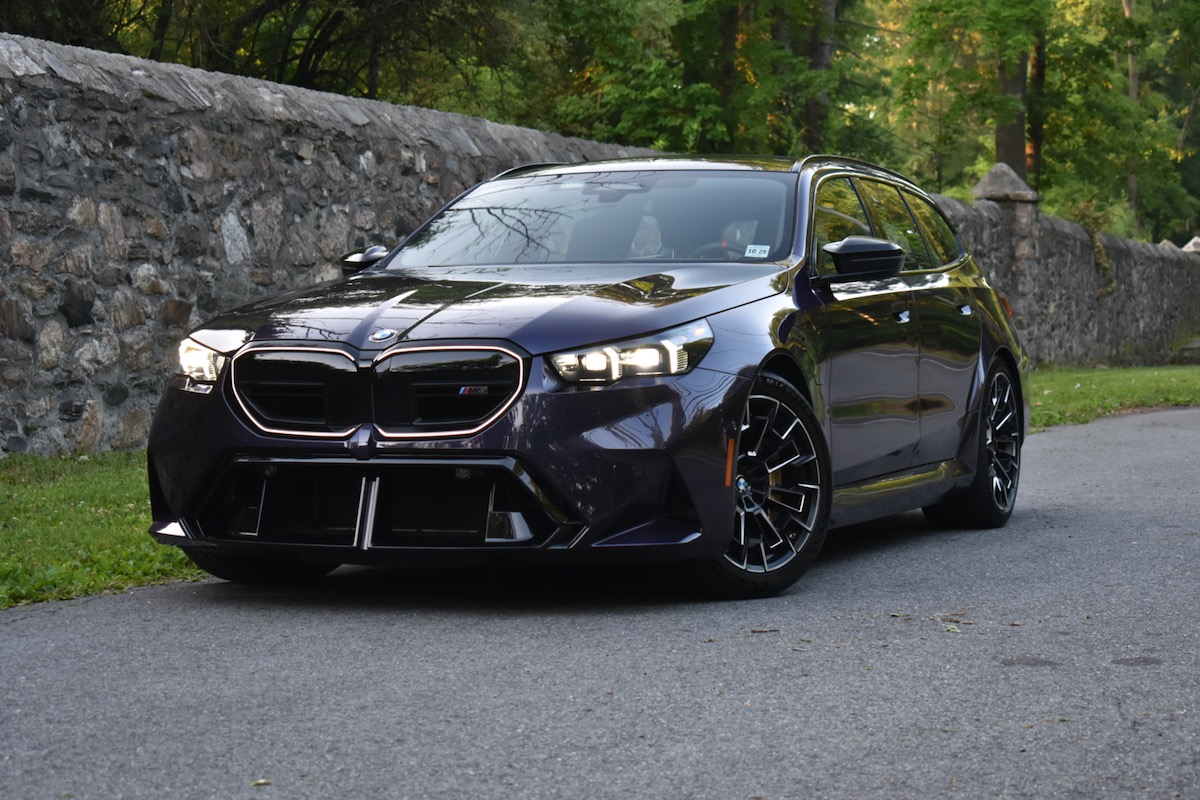
The changes start up front where the grille has been so enlarged that nostrils had to be molded into the hood to accommodate it. Standard grille lighting emphasizes the signature “twin kidney” shape, but the grille itself is a black hole containing mismatched bits of plastic. Below it is an equally busy lower opening with odd protuberances that do at least resemble the struts that hold up front splitters on race cars.
The profile view is a bit better with fender flares that are well integrated with the rest of the body rather than looking tacked on. They make room for steamroller-worthy 285/40 ZR20 front and 295/35 ZR21 tires, with 20-inch front and 21-inch rear wheels. Those wheels have a distinctive look like spokes within spokes, enhanced by the bi-colour treatment of our test car’s Style 952M option.
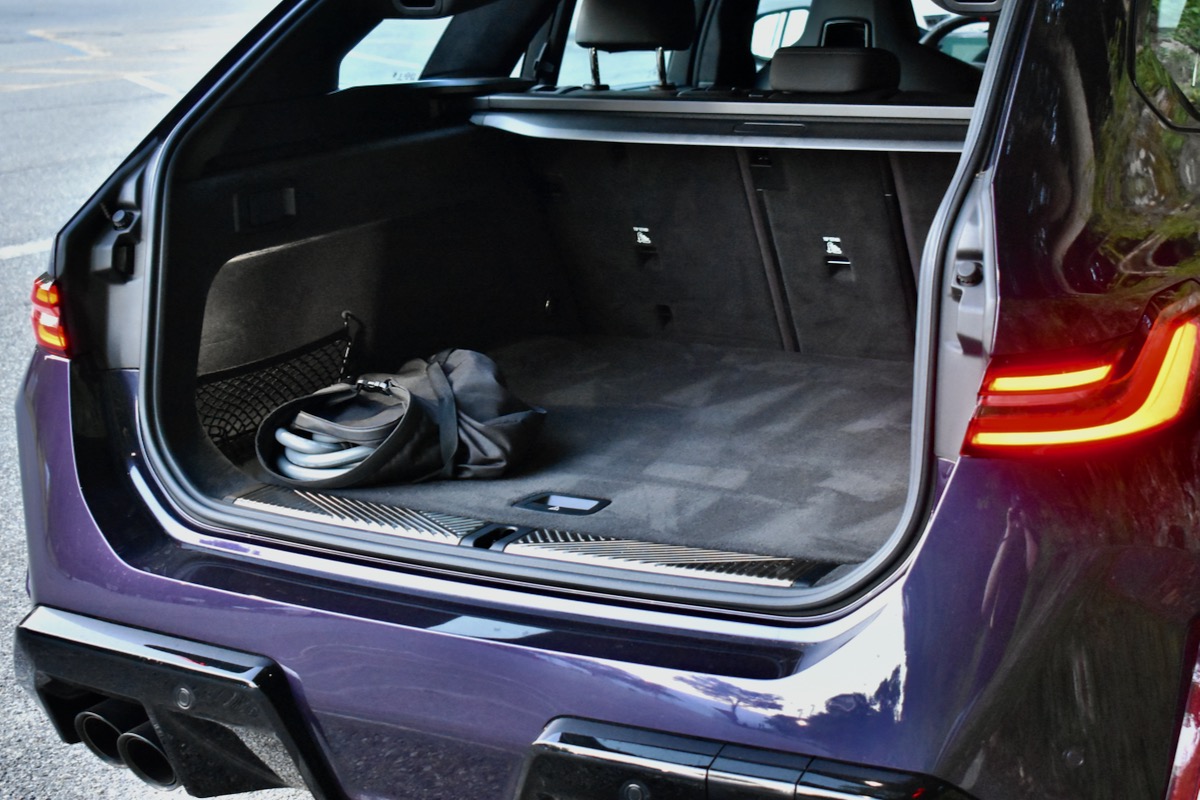
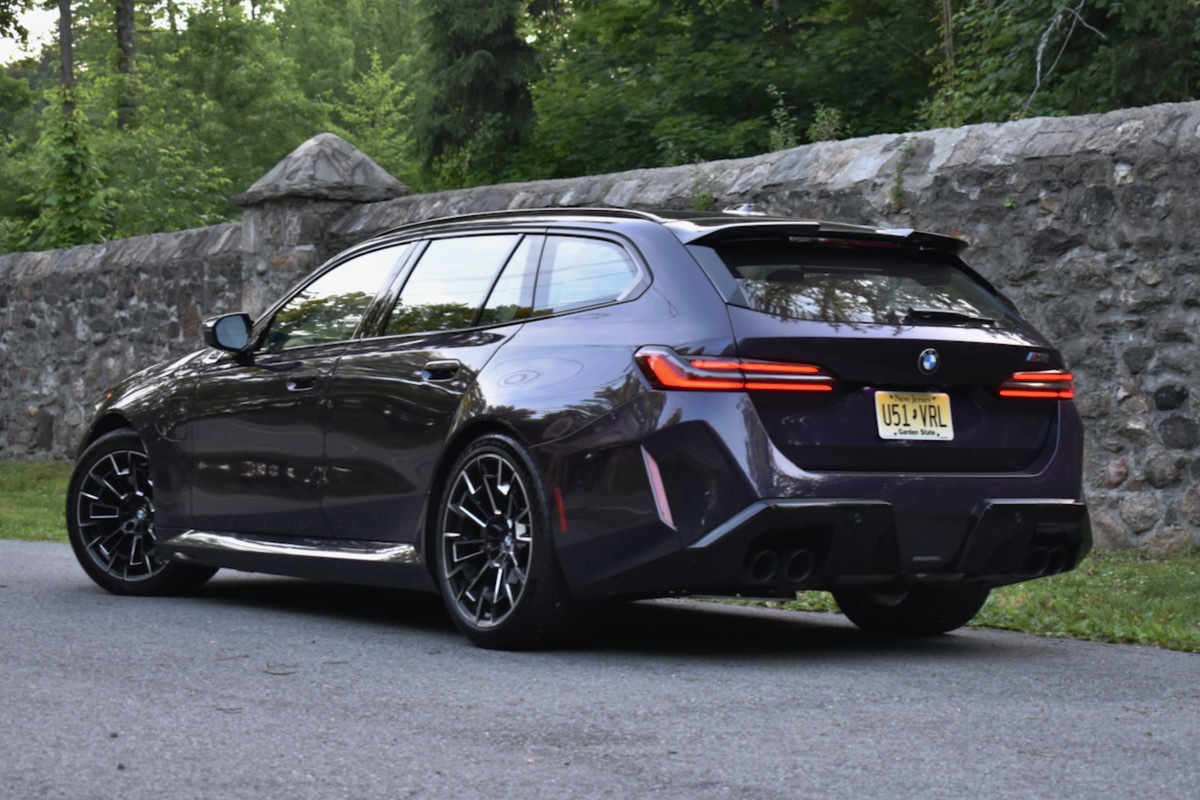
For the first time in North America, the M5 is available as either a sedan or a Touring wagon. Our test car was the latter, and we were impressed by the stately appearance of the long-roof body style. Touring models get a small rear spoiler above the tailgate and underfloor bracing, while both the sedan and wagon have a rear diffuser flanked by quad exhaust tips. BMW claims the diffuser does real aerodynamic work, but both it and those sporty exhaust tips get lost in the blacked-out lower rear bumper trim.
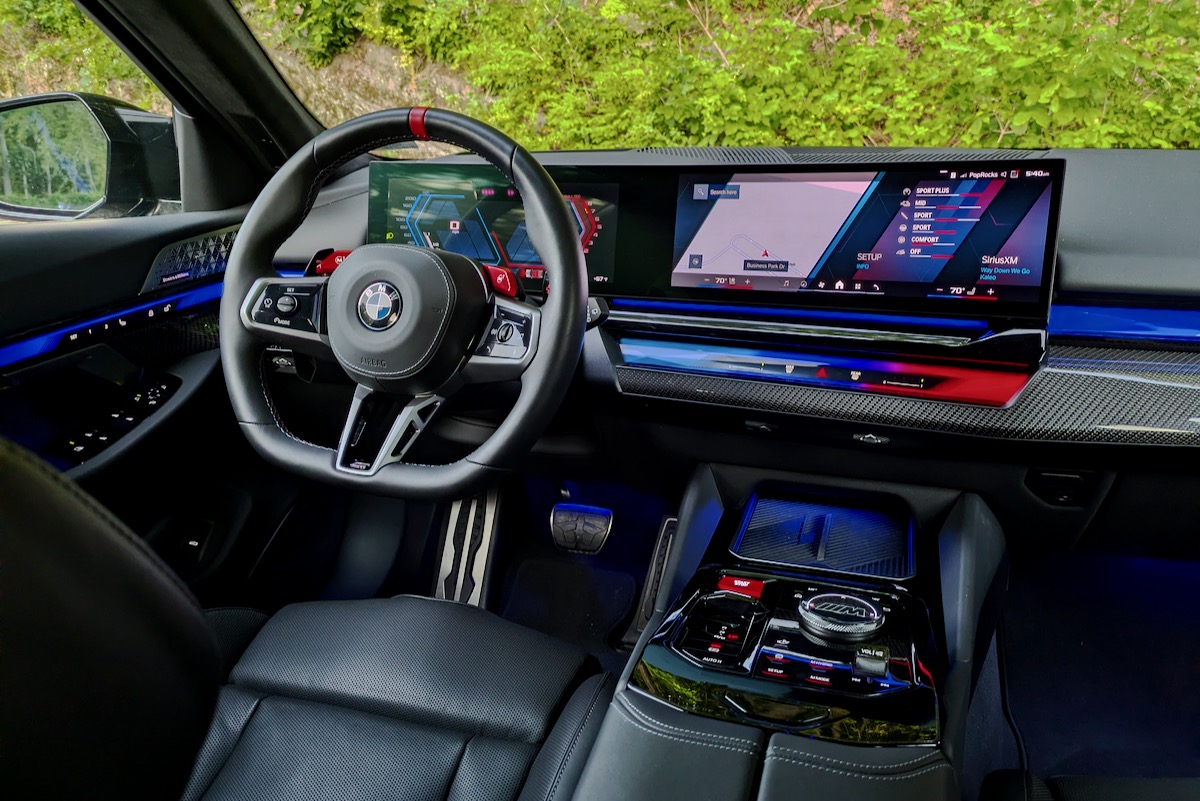
Like the exterior, the interior emphasizes drama over elegance. It’s defined by jarring angles with each piece of trim meeting up with its neighbour like colliding tectonic plates. Up front, a blue light bar runs along the perimeter of the dashboard and contains haptic controls for the likes of door locks and the fuel filler cap. It looks cool, but it’s a bit distracting at night.
M-specific touches include a leather-wrapped steering wheel with paddle shifters and two buttons that pull up performance presets, plus well-bolstered Merino leather front seats. Front and rear seat heating and a heated steering wheel are standard in Canada. A glass roof with a power sunshade is also standard, and sedans can be equipped with a carbon fibre exterior package including the roof. Overall material quality meets expectations, but there is still a lot of black plastic that produces a distracting glare in direct sunlight.
Performance
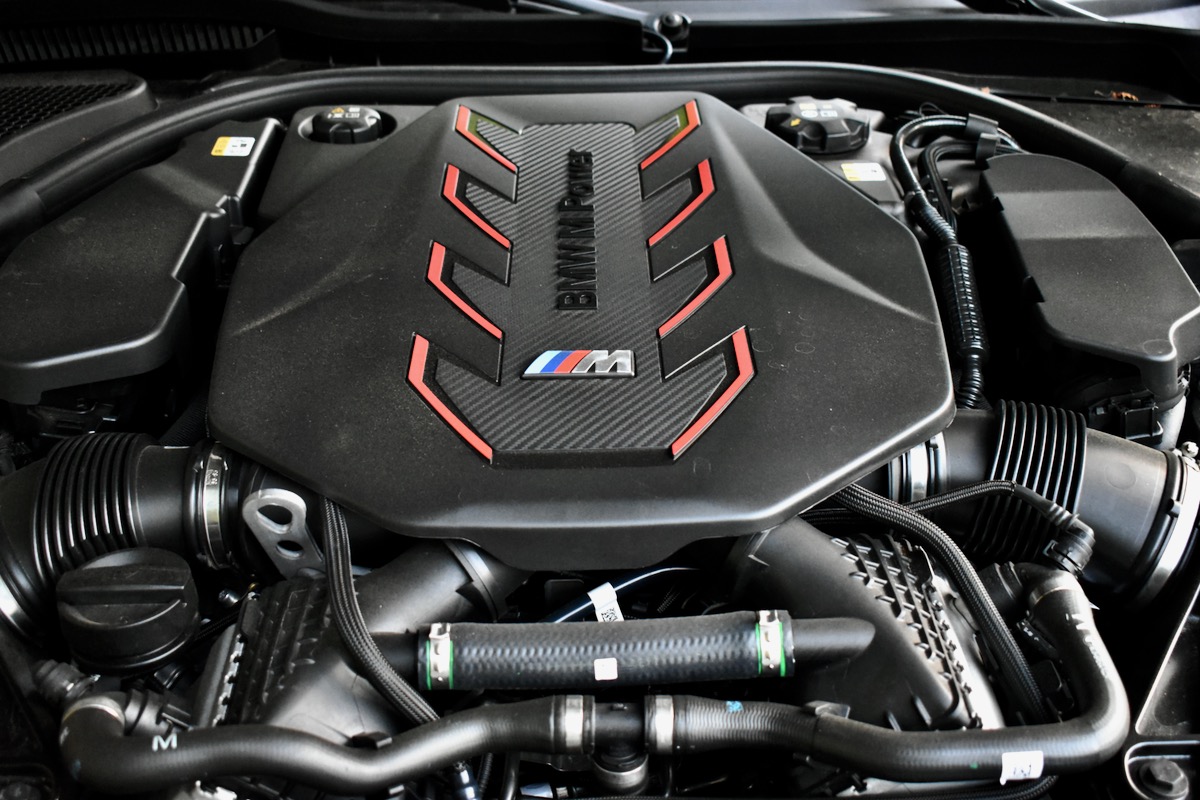
BMW threw everything it had at the 5 Series to turn it into the M5. Under the hood is a 4.4-litre twin-turbocharged V8 connected to an eight-speed automatic transmission and a plug-in hybrid system. The latter consists of an electric motor integrated with the transmission and a 14.8-kilowatt-hour battery pack. Total system output is 717 horsepower and 738 pound-feet of torque.
That power is channeled to the wheels through an M-specific version of BMW’s xDrive all-wheel drive (AWD), which allows drivers to decouple the front axle to make the M5 rear-wheel drive (RWD). Doing so also deactivates the stability control to make drifting easier (on a track, of course). The Active M Differential also adjusts the power split between the left and right rear wheels, providing a torque-vectoring effect to aid cornering.
In maximum-grip AWD mode, BMW says the M5 sedan will do 0–100 km/h in 3.5 seconds. The M5 Touring takes 0.1 second longer, which is also 0.2 second behind the Audi RS 6 Avant that's due to cease production at the end of the 2026 model year. Still, a hard launch is a proper thrown-into-your-seatback experience. And the M5 will keep accelerating until it runs into its electronic limiter at 250 km/h, or 305 km/h with the $2,500 M Driver’s Package. That package also includes a performance driving class to help owners get the most out of their cars.
Other notable performance features include active steering, adaptive dampers, and powerful brakes. Six-piston calipers and 16.1-inch rotors at the front and 15.7-inch rear rotors with single-piston floating calipers are standard. Carbon ceramics are available for a steep $10,900.
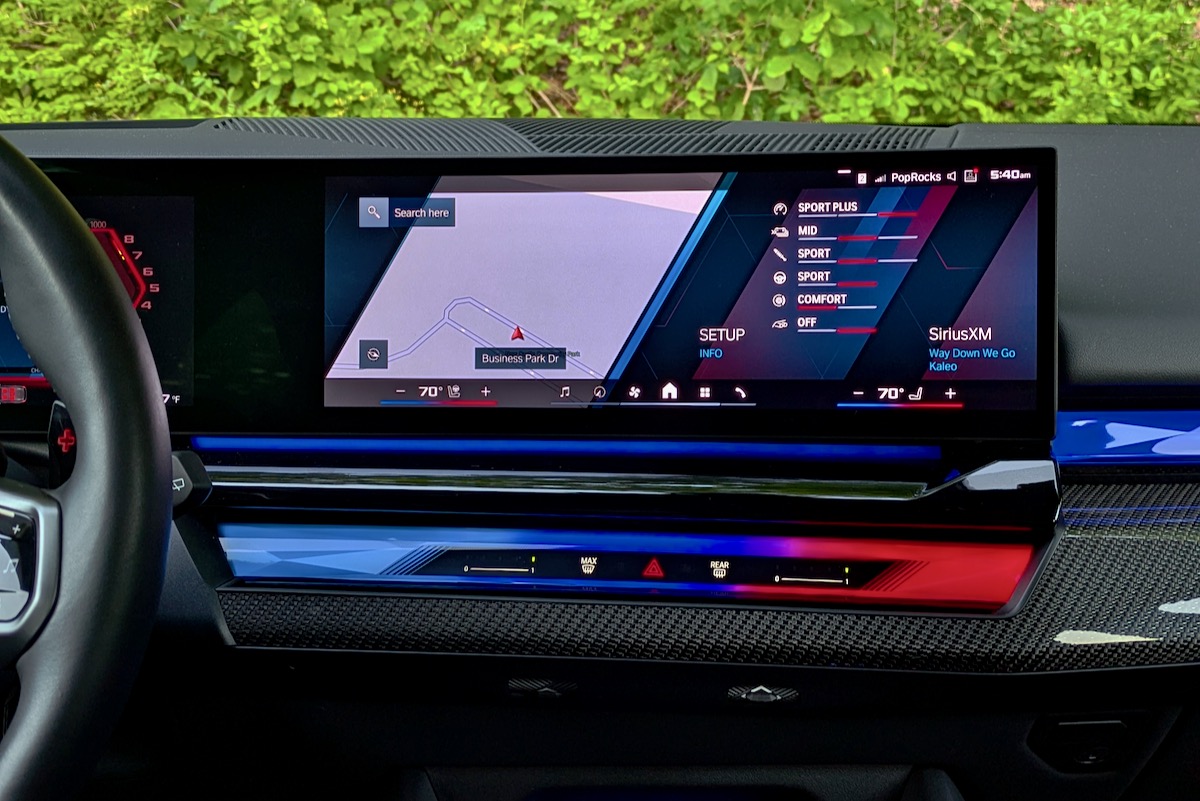
The electronic controls for the chassis and powertrain are well integrated and adjustable. Drivers can individually adjust the steering, brake feel, dampers, and powertrain, as well as the exhaust sound and regenerative braking. Settings can be saved and activated using the steering-wheel M buttons. Road, Sport, Track, Dynamic, and Dynamic Plus drive modes are equipped as standard in Canada.
All this makes the M5 as complicated as it is heavy at a base curb weight for the sedan of 2,445 kilograms (5,390 pounds), but BMW’s engineers made it work. The chassis tech feels natural, the amount of power on tap counteracts the weight, and the grippy tires and AWD system inspire confidence. It’s definitely not the purest driving experience but rather one defined by breadth of capability. The steering is wonderfully precise but lacks feel, and with peak torque arriving at just 1,800 rpm, drivers are approaching illegal speeds before they can really enjoy that V8.
The M5 will make a meal of a favourite driving road while preserving the driver’s back on the more sedate ride home. Even when the dampers are in the Sport Plus setting, ride quality is tolerable on less-than-perfect pavement. Dial everything back to Comfort mode and the M5 is a serene highway cruiser that maintains its quick reflexes. That BMW lets drivers choose degrees of sportiness or comfort rather than making it an all-or-nothing thing is what makes the M5 stand out, even among other luxury performance sedans and SUVs.
Form & function
Because it’s still a BMW 5 Series, the M5 offers generous interior space comparable to other midsize luxury cars. Outward visibility is also remarkably good despite the tall and deep dashboard needed to accommodate screens and fairly high body sides. Large exterior mirrors are a big help, although they create significant wind noise at highway speeds.
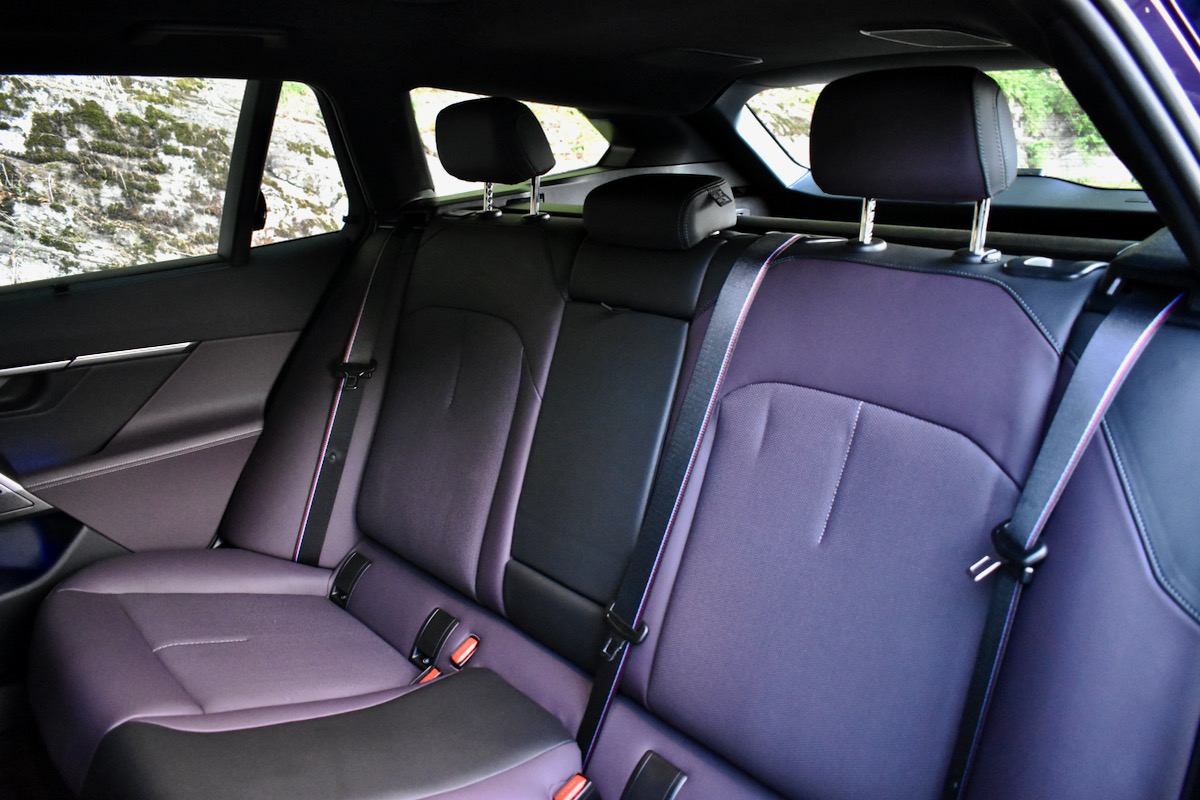
The front seats deserve a shoutout for substantial bolstering. It keeps occupants from sliding around during hard cornering but doesn’t impede ingress and egress or hip room. However, the backrest padding is a little too thin for our liking.
The M5 sedan offers a useful 466 litres of trunk space, while cargo space in the Touring wagon starts at 500 litres and expands to 1,630 litres when the standard 40/20/40-split rear bench seat is folded down. Both values are less than those of Audi or Mercedes-Benz wagons, but there’s still plenty of room for dogs or impulse buys
Where the M5 falters is ergonomics. The wireless phone charger is completely blocked by the cupholders, although that’s admittedly a good way to keep drivers from using their phones on the move. Less defensible is the centre console panel that houses the shifter, the rotary controller for the iDrive infotainment system, and other controls. In our experience, at least, many of these controls are hard to reach and identify while driving. That’s because some are haptic touchpoints for which it's hard to establish muscle memory. Audio volume is controlled by a scroll wheel, but it's just too far from the driver’s side of the console.
Technology
The M5’s high-tech powertrain and chassis are matched by a high-tech interface. The standard BMW Curved Display combines a 12.3-inch digital instrument cluster and 14.9-inch touchscreen into one housing. The aforementioned curvature makes it easier to see both screens from the driver’s seat, and the graphics are crisp and clear. The main touchscreen also helpfully shows the various powertrain and chassis settings by default, although having to use the screen to change them is a bit awkward.
The iDrive infotainment system allows drivers to use the signature rotary controller on the centre console, the touchscreen, or a natural-language voice assistant. The M5 has version 8.5 of the iDrive operating system, incorporating wireless Apple CarPlay and Android Auto connectivity, YouTube video streaming, and AirConsole gaming (the latter two while stationary only, of course).
An 18-speaker Bowers & Wilkins audio system and digital key functionality are standard, too, along with a lap timer and a head-up display that can show a tachometer and shift lights. The built-in navigation system also has a helpful augmented reality function that overlays an arrow onto a live camera feed of upcoming turns to show drivers exactly where to go.
Safety
Standard driver assistance features include forward collision warning, automatic emergency braking, lane keep assist, adaptive cruise control with automatic speed limit adjustment, blind spot monitoring, front and rear cross-traffic alert, parking sensors, and a Parking Assistant that can automatically reverse the car out of tight parking spaces or driveways by mirroring the original control inputs made by the driver to enter the space.
The $2,000 Driving Assistant Professional Package adds automated lane centring for highway driving and a Traffic Jam Assistant that facilitates hands-free driving in stop-and-go highway traffic at speeds up to 65 km/h. However, BMW doesn’t offer hands-free capability at higher speeds.
What BMW does offer is the ability to tailor the driver aids. A Sport setting deactivates most steering and brake interventions but keeps forward collision warning and automatic emergency braking active. Track mode turns everything off completely. These systems can be more annoying than helpful during enthusiastic driving, so this is very much appreciated.
Crash-test results from the Insurance Institute for Highway Safety (IIHS) and the U.S. National Highway Traffic Safety Administration (NHTSA) were not available at the time of writing. NHTSA hadn’t rated the 5 Series on which the M5 is based, either, while the IIHS had not published complete ratings. It did give the base 5 Series top “Good” ratings in the small overlap front and updated side-impact tests, which bodes well.
Cost-effectiveness
The M5 is a usable plug-in hybrid with 47 kilometres of electric range for the sedan and 40 kilometres for the M5 Touring wagon according to Natural Resources Canada. Electric mode is also available at speeds up to 140 km/h. For 2026, the onboard charger’s maximum power rate rises from 7.4 kilowatts to 11 kW, although BMW hasn’t quoted a new charge time.
In hybrid mode, the M5 sedan is rated at 16.4 L/100 km combined, while the wagon is rated at 17.5 L/100 km combined. That’s about the best that can be expected from a high-horsepower V8, but real-world efficiency will likely be better for those who regularly plug in the M5 and take full advantage of its all-electric range. With electric running factored in, we averaged 10.7 L/100 km, according to the car’s trip computer.
Pricing starts at $145,855 for the sedan and $150,855 for the wagon. (Both prices include a $2,955 destination charge but do not include the federal government’s luxury tax, which BMW estimates at roughly $9,300 and $10,300 respectively after fees.) Expensive options like the carbon-ceramic brakes will add to that cost, but they aren’t necessary unless drivers regularly visit the track.
For 2026, several of the M5’s traditional rivals are on hiatus or heading for the exit. The 621-hp Audi RS 6 Avant wagon starts at $145,125 before luxury tax and is just as quick as the M5 Touring, but production will likely have ended by the time this article is published. Porsche no longer offers a wagon version of the Panamera (the all-electric Taycan Cross Turismo and GTS Sport Turismo fill that niche), and M5 money only buys the 348-hp Panamera 4 model. The $114,499 Cadillac CT5-V Blackwing also isn’t available as a wagon, but it provides a throwback driving experience complete with an available manual transmission.
Like the M5, the Mercedes-AMG E 53 Hybrid is also a plug-in hybrid available as both a sedan and a wagon. It lacks some of the BMW’s chassis tech — Mercedes is keeping some stuff on the shelf for a future AMG E 63 — and has “only” 577 hp. But it’s nearly as quick as the M5 to 100 km/h, has an NRCan-rated 71 km of electric range in sedan form (66 km for the wagon), and starts at $110,695. But for those who want the most of everything in a four-door luxury performance car, the M5 is hard to beat. And until that new E 63 wagon arrives, the M5 Touring is effectively in a class of its own.

What owners say
Trims & specs
Base MSRP $125,300 | Seating 5 |
Engine 4.4L 717 hp V8 Hybrid | Cargo Capacity 27.2 cu ft |
Combined MPG 54 | Drivetrain AWD |
Base MSRP $123,300 | Seating 5 |
Engine 4.4L 717 hp V8 Hybrid | Cargo Capacity 16.5 cu ft |
Combined MPG 48 | Drivetrain AWD |


Pricing trends
MSRP range
$123,300 - $125,300
Current avg. market price
$148,165
Trending down by 0.8% this month
May 2026 - October 2026