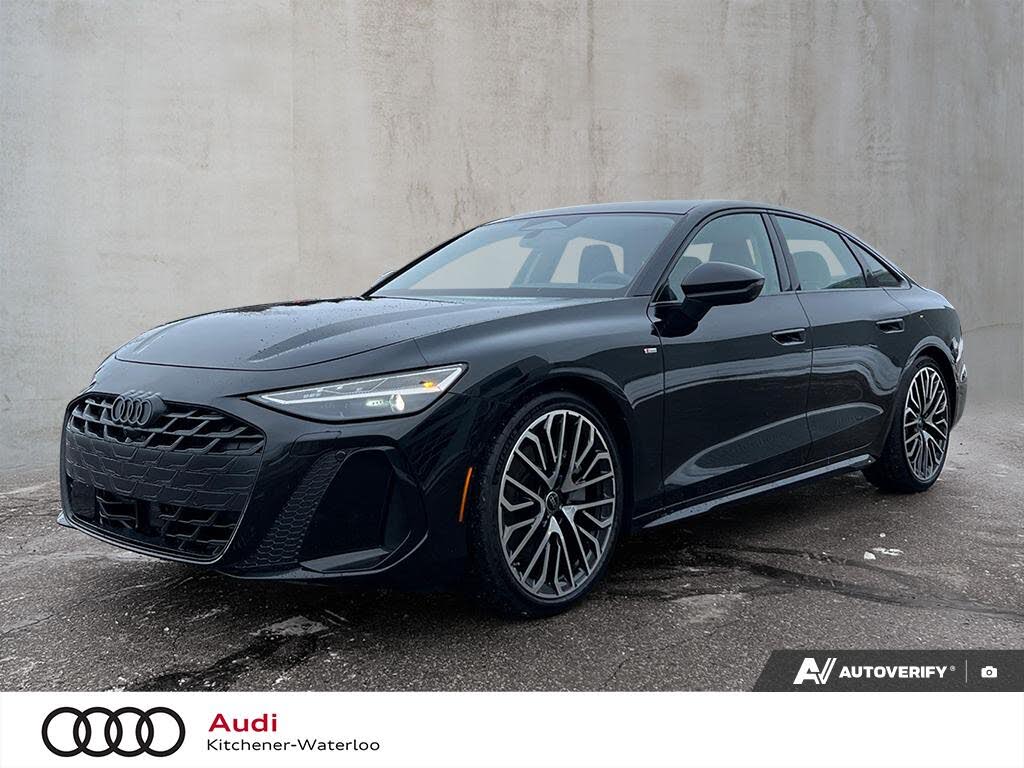
2026 Audi A6 Reviews, Pricing & Specs


Pros & cons
What we like
Powerful engine
Standard all-wheel drive
Spacious
What to consider
Unimpressive interior materials
Poorly executed infotainment system
Unrefined driving experience
Expert review
For new car shoppers who feel paralyzed by choice, the Audi A6 offers everything a luxury sedan should have in one package.
The redesigned 2026 Audi A6 marks the ninth generation of midsize luxury sedans from Ingolstadt, Germany. While it shares a name and some tech features with the Audi A6 e-tron introduced for the 2025 model year, the gasoline A6 is an otherwise different vehicle based on the same Premium Platform Combustion (PPC) as the A5 sedan and Q5 crossover. A redesign was certainly needed as most other midsize luxury sedans—specifically the BMW 5 Series and the Mercedes-Benz E-Class—were renewed more recently, and we haven’t had a genuinely new A6 since the 2020 model year.
Verdict: On paper, the A6 looks like more of a premium product than before, but it doesn’t feel that way from behind the wheel, and the tech is a work in progress.
out of 10 expert review
Look & feel
Like the smaller A5, the new A6 is handsome, if not visually striking. The trademark “singleframe” grille is now lower and pushed further out from the rest of the bodywork. Fender flares inspired by the iconic Quattro rally car and a pronounced rib in the lower door skins provide a lot of definition along the sides, but only if you’re looking down and at an angle. This Audi doesn’t make as much of an impression as a Cadillac CT5, but it’s not ungainly like the BMW 5 Series, and it’s more subdued than the Mercedes-Benz E-Class and its firmament of illuminated Mercedes logos.
The A6 has its own lighting party trick, though. Like other recent Audi models, the LED headlights have a pixelated effect with multiple programmable signatures to choose from for the daytime running lights. The taillights have been moved down and to the side to make room for programmable lights that can show different icons, such as a triangle when the hazards are on or an “A” when auto park mode is engaged. Unfortunately, these two symbols look very similar, and the regular flashing of the hazards gets more attention than the tiny triangle.
As is typical of Audi in Canada, the 2026 A6 is available in base, Progressiv, and Technik trim levels. The redesigned model is only available as a sedan for now, although Audi is still selling the previous-generation RS 6 Avant wagon as a 2026 model. Also missing is the S6 variant, although Audi is trying to incorporate features normally reserved for that sportier model into the regular A6 lineup.
An S Line Black package for the Technik trim level incorporates a sportier front bumper, blacked-out trim, and dark chrome 20-inch wheels. These wheels, along with a standalone 20-inch option, come with all-season tires, as do the 19-inch wheels on the base A6 (and these are run-flats). An available Sport Plus Package includes 21-inch wheels with summer tires.
Even in the top-spec Technik model, the materials are disappointingly bland and cheap-feeling. Almost everything you touch is tinny plastic.
Performance
The previous powertrain choices are gone for 2026, but what remains is compelling. The last engine standing is a turbocharged 3.0-litre V6, connected to a seven-speed dual-clutch transmission and standard quattro all-wheel drive (AWD).
This is the same engine used in the S5 sedan, and it makes the same 362 horsepower and 406 pound-feet of torque here. That’s 27 hp and 37 lb-ft of torque more than the more powerful of the two powertrain options for the 2025 A6. Despite its larger size, the A6 also weighs about the same as the S5 (not sure what that says about the latter), so it’s only 0.2 seconds slower from zero to 100 km/h. And the A6’s 4.8-second time is much quicker than a base BMW 5 Series or Mercedes E-Class can manage, as both come standard with less-powerful turbo-four-cylinder engines.
The amount of power on tap makes the A6 feel as energetic as one would expect of a sporty luxury sedan—if you can access it. There is a notable hesitation from the transmission when accelerating from a stop under heavy throttle, something we also noticed in the A5. Once up to speed, shifts are at least fairly smooth, which isn’t a given with dual-clutch gearboxes.
The more powerful V6 helps to make up for the lack of a dedicated S6 model at launch, as do a number of chassis enhancements. Brake-based torque vectoring is standard, while the Sport Plus package for the top A6 Technik trim level includes Audi’s sport rear differential. Previously reserved for Audi S and RS models, it applies more torque to the outside wheel when cornering to keep understeer in check. But while we were impressed by the A6’s overall handling neutrality, the sport differential only made a difference when we really pushed it.
The Sport Plus package also includes steel-spring suspension that gives the A6 a 1.7-centimetre lower ride height. That provides sportier handling, but it comes without the bandwidth for comfort afforded by the adaptive air suspension that’s standard on Technik models without this package. We felt the degradation in ride quality was much greater than the improvement in handling.
Also part of the Sport Plus package is rear-axle steering that decreases the turning circle by up to a metre flat at lower speeds and increases stability at higher speeds, according to Audi. All models have a progressive steering rack that becomes more responsive at higher steering angles to make the A6 feel nimbler and slows down at higher speeds to provide autobahn-worthy stability.
The base steering system provides excellent precision, albeit with a bit too much artificial heft when switching from the default Balanced drive mode to Dynamic. The third Comfort mode made little discernible difference in behaviour, and the same is true of the various enhancements of the Sport Plus package when taken together. The A6 is a very stable and composed car, but it’s definitely better suited to highway blasts than canyon carving. And even while cruising, the amount of tire noise on anything less than autobahn-smooth pavement is decidedly un-premium.
Form & function
The new A6 is six centimetres longer than the outgoing model but has the same 2,923-millimetre wheelbase, meaning that stretch in overall length doesn’t benefit passenger space. Front-seat headroom increases by five centimetres, but that’s thanks to the new panoramic glass roof. It stretches all the way to the back seats and has six dimmable panels so you can select your preferred level of sunshine regardless of where you’re sitting. However, rear seat headroom is about the same, as is legroom in both rows.
That leaves the A6 with comparable headroom and legroom to a BMW 5 Series for both front-seat and rear-seat occupants. Those in the back seats will have a bit less headroom in a Cadillac CT5, but a bit more legroom. They get climate controls and a pair of USB-C ports in the Audi, and all models in Canada have heated rear seats. Heated and ventilated front seats are standard, and a massaging function is available. The sport seats had a good balance of bolstering and cushioning that should make them comfortable over the long hauls between fun driving roads.
Unlike the smaller A5 and the electric A6 e-tron, which are technically hatchbacks, Audi sticks with a conventional trunk here along with 40/20/40 split-folding rear seats to accommodate longer items. With the back seats in place, trunk space drops by just over five litres compared to the previous generation, to 382 litres. That’s more cargo space than a CT5 or a Mercedes-Benz E-Class, but the 5 Series can swallow up to 521 litres of cargo.
Technology
This redesign brings the Digital Stage setup from the A5, Q5, and A6 e-tron to Audi’s gasoline-powered midsize sedan. A standard 11.9-inch digital instrument cluster and 14.5-inch touchscreen flank the driver like an elaborate multi-monitor desktop setup, although the housing is much larger than the screens themselves. An optional 10.9-inch front-passenger touchscreen accounts for the fact that the main touchscreen is tilted too far toward the driver to be easily used by the co-driver.
The screens are bigger and more numerous than in the outgoing A6, but that doesn’t improve the experience. The latest MMI (Multimedia Interface) infotainment system waters things down with layouts that are both oversimplified and hard to interpret. Audi’s improved voice recognition system helps to some extent, as do standard wireless Apple CarPlay and Android Auto, but not with things like reading the small, unorganized bits of text in the instrument cluster. Having to manually close pop-up menus after changing drive modes or turning on the seat massagers isn’t very convenient, either.
Audi knows this, and an entirely new interface is rolling out midway through the model year. That upgrade will also bring an integrated dashcam and a new steering wheel that relies less on haptic controls. Early-build cars can’t be refitted, though, so it’s best to wait a few months before heading to the dealership.
The optional Bang & Olufsen 3D audio system is remarkable, not for its audio quality but for the headrest speakers that allow navigation directions to be piped directly to the driver rather than blasted throughout the cabin and over whatever music is being played.
Safety
The A6 comes standard with the expected array of driver-assist features, including adaptive cruise control, forward collision warning, automatic emergency braking, rear cross-traffic alert, blind spot monitors, traffic sign recognition, parking sensors, and lane departure warning.
Audi doesn’t offer a hands-free driving system, and the lane centring feature allows the A6 to wobble from one side of the lane to the other quite a bit. Robust driver monitoring is at least part of the package—helping to guard against misuse of the tech—and the threshold for warnings of all sorts was higher than in an A6 e-tron we’ve driven previously. In that car, the tech was sensitive enough to be a distraction in its own right.
Crash-test ratings from the Insurance Institute for Highway Safety (IIHS) and National Highway Traffic Safety Administration (NHTSA) were not available at the time of writing. That’s typical for the first model year of a new generation of a given vehicle.
Cost-effectiveness
The A6’s Natural Resources Canada-rated 10.2 litres per 100 kilometres combined (12.1 city, 8 highway) isn’t bad for a sizeable sedan with a V6 and AWD. We averaged 10.7 L/100 km (according to the car’s trip computer) on a hilly, twisty route without really trying to be efficient, so it’s at least easy to get close to that rating in the real world.
Pricing starts at $85,150 for the base A6 (all prices include Audi Canada’s $2,800 destination charge and other fees). That’s an increase of more than $10,000 over the 2025 model, but the 2026 model has more standard equipment and that more powerful standard engine. The Audi’s base price is a few grand higher than that of an equivalent BMW 530i and Mercedes-Benz E 350, but those versions lack comparable power. The recently refreshed Cadillac CT5 is the real bargain, starting more than $10,000 lower than any of the German sedans.
The Progressiv and Technik trims start at $89,650 and $91,100 respectively, including fees. Based on the sampling of cars Audi made available for this test drive, it’s possible to spend more than $100,000 on an A6 if you check all the boxes. That’s not unreasonable for the segment, but most rivals also offer a powertrain upgrade at that price.
Audi’s four-year/80,000-kilometre warranty is comparable to that of BMW, Mercedes, and most other luxury brands.
By dialing up performance and adding more convenience features, the 2026 Audi A6 is reasonable value for a luxury sedan. Rivals offer more options, but the A6 covers the bases well as a single model. We just wish the luxury bona fides extended beyond the features list to the look and feel of the interior and the level of refinement of the driving experience. And even if you test drive an A6 and find it acceptable, there’s no point in buying one today when an improved interface is scheduled to arrive in just a few months.

What owners say
Trims & specs
Base MSRP $71,400 | Seating 5 |
Engine 3.0L 362 hp V6 | Cargo Capacity 13.5 cu ft |
Combined MPG 24 | Drivetrain AWD |
Base MSRP $64,100 | Seating 5 |
Engine 3.0L 362 hp V6 | Cargo Capacity 13.5 cu ft |
Combined MPG 24 | Drivetrain AWD |
Base MSRP $67,500 | Seating 5 |
Engine 3.0L 362 hp V6 | Cargo Capacity 13.5 cu ft |
Combined MPG 24 | Drivetrain AWD |