2025 MINI Countryman Reviews, Pricing & Specs


Pros & cons
What we like
Multiple powertrain options
Stylish design
Fun to drive
What to consider
Dissatisfying steering
Poor ride quality
Unintuitive technology
Expert review
The redesigned 2025 Mini Countryman is big on personality but short on refinement.
Redesigned this year, the 2025 Countryman grows in size but remains a small crossover SUV. Expressively styled, infused with parent company BMW’s engineering and technology, and packed with cheeky Mini quirks, the Countryman is available in S All4, John Cooper Works All4, and electric SE All4 model series, each equipped with standard All4 all-wheel drive (AWD). It can comfortably hold rear-seat passengers, carries a competitive amount of cargo, and remains fun to drive.
Verdict: With prices starting at around $45,000 in Canada before fees, the Mini Countryman sells in entry-level luxury territory. However, anyone expecting plush refinement will want to shop elsewhere because the Countryman is decidedly rough around the edges. We begrudgingly accept its quirks in exchange for its personality, but many people likely won’t.
out of 10 expert review
Look & feel
The new 2025 Countryman is fundamentally appealing, featuring traditional Mini cues including wide-eyed headlights, a floating roof in a choice of colours, and vertical Union Jack taillights, all wrapped in decidedly modern sheet metal. Depending on the model, paint, interior, and wheels, the Countryman can look like a typical conservative crossover or a custom-tailored performance SUV.
Before buying this new Mini, you must first decide which Countryman model to get. The Countryman S is the popular choice, the John Cooper Works (JCW) offers the most power and performance, and the SE is an electric model offering an estimated 341 kilometres of range. From there, you choose between the Premier and Premier+ packages (the latter is standard on the JCW), the Classic or Favoured style package (S and SE), and colour, wheel, interior, and equipment selections.
Canadian prices range from $49,269 for the Countryman S to $60,269 for the Countryman JCW, with the Countryman SE slotting in just above them at $63,269. Those prices the destination charge of $2,555 plus other fees.
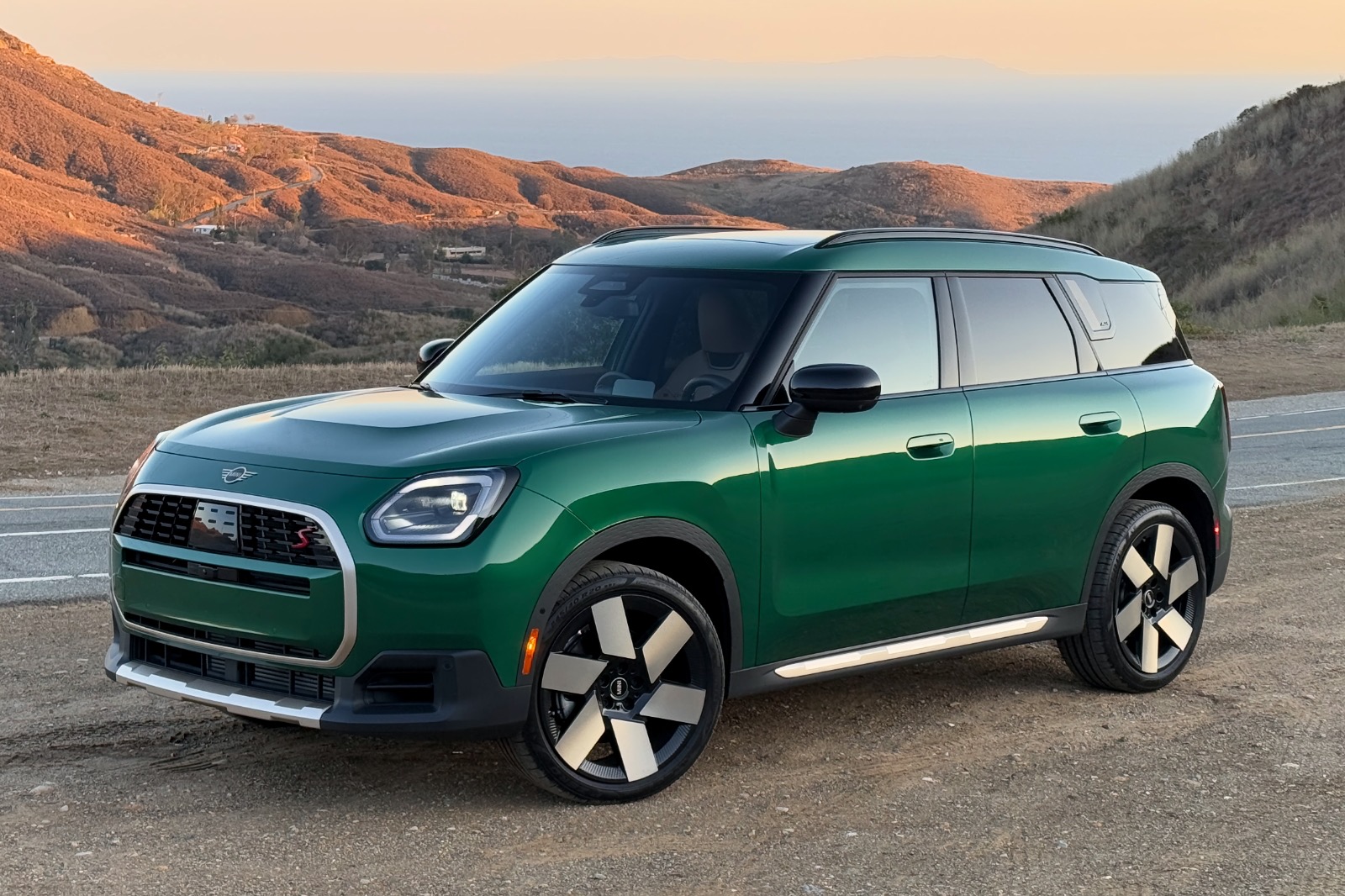
Our Countryman S test vehicle had the U.S. equivalent of Premier+ trim, the Favoured style, bright British Racing Green paint, a body-colour roof, and 20-inch Windmill Spoke wheels. In addition, it featured Vintage Brown artificial leather seats, and an adaptive damping suspension. The manufacturer’s suggested retail price (MSRP) in Canada for this configuration is $57,569, including the destination charge and other fees.
We’re not crazy about the faint gold tint on the test model’s trim and wheels, though it’s appropriate for a Mini. The bright green paint wouldn’t be our first choice, either. But there’s no denying a Countryman with Favoured style and 20-inch wheels makes a bold statement. And Mini says you can customize the LED exterior lighting to three different themes.
When you select the Favoured style, you get Petrol Blue fabric made of recycled polyester on the dashboard, and it features soothing ambient light projections at night. That fabric continues onto the upper door panels, fading to Vintage Brown by the time it reaches the centre roof pillar. Those two colours match two of the three artificial leather choices, the other a beige that complements the gold-tinted exterior trim.
Overall, the Countryman is stylish, and the interior imparts a sense of quality. Together, the look and feel make this Mini seem like a bargain in a world full of boring crossover SUVs.
Performance
The Mini Countryman S has a turbocharged 2.0-litre four-cylinder engine, a seven-speed dual-clutch automatic transmission (DCT), and standard all-wheel drive (AWD). The engine generates 241 horsepower between 4,500 rpm and 6,500 rpm and 295 pound-feet of torque from 1,500 rpm to 4,000 rpm. Mini claims it will accelerate to 100 km/h in roughly 6.4 seconds and offers a maximum towing capacity of 1,587 kilograms (3,500 pounds).
Using a toggle switch on the dashboard, you can choose from different Mini Experiences. They alter the artificial engine sound piped in through the speakers, may adjust the Countryman’s driving dynamics, and they customize the look of the round 9.4-inch touchscreen in the centre of the dashboard. Our test vehicle defaulted to the Core mode with each restart, which is the most like a Normal mode. We also used Go Kart when driving the Countryman with enthusiasm in the mountains.
If this all sounds good on paper, be warned that the Countryman lacks refinement. Our test vehicle arrived with the automatic engine stop/start and automatic brake hold features activated. So, each time we released the brake pedal to accelerate from a stop, the engine needed to shudder to life, the DCT needed to engage first gear, the accelerator input needed to override the automatic brake hold, and the turbo needed to spool enough to start delivering torque. So, not smooth.
Fortunately, you can turn off the engine stop/start and auto-hold functions. Unfortunately, you must remember to press the left-most button under the transmission gear selector and enter the Drivetrain & Chassis menu to deactivate them. Doing so helps to make the Countryman feel more refined, but there’s no avoiding the DCT’s occasionally clunky shifting, partly because paddle shifters are mystifyingly absent (though they’re equipped on JCW models). We don’t mind it because we understand why DCTs behave that way, but a typical consumer might find it irritating.
Zippy is a good way to describe the Countryman S. This spry SUV is quick and nimble, and in Go Kart mode with the optional adaptive suspension and bigger 20-inch wheels with summer performance tires, it is a blast to drive on the right kind of road. It also effortlessly cruises at extra-legal speeds, making the head-up display and the speed warning function especially helpful.
When you’re not ripping down a winding road in this little guy, it’s best to think of its driving dynamics as boisterous, like an unruly but still lovable kid who misbehaves in public. Like that child’s behaviour, the Mini’s overall lack of powertrain refinement, noise isolation, and ride compliance will get old, fast. Our Countryman test vehicle felt brittle and choppy on anything but smooth pavement, and road noise was a near-constant companion. On some highways, the Countryman bobs and wiggles more than a kindergartener in a bouncy house.
Also, the steering has an on-centre dead spot. Off-centre, while it’s reasonably quick to respond, it’s not crisp and doesn’t feel precise. The steering wheel itself is outstanding, but what it’s connected to is unrewarding and erodes driver confidence. The brakes are also problematic. They exhibit touchy response and inconsistent feel at all times, making them hard to modulate.
Still, despite all that, there is genuine fun to be had in a Countryman S. As for fuel economy, well, it should be better. The official estimate is 8.7 litres per 100 kilometres in combined driving, but our test vehicle returned 9.6 L/100 km, driven mostly in Core mode with Go Kart active for fun on mountain roads.
Form & function
The Mini Countryman offers seating for four adults, and while you can technically squeeze a fifth passenger in, that’s not advisable. Stick with four, and everyone will be happier. We thought the front seats were comfortable, and the artificial Vescin leather was convincingly upscale. Outward visibility is good, thanks in part to oversized side mirrors, and you can see the Countryman’s hood, making it easier to park. The surround-view camera system is excellent and provides guidance lines for the front wheels to help you avoid curbing them.
The new Countryman is roomier than the previous model, making it a reasonable choice for a family of four. However, the back seat remains snug, if comfortable. Teenagers did not complain about the rear-seat accommodations. Air vents, USB charging ports, and the panoramic sunroof add to passenger satisfaction.
Clearance for a reverse-facing child safety seat remains tight, though. Also, teach younger children to open the rear doors with care. The bottom corners are sharp and stick out, so if your kid throws one open with abandon, the neighbouring vehicle will receive a deep dimple in its bodywork.
Storage is generous and, in keeping with the Mini ethos, sometimes unusual. For example, the funky storage box with a lid on the centre console is much easier to access than a typical bin under a centre armrest. By relocating this storage solution, Mini also adds a deep tray that could hold a 32-ounce water bottle, though not securely.
A power tailgate reveals 708 litres of cargo space, including a generous compartment under the cargo load floor. Fold the 40/20/40-split rear seat down, and maximum volume measures 1,591 litres. Both volumes are on par for the subcompact SUV segment.
Technology
Mini’s new round 9.4-inch OLED touchscreen infotainment display hasn’t earned much praise, and based on our experience, that’s for a good reason. While it uses the latest Mini operating system from parent company BMW, it does pack a lot into its unusually shaped display. Mini has also reduced the physical switchgear in the Countryman, undoubtedly contributing to user consternation.
First, let’s cover what’s included. Our test car had cloud-based navigation with augmented video showing directions on the display, three connected services plans (Mini Connected Drive, BMW TeleServices, Mini Remote Services), and a Mini smartphone app providing access to features like remote engine starting. Each of the Mini Experiences modes tailors the appearance of and the content shown on the screen as well.
Along more conventional lines, the Countryman has wireless Apple CarPlay, wireless Android Auto, and wireless smartphone charging. If you’re a SiriusXM (SXM) satellite radio fan, this SUV has the expanded 360L service with more channels. No matter how you play music, the Harman Kardon premium audio system sounds terrific.
To make using the technology easier, an Intelligent Personal Assistant named Spike recognizes naturally spoken commands and queries. Well, in theory. For whatever reason, this feature was inactive in the test vehicle, so we couldn’t experience or evaluate it. In addition, we never figured out how to save our favourite SXM stations and conveniently scroll through them using the steering wheel controls. That’s utterly maddening.
The depth and breadth of menus and settings in a Countryman are breathtaking, and it’s easy to forget where things are and how to adjust certain settings. Just remember to touch the six-dot icon on the display to call up a directory with all the different menus and settings before taking your next action. That’s a great place to start.
Our test vehicle also had a head-up display shown on a translucent panel above the steering wheel. Considering how cluttered the centre display is, the HUD is genuinely helpful, and it can communicate upcoming turns and directions related to a programmed route, the status of the safety features, and more.
Safety
Unlike Minis of the past, the new Countryman is well equipped with safety and driver assistance features.
Standard equipment includes: forward collision warning, automatic emergency braking, lane-departure warning, lane-keep assist, rear cross-traffic alert, and a blind-spot monitoring system with active steering input to avoid a collision. In addition, Mini’s redesigned SUV has automatic high-beam headlights, front and rear parking sensors, and Mini Assist eCall with an SOS button and automatic collision notification.
An adaptive cruise control system with stop-and-go capability is available as part of the Driving Assistant Professional upgrade in the Premier+ package.
Driving Assistant Professional pairs the adaptive cruise control with lane-centring assist for a greater level of automation, but it still requires you to keep your hands on the steering wheel. The lane-keep assist is decisive about steering you away from lane markings or a road departure. However, when traveling in this mode, the Countryman regularly issued notifications that we should keep our hands on the wheel, even though they were already resting on the rim. Adding some minor wheel input is not good enough to satisfy the safety nanny. Instead, you must actively steer to tell the tech you’re still in control.
Should the Countryman’s generous list of safety features fail to prevent a collision, know that the Insurance Institute for Highway Safety (IIHS) named Mini’s redesigned SUV as a “Top Safety Pick” in 2024.
Cost-effectiveness
For a 2025 Mini Countryman to make good financial sense, you must value its heritage, personality, relative rarity, and driving experience.
Approach the purchase from a practical standpoint, and you can get more SUV for less money by choosing a Honda CR-V, Hyundai Tucson, or Toyota RAV4. And since the Countryman is stylish instead of luxurious, it’s hard to justify the price otherwise.
There’s really nothing else quite like a 2025 Countryman, which makes it easier to forgive its flaws. We fundamentally like Mini’s cheeky little SUV. There are a lot of quirks here, and Mini fans might embrace those. The majority of other people may not.
Note: Images show a US model.

What owners say
Trims & specs
Base MSRP $45,200 | Seating 5 |
Engine 308 hp Electric | Cargo Capacity 24.8 cu ft |
Combined MPG 97 | Drivetrain AWD |
Base MSRP $38,900 | Seating 5 |
Engine 2.0L 241 hp I4 | Cargo Capacity 25.0 cu ft |
Combined MPG 28 | Drivetrain AWD |
Base MSRP $46,900 | Seating 5 |
Engine N/A | Cargo Capacity 25.0 cu ft |
Combined MPG N/A | Drivetrain N/A |


Pricing trends
MSRP range
$38,900 - $46,900
Current avg. market price
$41,906
Trending down by 1.5% this month
May 2026 - October 2026

