2025 Kia Sorento Reviews, Pricing & Specs




Pros & cons
What we like
Powerful engine
Impressive technology
Great warranty
What to consider
Interior materials feel cheap
Cramped third-row
Not much cargo space
The CarGurus verdict
Need an SUV with an occasional-use third-row seat? The 2025 Kia Sorento is ready to serve.
Larger than a typical compact but smaller than many three-row midsize SUVs, the 2025 Sorento is “right-sized” in many respects. In addition, it comes with gasoline, turbocharged gasoline, turbocharged hybrid, and turbocharged plug-in hybrid powertrains. This review covers the turbo-gas version of the SUV, which sees no significant changes following a substantial refresh for 2024. A new grey paint colour is available, and some models get standard black exterior badges in 2025.
Verdict: When something isn’t broken, you don’t fix it. That helps explain why the 2025 Kia Sorento is almost exactly the same as last year. However, a problem looms for this family-friendly SUV. In 2025, the Sorento may lose its Insurance Institute for Highway Safety (IIHS) Top Safety Pick rating.
out of 10 expert review
Look & feel
In Canada, the gas-only 2025 Sorento lineup includes LX, EX, X-Line, X-Line Limited, and X-Pro trim levels. Only the LX is equipped with a merely adequate 2.5-litre four-cylinder engine, while the rest get a turbocharged 2.5-litre four-cylinder.
This year, Panthera Grey is a new paint colour, and the X-Line and X-Pro versions get black badges. You’ll notice our test car did not have the new badges, and that’s because it is a 2024 model. However, otherwise, it is exactly the same as what you can get in 2025, right down to its Spilled Coffee paint colour.
We kid, we kid. That colour is actually called Road Rider Brown, and it is brilliant for hiding dirt. It looked a little odd with the Olive Brown interior because the hues don’t match but also aren’t in sharp contrast with one another. In Canada, a 2025 Kia Sorento X-Pro costs $55,706, including the $2,100 destination charge and other fees.
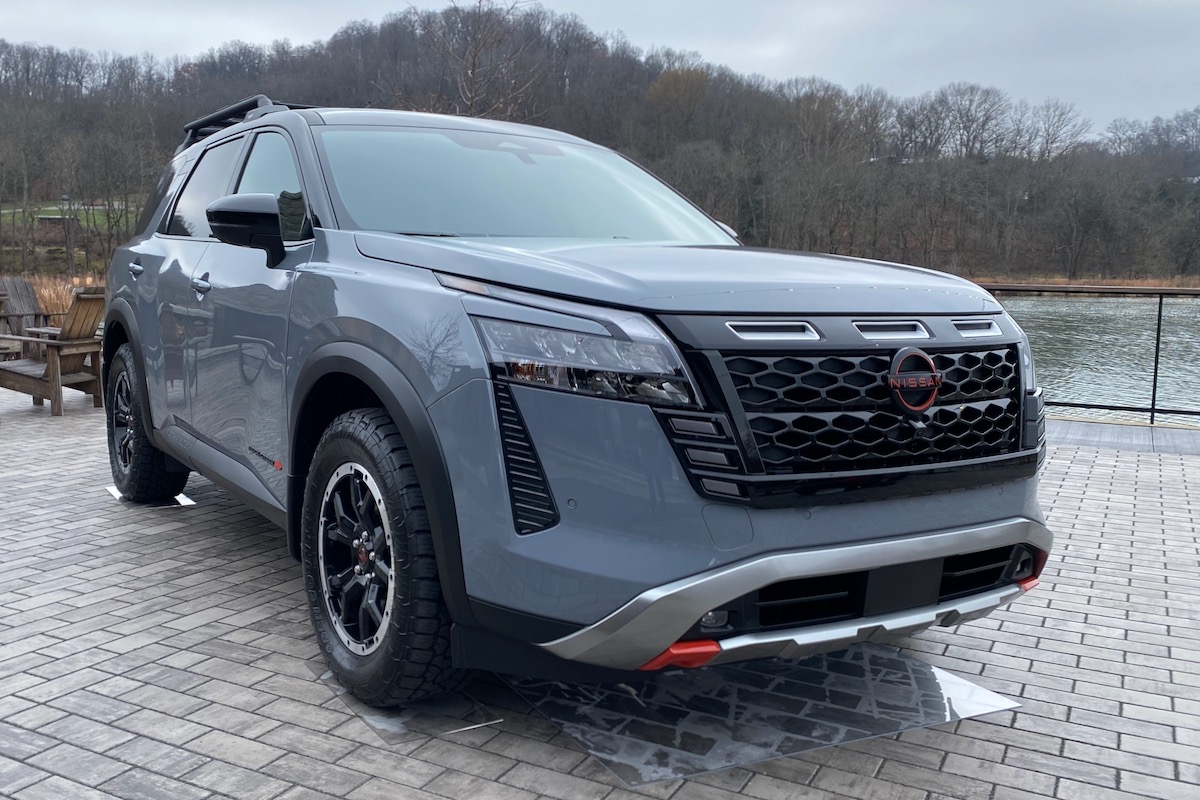
Last year’s styling updates brought the Sorento into better alignment with other Kias, showcasing a wide grille, stacked headlights, and amber “Star Map” signature running lights. The X-Pro has exclusive front and rear bumper covers, enhanced utility roof rails, unique matte-black 17-inch wheels with all-terrain tires, and an improvement in towing capacity to 2,040 kilograms (4,500 pounds).
Aside from the tires, the Sorento X-Pro does not offer better off-roading capability or extra clearance relative to the Sorento X-Line models. And, compared to the core trim levels, the X-Line and X-Pro offer only a marginally improved approach angle. So, while it has knobby tires and a purposeful roof rack, the X-Pro is more about a rugged look than added capability.
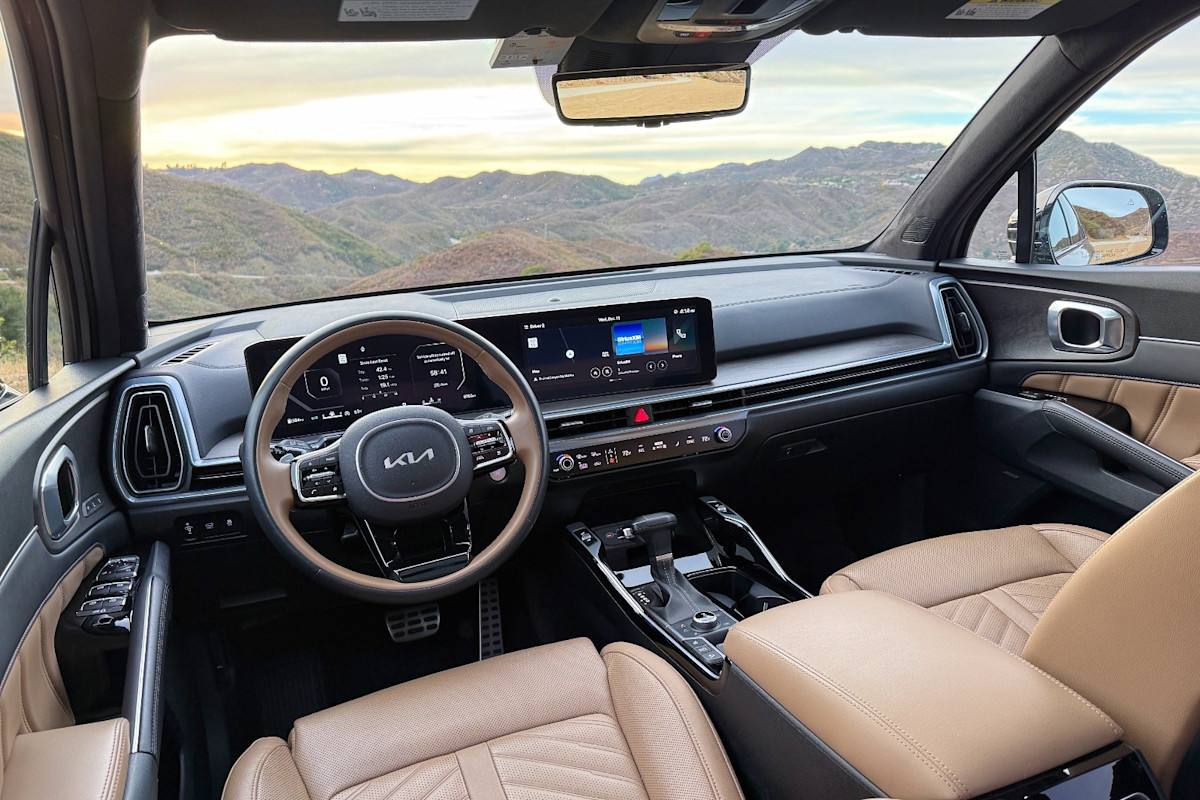
Inside, the test vehicle’s Olive Brown interior glowed under its panoramic sunroof, standard on X-Line and X-Pro models. The quality of the materials is a mixed bag, reflecting the base Sorento LX’s starting price of less than $40,000. But the hard and glossy plastic is largely restricted to the lower portions of the cabin, and our X-Pro was decked out like a luxury SUV with leather seats, an artificial suede headliner, and a 24-inch panoramic display dominating its dashboard.
Performance
Kia equips the Sorento LX with an underwhelming 191-horsepower, 2.5-litre four-cylinder engine and an eight-speed automatic transmission. It is adequate and will return an estimated 9.4 litres per 100 kilometres in combined driving. If you’re on a tight budget, it’s the right choice.
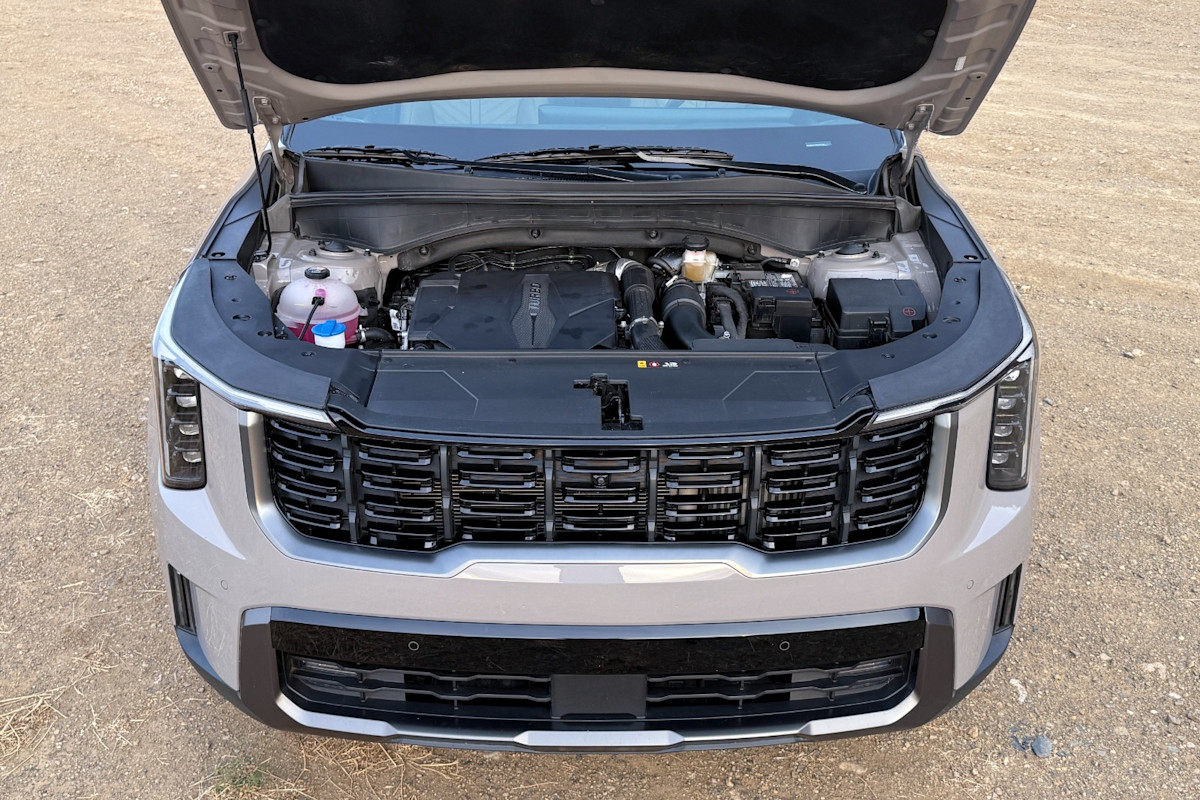
Anyone seeking speedier acceleration will want the turbocharged 2.5-litre four-cylinder that’s standard in all other Sorentos. It generates 281 horsepower (+90) and 311 pound-feet of torque (+130), and the peak torque is available at 2,300 rpm sooner, spread across the rev range from 1,700 rpm to 4,000 rpm.
The turbo four is a far more satisfying engine, and the official fuel economy rating from Natural Resources Canada is 10.3 L/100 km in combined driving. During our evaluation, the Sorento X-Pro did slightly better, averaging 10.0 L/100 km, perhaps because it doesn’t need to work as hard as a smaller-displacement turbo four might.
However, the turbo engine pairs with an eight-speed dual-clutch automatic transmission (DCT). If you’re not accustomed to how a DCT works and what it feels like when you’re driving, you might think the transmission is slipping between gears. Rest assured, it isn’t. That sensation is natural to a DCT. But that doesn’t mean you need to like it.
With its 17-inch wheels and all-terrain tires, the Sorento X-Pro reminds us how modern low-profile tires contribute to poor ride quality. The thick sidewalls provide plenty of cushion between the Sorento and the road, giving this version a fantastic ride quality while reducing concerns about potholes and curbs.
Unexpectedly, that choice of rubber doesn’t appear to come at the expense of handling or even noise. We found the X-Pro to be remarkably quiet inside, with only a trace of the tire whir that typically comes with this type of tire tread. Better yet, on winding mountain roads, the all-terrains equipped on our tester offered plenty of grip. Dare we say this SUV was even tossable in the twisties.
In Canada, all Sorentos come with all-wheel drive (AWD) that features torque vectoring and a locking centre differential. These features undoubtedly contributed to the X-Pro’s nimble feel on pavement and its traction during a brief off-road jaunt across deeply rutted terrain. That challenging surface demonstrated the added grip the all-terrain tires bring but also showcased how the somewhat softly tuned suspension can allow the Sorento’s underside to contact terra firma unless you take extra care.
In daily driving situations with the Normal driving mode engaged, the Sorento excels, though the DCT can sometimes seem eager to upshift to improve fuel economy. Changing to Sport mode resolves that. Otherwise, the Sorento’s size, driving dynamics, fat tire sidewalls, and outward visibility all make it a pleasure to pilot in cities, on highways, and in the suburbs.
Form & function
A family of four with occasional use for a back seat will find a Kia Sorento appealing. The first two rows of seats are roomy, and if people sitting in the second row are willing to slide forward, adults can fit into the third-row seat for shorter trips. If you need more space, the larger and slightly more expensive Kia Telluride is what you want.
Our Sorento X-Pro had heated and ventilated front seats, each offering 10-way power adjustment. In addition, the driver’s seat added extra lumbar and seat cushion thigh support adjustments. During this evaluation, we found the seats agreeable at all times. However, a recent road trip in a Sorento Plug-in Hybrid revealed that after hours of highway driving, the cushion isn’t as supportive as you might like.
A second-row bench seat is standard in the Sorento LX, making this a seven-passenger SUV. Every turbocharged trim offers second-row captain’s chairs and six-passenger capacity. Second-row passengers in the test vehicle enjoyed heated seats, side window sunshades, USB charging ports, and air conditioning vents.
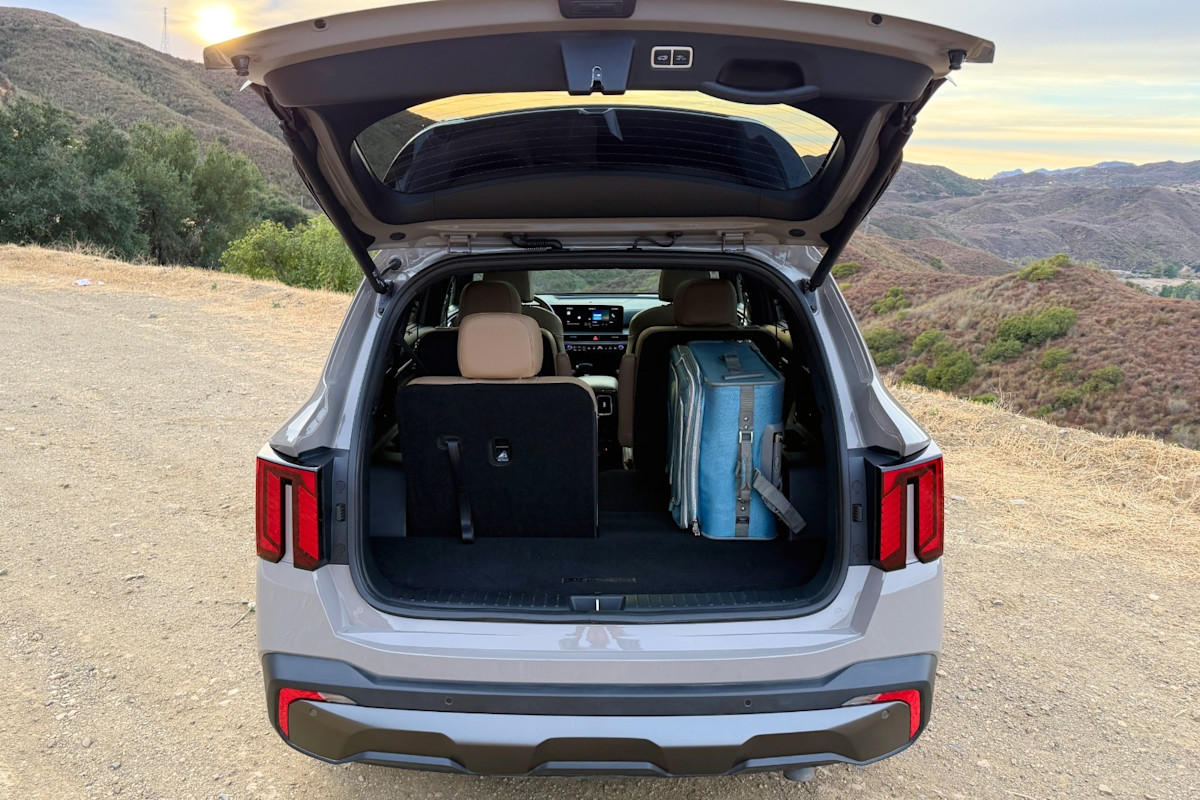
Storage space throughout the cabin is generous and practical. The cargo room is useful, too, but only when the third-row seat is folded flat. With it raised, the Sorento offers just 357 litres of cargo space. With the third row folded, a minimum of 1,090 litres is available behind the second-row seats. Maximum cargo volume measures 2,139 litres. Those figures compare favourably with the largest compact crossovers, which are also typically more affordable. But they don’t offer a third-row seat or as much power as you’ll find in the Sorento.
Technology
The Sorento’s 24-inch panoramic display, new in 2024, is a simple, clean, intuitive interface. With the X-Line Limited and X-Pro trims, it pairs a larger 12.3-inch digital instrument panel with the Sorento’s standard 12.3-inch touchscreen infotainment system, creating a presentation reminiscent of high-end luxury brands.
Unfortunately, to use the native conversational voice assistant, you need an active Kia Connect subscription. Kia Connect is complimentary for three years, but our test vehicles rarely have it activated. But that’s OK because every 2025 Sorento has wireless Apple CarPlay and Android Auto. Thanks to Siri and the wireless Apple CarPlay connectivity, we didn’t miss Kia Connect at all. However, that’s not to say Kia Connect is worthless. In addition to voice recognition, its highlights include 911 Connect, a find-my-car function, remote access to certain vehicle features, and safe driver settings related to curfew time, vehicle speed, and local geographic boundary limits.
Below the infotainment screen and centre dashboard air vents, Kia provides a touch-sensing strip of dual-function controls anchored by knobs at each end. It lets you control the stereo volume, radio tuning, and infotainment system, but if you change the panel’s functionality, it doubles as the climate controls. That approach can cause frustration. What we’ve learned is to keep the panel on the climate controls and use the volume and tuning switches on the steering wheel. But that’s not always practical because nothing beats a big volume/mute knob.
Digital Key technology is available as part of the new infotainment system, transforming your smartphone into the SUV’s key fob. Our test vehicle also had a digital rearview mirror showing a camera-based view of what’s behind the Sorento, which is helpful when the cargo area is piled high with items.
Lastly, we must mention the Sorento’s excellent available surround-view camera system. It makes parking in tight quarters easy and gives you plenty of information about how close you’re getting to objects and where the SUV‘s wheels will track.

Safety
Kia installs plenty of standard safety features in the 2025 Sorento. Naturally, as you move higher up the trim-level ladder, you get more technology, and, in some cases, it is more sophisticated.
Significant upgrades are associated with the X-Line Limited and X-Pro, which add numerous active collision avoidance features, a camera-based Blind-Spot View Monitor, and the surround-view camera system. These versions of the SUV also feature an enhanced version of the Highway Driving Assist technology.
Highway Driving Assist is a semi-autonomous, hands-on driver-assistance feature that pairs the adaptive cruise control system with lane-centring assist technology. It is standard on X-Line, and with X-Line Limited and X-Pro trim, it adds lane-changing functionality to create a Highway Driving Assist 2 (HDA 2) system. Note that HDA 2 remains a hands-on system.
During testing, HDA 2 worked better on low-traffic rural highways than on high-traffic multi-lane highways in the city. But that’s typically true of all similar technologies from Kia’s rivals. The lane-change function works as advertised but requires patience while waiting for it to take action. Also, HDA 2 appears to require regular driver steering inputs as its signal that you’re still holding the wheel in your hands, which can be aggravating.
According to the National Highway Traffic Safety Administration (NHTSA), the 2025 Sorento earns five-star overall and individual four-star ratings for its frontal impact and rollover resistance evaluations. The Sorento also earns a Top Safety Pick rating from the Insurance Institute for Highway Safety (IIHS), but that accolade is valid only for the 2024 calendar year. Unfortunately, rule changes and an unimpressive result in a new test may cost the Sorento that badge of honour in 2025.

Cost-effectiveness
The most expensive compact two-row crossovers typically approach or surpass $60,000 in their top trim levels. Meanwhile, fully loaded midsize three-row SUVs commonly blow past the $60,000 mark. At just over $55,000 Canadian, our Sorento X-Pro appears to be priced right, especially given its near-luxury interior, powerful turbocharged engine, impressive AWD system, and sophisticated tech. Add the part-time third row and three-year Kia Connect subscription plan, and the 2025 Sorento appears to compete in a Goldilocks-style niche bridging two saturated market segments.
Better yet, the Sorento is exceptionally easy to live with on a daily basis. You’re never excited to drive it, but it is rewarding just the same, whether you recognize it or not. It’s not abundantly roomy inside, but it rarely seems too small, especially if you use the third row only on occasion. And its design is appealing without resorting to polarization, so you can “wear” it with pride.
With that said, Kia needs to step up its game, and soon. The new 2025 Mazda CX-70 looks and feels even more upscale, and the upcoming 2026 Honda Passport promises genuine off-roading capability in TrailSport spec. The next-generation Subaru Outback, freed of its Legacy station wagon shackles, will likely prove a formidable rival, too.
Note: Images show a US model.

What owners say
Fuel economy, easy handling, very comfortable interior and quiet cabin. Third row seats allow tethering of child car seats.
October 25, 2025Trims & specs
Base MSRP $36,890 | Seating 7 |
Engine 2.5L 191 hp I4 | Cargo Capacity 12.6 cu ft |
Combined MPG 25 | Drivetrain AWD |
Base MSRP N/A | Seating N/A |
Engine N/A | Cargo Capacity N/A |
Combined MPG N/A | Drivetrain N/A |
Base MSRP $38,090 | Seating 6 |
Engine 2.5L 281 hp I4 | Cargo Capacity 12.6 cu ft |
Combined MPG 24 | Drivetrain FWD |
Base MSRP $41,790 | Seating 6 |
Engine 2.5L 281 hp I4 | Cargo Capacity 12.6 cu ft |
Combined MPG 23 | Drivetrain AWD |
Base MSRP $34,890 | Seating 7 |
Engine 2.5L 191 hp I4 | Cargo Capacity 12.6 cu ft |
Combined MPG 27 | Drivetrain FWD |
Base MSRP N/A | Seating N/A |
Engine N/A | Cargo Capacity N/A |
Combined MPG N/A | Drivetrain N/A |
Base MSRP $46,390 | Seating 6 |
Engine 2.5L 281 hp I4 | Cargo Capacity 12.6 cu ft |
Combined MPG 23 | Drivetrain AWD |
Base MSRP $41,690 | Seating 6 |
Engine 2.5L 281 hp I4 | Cargo Capacity 12.6 cu ft |
Combined MPG 24 | Drivetrain FWD |
Base MSRP $43,490 | Seating 6 |
Engine 2.5L 281 hp I4 | Cargo Capacity 12.6 cu ft |
Combined MPG 23 | Drivetrain AWD |
Base MSRP $47,390 | Seating 6 |
Engine 2.5L 281 hp I4 | Cargo Capacity 12.6 cu ft |
Combined MPG 23 | Drivetrain AWD |
Base MSRP $31,990 | Seating 7 |
Engine 2.5L 191 hp I4 | Cargo Capacity 12.6 cu ft |
Combined MPG 27 | Drivetrain FWD |
Base MSRP $39,590 | Seating 6 |
Engine 2.5L 281 hp I4 | Cargo Capacity 12.6 cu ft |
Combined MPG 23 | Drivetrain AWD |
Base MSRP N/A | Seating N/A |
Engine N/A | Cargo Capacity N/A |
Combined MPG N/A | Drivetrain N/A |
Base MSRP N/A | Seating N/A |
Engine N/A | Cargo Capacity N/A |
Combined MPG N/A | Drivetrain N/A |