2025 Hyundai Santa Cruz Reviews, Pricing & Specs

Pros & cons
What we like
Fun to drive
Impressive technology
Great warranty
What to consider
On-pavement handling with all-terrain tires
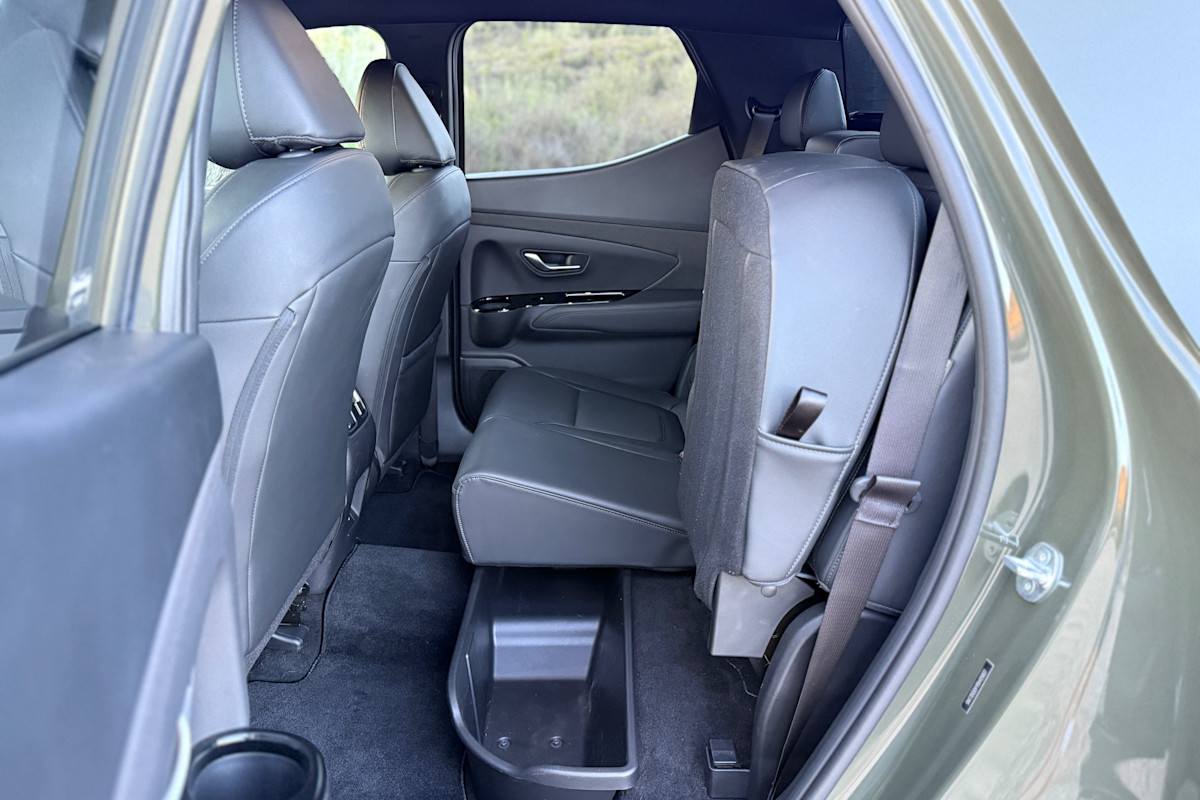
Cramped back seat
Not much cargo space
The CarGurus verdict
The 2025 Hyundai Santa Cruz is the perfect sport truck for ultra-light-duty tasks.
Based on the Hyundai Tucson compact crossover SUV, the Santa Cruz is not about towing the heaviest loads or driving to off-the-grid locations. Instead, it’s perfect for weekend DIY projects, hauling bulky items home from the big-box store, and carrying adventure gear on day trips. The 2025 Santa Cruz is better at these tasks than ever thanks to new tech, styling updates, and off-roading enhancements.
Verdict: We realize the Santa Cruz’s styling isn’t broadly appealing. If this Hyundai trucklet’s appearance is just too hard to accept, then its direct rival, the Ford Maverick, might be more to your liking. If you like the 2025 Hyundai Santa Cruz, you’ll find it plenty fun to drive.
out of 10 expert review
Look & feel
Hyundai sells the 2025 Santa Cruz in three trim levels in Canada: Preferred, XRT, and Ultimate. All three come with a turbocharged 2.5-litre four-cylinder engine and standard all-wheel drive (AWD). Prices range from $44,994 to $53,494, including the $2,050 destination charge and other fees. Our 2025 Hyundai Santa Cruz XRT test truck carried a Canadian manufacturer’s suggested retail price (MSRP) of $50,494 with destination.
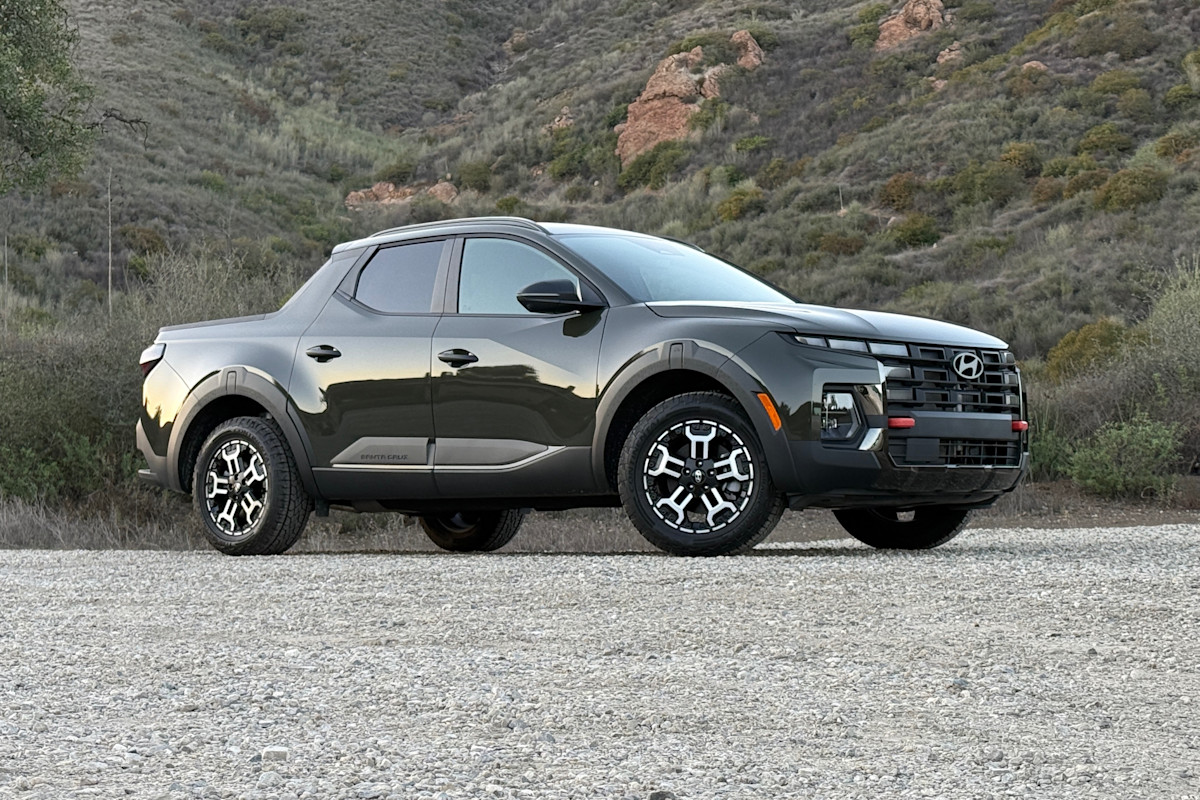
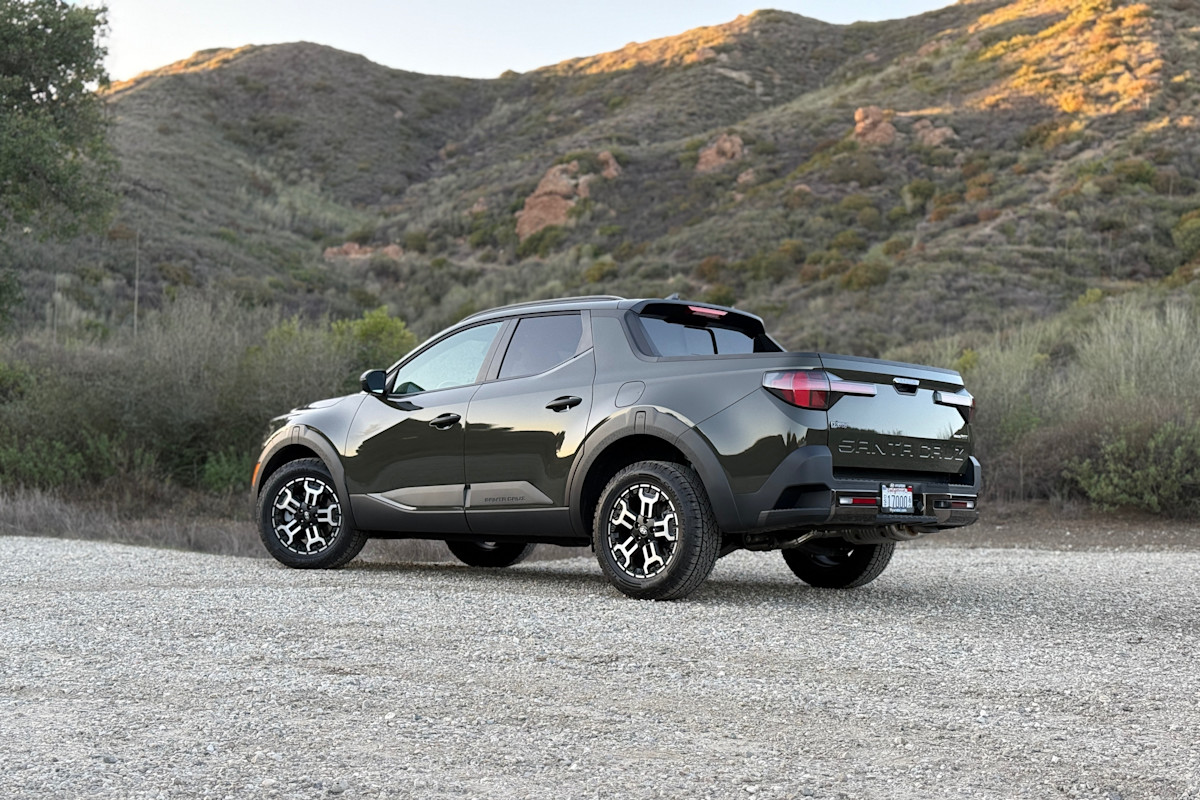
While the Santa Cruz’s styling might represent an acquired taste, Hyundai has tried to improve it for 2025. Across the lineup, revised front styling, wheel designs, and paint colours give it a fresh look. The XRT off-road variant takes things further, with an improved approach angle and standard all-terrain tires wrapped around a bolder wheel design.
The modifications help the Santa Cruz XRT look more like a pickup truck and less like the Tucson crossover SUV on which it’s based. However, whether you like it or not is a matter of personal taste. We’re not fans of some of the design details or the new Rockwood Green paint, but the underlying forms and proportions are pleasing.
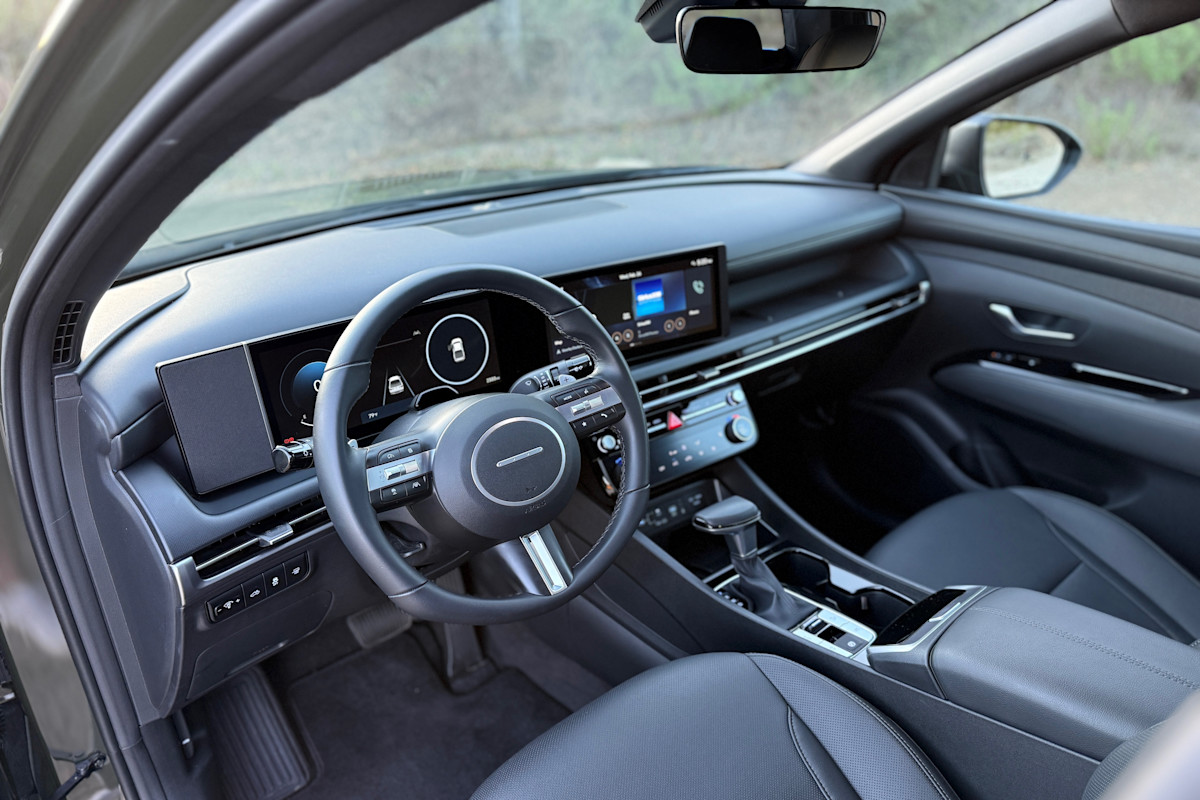
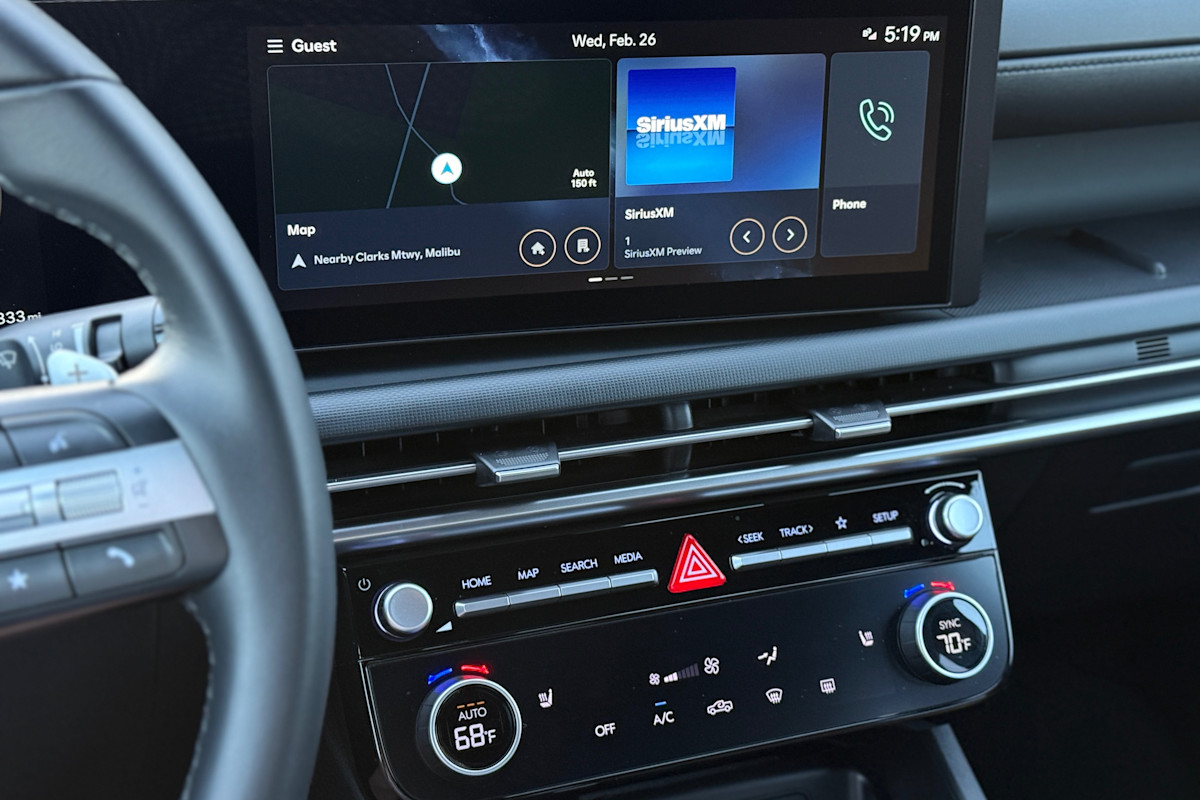
Inside, a new high-tech dashboard debuts, dominated by a panoramic curved display. Our test truck contained two 12.3-inch digital display screens, with the instrumentation panel on the left and an infotainment touchscreen on the right. The 2025 Santa Cruz also features revised infotainment and climate system switchgear, a redesigned steering wheel, and new air vents. Hyundai has carved a practical storage shelf into the dashboard, located in front of the passenger, while the Santa Cruz retains its traditional solid and quality transmission shifter.
Performance
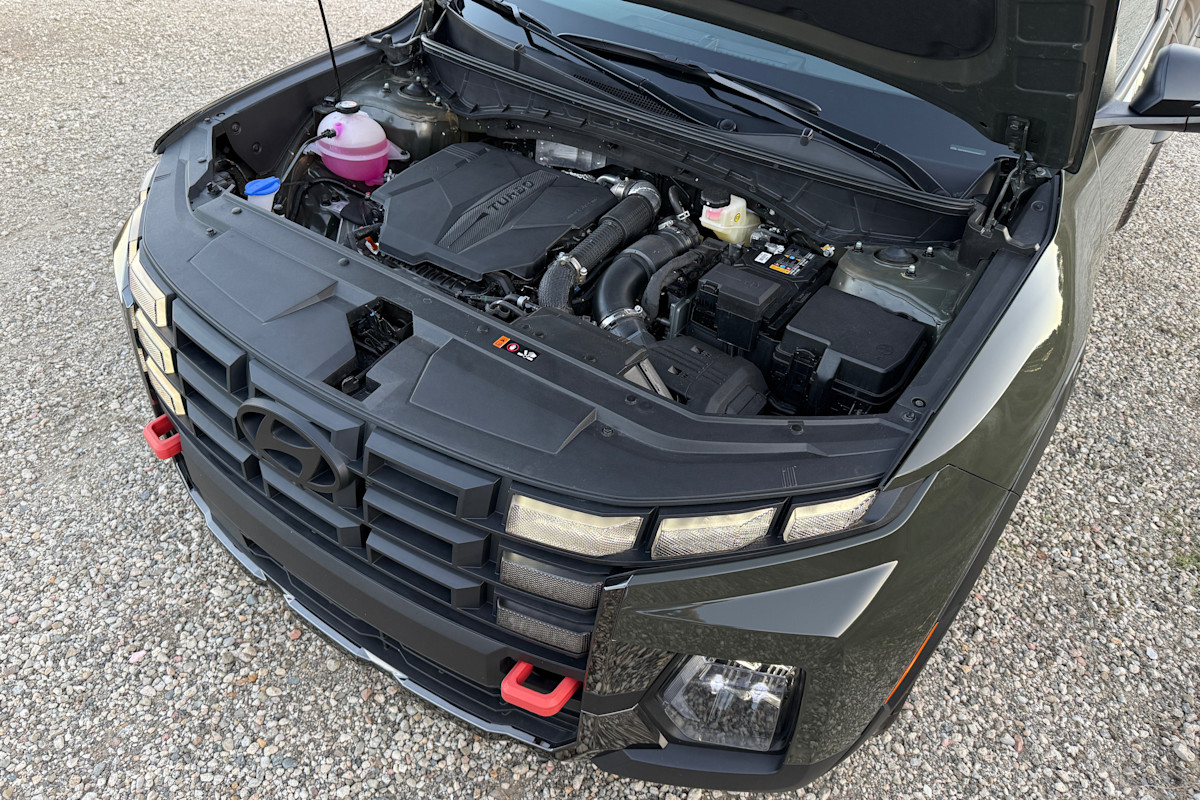
Driving a turbocharged Hyundai Santa Cruz is fun because the engine produces a robust 281 horsepower at 5,800 rpm and 311 pound-feet of torque between 1,700 rpm and 4,000 rpm. Better yet, the turbo-four-cylinder engine makes its power on regular gas instead of premium.
The Preferred and Ultimate trims see fuel economy ratings of 10.7 litres per 100 kilometres combined. The XRT is the least efficient version of the Santa Cruz at 11.1 L/100 km combined (that’s equivalent to the much larger Hyundai Palisade, while the Tucson with which the Santa Cruz shares a platform averages a more conservative 8.8 L/100 km combined, albeit with a different non-turbo engine). We averaged 13.4 L/100 km while driving the XRT on our mountainous evaluation loop.
While the Santa Cruz XRT is satisfyingly quick, its transmission is quirky. It features an eight-speed dual-clutch automatic transmission (DCT), which can contribute to the sensation of turbo lag and uneven power delivery. Switching from Normal to Sport mode helps to reduce, but not resolve, those issues. Hyundai is aware of the DCT’s shortcomings, and the 2026 Santa Cruz drops it in favour of a traditional eight-speed automatic with a torque converter.
Additionally, the XRT’s standard all-terrain tires compromise handling on paved roads. On the highway, we suspect they were the cause of the Santa Cruz’s disconnected on-centre feel when driving at speed. On winding mountain roads, they had limited grip in corners. The upside to the XRT’s tires is a comfortable ride and good grip in the dirt. Hyundai’s little truck soaks up bumps and cracks in the pavement and handles speed bumps and humps with ease. It’s also easy to park, thanks to its compact dimensions. Light off-roading revealed the XRT’s admittedly modest talent (it can go places a typical car or crossover can’t) when the pavement ends.
However, while descending a mountain grade, the Santa Cruz’s brakes heated up and started to rumble, accompanied by slight brake pedal vibrations. Since Hyundai rates this truck to tow up to 2,268 kilograms (5,000 pounds), that’s a concern since it happened on a cool day with only a driver aboard and no cargo in the bed.
Form & function
Slide inside the Santa Cruz’s cabin, and it looks and feels more like a crossover SUV than a typical truck. There is a sense of style to it, with higher quality materials than you might expect. But that doesn’t mean it lacks the functionality of a small pickup.
The new shelf located in front of the front passenger is genuinely useful. The centre console provides clearly defined compartments, and small trays are nestled into the door-panel armrests. Under the centre armrest, you’ll find a sizable storage bin, and beneath the back-seat cushions, a deep tray holds plenty of items. Unfortunately, it also makes it harder to load larger things into the cab for weather- and theft-proof storage.
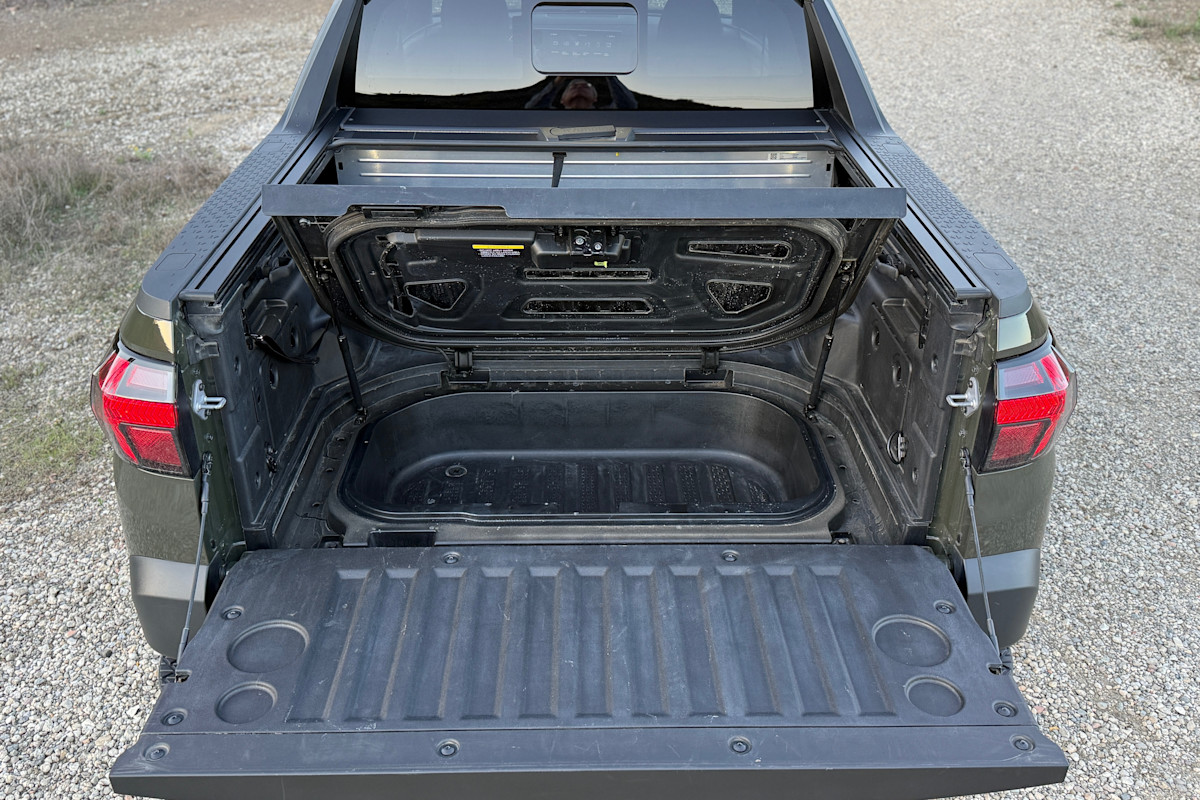
Don’t worry, though, because the four-foot cargo bed contains a locking in-floor trunk similar to what you’ll find on a Honda Ridgeline. Our XRT test truck also had a retractable tonneau cover that was somewhat fussy to use but, when it’s closed and the tailgate is locked, cargo is secure. Fixed loops and adjustable cleats help you tie down cargo when hauling larger items.
Heated front seats are standard in Canada and our XRT featured an eight-way power-adjustable driver’s seat and artificial leather upholstery. The front seats are comfortable, but only the driver’s chair is adjustable for height. Rear-seat room is snug for taller adults, but the Santa Cruz has soft, padded front seat backs to improve passenger comfort.
Technology
Every 2025 Santa Cruz includes a sophisticated 12.3-inch touchscreen infotainment system featuring navigation, wireless Apple CarPlay and Android Auto, SiriusXM satellite radio, and Bluelink connected services. A digital key system, fingerprint scanning, and other advanced features are available. Over-the-air software updates keep the technology up to snuff, and physical controls for the infotainment system are located on the dashboard underneath the centre air vents.
If you know how to use a smartphone, you’ll also know how to use this infotainment system. The user interface is intuitive, and the native voice recognition technology is capable enough that you won’t quickly resort to Apple CarPlay or Android Auto. Since the Santa Cruz features stereo knobs and a separate climate control panel for heating and air conditioning, you may find that you rarely need to touch the screen.
Wireless smartphone charging is standard with the XRT and Ultimate trims, and the charger thoughtfully indicates its status, so you know it’s working properly. And while we didn’t use some of the unusual tech features in the Santa Cruz, few pickup trucks offer fingerprint scanning or digital key systems.
Comparatively, the Santa Cruz’s connected services are far more common. Hyundai’s version includes a remote car finder service, safe teen driver functions, a panic notification system, automatic emergency assistance, and much more.
Safety
Like other Hyundai models, the Santa Cruz comes standard with several driver-assistance features. Highlights include forward collision warning, automatic emergency braking, blind-spot monitoring, rear cross-traffic alert, lane departure warning, and lane-keep assist.
Starting with the XRT trim level, the Santa Cruz features an intersection collision braking system, a surround-view camera system, blind-spot cameras (called Blind Spot View Monitor in the brochure), and adaptive cruise control with automatic speed adjustment for curves. Highway Driving Assist is also standard with the Ultimate trim. It pairs the adaptive cruise control with the lane-centring assist system for highway use.
We tested Highway Driving Assist on various types of roads, and it worked well most of the time. However, we found it more useful in light traffic situations than in urban areas with heavier traffic, simply because in the latter environment, drivers are constantly monitoring both the system’s behaviour and that of other motorists. That can get tiring. Additionally, we found the automatic curve speed-reduction feature was irritating to other motorists because it decelerated excessively, resulting in traffic congestion.
New testing performed by the Insurance Institute for Highway Safety (IIHS) reveals some concerns. Specifically, the Santa Cruz earns a “Marginal” rating in the latest moderate overlap frontal-impact assessment, and the driver assistance technologies receive that same rating for their effectiveness in preventing a front crash. The U.S. National Highway Traffic Safety Administration (NHTSA) gave the Santa Cruz the highest five-star rating in each collision evaluation, coupled with a four-star rollover resistance rating.
Cost-effectiveness
Although the Santa Cruz is one of only two small trucks on sale in Canada, its rival costs less, offers better fuel economy, and provides a broader range of trim levels. The 2025 Ford Maverick isn’t quite as technologically sophisticated as the Santa Cruz, and the Ford is more truck-like than the Hyundai. But with its available hybrid powertrain and fuel economy ratings reaching as low as 6.2 L/100 km in combined driving, it makes a strong case for itself.
Not only that but lightly used versions of larger midsize pickups are also price-competitive with the Santa Cruz. That opens you up to a long list of alternatives with more space inside, a larger cargo bed volume, increased towing capacity, and enhanced off-roading capability.
Still, we’re fans of the Santa Cruz. Zippy, fun to drive, and equipped with tech you can’t find in rivals, it’s a good little sport truck if that’s what you’re after. And we’d choose the Hyundai Santa Cruz Ultimate trim level instead of the XRT for its better on-road driving dynamics.
What owners say
Trims & specs
Base MSRP $30,450 | Seating 5 |
Engine 2.5L 191 hp I4 | Cargo Capacity N/A |
Combined MPG 26 | Drivetrain FWD |
Base MSRP $31,950 | Seating 5 |
Engine 2.5L 191 hp I4 | Cargo Capacity N/A |
Combined MPG 25 | Drivetrain AWD |
Base MSRP $34,950 | Seating 5 |
Engine 2.5L 191 hp I4 | Cargo Capacity N/A |
Combined MPG 25 | Drivetrain AWD |
Base MSRP $42,750 | Seating 5 |
Engine 2.5L 281 hp I4 | Cargo Capacity N/A |
Combined MPG 23 | Drivetrain AWD |
Base MSRP N/A | Seating 5 |
Engine N/A | Cargo Capacity N/A |
Combined MPG N/A | Drivetrain N/A |
Base MSRP N/A | Seating N/A |
Engine N/A | Cargo Capacity N/A |
Combined MPG N/A | Drivetrain N/A |
Base MSRP $33,450 | Seating 5 |
Engine 2.5L 191 hp I4 | Cargo Capacity N/A |
Combined MPG 26 | Drivetrain FWD |
Base MSRP N/A | Seating N/A |
Engine N/A | Cargo Capacity N/A |
Combined MPG N/A | Drivetrain N/A |
Base MSRP $30,250 | Seating 5 |
Engine 2.5L 191 hp I4 | Cargo Capacity N/A |
Combined MPG 25 | Drivetrain AWD |
Base MSRP $40,250 | Seating 5 |
Engine 2.5L 281 hp I4 | Cargo Capacity N/A |
Combined MPG 22 | Drivetrain AWD |
Base MSRP $28,750 | Seating 5 |
Engine 2.5L 191 hp I4 | Cargo Capacity N/A |
Combined MPG 26 | Drivetrain FWD |


Pricing trends
Current avg. market price
$37,602
Trending down by 2.2% this month
May 2026 - November 2026

