2024 Chevrolet Suburban Reviews, Pricing & Specs


Pros & cons
What we like
Massively useful cargo capacity
Excellent powertrain options
Great towing capability
What to consider
V8s are not fuel-efficient
Technology is underwhelming
Expensive
Expert review
Even with a new Suburban on the horizon, the 2024 model remains the gold standard workhorse for big families with big toys.
For most families, the smart vehicle choice is either a minivan or a three-row crossover—something big but built on a car platform, like the Toyota Highlander or the Kia Telluride. But for families that are both big and enjoy big hobbies (think boats and horses), there’s no replacement for a body-on-frame hauler like the Chevrolet Suburban.
Verdict: The Suburban has long been a truck re-fitted to haul people, but its 2021 redesign introduced an independent rear suspension that resulted in more usable third-row space than ever before. Now, three years later, the 2024 Chevrolet Suburban still thrives as a capable and capacious family truckster, and it's a genuinely great option for anyone that needs its special blend of practicality.
out of 10 expert review
Look & feel
The Suburban has been with us for a long, long time. It’s the longest-tenured name in automotive, stretching back 90 years. That may be why, despite its larger-than-life silhouette, the Suburban seems to blend in with traffic. Yes, it’s huge, but it’s not a novelty. These long dinosaurs of the highway are a common sight, an automotive institution.
And long they are. At 5,733 millimetres, the Suburban nearly stretches the length of an NBA baseline three-point shot. And it’s tall enough to play in the NBA, too, at 1,923 millimetres. Vehicles this size aren’t for everybody. Anyone who drives in (or, frankly, near) an urban area may hate the Suburban’s mammoth dimensions. But, just as a 300-kilometre-range electric car is right for some drivers and wrong for others, the Suburban does have a target market. Folks who need cargo space, passenger space, and towing capacity can do far worse than a Chevy Suburban.
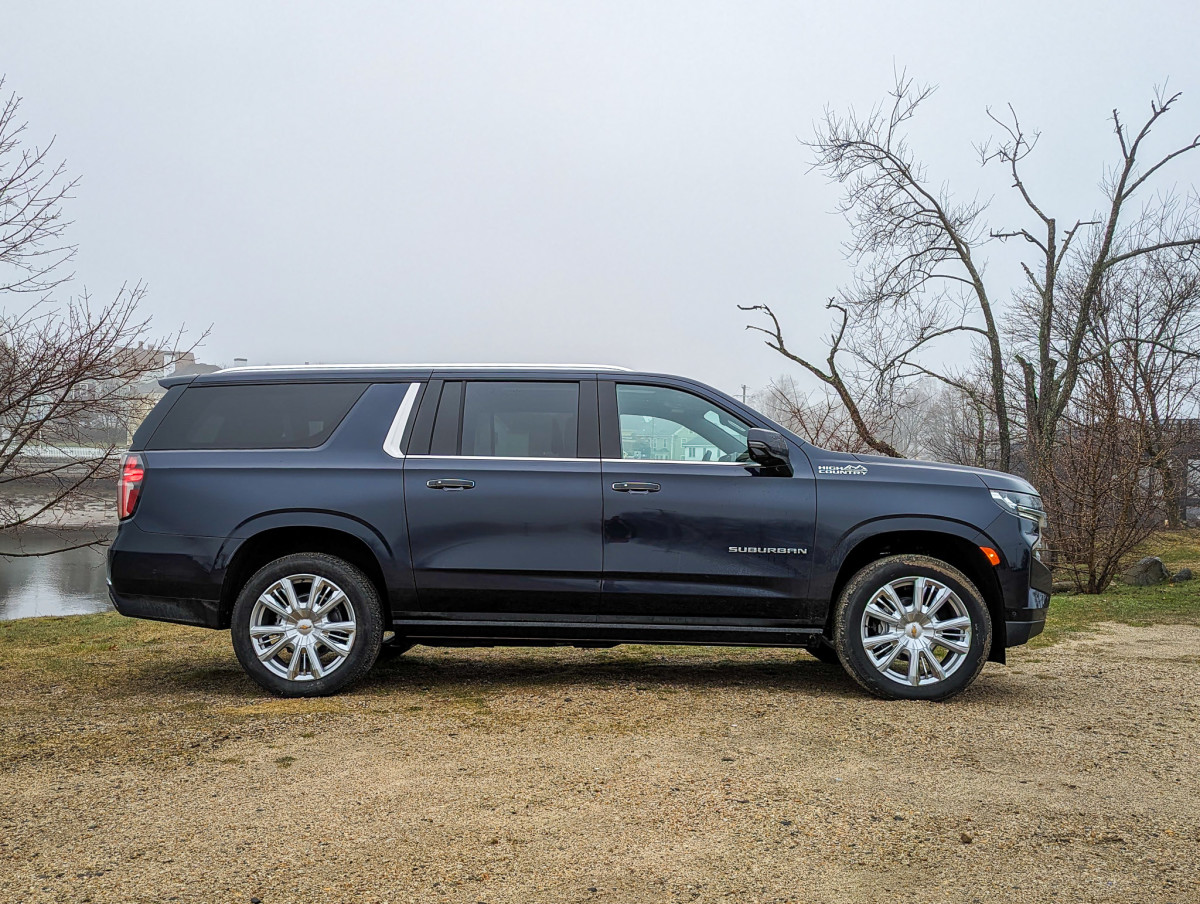
Chevrolet sells the Suburban in six trims: LS, LT, RST, Z71, Premier, and High Country. They all come with some basic niceties like automatic windshield wipers, LED headlights and taillights, and tinted windows. And the offerings get nicer as you climb the trim ladder. For instance, the Suburban LS comes standard with handsome 18-inch alloy wheels, but by the time you’ve reached the top-tier High Country trim level, the Suburban is riding on 22-inch alloys.
That said, even the top trims still offer a number of options we’d typically expect to see included as standard equipment at the highest levels. A set of running-board steps is standard (and appreciated) on every grade, but on the pricey High Country, power running-board steps cost an extra $1,999, and if you want the panoramic power moonroof, that’s an extra $1,725.
Inside, the Suburban offers a comfortable cabin for the driver and front passenger, and there’s plenty of space in the back for everyone else. Cloth seats are standard fare, but on only the lowest-level LS trim. Every other Suburban receives leather upholstery, and the Premier trim and the High Country (which we tested for this review) can be fitted with beautiful brown leather interiors—Maple Sugar in the Premier and Mocha for the High Country.
Our test vehicle came with a heated steering wheel and three-stage heat and ventilation for the front seats, plus tri-zone automatic climate control to keep backseat passengers happy. But beyond the heated and cooled seats and the pretty upholstery, even our top-spec Suburban felt surprisingly pedestrian on the inside. The driver’s seat and front passenger seat offered 12-way power adjustments, and most other trims make do with 10-way adjustment. The seats themselves are supportive but not as comfortable as we’d want for a long road trip.

Performance
Chevrolet offers the Suburban with three engine options: two V8s and a straight-six diesel. The 5.3-litre V8 engine comes standard on the LS, LT, Z71, RST, and Premier trim, making it the most common powerplant found in the 2024 Suburban. With 355 horsepower and 383 pound-feet of torque, it has plenty of power—in fact, with the available Max Trailering Package, RWD Suburbans with the 5.3-litre top out at 3,765 kilograms (8,300 pounds) of towing capacity.
The upgrade engine, available on the Z71, RST, Premier, and High Country, is the 6.2-litre V8. With 420 hp and 460 lb-ft of torque, its towing capabilities don’t top out as high as the 5.3’s, but it nonetheless accelerates with much less effort. If you want a High Country trim with a V8, the 6.2-litre is your only choice.
The third engine is a Duramax 3.0-litre turbodiesel six-cylinder. With 277 horsepower and 460 pound-feet of torque, the diesel doesn’t struggle to tow or accelerate, and it delivers significantly better fuel economy than the eight-cylinder options. Better yet, on the High Country trim, the diesel costs the same as the V8, meaning it can keep you away from the gas pump for longer stretches of time for no extra cost up front.
If it were our decision, we’d go with the diesel. We’ve sampled it in the Suburban and the Chevrolet Silverado 1500. It’s a sweet engine, with plenty of acceleration and great passing power. Unlike older diesel powertrains, this one isn’t rough. It’s managed by a 10-speed automatic transmission with decisive shift points, and although the Suburban’s size is impossible to ignore, we were amazed at how quickly we got comfortable driving our tester.
About the transmission: it’s well-tuned and works well, but Chevrolet does employ an electronic button-style shift mechanism instead of the more traditional PRNDL lever. That may annoy some drivers, but it also frees up extra space in the centre console.
In Canada, rear-wheel drive (RWD) comes standard on the lowest LS and LT trims, while every other Suburban comes with standard four-wheel drive (4WD). The Suburban’s steering and brakes are impressively up to the task, and our test car’s height-adjustable air suspension handled pockmarked pavement without much drama. (It also let us squeeze the Suburban into some low-ceiling parking garages). That said, there’s also no denying physics: this is a 2,594-kilogram (5,718-pound) vehicle, so drivers should expect some body roll and we recommend braking earlier than in, say, a Honda HR-V.

Form & function
If the number one reason to buy a Suburban is its towing capability, the number two reason is its cargo space. And, frankly, we could be convinced to switch that order.
1,175 litres of cargo will fit behind the Suburban’s third row of seats. For context, that’s 27% more than you can fit in the trunk of the two-row Subaru Outback. If you fold down the third-row seats, cargo volume expands to 2,656 litres (nearly three times the size of an Outback’s trunk). Maximum cargo capacity sits at 4,097 litres, roughly equal to the volume of not one, but two eight-person hot tubs.
The enormity of these figures can’t be overstated. The Suburban trounces the Ford Expedition Max and the Jeep Wagoneer L in terms of maximum carrying capacity. Anyone looking for a three-row SUV to take their family of seven on a road trip to the lake house—towing the boat, of course—needs to head straight to their nearest Chevrolet dealership.
Speaking of road trips, the Suburban also comes standard with a 106-litre fuel tank. While it’s not the 160-litre unit found on Suburbans of the late 1990s, given the diesel engine’s 8.7 litres per 100 kilometres rating from Natural Resources Canada (with RWD, or 9.0 L/100 km with 4WD), it does mean this SUV should be able to do well over 1,000 kilometres of highway driving between fill-ups.

Technology
Given the extensive tech updates expected with the 2025 model year Suburban, shoppers who value a best-in-class infotainment experience may want to skip the 2024 model. Our test car came fitted with a 10.2-inch touchscreen, standard on all but the base LS trim (which has an 8-inch screen). The display works well and is easy to use, but it looks disappointingly small against the larger-than-life Suburban’s cabin.
Chevrolet has been delivering good, easy-to-use software interfaces for a while now, and the 2024 Suburban’s infotainment system is no different. The best feature is Google Built-in, which allows users to access critical apps including Google Maps, Google Assistant, and the Google Play Store without needing to pair their phone. Having those features available within the software allows you to skip a step. And in our experience, they worked flawlessly.
Wireless Android Auto and wireless Apple CarPlay are included, although Google Built-in will reduce your reliance on them. Our test car also came equipped with a rear-seat entertainment system. It’s a $2,295 option that adds twin touchscreens to the front seat backs, and we can see them being well worth the cost on long trips.
One final area of disappointment: our car’s 10-speaker Bose audio system. Fidelity was good, as is often the case with Bose systems, but it lacked the richness and full sound that comes with a higher speaker count. For audiophiles, we recommend either the 22-speaker B&O stereo available in the Ford Expedition or the 19-speaker McIntosh system offered with the Jeep Wagoneer.

Safety
Large SUVs like the Suburban tend to feel safe, but crash tests occasionally prove otherwise. The National Highway Traffic Safety Administration (NHTSA) awarded the 2024 Chevrolet Suburban four out of a possible five stars in its overall crash safety rating. The SUV received four stars in frontal crash tests, five in side-crash tests, and three in rollover tests.
There are a lot of advanced driver assistance systems (ADAS) included as standard equipment on the Suburban. Safety features such as forward collision warning and automatic emergency braking with pedestrian detection, front and rear park assist, lane-keeping assist with lane-departure warning, and Chevy’s Teen Driver feature are all included on every trim. Additional ADAS like rear cross-traffic alert are available on lower trims and standard on higher ones.
The Premier and High Country trims can be equipped with Super Cruise as part of the Advanced Technology Package. Super Cruise is an impressive bit of semi-autonomous driving tech. With a subscription and when activated on pre-mapped roads, it will manage speed, steering, and lane changes, all without the driver needing their hands on the wheel. Chevrolet says Super Cruise is set to work on more than 1.2 kilometres of roads across North America by the end of 2025.

Cost-effectiveness
Regardless of powertrain choice or trim level, the 2024 Chevrolet Suburban is plenty capable. It offers midsize pickup-truck levels of towing capacity with the added benefit of massive cargo space (even with seven passengers aboard). All of this, however, comes at a cost.
The starting MSRP in Canada for a 2024 Chevrolet Suburban LS with RWD is $79,834, including the $2,200 destination charge and other fees. That’s not a small chunk of change. The base Suburban is roughly six grand less expensive than a comparable Ford Expedition, but it’s nearly twenty grand less than a Jeep Wagoneer (which due to its base configuration isn’t really an equal comparison). And prices go up from there. 4WD adds an extra $3,300 to the LS and LT trims, while the Z71 starts at $92,134, and the Premier trim starts at $100,041. A Suburban High Country carries a starting MSRP of $111,201. Additional options like the power running boards, panoramic sunroof, air suspension, trailer package, and the Advanced Technology Package jack the price of a top-trim Suburban up well past $120,000 and deep into luxury tax territory.
Given the underwhelming tech included, we’re likely to look further down the Suburban’s trim lineup when shopping for a good deal. And, of course, full-size SUVs like the Suburban only make sense for shoppers who are going to use the towing capability. Unless you need to haul a trailer and carry a full load of passengers (and their things), a minivan or three-row crossover is likely a better choice.
Note: Images show a US model.


What owners say
Trims & specs
Base MSRP N/A | Seating 7 |
Engine N/A | Cargo Capacity N/A |
Combined MPG N/A | Drivetrain N/A |
Base MSRP $59,200 | Seating 9 |
Engine 5.3L 355 hp V8 | Cargo Capacity 41.5 cu ft |
Combined MPG 17 | Drivetrain 4X2 |
Base MSRP $62,200 | Seating 9 |
Engine 5.3L 355 hp V8 | Cargo Capacity 41.5 cu ft |
Combined MPG 16 | Drivetrain 4X4 |
Base MSRP $57,600 | Seating 9 |
Engine 5.3L 355 hp V8 | Cargo Capacity 41.5 cu ft |
Combined MPG 17 | Drivetrain 4X2 |
Base MSRP $67,300 | Seating 8 |
Engine 5.3L 355 hp V8 | Cargo Capacity 41.5 cu ft |
Combined MPG 17 | Drivetrain 4X2 |
Base MSRP $60,600 | Seating 9 |
Engine 5.3L 355 hp V8 | Cargo Capacity 41.5 cu ft |
Combined MPG 16 | Drivetrain 4X4 |
Base MSRP $70,300 | Seating 8 |
Engine 5.3L 355 hp V8 | Cargo Capacity 41.5 cu ft |
Combined MPG 16 | Drivetrain 4X4 |
Base MSRP $64,700 | Seating 8 |
Engine 5.3L 355 hp V8 | Cargo Capacity 41.5 cu ft |
Combined MPG 17 | Drivetrain 4X2 |
Base MSRP $67,700 | Seating 8 |
Engine 5.3L 355 hp V8 | Cargo Capacity 41.5 cu ft |
Combined MPG 16 | Drivetrain 4X4 |
Base MSRP $79,900 | Seating 8 |
Engine 6.2L 420 hp V8 | Cargo Capacity 41.5 cu ft |
Combined MPG 17 | Drivetrain 4X2 |
Base MSRP $82,900 | Seating 8 |
Engine 6.2L 420 hp V8 | Cargo Capacity 41.5 cu ft |
Combined MPG 16 | Drivetrain 4X4 |
Base MSRP $72,600 | Seating 8 |
Engine 5.3L 355 hp V8 | Cargo Capacity 41.5 cu ft |
Combined MPG 17 | Drivetrain 4X2 |
Base MSRP $75,600 | Seating 8 |
Engine 5.3L 355 hp V8 | Cargo Capacity 41.5 cu ft |
Combined MPG 16 | Drivetrain 4X4 |
Base MSRP $69,300 | Seating 8 |
Engine 5.3L 355 hp V8 | Cargo Capacity 41.5 cu ft |
Combined MPG 16 | Drivetrain 4X4 |


Pricing trends
MSRP range
$57,600 - $82,900
Current avg. market price
$72,759
Trending down by 3.2% this month
May 2026 - October 2026

