2023 Lexus RX Reviews, Pricing & Specs


Pros & cons
What we like
Comfortable
Premium interior materials
Impressive technology
What to consider
Woozy ride on imperfect pavement with standard suspension
Not much cargo space
Poor head-up display integration
Expert review
The automaker takes no risks with the redesigned 2023 Lexus RX, but dynamic and technological upgrades enhance the model’s appeal.
The first Lexus RX went on sale about 25 years ago, and it has cultivated a loyal following with people who aspire to own a reliable, refined, safe, and stylish luxury crossover SUV. To say the redesigned 2023 Lexus RX represents the mother of all risk/reward scenarios is an understatement. But based on a day driving numerous versions of the new 2023 RX, we’d say Lexus has struck the right balance with its latest two-row midsize SUV.
out of 10 expert review
Look & feel
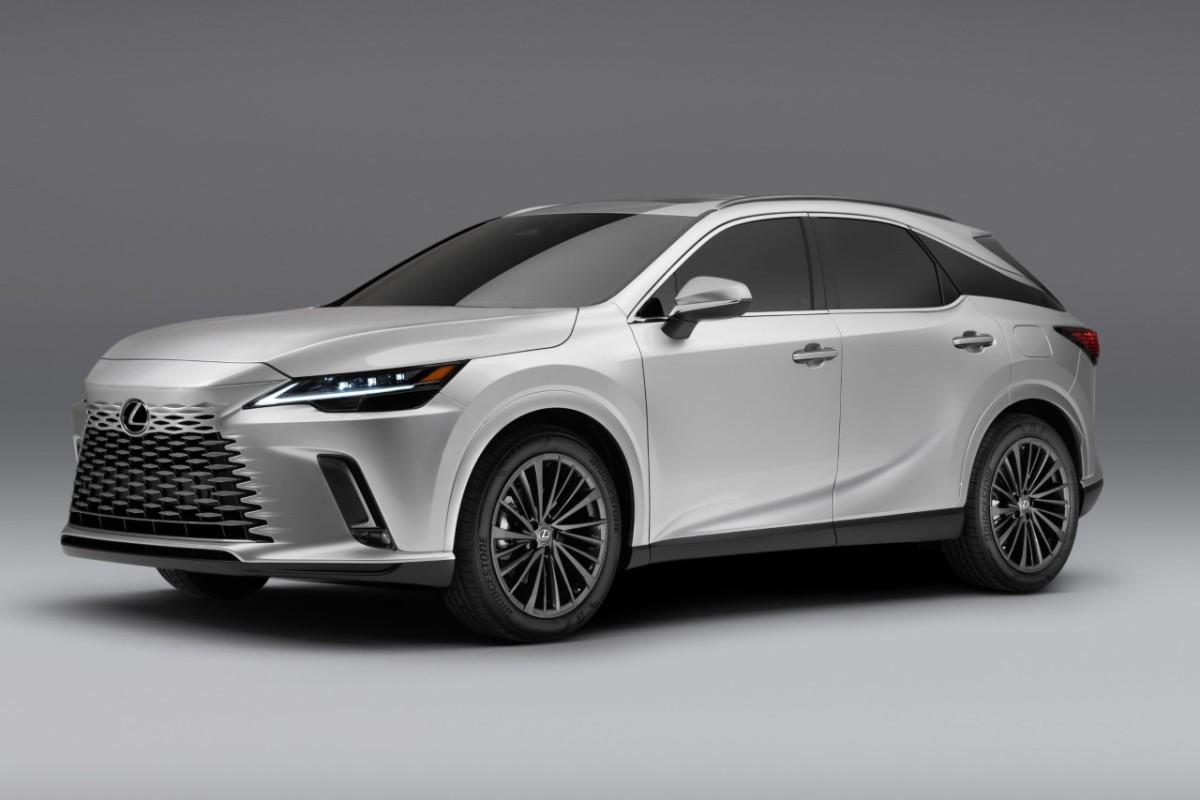
The new 2023 Lexus RX continues into its fifth generation and is built in Canada at the Toyota Motor Manufacturing Canada facility in Cambridge, Ontario. It’s shorter in height, broader in width, and longer in wheelbase than the outgoing version, but it is the same overall length as the SUV it replaces. It offers more cargo space in the trunk than the 2022 model (though still less than rivals). Nevertheless, it looks smaller both in photos and in person, mainly due to the reduction in rear overhang, softer design lines, and the down-sloping black trim on the rear pillar that gives the RX a floating roof effect but also creates a stubby look.
In front, the signature spindle-style grille is better integrated into the overall design, adding a modern mesh texture and flowing into a dramatically elevated hood that sweeps back into the windshield pillars. Upswept body sides recall the Lexus IS sedan while defining the flared rear fenders. Around back, the new RX adds a light-blade taillight design, block lettering for the Lexus name, and a sporty-looking bumper with simulated air vents.
Overall, the exterior styling is familiar enough that you can identify this SUV as a Lexus RX without reading the badges, but different enough that it looks fresh (and comparatively conservative) when parked next to the sharply angled and wildly styled previous-generation model. Also, though the new RX shares an overall aesthetic with the recently redesigned and smaller Lexus NX, it is not a larger copy of the same, ensuring people have a reason to spend more on the midsize model.
Open any of the new RX’s digitally latched doors, and you’ll find a thoroughly modern interior with fewer buttons and knobs than before. Digital instrumentation and a 9.8-inch or 14-inch touchscreen display take centre stage, and a head-up display is available. Natural voice-recognition technology makes using the RX’s features and functions easier, but the Intelligent Assistant technology that is as easy to use as your smartphone’s digital assistant or a home smart speaker is complimentary for only three years and only on some models. After that, you’ll need to pay for a subscription to the service.
Quality levels are high, as Lexus buyers expect, and in this regard the RX represents a clear step up from the smaller NX. NuLuxe artificial leather is standard, but genuine leather is available and some versions of the new RX also feature simulated suede. Textured black plastic, real wood, and aluminum dashboard trims are available.
The 2023 Lexus RX is available as the RX 350, RX 350h (hybrid, additionally powered by electric motors), and RX 500h (performance RX hybrid). An RX 450h+ (plug-in hybrid powertrain) is also coming, but not right away. This review covers the RX 350, which is available with F Sport 1, Luxury, F Sport 2, Executive, Executive, and F Sport 3 trim levels. Canadian pricing starts at $58,650 for the RX 350 and rises to $80,000 for the RX 500h, not including the $2,205 destination charge, fees, or packages.
Performance
During a Lexus ride-and-drive media event, we sampled two versions of the Lexus RX 350 on the same 30-kilometre driving loop just south of Santa Maria, California. The first had all-wheel drive (AWD, which is the standard drivetrain in Canada), the U.S. equivalent of Executive trim, and 21-inch alloy wheels. The second came with the U.S. equivalent of F Sport 3 trim, which includes AWD and equips the RX with an adaptive damping suspension. Both employed a turbocharged 2.4-litre inline four-cylinder engine making power specs of 275 horsepower and 317 lb-ft of torque and an eight-speed automatic transmission.
The turbo-four makes less horsepower but more torque than the outgoing 3.5-litre V6, and it also performs better at higher altitude while returning slightly better fuel economy. What’s the downside? It doesn’t sound as smooth and refined as the V6. But that’s a small price to pay for the turbo engine’s benefits.
On the testing loop, which included city, highway, and winding country roads, the RX 350 Executive displayed occasional hints of torque steer under hard acceleration and an excess of body motion over undulating pavement. It offered a smooth, comfortable ride most of the time, but if you drive over a swell, a dip, or an uneven patch in the pavement, it can react with too much vertical or lateral motion for comfort.
Taken on the same route, the RX 350 F Sport 3 felt more sure-footed and secure, especially when we switched the SUV into its Sport driving mode. (Since the RX doesn’t have a drive mode control knob, you must do this through Lexus Interface, which is a real pain in the you-know-what.) Both of the RX 350s we sampled had 21-inch wheels with 235/50 all-season tires, but the F Sport 3 model’s adaptive suspension eliminated most of the unwanted bouncing and rolling we experienced in the RX 350 Executive.
Additionally, the F Sport 3 gets upgraded brakes, but the testing route was not dynamic enough to compare the two RX 350s for resistance to heat and fade. In both SUVs, pedal feel and modulation proved superior to the RX 350h and RX 500h hybrids, each of which use regenerative braking systems.
Aside from its less refined note, the turbocharged 2.4-litre engine is a good choice for the new RX. Lexus says the RX 350 AWD hits 100 kilometres per hour in roughly 7.3 seconds. The SUV feels quicker than that, though, and most people will find it satisfying.
As far as fuel economy goes, the RX 350 AWD is estimated to average 9.9 litres per 100 kilometres in combined driving. Our results were 10.5 L/100 km and 10.8 L/100 km, respectively.
Form & function
Both of the RX 350 models we drove were comfortable, but the sport seat bolsters that come with the F Sport 3 package may hug you a little more than you prefer. However, they do a better job of holding you in place if you decide to chuck the crossover SUV through a set of S curves.
The RX 350 Executive came with semi-aniline premium leather upholstery, exclusive luxury seat designs with ten-way power adjustment for the driver and front passenger, heated and ventilated front seats, and a heated wood-and-leather steering wheel with power tilt and telescopic adjustment. The Peppercorn interior colour, suede door panel accents, and black open pore wood trim made the RX look and feel modern and sophisticated.
A more serious cabin awaited in the RX 350 F Sport 3. Black NuLuxe simulated leather seats coupled with Dark Graphite trim is par for the course with sport-oriented vehicles. If you’re feeling saucy, you can get Rioja Red NuLuxe in this model. This test vehicle had eight-way power-adjustable front seats, a thick-rimmed and heated steering wheel, and heated and ventilated front seats.
Aside from the squeezy F Sport seat bolsters, both RX 350s offered exceptional comfort on a warm and sunny day. The back seat is roomy and supportive, too, mounted high off the floor because in the hybrid models the battery lives beneath the rear seat cushion. This tall positioning results in terrific leg support coupled with good legroom and enough space for your feet. However, taller people will likely find headroom to be unexpectedly tight.
Lexus provides useful storage areas front and rear, and the company claims cargo space is improved over the previous-generation RX. The cargo area measures 838 litres when the second row is in position. Maximum space with the rear seat folded down measures 1,308 litres, which is more than before but is still not a generous number for the segment.
Technology
Slowly but surely, a new Lexus Interface multimedia infotainment system is rolling out with each vehicle the automaker redesigns. Now, it’s the RX’s turn to benefit from this next-generation technology that comes with a 9.8-inch or a 14-inch touchscreen display. Lexus Interface includes expected features such as wireless Apple CarPlay, wireless Android Auto, satellite radio, and numerous connected services plans with varying complimentary trial service periods.
One of those plans is Drive Connect, which is free for three years on certain models (and requires a subscription from purchase with others) and includes both Destination Assist and an Intelligent Assistant natural voice recognition. Just say “Hey Lexus,” followed by a command or a question, and the Intelligent Assistant quickly responds, usually with accuracy. This go-round, it gave us a list of Taco Bells when we asked for directions to the closest Chipotle, and when requesting a route to the nearest hospital the results mixed in some seemingly unrelated medical facilities. Otherwise, the responses were fast and flawless.
This infotainment technology also allows you to set up user profiles for different drivers. These profiles save a specific user’s settings and preferences, and can even transfer them between vehicles equipped with Lexus Interface. Additionally, you can stream Apple Music or Amazon Music through apps embedded into the system.
In our experience, after you’ve learned how to use the system, Lexus Interface is an excellent replacement for the company’s previous infotainment technology. The primary failing is that you can’t view multiple data panels on the screen at the same time. Instead, you’re forced to switch between them, which is a step backward compared to the company’s old technology.
Both test vehicles had the 21-speaker Mark Levinson premium sound system, and it proves its worth—if you’re willing to fiddle with the tone settings. With everything centred, some styles of music sound a little flat. Additionally, digital instrumentation and Digital Latch door handles are standard, while a digital rearview mirror and digital key smartphone technology are available.
You can also get a colour head-up display (HUD) in the new RX, and when the SUV is equipped with this option it adds unmarked, dual-function steering wheel controls. To discern which functions are active, you must reference the HUD, which is easy unless you’re wearing polarized sunglasses and driving on concrete in the middle of a sunny day. Under those conditions, the HUD is invisible to you.
Safety
Every 2023 RX also gets Lexus Safety System+ 3.0 (LSS+ 3.0), a robust collection of advanced driving assistance systems (ADAS). It contains the driver assistance and collision avoidance features that people have now come to expect from modern luxury vehicles such as lane departure warning, and automatic high beams. Blind spot monitoring and rear cross-traffic alert are standard as well. The new items include motorcycle detection, evasive steering assistance, intersection turn assistance with front cross-traffic alert, and a curve speed-reduction function when using the adaptive cruise control.
Additionally, three semi-autonomous driving technologies debut. Proactive Driving Assist is one of them, and you can choose to use it by turning it on through the Lexus Interface menu pertaining to ADAS settings. This feature proactively attempts to maintain a safe following distance to vehicles ahead by automatically modulating the brakes for drivers when they lift their foot off of the accelerator pedal, and it can bring the RX nearly to a stop. In effect, it’s much like using a one-pedal driving system in an electric vehicle. We didn’t mind using the tech, but acknowledge that some people won’t want to.
Traffic Jam Assist is also newly available for 2023, and Lexus says it offers hands-free, low-speed driving in traffic. However, you cannot check your email or watch a movie or scroll through your social media feed while commuting to and from work because a driver monitoring system is constantly watching you, and when you’re not paying proper attention, it’s not shy about letting you know about it.
Advanced Park Assist is another newly available feature for 2023. It takes full control of the RX and parks it in parallel and perpendicular parking spaces, but like other systems that do the same thing, it can be a painstakingly slow process and is not useful in busy, congested areas.
During our evaluation, LSS+ 3.0 proved impressive, but not flawless. One problem is that in RX models equipped with an HUD, the adaptive cruise controls are unmarked. To understand their functionality, you must reference the HUD, which isn’t visible when the driver is wearing polarized sunglasses. Also, the front cross-traffic warnings are shown on the HUD, so if you’ve got polarized shades on your face, all you get are the audible warnings, which can cause confusion.
We’re not big fans of curve-speed reduction technology. In the RX, it isn’t predictive, so the RX flings itself into the curve and then brakes after the fact, which is the opposite of what you would learn in any worthwhile driving school. So, turn this off.
Lastly, if you drive one-handed with your forearm crossing in front the gauges, you’ll block the driver monitoring system, which makes it angry. And as TV’s Incredible Hulk used to say back in the late 1970s, you won’t like it when its angry.
Cost-effectiveness
Lexus named the Acura MDX, BMW X5, Mercedes-Benz GLE, and Volvo XC90 as the new RX’s chief rivals in the midsize luxury SUV segment, and these competitors carry base prices ranging from about $66,300 to around $86,000. Canadian pricing starts at $58,650 for the RX 350 and rises to $80,000 for the RX 500h, not including the $2,205 destination charge, fees, or packages.
However, the empty-nester target customer might also compare the new RX with traditional compact luxury SUVs such as the Audi Q5, BMW X3, Mercedes-Benz GLC, and Volvo XC60. After all, the RX isn’t dramatically larger inside, especially when it comes to cargo space, so these popular models can also pose a threat, along with the excellent Genesis GV70.
Still, these comparisons with Lexus alternatives might prove a moot point. With the upcoming Lexus TX with a third row coming soon, the RX may discover that the biggest threat to its luxury SUV segment dominance may come from within.
Note: Images and video show a US model.

What owners say
After spending a day with my grandmother’s brand new 2023 Lexus RX350 AWD, I have to say it was one of the nicest cars I’ve ever driven. It has great handling for an Suv, plenty of power to get it moving, and all of the safety, comfort, and luxury features you want, and some pleasant surprises. I very much recommend this car for anybody looking for a decent sized luxury suv, even after driving a bmw x7 a few days earlier.
July 7, 2023I had a 2015 Rx 350. Best car I ever drove. 175000 miles and going strong until I had 2 accidents in one week and was totaled.
January 18, 2023Trims & specs
Base MSRP N/A | Seating N/A |
Engine N/A | Cargo Capacity N/A |
Combined MPG N/A | Drivetrain N/A |
Base MSRP $49,800 | Seating 5 |
Engine 2.4L 275 hp I4 | Cargo Capacity 29.6 cu ft |
Combined MPG 25 | Drivetrain FWD |
Base MSRP $52,400 | Seating 5 |
Engine 2.4L 275 hp I4 | Cargo Capacity 29.6 cu ft |
Combined MPG 25 | Drivetrain FWD |
Base MSRP N/A | Seating N/A |
Engine N/A | Cargo Capacity N/A |
Combined MPG N/A | Drivetrain N/A |
Base MSRP $51,400 | Seating 5 |
Engine 2.4L 275 hp I4 | Cargo Capacity 29.6 cu ft |
Combined MPG 24 | Drivetrain AWD |
Base MSRP N/A | Seating N/A |
Engine N/A | Cargo Capacity N/A |
Combined MPG N/A | Drivetrain N/A |
Base MSRP $54,000 | Seating 5 |
Engine 2.4L 275 hp I4 | Cargo Capacity 29.6 cu ft |
Combined MPG 24 | Drivetrain AWD |
Base MSRP $49,400 | Seating 5 |
Engine 2.4L 275 hp I4 | Cargo Capacity 29.6 cu ft |
Combined MPG 24 | Drivetrain AWD |
Base MSRP $55,800 | Seating 5 |
Engine 2.4L 275 hp I4 | Cargo Capacity 29.6 cu ft |
Combined MPG 25 | Drivetrain FWD |
Base MSRP N/A | Seating N/A |
Engine N/A | Cargo Capacity N/A |
Combined MPG N/A | Drivetrain N/A |
Base MSRP $57,400 | Seating 5 |
Engine 2.4L 275 hp I4 | Cargo Capacity 29.6 cu ft |
Combined MPG 24 | Drivetrain AWD |
Base MSRP N/A | Seating N/A |
Engine N/A | Cargo Capacity N/A |
Combined MPG N/A | Drivetrain N/A |
Base MSRP $47,800 | Seating 5 |
Engine 2.4L 275 hp I4 | Cargo Capacity 29.6 cu ft |
Combined MPG 25 | Drivetrain FWD |
Base MSRP $57,000 | Seating 5 |
Engine 2.4L 275 hp I4 | Cargo Capacity 29.6 cu ft |
Combined MPG 24 | Drivetrain AWD |


Pricing trends
MSRP range
$47,800 - $57,400
Current avg. market price
$49,702
Trending down by 0.4% this month
May 2026 - October 2026

