2023 Lexus RX Hybrid Reviews, Pricing & Specs



Pros & cons
What we like
RX 350h trims are fuel efficient
RX 500h trims are fun to drive
Impressive technology
What to consider
RX 500h delivers poor fuel economy
Not much cargo space
Poor head-up display integration
Expert review
When shopping for a new 2023 Lexus RX, strongly consider one of the hybrid models.
Since the redesigned 2023 Lexus RX mid-size crossover went on sale toward the end of 2022, the automaker has filled out its electrified line-up with three hybrid models: the RX 350h, RX 450h+ PHEV, and the RX 500h F Sport Performance. Based on time spent driving two of these three new 2023 Lexus RX Hybrid models, we expect them to at least double, if not triple, the previous-generation RX 450h’s share of sales.
out of 10 expert review
Look & feel
Lexus invited us to Santa Barbara, California, to test drive the redesigned 2023 RX models. To see what we thought of the standard RX 350 and the RX 350 F Sport Handling, read our separate review of those vehicles. This review is focused on the RX 350h and RX 500h F Sport Performance hybrid versions of the new SUV. We did not get a chance to drive the RX 450h+ plug-in hybrid, which arrived to market later on.
You can’t easily tell the difference between a standard Lexus RX 350 and a Lexus RX 350h. Except for the badge on the liftgate, they look identical to one another. Our Iridium (silver) RX 350h Luxury test vehicle, equipped with attractive 21-inch alloy wheels, didn’t have so much as a “HYBRID” badge, a blue-ringed Lexus logo, or a weird aero panel on it. Even the wheel design matched the standard RX 350. We prefer our hybrids this way.
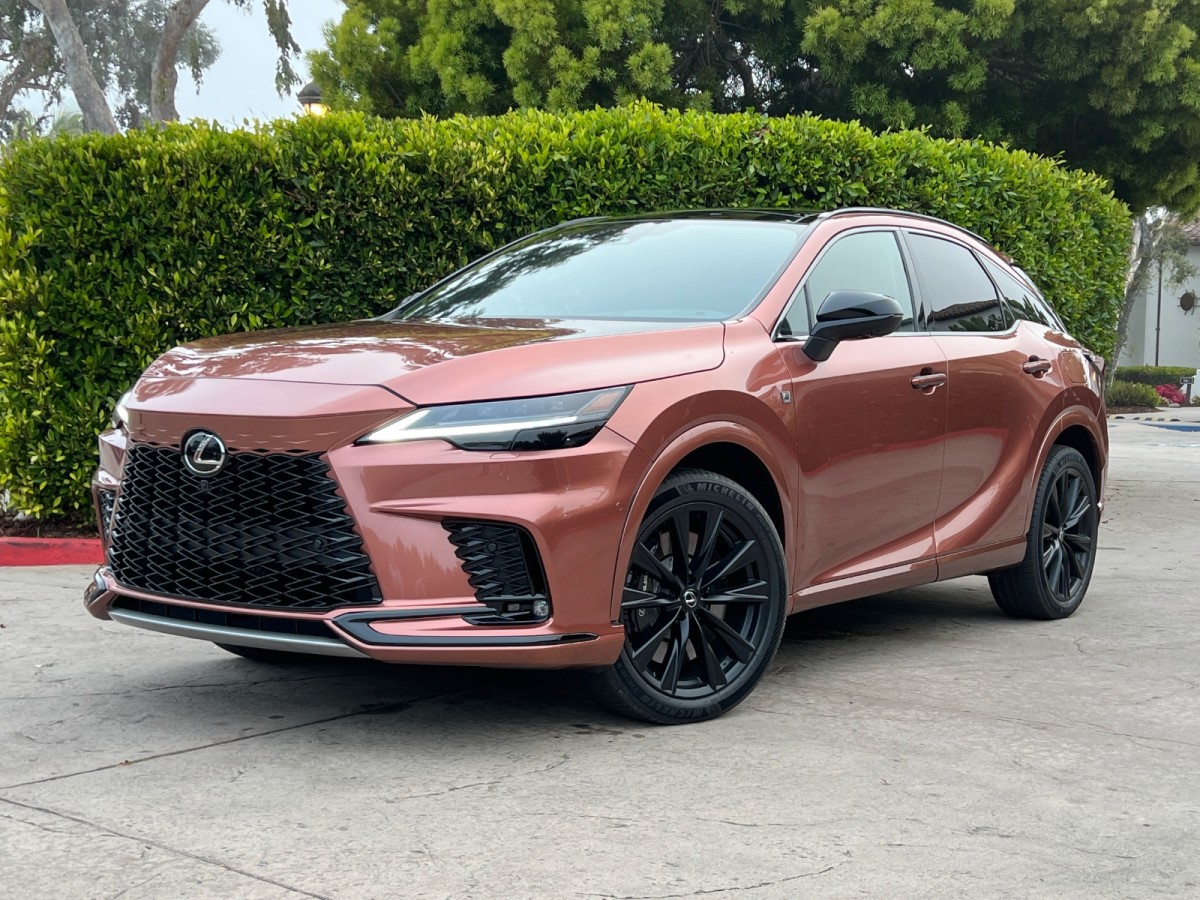
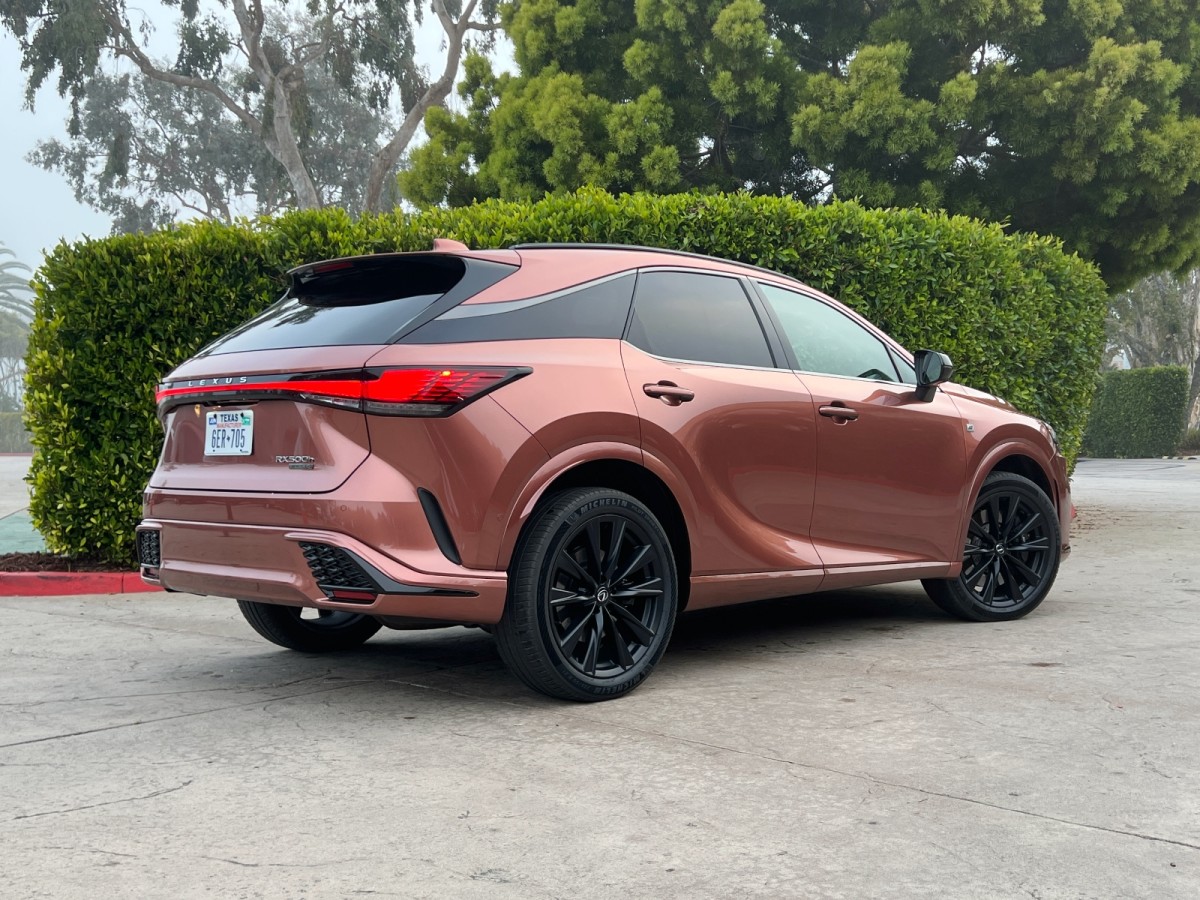
The RX 500h F Sport Performance test vehicle did visually distinguish itself, and not just because of its Copper paint job. This is a performance-tuned version of the SUV, and it looks the part with a blacked-out grille and exterior styling details, matte-black 21-inch wheels, more aggressive bumper designs, and specific interior trimmings.
Though the Lexus RX has long been popular, it’s never been what you’d call gorgeous. That remains true of the blunt-nosed 2023 RX models. They carry too much of their visual weight over the front wheels, and this imbalance is magnified by a wheelbase stretch that reduces the SUV’s rear overhang. In addition, the RX’s signature rear roof pillar design visually shortens the SUV’s rear end. So, though it’s about the same size as the outgoing model, the new 2023 RX looks smaller.
Inside, the RX adopts a cleaner, more minimalistic appearance. For better or for worse, there is less switchgear than before, and for the most part the new Lexus Interface infotainment system is an improvement over the technology in the previous model. Additionally, the new RX adopts contemporary approaches to textures and detailing, and features backlit ambient lighting after dark.
Our RX 350h Luxury test vehicle had beautiful Macadamia semi-aniline leather and Ash Bamboo wood trim, giving it a decidedly luxurious look and feel. The RX 500h F Sport Performance was all black inside, with artificial suede on the door panels and seat bolsters and dark gray aluminum trim decorating the cabin. If you want a splash of contrast and colour, you can get this model with Rioja Red upholstery.
In Canada, the 2023 Lexus RX 350h, the more fuel-efficient hybrid, starts at a new car price of $63,436 including a mandatory $2,205 destination charge and other fees. The 2023 Lexus RX 500h performance hybrid starts at $83,086 as a new vehicle, fees in.
Performance
Previously, Lexus equipped the RX 450h with a hybrid powertrain using a 3.5-litre V6 engine, a continuously variable transmission, electronic all-wheel drive (AWD) courtesy of a rear-mounted electric motor, five different Drive Mode Select settings, and 308 horsepower. Natural Resources Canada rated it to return 7.9 litres per 100 kilometres in combined driving, and Lexus said it would accelerate to 100 km/h in roughly 8 seconds.
The new 2023 RX 350h should prove more efficient, with our Luxury-trimmed test vehicle expected to average 6.5 L/100 km in combined driving even when equipped with its available 21-inch wheels. However, the RX 350h is also less powerful, producing 246 hp and 233 lb-ft of torque from a hybrid powertrain based on a 2.5-litre four-cylinder engine. Nevertheless, Lexus claims the RX 350h accelerates to 100 km/h in about the same time as a standard RX 350. You should hit that velocity in roughly 7.5 seconds in the RX 350h AWD.
If you’d like to get to 100 km/h in closer to 6 seconds, get the new 2023 RX 500h F Sport Performance. It’s got a hybrid system employing a turbocharged 2.4-litre four-cylinder from the RX 350, a traditional six-speed automatic transmission, and an exclusive Direct4 AWD system that uses an 80-kW rear eAxle with an inverter and electric drive motor. Total output from the turbo hybrid measures 366 hp and 406 lb-ft of torque, but the RX 500h is expected to consumer no less than 8.6 L/100 km in combined driving.
In addition to its turbocharged hybrid Direct4 drivetrain, our RX 500h F Sport Performance test vehicle had an adaptive damping suspension and an exclusive Dynamic Rear Steering system. Active Sound Control delivers a simulated engine and exhaust note to the cabin, and it certainly helps to make the RX 500h more (psychologically) fun to drive.
Dynamically, the RX 500h F Sport Performance is a legitimately good time. The adaptive damping suspension, upgraded brakes, and rear-wheel steering all lend this hybrid plenty of athleticism. Compared to the RX 350 F Sport model, it supplies greater confidence when approaching and tossing the SUV into corners and curves, and its Sport driving mode keeps the powertrain on high alert, ready to instantly respond to a driver’s requests for more power. Plus, thanks to its six-speed automatic, it doesn’t suffer the incessant droning many hybrid vehicles exhibit under acceleration.
Unfortunately, to access Sport mode (or Eco, Normal, or Custom), you need to remember to choose the Vehicle menu on the infotainment system, then select Drive Mode, then stab your finger at a virtual button on the display. As it turns out, perhaps we should have used Eco mode for part of our drive because the RX 500h F Sport Performance came nowhere near its estimated fuel economy rating of 8.6 L/100 km in combined driving. We averaged 11.3 L/100 km, reflecting the use of Sport mode and regular dips into the RX 500h’s power and torque reserves.
If fuel economy is important to you, get the 2023 Lexus RX 350h. In this version of the SUV, we averaged 7.4 L/100 km. That’s still short of the Lexus estimate of 6.5 L/100 km, but is certainly better than any other version of the new RX. Better yet, we preferred driving the RX 350h to the standard RX 350.
Near as we can tell, the added weight of the battery pack underneath the rear seat, combined with the electric assist motor at the rear axle and the lower centre of gravity associated with the RX’s new GA-K vehicle architecture, helped to make the RX 350h feel more secure in curves and less busy on uneven pavement. Also, while the four-cylinder and CVT can sound unpleasant at higher revs, most of the time you don’t even notice the powertrain. Instead, you get instant electric motor torque, a quiet cabin, and effortlessly good fuel economy.
If we had to choose between the standard RX 350 and the RX 350h, the hybrid would get the nod given that the difference in price in Canada is $1,500. But the RX 500h F Sport Performance is the version that can make you look forward to the journey as much as the destination.
Form & function
Not only is the RX 350h fuel efficient, but it’s downright comfortable on a warm summer day. With the Luxury trim’s ten-way power-adjustable front seats; soft, supple, premium leather and standard seat heating and ventilation; and three-zone automatic climate control that iced the interior in a hurry, it was a terrific place to spend quality time.
The RX 500h F Sport Performance model’s front seats offer eight-way power adjustment and larger side bolsters, so you’re more aware of them while seated in the vehicle. The leather is the standard grade, which isn’t a bad thing, but it isn’t as good as a semi-aniline hides available in the RX 350h Luxury that we drove. The RX 500h does have standard heated and ventilated front seats and an effective climate control system, plus a thicker F Sport steering wheel that we preferred to grip.
Lexus houses the hybrids’ battery packs underneath the back seat. This forces placement of the seat cushion a little higher in the vehicle, and the new RX has a lower roofline than it did before. The result is excellent leg support for rear passengers, combined with good legroom and space for feet. However, rear headroom is tight. A panoramic moonroof is standard on the RX 500h and available on lower trims.
The new RX has decent storage space. Lexus has increased the cargo space to 838 litres behind the rear seat and 1,308 litres with the back seat folded down. (These numbers match the standard RX 350, so the hybrid drivetrain does not encroach upon cargo volume.) For comparison, the old RX 450h supplied 453 litres behind the back seat and a maximum of 926 litres. So, while the new RX offers significant improvement over the old model, it also continues to fall a little short compared to some of its rivals.
Technology
The 2023 Lexus RX gets a new infotainment system, a long-overdue upgrade that brings the SUV into the modern era. However, to optimize this technology you’ll need to fork over a credit card and pay for the connected services plans after the complimentary trial subscriptions expire. Otherwise, the new Lexus Interface will only serve as your gateway to vehicle settings and configuration and a platform for running wireless Apple CarPlay or Android Auto.
To set up the system, you’ll first want to activate your free trial subscriptions to the various connected services plans and create a user profile. This will save all of your preferred vehicle settings, and you can transport them to other Lexus and Toyota models that use this same infotainment technology. (Toyota calls it Toyota Audio Multimedia.)
In addition to Service Connect, Wi-Fi Connect, Safety Connect, and Remote Connect, the Lexus Interface offers Drive Connect. It is free to use for three years on the RX 500h and requires payment from the start in other models, and it includes a cloud-based navigation system with Google points of interest and an Intelligent Assistant digital voice assistant. Use the “Hey Lexus” wake phrase, tell the assistant what you seek, and you should get fast, accurate results, just like when you use your smartphone.
During testing near Santa Maria, California, the Intelligent Assistant worked reasonably well. An urgent directive to find the nearest hospital produced some results that were not hospitals, and when we asked for directions to the closest Chipotle the system spat back several Taco Bell locations. Otherwise, it worked as expected.
We do have a handful of complaints related to Lexus Interface. First, although we appreciate the touchscreen display’s size, you can view only one screen menu at a time. In other words, you can’t simultaneously view the navigation map, the music you’re listening to, and another set of data. This means you’re constantly fiddling with the five main menu virtual buttons along the left side of the display.
Second, the screen does suffer from reflections, especially in models with light-coloured seat upholstery. Third, there isn’t a tuning knob to accompany the volume knob. Lexus has a single, dual-function knob in its ES sedan that performs both of these functions, and it would be perfect applied to the RX. Fourth, it’s easy to forget where you may have discovered something within the menus, and it can be frustrating to go hunting for such things while driving.
Our test vehicles also had the available head-up display. When you get this option, you also receive dual-function touch-sensing control pads on the steering wheel. Because they serve dual functions, they are unmarked. In order to see which set of functions is active at a given time, you touch the pad and look at the head-up display (HUD). This is distracting under any circumstance, but if you wear polarized sunglasses the situation is worse because you can’t see the HUD and so you can’t discern which functions are active. It’s a frustratingly obvious user-experience problem that has made it through to production.
Safety
Every 2023 RX comes with Lexus Safety System+ 3.0 (LSS+ 3.0). It is a robust collection of advanced driver assistance systems (ADAS), and it gets a “3.0” designation for its new motorcycle detection system, evasive steering assistance, intersection turn assistance with front cross-traffic alert, and a curve-speed reduction feature for the adaptive cruise control system. Other features include lane departure warning, automatic emergency braking, and blind spot monitoring.
Additionally, the new RX has Proactive Driving Assist, which you can choose to use or turn off via the driving assistance menu in Lexus Interface. This feature automatically slows the RX when you release the accelerator pedal in order to maintain a safe following distance to vehicles ahead or to maintain speed on hill descents. In the RX Hybrid models, the regenerative braking system feeds energy to the battery pack and recharges it as you drive.
We liked the Proactive Driving Assist technology, and while those features of LSS+ 3.0 that we could test operated mostly with refinement and accuracy, there are some irritations.
First, the new front cross-traffic alert system warns the driver when vehicles are approaching from the sides at an intersection. The feature beeps, but also provides orange arrow visual indicators on the HUD so that a driver can tell from which direction the vehicles are approaching. But, as we’ve mentioned, if you have polarized sunglasses on, you don’t get these visual indicators. Instead, you get a mystery beep.
Second, the new curve-speed reduction tech appears to be reactive instead of proactive, slowing the RX upon curve entry rather than prior to curve entry. In any case, we’re not fans, so we turned this off.
Third, a driver monitoring system is mounted to the steering wheel column. If you drive one-handed with your forearm crossing the steering wheel’s vertical centre axis, you’ll block the monitoring system and that will result in lots of warnings from the tech.
Lexus also offers a new Traffic Jam Assist system on the new RX. It works at low speeds, combining the adaptive cruise control with stop-and-go capability and the lane-centring assist system with the driver monitoring system to allow low-speed, hands-free driving capability. We did not test this, since the outskirts of Santa Maria are largely traffic-free.
Advanced Park is an available semi-autonomous parking technology. Our test vehicles didn’t have the upgrade, and we likely wouldn’t have tested it even if it did. These systems are mostly useful only on deserted streets and the remote reaches of parking lots because they take so long to identify a suitable spot and park the vehicle. And the spots are usually so big that you can tuck the vehicle in yourself without much trouble and in a fraction of the time.
Cost-effectiveness
The RX 350h’s nominal $1,500 premium over the RX 350 AWD makes it the best deal in the lineup in Canada. Without a performance penalty and with the ability to effortlessly deliver fuel economy in the mid 7s per 100 kilometres, the RX 350h makes the most sense for most people most of the time. The only downside is the unrefined sound of the powertrain, but only when it makes itself evident (and that’s where the Mark Levinson audio system shows its value).
As for the RX 500h, it gives the lineup a needed performance boost and a dose of driving excitement that this SUV has traditionally lacked. It is pricy at more than $80,000 with fees, but this falls below where German luxury SUV equivalents start such as the BMW X5 and Audi Q7 55, making it an appealing alternative.
Note: Images show a US model.

What owners say
Excellent handling, lots of power, and all the tech you could want. Very happy with our purchase so far. Only little negative is the small gas tank.
May 16, 2025This car is great as far as luxury and performance features. It looks very good too. I just don’t like that it doesn’t have a third seat in the back.
March 6, 2023Hybrid with convenient advanced features More advanced technology Value is little bit expensive Other model compare is Rav 4 prime
May 27, 2023Trims & specs
Base MSRP N/A | Seating 5 |
Engine N/A | Cargo Capacity 29.6 cu ft |
Combined MPG N/A | Drivetrain N/A |
Base MSRP $64,745 | Seating 5 |
Engine N/A | Cargo Capacity 29.6 cu ft |
Combined MPG N/A | Drivetrain N/A |
Base MSRP N/A | Seating N/A |
Engine N/A | Cargo Capacity N/A |
Combined MPG N/A | Drivetrain N/A |
Base MSRP $59,690 | Seating 5 |
Engine N/A | Cargo Capacity 29.6 cu ft |
Combined MPG N/A | Drivetrain N/A |
Base MSRP $66,900 | Seating 5 |
Engine 2.4L 366 hp I4 Hybrid | Cargo Capacity 29.6 cu ft |
Combined MPG 27 | Drivetrain AWD |
Base MSRP $56,200 | Seating 5 |
Engine N/A | Cargo Capacity 29.6 cu ft |
Combined MPG N/A | Drivetrain N/A |
Base MSRP N/A | Seating N/A |
Engine N/A | Cargo Capacity N/A |
Combined MPG N/A | Drivetrain N/A |
Base MSRP N/A | Seating N/A |
Engine N/A | Cargo Capacity N/A |
Combined MPG N/A | Drivetrain N/A |
Base MSRP N/A | Seating N/A |
Engine N/A | Cargo Capacity N/A |
Combined MPG N/A | Drivetrain N/A |


Pricing trends
MSRP range
$49,400 - $62,000
Current avg. market price
$55,383
Trending down by 2.4% this month
May 2026 - October 2026

