2023 Jeep Grand Cherokee 4xe Reviews, Pricing & Specs

Pros & cons
What we like
Stylish design
Plug-in hybrid powertrain
Trailhawk’s off-roading capability
What to consider
Falls short of range, mileage expectations
Poor ergonomic design
Poor value for money
The CarGurus verdict
The 2023 Jeep Grand Cherokee Trailhawk 4xe plug-in hybrid SUV is a rock star when off-roading.
Verdict: As a daily driver, Jeep’s electrified midsize SUV is unimpressive. Electric-only driving range is merely adequate compared to other plug-in hybrids, the powertrain is unrefined, and the Trailhawk trim’s all-terrain tires compromise on-pavement handling. Starting in 2023, the Trailhawk comes in only 4xe specification, with the V6 and V8 gasoline engines dropped for the off-roader.
out of 10 expert review
Look & feel
In Canada, the 2023 Jeep Grand Cherokee 4xe lineup includes five trim levels. These are the base model, Trailhawk, Overland, Summit, and Summit Reserve. Prices start at $72,395 before you add any options, and a Summit Reserve costs $91,490 before upgrades, which include most paint colours and, incredulously, a wireless smartphone charger. Those prices don’t include Jeep Canada’s destination charge, which varies across the country.
Our test vehicle arrived in the Trailhawk trim level. It had a panoramic sunroof, Luxury Tech Group III, and Advanced ProTech Group II, options that bringn the manufacturer’s suggested retail price (MSRP) to roughly $85,000, including destination. Yes, the Grand Cherokee 4xe is expensive. Sadly, it’s too expensive to qualify for Canada’s EV sales incentives.
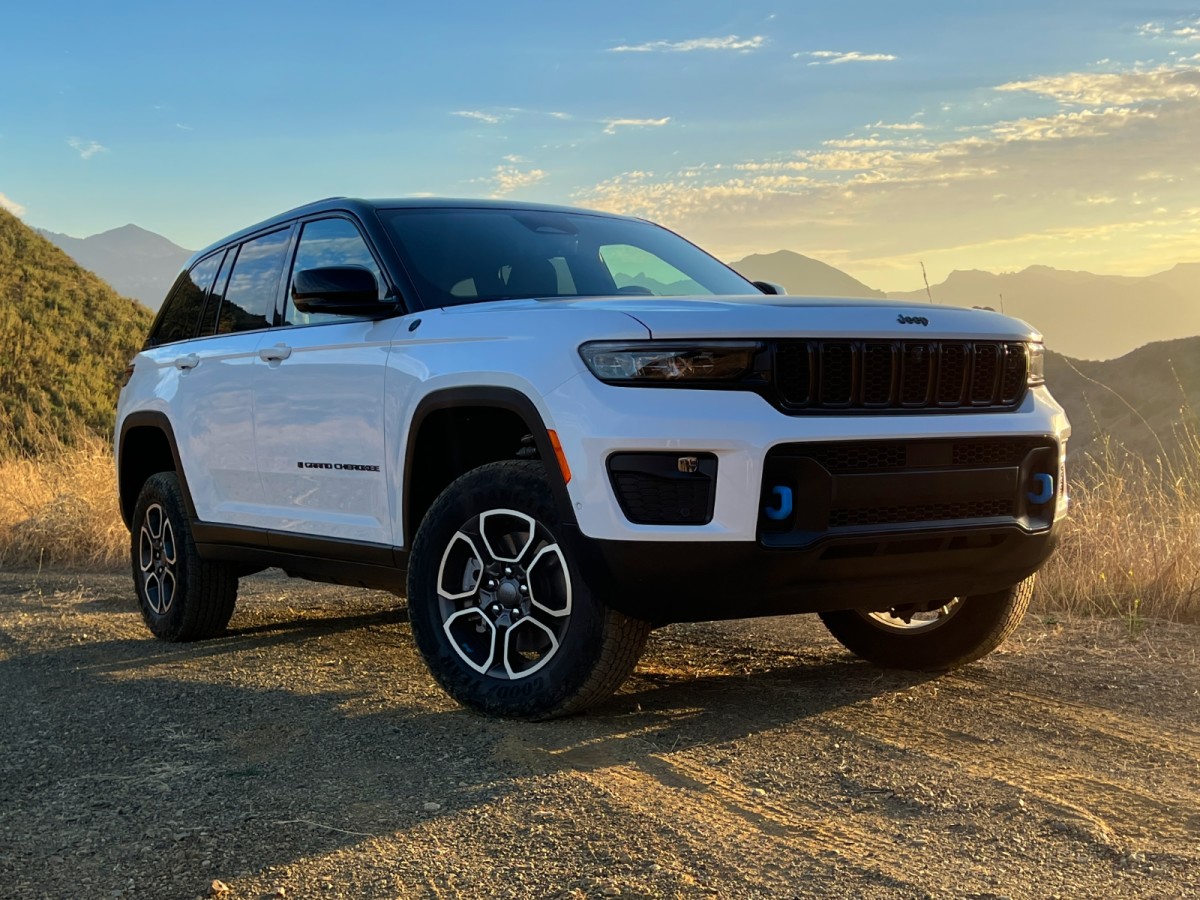
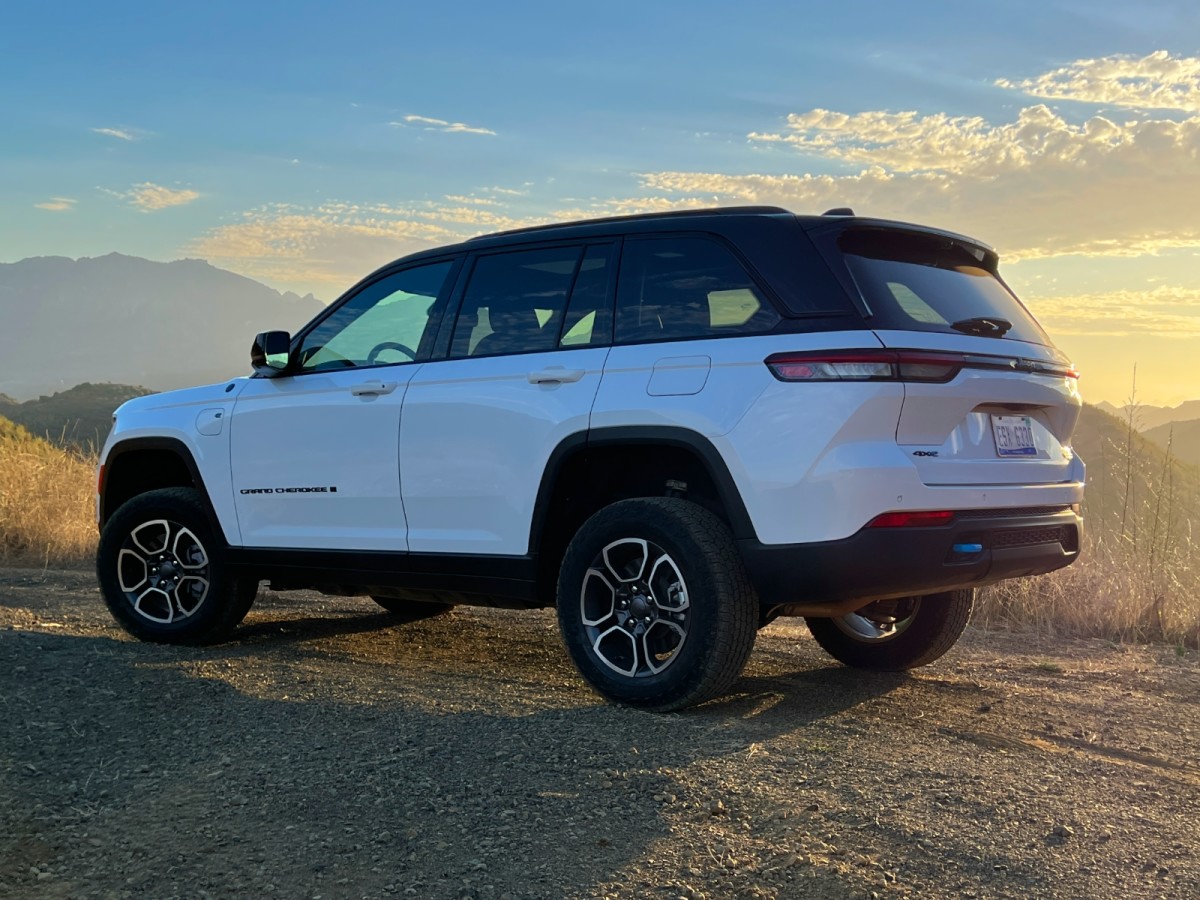
You can spot the Grand Cherokee Trailhawk 4xe by its sky blue exterior detailing and matte-black hood decal, which Jeep says can reduce glare when driving. The Trailhawk also gets unique wheels wrapped in more aggressive all-terrain tires and the coveted Trail Rated badge that Jeep only applies to models that can tackle the legendary Rubicon Trail.
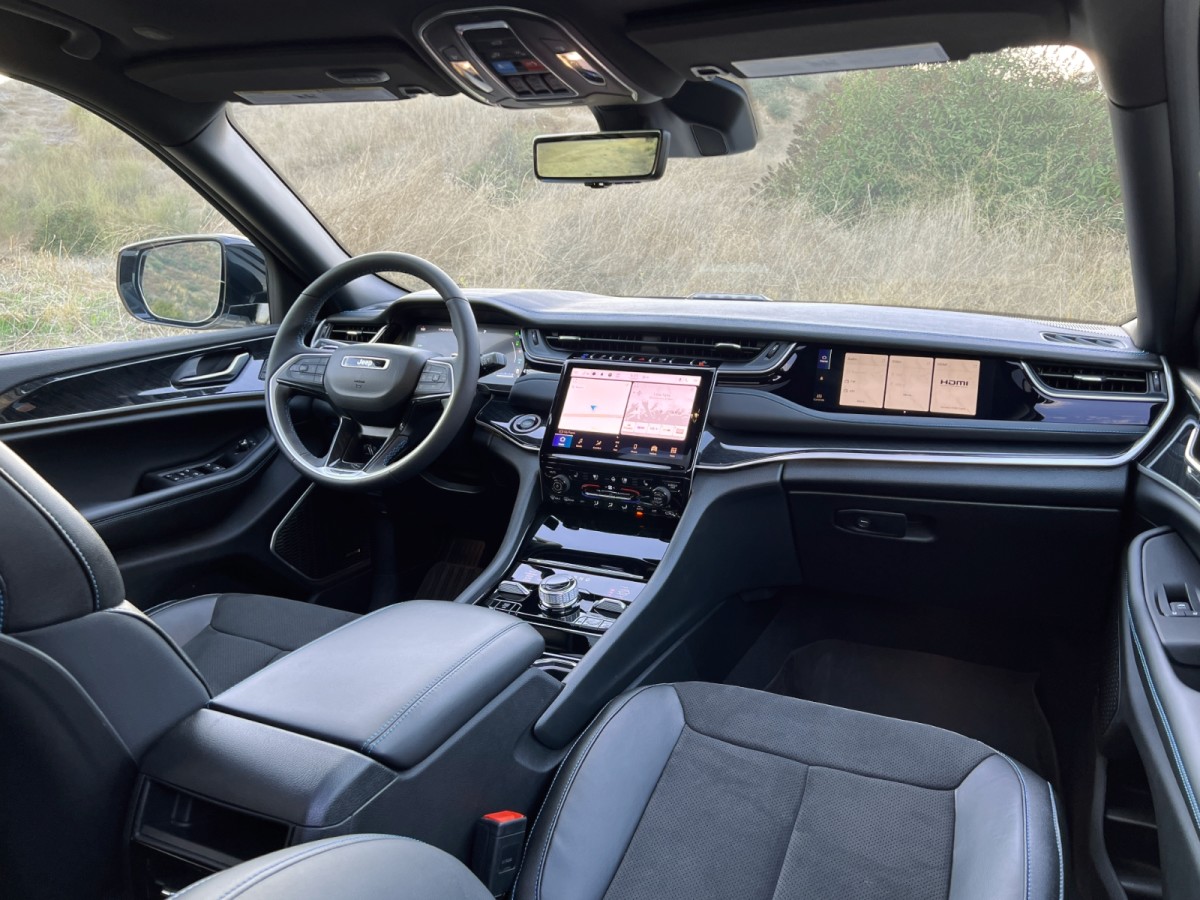
When you spend this kind of money on a new ride, you expect an upscale interior. The Grand Cherokee Trailhawk 4xe falls short in this regard. There is too much plastic, including significant amounts of gloss black surfacing that serves as a magnet for dust and fingerprints. The leather and artificial suede upholstery is nice, but otherwise, Jeep leans too hard on shiny and fancy—instead of substance and quality—to convey luxury.
In addition, when you buy a rugged off-roader, you expect utility. But with the Grand Cherokee Trailhawk 4xe, the interior prioritizes style. The glossy surfaces make some controls hard to read, and the rapidly accumulating dust makes the problem worse. Also, Jeep locates other controls where they’re difficult or impossible to see while driving.
An exception is the steering wheel controls, rendered in a matte-black finish that makes them easy to see and read. Plus, the Grand Cherokee 4xe provides excellent radio tuning and stereo volume controls on the back of the steering wheel spokes. It might seem counterintuitive, but using them is a delight.
Performance
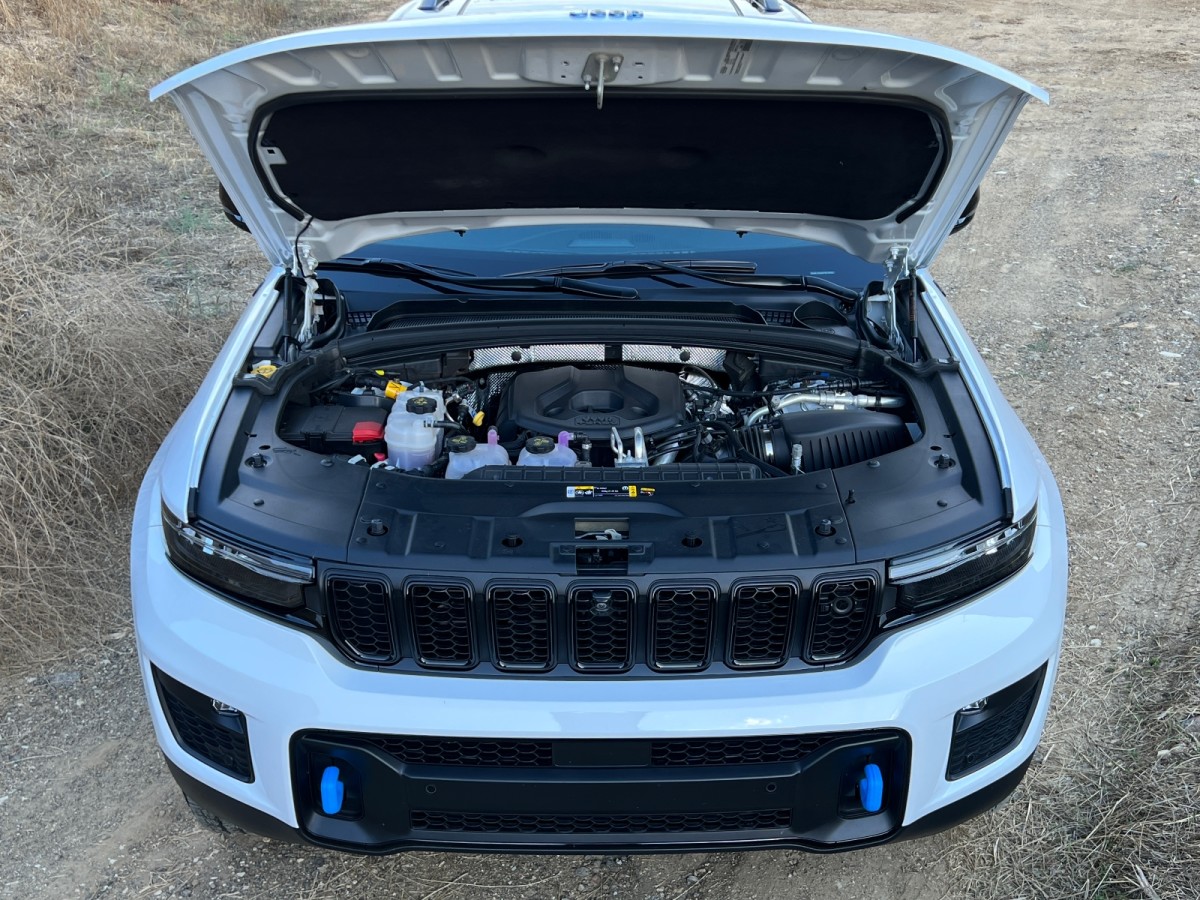
To create its plug-in hybrid (PHEV) powertrain, Jeep marries a turbocharged 2.0-litre four-cylinder engine with a 17.3-kilowatt-hour lithium-ion battery pack and an 8-speed automatic transmission with an integrated 100-kilowatt electric motor. Together, these components produce a robust 375 horsepower and 470 lb-ft of torque, and Jeep says the Trailhawk can tow up to 2,720 kilograms (6,000 pounds).
In addition, the Trailhawk has a standard four-wheel-drive (4WD) system with a two-speed transfer case. According to Jeep, this 4x4 system can deliver all of the power to a single rear wheel if necessary, one of several factors that guarantee the Trailhawk’s impressive off-roading capability. Selec-Terrain technology provides Auto, Sport, Mud/Sand, Rock, and Snow modes, and the Trailhawk also has Selec-Terrain off-road cruise control and a hill descent control system.
There’s more to the story. The Trailhawk has a front-axle sway bar disconnect system and a standard height-adjustable air suspension with semi-active damping. In its highest setting, it provides 27.6 centimetres of maximum ground clearance, plus approach, breakover, and departure angles measuring 35.7 degrees, 22.3 degrees, and 30 degrees, respectively. Jeep claims the battery is sealed to ensure 60 centimetres of water fording capability.
Undeniably, these are impressive specs. But, unless you’re a doomer, a prepper, or someone who spends a whole bunch of time off-road, most of it doesn’t matter and is a poor use of your money.
The point of a plug-in hybrid vehicle is to use electric power when desirable or necessary and to benefit from improved fuel economy the rest of the time. The Grand Cherokee 4xe provides a Natural Resources Canada estimated 42 kilometres of all-electric range and 11.7 litres per 100 kilometres in combined driving when used as a hybrid vehicle.
So, how did it perform on our testing loop? We started off with an indicated 42 kilometres of electric range, but the test vehicle traveled just 34 kilometres before the gasoline engine turned on and stayed on. That’s not a clean measure, though, because, on an uphill highway ramp, the turbo four activated and remained running for about a kilometre.
After expending the energy in the battery, the Grand Cherokee Trailhawk 4xe averaged 14.6 L/100 km in the Auto driving mode and with the air suspension in its middle setting. Again, the Jeep fell short of expectations.
You can easily recharge the battery overnight using a standard household outlet. Also, as a daily driver, you’re likely to find yourself manually switching between the Hybrid and Electric modes. Unfortunately, Jeep tucks the control buttons low on the left side of the dashboard, where you can’t see them while driving. There is an E-Save mode, too, which you might use while traveling to an off-road destination to preserve battery power and electric-motor torque for tackling the trail.
We’ve experienced how capable the Grand Cherokee Trailhawk is off-road on trails in Moab, Utah. This time around, the Jeep shrugged off a trail we haven’t attempted since parts of it washed out during a deluge of rain. So yeah, the Trailhawk is seemingly ready for anything.
Unfortunately, most of the time, you’re not off-roading. During the daily drive, the gas engine sounds unrefined when it revs, drivetrain power delivery is often uneven due to surges of torque, and the regenerative braking system can make it hard to stop smoothly. Body lean is evident in higher-speed curves, especially if the surface undulates and the Jeep starts throwing its weight around. And, in our opinion, the steering response is too fast, given the all-terrain tires, making the Trailhawk’s handling feel sketchy.
Benefits of driving the Trailhawk include quick acceleration in Hybrid mode, impressive ride quality, and the Jeep’s ability to effortlessly handle the heaves and holes in the road. Plus, when you’re driving in urban and suburban areas, you’re unconcerned about body or wheel damage from parking blocks and curbs. Undoubtedly, it also gives its driver an added measure of confidence when traveling in a snowstorm.
Form & function
When you head out on an adventure, you need places to put things. From a lack of practical storage to relatively little cargo space, the Grand Cherokee falls short in this regard. Jeep’s need to provide serious off-roading hardware contributes to this problem in the form of a centre driveshaft tunnel, but because the Grand Cherokee also must appear convincingly upscale inside, ugly trays, bins, and shelves are in relatively short supply.
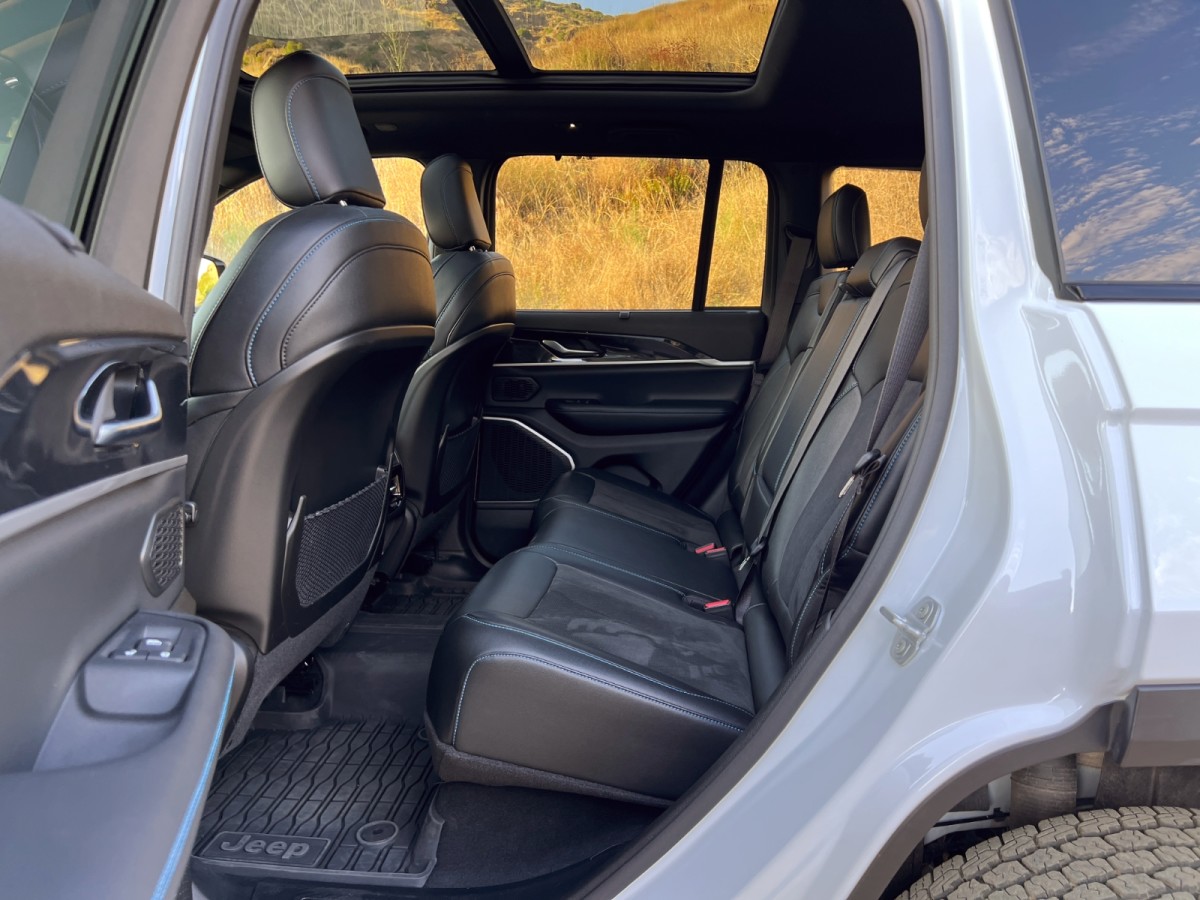
Jeep equips the Trailhawk with artificial suede and leather seats with eight-way power adjustment. You can get the interior in any colour you want, as long as it’s black. The front seats include heating and ventilation, and Jeep heats the steering wheel and the rear outboard seats. Nappa leather is available on more expensive trims.
The Grand Cherokee isn’t as comfortable as expected. The front seats are firm and relatively flat, so you feel like you’re sitting on them instead of in them. In addition, the second-row seat cushions are mounted relatively low and lack support, presumably to ensure a flat load floor when they’re folded down. In addition, the rear legroom is tight, and the protruding plastic hooks on the hard-paneled front seatbacks can dig into your knees without warning.
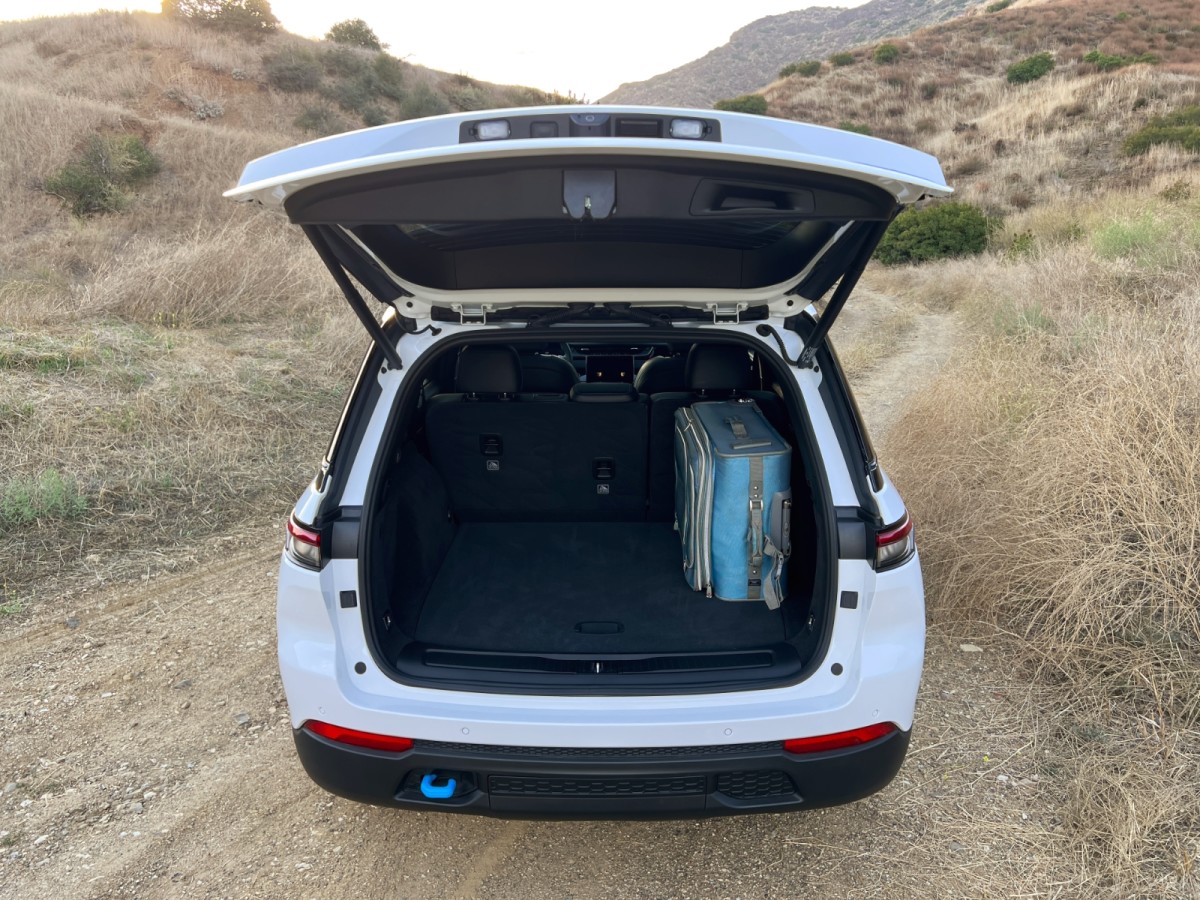
Open the power liftgate and you’ll find 1,067 litres of cargo space behind the Grand Cherokee’s back seat. You can slide four full-size suitcases in and then add a couple of duffel bags or a few backpacks. For maximum cargo space, fold the back seat down to get a maximum of 2,004 litres. This figure is small for a midsize SUV and measures less than some compact SUVs.
Technology
Jeep makes a big deal out of the number of screens you’ll find in a Grand Cherokee. There are up to six, including the optional head-up display and dual-screen rear-seat entertainment system with Amazon Fire TV compatibility.
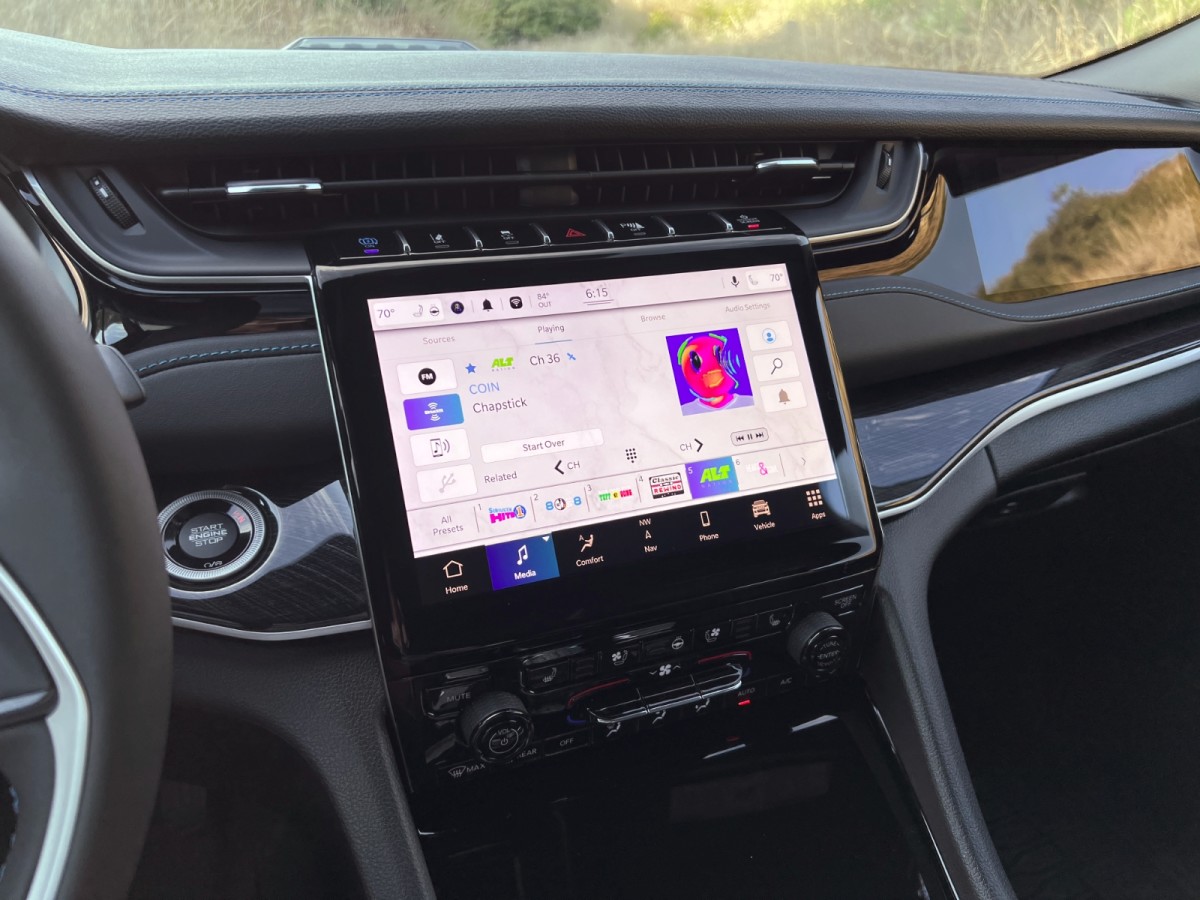
Trailhawk trims include a standard 10.3-inch digital instrumentation panel and a 10.3-inch front passenger infotainment screen, which is not visible to the driver. Between them, you’ll find a comparatively small 10.1-inch touchscreen infotainment system.
The Trailhawk’s infotainment system uses Jeep’s Uconnect 5 technology, which is also found in vehicles from the Chrysler, Ram, Alfa Romeo, Fiat and Dodge brands. It comes with wireless Apple CarPlay and Android Auto, SiriusXM satellite radio, a navigation system, and Jeep Connect services with access to SOS emergency calling, a Wi-Fi hotspot, and other features. In addition, the Trailhawk has an Alpine premium sound system. A 19-speaker McIntosh audio system is offered in higher trims.
Uconnect 5 offers a simple and straightforward user interface. Unfortunately, Jeep renders delicate graphics over what appears to be a topographical background pattern, and the low-contrast combination can make the display appear washed out while also making it harder to read. The voice recognition system is average, quickly and accurately responding to some directives while failing to do so for others.
Fortunately, you can configure the system’s Apps screen to provide quick access to your favourite functions. In addition, you can configure the digital instrumentation to please your preferences for aesthetics and data points.
Below the centre display, you’ll find stereo volume and radio tuning knobs. However, we think you’ll enjoy using the buttons on the back of the steering wheel so much that these knobs will exist more for the front passenger to use than the driver.
In front of the front-seat passenger, the Trailhawk has a 10.3-inch infotainment screen for whoever is along for the ride. It supports Bluetooth, USB, and HDMI connectivity and went completely unused during testing because occupants preferred their hand-held devices.
Tech-related options include wireless smartphone charging and a camera-based digital rearview mirror. Oddly, the wireless charger is optional on all Grand Cherokee 4xe models, including the top-shelf Summit Reserve. At these prices, it should be standard.
Safety
Jeep equips the Grand Cherokee 4xe with adaptive cruise control, forward-collision warning, automatic emergency braking, blind-spot monitoring, rear cross-traffic alert, lane-departure warning, lane-keeping assist, rain-sensing wipers, and a reversing camera paired with rear parking sensors.
Our test vehicle had the Advanced ProTech Group II. This upgrade installs an intersection collision assist system that can actively try to prevent an unsafe turn, a surround-view camera, front parking sensors, and a Night Vision system. The Night Vision system uses thermal imaging to show pedestrians, cyclists, and animals on the road ahead, depicted within the digital instrumentation.
On some versions of the Grand Cherokee 4xe, you can get Jeep Active Drive. It pairs the adaptive cruise control with a lane-centring assist system to provide a hands-on, semi-autonomous driving assistance system. It is unavailable on the Jeep Grand Cherokee 4xe Trailhawk.
During the evaluation, the lane-departure warning system issued a few false alerts, and the lane-keeping assist system felt intrusive in curves. These features, and the adaptive cruise control, worked best on highways. However, when other motorists cut into or departed the gap ahead, the adaptive cruise was not as responsive as we desired.
According to the National Highway Traffic Safety Administration (NHTSA), the Grand Cherokee 4xe gets a five-star overall rating. The only ding against this Jeep is a four-star rating for driver protection in a frontal-impact collision.
The Insurance Institute for Highway Safety (IIHS) says the 2023 Grand Cherokee earns a Top Safety Pick+ safety rating. However, the IIHS uses a mix of models and trim levels to aggregate data for this rating, and none of them have the 4xe plug-in hybrid powertrain. Therefore, while the IIHS doesn’t state the rating excludes the 4xe, we caution against assumptions that they apply to the plug-in hybrid version.
Regardless, it is important to note the Poor rating in the updated moderate overlap frontal-impact test. The IIHS used a 2022 Grand Cherokee Trailhawk with a gasoline engine for that evaluation, and the rear passenger did not fare well in the collision.
Cost-effectiveness
Jeep positions the Grand Cherokee as a premium SUV. That elevates it above mainstream brands but tucks it below traditional luxury models. Your perception and acceptance of Jeep as a premium brand are essential to the cost-effectiveness equation.
Furthermore, Jeeps are known for their off-roading capabilities. The Grand Cherokee Trailhawk is immensely capable in this regard, but the hardware and software that make it so unstoppable in the dirt is of value only to those who will use it.
Finally, the point of a plug-in hybrid is to reduce reliance on gasoline. The Grand Cherokee’s electric-only range isn’t impressive, and Jeep recommends more expensive premium fuel for the turbocharged 2.0-litre four-cylinder engine. Unfortunately, in our testing, the Grand Cherokee 4xe fell short of expectations regarding range and fuel economy.
We don’t think the Grand Cherokee 4xe is cost-effective as a daily driver. You can get more electric range for less money by choosing a more fuel-efficient Hyundai Santa Fe Plug-in Hybrid or Kia Sorento Plug-in Hybrid.
The Mazda CX-90 PHEV is another alternative to the Jeep Grand Cherokee 4xe. It matches the Jeep’s range and efficiency ratings, but it is far more convincing as a premium SUV regarding interior quality and materials. Plus, it and the Kia have a third-row seat.
Or, you could spend a little more and get a BMW X5 xDrive50e. It is legitimately luxurious, offers more power, provides 63 kilometres of range, is slightly more efficient, and tows nearly as much weight.
Still, none of those rivals are as capable as the Grand Cherokee Trailhawk 4xe off-road. So, if you’re planning to spend plenty of time traversing challenging terrain and you want to drive a plug-in hybrid SUV, then this Jeep is your only choice.
Note: Images show a US model.
What owners say
Lots of cool features including night vision, heads up and video screens. Great value
August 12, 2024The Trailhawk features on the 4xe make this a truly capable off-roader while enjoying the environmental benefits of electrification in a very comfortable highway cruiser. It checks ALL our boxes!
July 6, 2023Hybrid technology in a very off-road capable and highway comfortable package. Lots of bells and whistles ... hope Jeep reliability shines on this one.
June 20, 2023Trims & specs
Base MSRP $72,595 | Seating 5 |
Engine 2.0L 375 hp I4 Hybrid | Cargo Capacity 37.7 cu ft |
Combined MPG 57 | Drivetrain 4X4 |
Base MSRP $65,260 | Seating 5 |
Engine 2.0L 375 hp I4 Hybrid | Cargo Capacity 37.7 cu ft |
Combined MPG 23 | Drivetrain 4X4 |
Base MSRP $64,565 | Seating 5 |
Engine 2.0L 375 hp I4 Hybrid | Cargo Capacity 37.7 cu ft |
Combined MPG 23 | Drivetrain 4X4 |
Base MSRP $77,075 | Seating 5 |
Engine 2.0L 375 hp I4 Hybrid | Cargo Capacity 37.7 cu ft |
Combined MPG 23 | Drivetrain 4X4 |
Base MSRP $67,880 | Seating 5 |
Engine 2.0L 375 hp I4 Hybrid | Cargo Capacity 37.7 cu ft |
Combined MPG 23 | Drivetrain 4X4 |
Base MSRP $59,865 | Seating 5 |
Engine 2.0L 375 hp I4 Hybrid | Cargo Capacity 37.7 cu ft |
Combined MPG 23 | Drivetrain 4X4 |
Base MSRP $66,555 | Seating 5 |
Engine 2.0L 375 hp I4 Hybrid | Cargo Capacity 37.7 cu ft |
Combined MPG 57 | Drivetrain 4X4 |


Pricing trends
MSRP range
$59,865 - $77,075
Current avg. market price
$48,732
Trending down by 0.9% this month
May 2026 - November 2026

