2023 Hyundai Santa Fe Hybrid Reviews, Pricing & Specs


Pros & cons
What we like
Standard advanced safety features
Plenty of cargo space
Excellent value for money
What to consider
Outdated styling
The CarGurus verdict
In its last year ahead of a major redesign, the Hyundai Santa Fe Hybrid delivers comfort, space, and efficiency–if not brilliant style.
The 2023 Hyundai Santa Fe Hybrid comes equipped with a hybrid four-cylinder powertrain and plenty of cargo space. Although the Santa Fe hybrid may not look as modern as some of its primary competitors—namely the Kia Sorento Hybrid, Toyota Highlander Hybrid, or Jeep Grand Cherokee 4xe—it remains a sensible choice, priced competitively against those other options.
Verdict: We recommend the 2023 Hyundai Santa Fe Hybrid to shoppers who value cargo space and fuel efficiency over the latest tech features or the newest styling trends.
out of 10 expert review
Look & feel
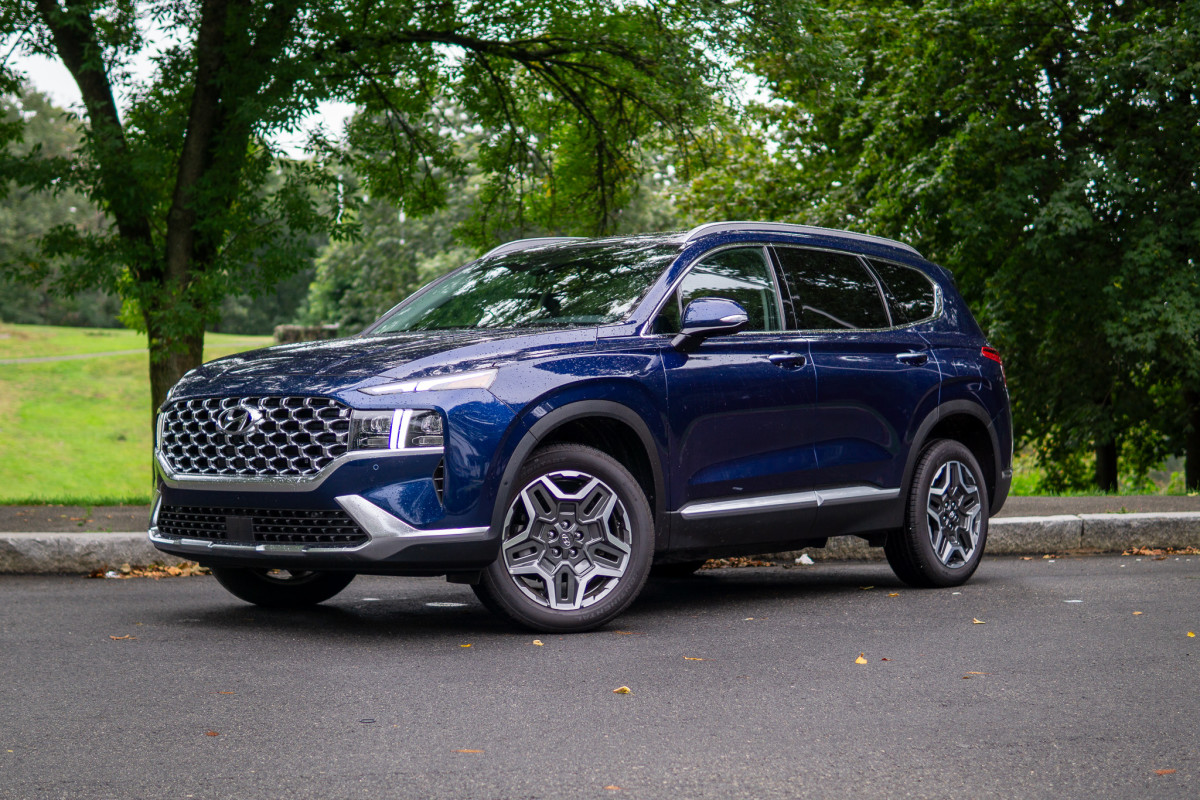
The 2023 Hyundai Santa Fe has a lot in common with a pair of “dad jeans.” Although its styling, inside and out, no longer looks modern or hip, the Santa Fe is undeniably practical and offers outstanding value. The fourth-generation Santa Fe debuted in 2018 for the 2019 model year and, although it was refreshed in 2021, the 2023 model nonetheless looks unfortunately outdated when compared with more recently revealed crossovers. Put it next to a Hyundai Palisade, a Kia Sorento, or a Jeep Grand Cherokee, which were revealed or redesigned in 2020, 2021, and 2022, respectively, and the Santa Fe looks soft and bloated, instead of strong and chiseled.
Admittedly, the Santa Fe isn’t an unattractive crossover, it’s just not modern. At the front, the Santa Fe sports a handsome grille with an attractive mesh pattern. Hyundai squared up this grille in 2021, and the headlights now mount flush to either side, with squinty running lamps above those.
Along the Santa Fe’s profile, the wheel arches are tastefully protected with light plastic fenders. On the Santa Fe Hybrid, 19-inch alloy wheels are the default size in Canada, while 18-inch and 20-inch wheels are available on other trims. (Note the test vehicle is in U.S. specification, where multiple trims of the Hyundai Santa Fe Hybrid are available, and is fitted with 20-inch wheels.) Hyundai offers a base Preferred, a mid-grade Urban, and a top-shelf Ultimate Calligraphy trim on gas-powered Santa Fes, but those three options aren’t available as hybrids in Canada. Instead, the Luxury trim is the only trim available as a hybrid, and it’s sold exclusively with the hybrid powertrain. And if you want the hybrid, the only exterior colours available are white, black, silver, or grey.
Above the wheels, the car’s silhouette rises tall without a lot of strength or definition; it looks too soft to be a modern SUV. Part of the problem is the Santa Fe’s length. At 4,785 millimetres long stretched over a 2,765-millimetre wheelbase, the Santa Fe is too big to have the stylish proportions of a compact crossover but too short to be a comfortable three-row crossover. And, indeed, Hyundai dropped the Santa Fe’s slightly longer, three-row iteration after the third generation. Now, the Santa Fe is a two-row midsize SUV, akin to a Ford Edge, Nissan Murano, Honda Passport, or Subaru Outback.
It’s most casual at the rear, where a high-mounted rear window sits atop a concave lower half. There are no trendy wide-set letters on the back of this Santa Fe; instead, we have the name on the lower left and a “Hybrid” badge on the lower right. The lower fascia curls up, giving a rounded bottom to a rounded car. The single-tip exhaust outlet is hidden from sight.
The Santa Fe’s frumpy looks are a result of a function-first mentality. Nearly large enough to fit three rows of seats, the Santa Fe instead houses only five people–but it compensates with a big trunk.
Inside, it’s more of the same: practical, but outdated. The centre console is a massive swath between the front seats and is filled to the brim with physical buttons and knobs. Is it easy to use? Absolutely. But in an era where fiddly touchscreens are the norm, the Santa Fe’s interior looks sensible, not stylish.

Performance
Buy a 2023 Hyundai Santa Fe Hybrid, and you’ll enjoy performance and efficiency courtesy of a 1.6-litre turbocharged four-cylinder engine mated to a 44.2-kW electric motor and employing standard all-wheel drive (AWD). All told, the hybrid powertrain produces 226 horsepower and 195 pound-feet of torque and impressive fuel economy estimates of 7.1 litres per 100 kilometres in city driving, 7.9 on the highway, and 7.4 combined.
The Santa Fe Hybrid’s power is managed via a six-speed automatic transmission (complete with paddle shifters), and while the HTRAC AWD system defaults to 100% of power being sent to the front wheels, it’s capable of splitting that power when necessary, so 50% goes to the front and 50% goes to the back. Better yet, an AWD lock button will ensure that a minimum of 20% of the Santa Fe’s power goes to the rear wheels, with up to 50% when necessary. This is particularly good when climbing snowy or muddy hillsides.
The Santa Fe hybrid isn’t quick, but it’s still more powerful than the Preferred trim Santa Fes with internal combustion engines (ICE). Those models make do with a naturally aspirated 2.5-litre four-cylinder capable of 191 hp and 181 lb-ft. Upgrade to a Santa Fe Urban or Ultimate Calligraphy, and the gas engine gets a turbo and a power boost to 281 hp and 311 lb-ft. Still, when equipped with an AWD drivetrain—which is standard in Canada, as opposed to the front-wheel drive (FWD) versions offered in the U.S.—they drop out at 10.6/9.3/10.0 in terms of fuel efficiency. So, while a gas-powered Santa Fe Ultimate Calligraphy might beat the hybrid Santa Fe Limited to 100 km/h, it won’t beat it in terms of distance between fill-ups.
We came away from our test drive impressed by the 2023 Santa Fe Hybrid’s noise insulation and compliant suspension. The car is impressively quiet, even at highway speeds. The Santa Fe’s ride quality also remains composed when driving over bad pavement, swallowing up potholes and frost heaves with only the most minor disturbances.
Handling, steering, and braking are all fine, if not superlative. This is a big, tall vehicle designed for transporting people and things in comfort. The goal isn’t speed or cornering agility, and as such, the Santa Fe excels as designed.

Form & function
Hyundai employs a shift-by-wire, push-button transmission in the 2023 Santa Fe Hybrid, which frees up space below the centre stack. However, the centre stack itself remains massive with limited storage space up top. A single cup holder sits next to a rectangular cubby, ahead of which is a flip-up compartment cover that reveals another cup holder and a USB-A port.
The centre stack is massive, but it’s also filled with physical controls that are well-labeled. Everything from climate control to drive modes to heated-seat buttons can be found between the front passengers, meaning you won’t need to dig around in touchscreen menus to lower the AC or turn on your seat heater.
In the rear seats, hybrid passengers enjoy a panoramic sunroof, standard manual sunshades, and 1,035 millimetres of legroom, the latter of which puts the Santa Fe on par with other big two-rows like the Subaru Outback, although it’s strangely smaller in the rear than the compact Hyundai Tucson. A hands-free power liftgate comes standard and reveals 1,032 litres behind the second row, which expands to 2,041 litres when the second row is folded. Notably, you won’t pay a cargo-space penalty if you choose a Santa Fe Hybrid over its ICE counterpart.
Up front, a Santa Fe Hybrid comes equipped with heated and ventilated front seats with leatherette upholstery (heated front seats and a heated steering wheel are standard on all trims) and an eight-way power driver’s seat.

Technology
The Hyundai Santa Fe comes equipped with a 10.25-inch touchscreen with an onboard navigation system as a standard feature across the board in Canada. Although the screen isn’t as brilliant to look at as some of the Santa Fe’s competitors, it nonetheless offers Bluetooth as well as Over-The-Air (OTA) map updates and dynamic voice recognition, two tech-forward inclusions that keep the Santa Fe’s features up-to-date and easy-to-use. Additionally, the infotainment system supports both Android Auto and Apple CarPlay, ensuring seamless integration with your smartphone, although both systems require a wired connection. A 12.3-inch digital instrument cluster, providing a clear and customizable view of essential driving information, also comes standard on the Santa Fe Hybrid.
The 12-speaker Harman Kardon audio system shown on our U.S.-specification test unit is unfortunately not available on the 2023 Hyundai Santa Fe Hybrid in Canada.

Safety
Hyundai prioritizes safety in the 2023 Santa Fe Hybrid, earning it commendable ratings and features. However, the surround-view monitor and blind-spot view monitor equipped on our U.S.-spec test unit are not available on the Hyundai Santa Fe Hybrid in Canada. These features are exclusive to the gas-powered Ultimate Calligraphy trim, and both enhance visibility and awareness, contributing to safer maneuvering in various driving conditions. While the surround-view monitor is particularly helpful when reversing and parking, the blind-spot view monitor supplies a camera feed showing your blind spot in either the right or left cluster of the instrument display, making all the difference when merging in traffic. The Highway Driving Assist semi-autonomous driver assistance technology is also exclusive to the Ultimate Calligraphy trim.
Additional standard safety feature equipment is comprehensive, including adaptive cruise control, forward collision avoidance with automatic emergency braking (with detection for pedestrians, cyclists, and junction-turning), lane keep assist, blind-spot collision avoidance, rear cross-traffic collision avoidance, safe exit assist, and rear occupant alert (which is ultrasonic in upper trims, including the Santa Fe Hybrid). These features collectively contribute to the Santa Fe Hybrid being a particularly good choice for parents or other drivers responsible for precious cargo.
Finally, the 2023 Santa Fe Hybrid has undergone rigorous testing, receiving a five-star overall rating from the NHTSA and achieving the coveted Top Safety Pick+ designation from the IIHS in the gas model category. These accolades underline the vehicle's commitment to passenger safety and overall crashworthiness.

Cost-effectiveness
In Canada, the 2023 Hyundai Santa Fe Hybrid SUV is available in a single Luxury trim level. This trim is the only trim available with the hybrid powertrain, and it’s also available exclusively as a hybrid. Pricing for the 2023 Hyundai Santa Fe Hybrid in Canada rings up at $48,331, including the $2,000 destination charge and other fees. The Hyundai Santa Fe plug-in hybrid model (PHEV) that has previously been available sold out early in the 2023 model year.
Comparing the hybrid to its gas-powered counterparts, the gas Santa Fe starts at a lower Preferred trim price of $40,731 with destination. A better comparison is the Urban trim, which has a more powerful engine and more features and starts at $45,031 with destination. Given that the average driver will likely save $750 per year in fuel costs by choosing the Hybrid according to Natural Resources Canada fuel consumption estimates, the $3,300 price delta between the Hybrid and ICE limited trims should be easy to overcome. If there is one area in which the Hybrid falls short, it’s the relative lack of trim options.
2024 will usher in a brand new Santa Fe with a dramatic new design. For 2023, however, this remains a practical, sensible, and value-filled option, even if it could use a makeover.
Note: Images show a US model.

What owners say
I bought a 2023 Hyundai Santa Fe limited and I couldnt be happier! The size is perfect, the ride is amazing and the features are unbelievable! Highly recommend!
August 7, 2023Trims & specs
Base MSRP N/A | Seating N/A |
Engine N/A | Cargo Capacity N/A |
Combined MPG N/A | Drivetrain N/A |
Base MSRP $35,910 | Seating 5 |
Engine 1.6L 226 hp I4 Hybrid | Cargo Capacity 36.4 cu ft |
Combined MPG 34 | Drivetrain AWD |
Base MSRP $41,570 | Seating 5 |
Engine 1.6L 226 hp I4 Hybrid | Cargo Capacity 36.4 cu ft |
Combined MPG 32 | Drivetrain AWD |
Base MSRP $39,770 | Seating 5 |
Engine 1.6L 226 hp I4 Hybrid | Cargo Capacity 36.4 cu ft |
Combined MPG 32 | Drivetrain AWD |


