2022 Subaru BRZ Reviews, Pricing & Specs


Expert review
The Subaru BRZ sports car returns with more torque and more tech for 2022. Does it deliver on its promise?
Subaru performance has traditionally boiled down to three letters: WRX. But for almost a decade, Subaru fans have gotten familiar with another three-letter code: BRZ.
The Subaru BRZ is unlike anything else in the automaker’s lineup. Subaru is known for building practical cars with all-wheel drive (AWD) and turbocharged engines, but the BRZ throws all of that away. It’s a willfully impractical two-door sport coupe with rear-wheel drive (RWD) and a naturally aspirated engine, aimed at providing the most satisfying driving experience.
The first-generation BRZ was introduced as a 2013 model, so the sports car was due for a redesign. The 2022 Subaru BRZ gets a restyled exterior and a more powerful engine, as well as more tech features than its predecessor. As before, the new BRZ is twinned with a Toyota product. Its previous counterpart was the Scion FR-S; it's now the Toyota 86, which was renamed GR 86 as part of its redesign (and is covered in a separate review).
Subaru keeps the 2022 BRZ lineup simple, with just base and Sport-tech trim levels to choose from. We spent a day with the higher-tier BRZ Sport-tech, driving it on winding roads as well as a race circuit and autocross course.
out of 10 expert review
Look & feel
The BRZ (the name stands for “Boxer RWD Zenith,” by the way) remains nearly identical to its Toyota sibling, which is likely the only reason these two sports cars remain in production. Joint development helps spread out costs over more units, making a stronger business case for these niche vehicles. For the 2022 models, Toyota was primarily responsible for design, while Subaru was charged with engineering, BRZ product line manager Michael Redic said in a presentation ahead of our test drive.
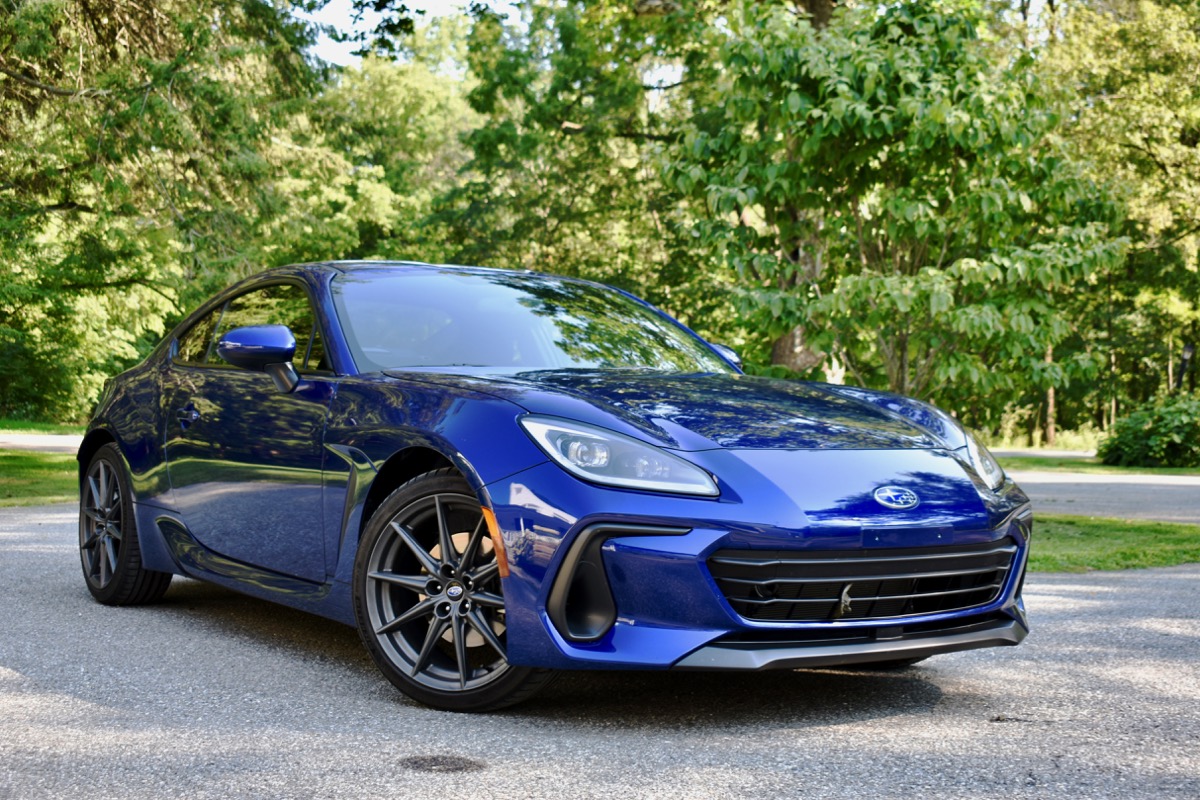
Subaru and Toyota used an updated version of the previous-generation platform for these new models, but with different exterior styling. That includes model-specific headlights and grilles, along with new fender vents and taillights that are shared by both models. If anything, the visual difference between the Subaru and Toyota models has shrunk with this redesign.
Like Toyota, Subaru gave its version an aluminum roof and fenders to reduce weight. At 1,277 kilograms (2,815 pounds), the lightest 2022 BRZ model is 7.7 kg (17 pounds) heavier than the lightest 2020 model (the BRZ skipped the 2021 model year), and 1.8 kg (4 pounds) heavier than the lightest 2022 Toyota GR 86. Those differences likely won’t be noticeable, and any curb weight under roughly 1,350 kilograms (3,000 pounds) is fairly good for a modern car.
The base BRZ model gets 17-inch alloy wheels with Michelin Primacy tires, while the BRZ Sport-tech rides on 18-inch wheels with Michelin Pilot Sport 4 tires. These are the same options you get on the GR 86, with the Pilot Sport 4 tires offering more grip.
The interior has the same all-business feel as before, with some new additions like digital displays and a large trio of climate-control knobs. In true sports-car fashion, the front bucket seats are heavily bolstered to hold bodies in place during aggressive cornering. Cloth upholstery is standard, while Sport-tech models get Ultrasuede with red accent stitching, and dual-mode heaters. A leather-wrapped steering wheel is standard on both trim levels, along with Brin Naub dashboard and door trim.
Performance
As before, the 2022 BRZ uses a Subaru boxer-four engine with Toyota’s D-4S fuel-injection system, which combines port and direct injection. The car retains its Torsen limited-slip differential, and transmission choices are unchanged as well, so the BRZ still gets a standard six-speed manual gearbox or a six-speed automatic (with paddle shifters). The automatic was retuned to downshift quicker and hold gears longer, while the manual got some tweaks to improve shift feel, according to Subaru.
The engine’s displacement has grown from 2.0 litres to 2.4 litres, bringing an increase in power and a lower torque peak. The new 2.4-litre BRZ engine makes power specs of 228 horsepower and 184 pound-feet of torque, up from the previous 205 hp and 156 lb-ft of torque. In addition, the new engine can still rev to 7,000 rpm, an advantage of natural aspiration over forced induction.
You won’t have to work the engine too hard to access that 184 lb-ft of torque, though. The 2.4-litre engine’s torque peak comes at 3,700 rpm, compared with 6,600 rpm for the old 2.0-litre engine, according to Subaru. That would normally require bolting on a turbocharger, but Subaru (and development partner Toyota) managed to make it happen while preserving the boxer engine’s free-revving character.
Subaru quotes zero to 100 km/h times of 6.1 seconds with the 6-speed manual transmission and 6.6 seconds with the 6-speed automatic. Those are improvements of 12% over the old car, according to Subaru. Toyota quotes a 6.3-second zero to 100 km/h time for the manual GR 86 and 6.8 seconds for the automatic version, but the gap is likely due to differences in each manufacturer’s testing procedures.
Both the 2022 BRZ and GR 86 use an updated version of the previous-generation cars’ platform. Subaru stiffened things up, though, claiming a 60% increase in lateral bending rigidity. That extra stiffness was gained through re-tuned struts and changes to the steering-box and suspension mounting points, including a body-mounted rear stabilizer bar that’s unique to the BRZ. Both Subaru and Toyota also applied their own individual tuning to the engine and suspension.
As with the GR 86, one of the standout differences between the 2022 BRZ and its predecessor was improved on-road manners. While the ride was still fairly firm, it was a bit more forgiving than in the previous-generation BRZ. The new car was also a lot quieter, even with an engine note augmented by an active-sound system that pipes noise through the in-car speakers. Overall, we’d be much more likely to take a long drive in this second-generation BRZ than in the first-generation model.
The old BRZ was a great car to drive, but the new one is even better. On the track, we appreciated the flexibility of the 2022 model’s low-end torque, and the car also felt tauter and more precise than its predecessor. We didn’t find the driving experience to be dramatically different from the GR 86, although the Subaru did feel a bit less tail-happy in corners. Still, the rear end provided enough rotation to get the car properly pointed for corner exit, and those so inclined will also find the Subie easy to drift.
Form & function
The carryover platform means the 2022 Subaru BRZ is dimensionally similar to its predecessor. The new car is 3 centimetres longer than the 2020 model, with a 5-millimetre wheelbase stretch. Width is unchanged, but the 2022 model sits 1 centimetre lower than before, bringing the car's centre of gravity even lower than the previous version's.
The changes result in a marginal decrease in headroom. Despite the 2022 model’s longer wheelbase, front seat legroom also decreased by 1 centimetre. However, this car wasn’t designed to be a grand tourer. Its trim dimensions help keep the curb weight down and increase agility, albeit at the expense of passenger space.
The BRZ is technically a 2+2, with small rear seats. However, those seats are only suitable for children, or as extra storage space. As before, the rear seats fold to increase trunk space. Subaru didn’t quote a cargo-space figure with the rear seats folded but, at 178 litres, the 2022 BRZ has slightly less space with the rear seats in place than its predecessor.
With the back seats folded, Subaru claims the BRZ can carry four tires or a mountain bike. The automaker made similar claims for the previous-generation BRZ, but it’s not something we’ve attempted with either generation. If you’re buying a small sports car, you should be prepared to travel light.
We did like the look and feel of the BRZ’s large, chunky controls. Like the GR 86, the Subaru gets three large knobs with built-in digital displays for climate control, plus a row of buttons beneath them. The setup looked cool and was easy to use while driving. We also appreciated the BRZ’s low hood line and window sills, which aided outward visibility and made the cockpit feel surprisingly open for its size.
Technology
Like the related Toyota GR 86, the BRZ gets a major tech upgrade for the 2022 model year. A standard 8-inch touchscreen and digital gauge cluster replace the previous 7-inch touchscreen and analog gauges. Apple CarPlay, Android Auto, Bluetooth connectivity, and SiriusXM satellite radio are standard as well.
Subaru was quick to note that this touchscreen was developed in-house (it’s based on the head unit that debuted in the 2020 Legacy and Outback), but it doesn’t exactly provide a unique experience. As with the GR 86, the latest infotainment system is a big improvement over the old system and is fairly easy to use, but it isn’t the main reason for buying this car. Still, we liked the digital instrument cluster, which gives drivers access to sport mode and track mode. It put the tachometer front and centre and managed to show a lot of information comprehensibly.
Safety
The National Highway Traffic Safety Administration (NHTSA) and Insurance Institute for Highway Safety (IIHS) haven’t released safety ratings for the 2022 BRZ yet. That’s typical of new models, but as a low-volume sports car, the BRZ likely won’t be a priority for the safety organizations.
The BRZ gets Subaru’s EyeSight driver-assist technology for the first time, albeit only on automatic-transmission models. Standard features include adaptive cruise control, automatic emergency braking, lane-keep assist and lane-departure warning, lane-sway warning, lead vehicle start alert, and automatic high beams.
With either transmission, the BRZ Sport-tech adds blind-spot monitoring, rear cross-traffic alert, lane-change assist, and steering responsive LED headlights. Automatic-transmission Sport-tech models also get reverse automatic braking. Most of these safety features are also available on the BRZ’s Toyota GR 86 twin, but the Toyota doesn’t get lane-change assist or reverse automatic braking.
Cost-effectiveness
Natural Resources Canada fuel consumption ratings for the 2022 Subaru BRZ are 9.5 litres per 100 kilometres combined (11.0 city, 7.7 highway) with the automatic transmission and 10.5 L/100 km combined (12.0 city, 8.8 highway) with the manual transmission.
Subaru offers a five-year/100,000-kilometre major component warranty, which includes the powertrain, and three-year/60,000-kilometre new vehicle limited warranty. That’s pretty standard coverage for a mainstream brand.
Pricing for the 2022 Subaru BRZ starts at an MSRP of $29,495 for the base trim level with the manual transmission (a mandatory $1,725 destination charge is extra). The Sport-tech trim level starts at $32,495 with the manual. The base model with the automatic transmission and EyeSight costs $31,895, and the Sport-tech with those features costs $34,895.
In Canada, the BRZ undercuts the GR86 slightly on price by roughly $2,000.
Choosing between the “Toyobaru” twins will likely depend on personal styling preferences, and which dealership offers the best experience. The two cars also don’t have much direct competition, aside from the convertible-only Mazda MX-5 Miata and four-cylinder versions of the larger Ford Mustang and Chevrolet Camaro. The redesigned 2023 Nissan Z will likely be priced higher than the BRZ, but will also boast a 400-hp twin-turbo V6 engine.
Previous-generation BRZ sales were just a drop in the bucket compared to Subaru’s bread-and-butter crossover SUVs and wagons, which explains why so few automakers are interested in sports cars these days. If the 2022 BRZ has the same lifespan as the original, the auto industry could be deep into its electrification push by the time it needs to be replaced. So, if you’re a driving enthusiast who's always wanted a traditional sporty car but never pulled the trigger on one, now might be the time.
Note: Images show a US model.

What owners say
"Owners of the 2022 Subaru BRZ are thrilled with its sporty performance, fun driving experience, and comfortable ride. They particularly love the engaging handling and stylish design. However, some drivers wish for a more powerful engine, improved audio system, and better seating comfort. Despite minor complaints, many feel it's a fantastic value for a sports car."
The car's features: The infotainment is slow, and the audio quality is terrible. Loud enough or just enjoyable enough for a regular commute. It offers an amazing 6-speed manual, easy to clutch in and out. However getting from first to second gear are a bit difficult, and you have to hold the clutch a little bit longer before shifting to prevent shaking. This car is so fun to drive. I love how direct the steering is and how it feels, also doesn't have to be too heavy in parking lots. It also rides surprisingly well for what it is. This car is definitely a good value, literally the cheapest RWD car i could find brand new at the time of purchase with amazing lease deal. I couldn't even afford a Honda Civic Si, or a Hyundai Veloster N. This car is just missing practicality, honestly if rear seats have more foot room (not knee room), and a tiny bit higher ride height, maybe 5.3 inches of ground clearance instead of 5.1? It can survive better with a lot of uneven pavement I see here in Vancouver. It's just missing that bit of practicality where I might want to switch to a different vehicle and wished I had the Honda Civic SI. Also the fuel economy is really bad considering it's still a 4 cylinder engine, and requiring a recommended 93 octane with high insurance makes it difficult to own. I would not compare it to any other car except maybe the Mazda Miata, or Hyundai Veloster N. Those are very different cars due to no one making any sports cars anymore.
October 21, 2025The BRZ is a fantastic, not too expensive, sports car. Lots of nice features. But most of all amazing handling and a comfortable ride.
April 21, 2022The model I purchased is the top trim line with pretty much all features available. I expected it to have lane keeping rather than only lane departure warning, also assumed that an option called Starlink would include ability to program for remote garage door operation. Small items and would not have changed decision to buy. Car seems like it will be very satisfactory. Feels great.
January 8, 2023What owners say
The car's features: The infotainment is slow, and the audio quality is terrible. Loud enough or just enjoyable enough for a regular commute. It offers an amazing 6-speed manual, easy to clutch in and out. However getting from first to second gear are a bit difficult, and you have to hold the clutch a little bit longer before shifting to prevent shaking. This car is so fun to drive. I love how direct the steering is and how it feels, also doesn't have to be too heavy in parking lots. It also rides surprisingly well for what it is. This car is definitely a good value, literally the cheapest RWD car i could find brand new at the time of purchase with amazing lease deal. I couldn't even afford a Honda Civic Si, or a Hyundai Veloster N. This car is just missing practicality, honestly if rear seats have more foot room (not knee room), and a tiny bit higher ride height, maybe 5.3 inches of ground clearance instead of 5.1? It can survive better with a lot of uneven pavement I see here in Vancouver. It's just missing that bit of practicality where I might want to switch to a different vehicle and wished I had the Honda Civic SI. Also the fuel economy is really bad considering it's still a 4 cylinder engine, and requiring a recommended 93 octane with high insurance makes it difficult to own. I would not compare it to any other car except maybe the Mazda Miata, or Hyundai Veloster N. Those are very different cars due to no one making any sports cars anymore.
October 21, 2025The BRZ is a fantastic, not too expensive, sports car. Lots of nice features. But most of all amazing handling and a comfortable ride.
April 21, 2022The model I purchased is the top trim line with pretty much all features available. I expected it to have lane keeping rather than only lane departure warning, also assumed that an option called Starlink would include ability to program for remote garage door operation. Small items and would not have changed decision to buy. Car seems like it will be very satisfactory. Feels great.
January 8, 2023Its incredible, sporty, fun, comfortable, quiet. Dont be fooled by back seat, there is only room for 2 passengers but its a great spot for a backpack or large purse.
February 27, 2022The BRZ maximizes your bang for the buck. Its styling is more classic 50s Vette than other testosterone addled sports cars. The major complaint I read about was that it was underpowered. Since this was addressed with the 2022 model, that was the car I bought. My only complaint (I bought the Limited) is the mediocre audio system, which I will probably upgrade in the future. The seats could also be improved upon, but let’s be real; the BRZ is a $30,000 bargain, not an M3.
July 26, 2023This car is a drivers car. Very engaging and fun to drive. If you want a top down option then you’re left with another choice. I’m glad there’s a sporty (240z ish) good looking coupe still being made.
April 3, 2024In manual really have to give it a lot of gas to get it into 1st and 2nd gear , the rpm’s have to be high or it just won’t go so it jerks you a lot.
December 4, 2023Trims & specs
Base MSRP N/A | Seating N/A |
Engine N/A | Cargo Capacity N/A |
Combined MPG N/A | Drivetrain N/A |
Base MSRP $30,495 | Seating 4 |
Engine 2.4L 228 hp H4 | Cargo Capacity 6.3 cu ft |
Combined MPG 25 | Drivetrain RWD |
Base MSRP $27,995 | Seating 4 |
Engine 2.4L 228 hp H4 | Cargo Capacity 6.3 cu ft |
Combined MPG 23 | Drivetrain RWD |
Base MSRP N/A | Seating N/A |
Engine N/A | Cargo Capacity N/A |
Combined MPG N/A | Drivetrain N/A |
Base MSRP N/A | Seating N/A |
Engine N/A | Cargo Capacity N/A |
Combined MPG N/A | Drivetrain N/A |
Base MSRP N/A | Seating N/A |
Engine N/A | Cargo Capacity N/A |
Combined MPG N/A | Drivetrain N/A |


Pricing trends
MSRP range
$27,995 - $30,495
Current avg. market price
$27,677
Trending down by 0.5% this month
May 2026 - October 2026

